
Your 2026 Medicare Premium Was Set by Your 2024 Taxes
In 2026, your Medicare Part B premium is set by the income on your 2024 tax return. Here's how IRMAA's brackets work, what trips retirees into them, and how to plan the income you control now.

If you’re on Medicare, this is the week the mail gets loud. Open enrollment runs from October 15 to December 7, and every insurer in the country is asking you to compare Advantage plans, weigh drug coverage, and double-check your pharmacy. It’s worth doing — the choice between Medicare Advantage and Medigap alone can shape your costs for the rest of your life. But the single largest Medicare number for a lot of higher-income retirees isn’t on any of those comparison screens.
It’s called IRMAA, and it was decided two years ago by your tax return.
I’ve written before about how IRMAA ambushes retirees who never see it coming. This time I want to focus on the single feature that makes the whole thing so avoidable: the timing.
What IRMAA actually is
IRMAA stands for the Income-Related Monthly Adjustment Amount. In plain terms, it’s a surcharge the government adds to your Medicare Part B and Part D premiums once your income crosses certain lines. Most people pay the standard Part B premium — $202.90 a month in 2026. Cross into IRMAA territory and that number climbs, in steps, to as much as $689.90 a month per person at the top of the scale.
The income figure Medicare uses is your modified adjusted gross income, or MAGI — your adjusted gross income plus any tax-exempt interest, like the interest on municipal bonds. That last part surprises people. Tax-free income is still counted here.
IRMAA applies per person, not per household. For a married couple who both cross a threshold, the surcharge lands on each of you. That doubles the sting, and it’s the part couples most often miss when they’re running the math on one spouse.
The two-year lookback that catches people
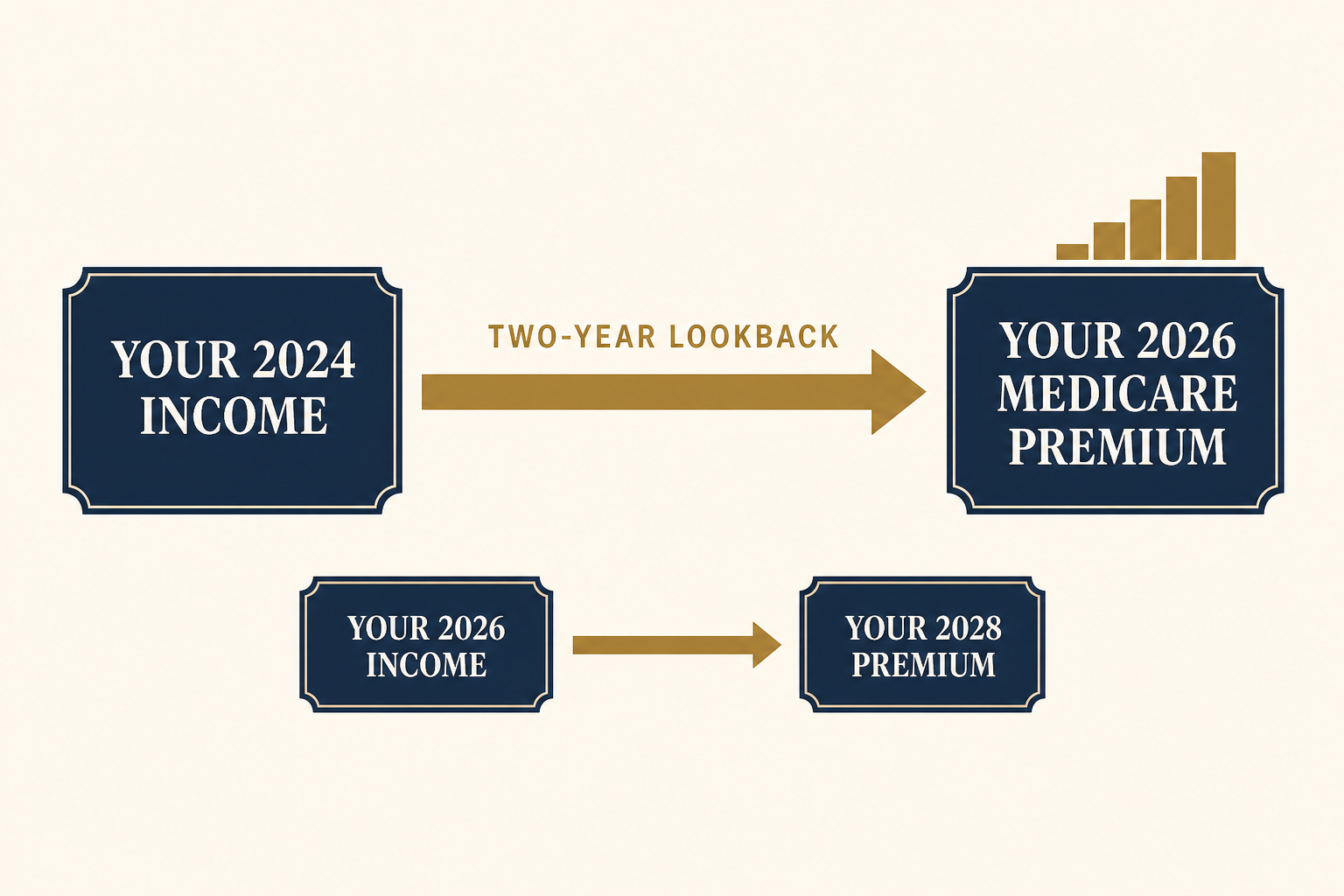
Here’s the mechanism almost nobody plans around: Medicare doesn’t look at the income you have now. It looks back two years.
Your 2026 premium is based on the MAGI from your 2024 tax return. The premium you’ll pay in 2027 is set by the 2025 return you already filed. And the income you create this year, in 2026 — the Roth conversion you do in December, the appreciated fund you sell, the house that finally closes — sets your premium for 2028.
That lag is why open enrollment is the wrong moment to think about IRMAA for the first time. By the time the premium notice arrives, the income that caused it is two years in the rearview mirror. You can’t un-earn it. The only real lever is the one you pull in the planning years before — which means the time to think about your 2028 premium is right now, as you make this year’s income decisions.
The 2026 brackets — and why they’re a cliff, not a ramp
Here are the 2026 tiers, based on your 2024 MAGI, showing the total monthly Part B premium per person:
| 2024 MAGI — Single | 2024 MAGI — Married filing jointly | 2026 monthly Part B premium |
|---|---|---|
| $109,000 or less | $218,000 or less | $202.90 (standard) |
| $109,001 – $137,000 | $218,001 – $274,000 | $284.10 |
| $137,001 – $171,000 | $274,001 – $342,000 | $405.80 |
| $171,001 – $205,000 | $342,001 – $410,000 | $527.50 |
| $205,001 – $499,999 | $410,001 – $749,999 | $649.20 |
| $500,000 or more | $750,000 or more | $689.90 |
A separate Part D surcharge, ranging from about $14.50 to $91.00 a month in 2026, stacks on top using the same brackets. (Source: Medicare.gov and the Social Security Administration.)
Now look closely at how those tiers behave, because this is where IRMAA is genuinely different from the income tax you’re used to. When I wrote about how tax brackets actually work, the whole point was that they’re marginal — earning one more dollar only taxes that dollar at the higher rate. IRMAA does the opposite. It’s a cliff.
Go one dollar over a threshold and you don’t pay a little more on that dollar. You pay the entire higher premium for the whole year. A married couple sitting at $273,999 of MAGI pays $284.10 each. Earn one more dollar of interest and both of you jump to $405.80 — roughly $2,900 of additional premium across the two of you, triggered by a single dollar. That cliff is exactly why the dollars near a bracket line matter so much more than they look.
What pushes retirees over a line
Most people who get caught by IRMAA aren’t high earners in the ordinary sense. They’re retirees with a modest ongoing income and one unusually large year. The surcharge is almost always triggered by a one-time event:
A Roth conversion is the classic one. Converting a big chunk of a traditional IRA in a single year is often smart tax planning — but the converted amount lands in your MAGI, and a conversion sized without IRMAA in mind can push you up a tier or two two years down the road. The same goes for realizing capital gains, whether you’re rebalancing a taxable account or finally selling the appreciated fund you’ve held for a decade.
Then there are the life events that don’t feel like income until the tax return says otherwise: selling a home with gains above the exclusion, taking a large required minimum distribution once RMDs begin, inheriting and drawing down an IRA, or receiving a pension lump sum. Any of these can spike a single year’s MAGI well above your normal baseline.
This is where coordinated withdrawal planning earns its keep. The same thinking behind bucket planning — being deliberate about which account you draw from and when — is what lets you smooth income across years instead of bunching it into one expensive spike. And keep an eye on the interaction with your benefits: the annual Social Security COLA nudges your taxable income up a little each year, which can quietly carry a borderline household over a bracket line over time.
Consider a hypothetical couple. Frank and Susan, both 66, are newly retired with about $95,000 of normal annual income — comfortably under the first IRMAA threshold. In December, their advisor suggests converting $160,000 from Frank’s traditional IRA to a Roth to take advantage of a low-income year. On the tax return, it’s a reasonable move. But that conversion lifts their 2026 MAGI to roughly $255,000, and in 2028 — two years later — both of them open a Medicare notice showing a premium of $405.80 instead of $202.90. The conversion may still have been worth it. The point is that nobody put the 2028 premium on the ledger when they decided how much to convert.
What you can actually do about it
The planning happens in the year you control the income, not the year you get the bill. A few moves do most of the work.
Size one-time income events against the brackets. If a Roth conversion or a sale is going to push you up a tier, check how far up — and whether splitting it across two tax years keeps you under a line. Sometimes converting a little less this year and a little more next year lands you in the same tax result without the premium cliff.
Watch tax-exempt interest. Because municipal bond interest counts toward MAGI, a portfolio built for tax efficiency can still push you into IRMAA. It belongs in the calculation.
Appeal when a life-changing event drops your income. If your income falls because you retired, stopped working, lost a pension, or went through a death of a spouse, marriage, or divorce, you don’t have to wait out the two-year lag. File Form SSA-44 with Social Security and ask them to use your more recent, lower income instead. This is one of the most underused forms in retirement. A one-time Roth conversion doesn’t qualify — but a genuine drop in your ongoing income does.
This is the kind of decision that’s hard to eyeball and easy to model. If you’re weighing a conversion or a large sale, it’s worth running your own numbers to see where the income lands two years out and whether a bracket line is in play. A planning tool like ProjectionLab lets you test those scenarios side by side before you commit.
Disclosure: ProjectionLab is an affiliate partner. If you start a subscription through that link, Confluence Media Group may earn a commission at no additional cost to you. I only point readers toward tools I’d actually use for this kind of planning.
Thomas’s Take: IRMAA punishes the year, not the lifestyle. A retiree living on $80,000 can pay the top-tier premium because of one big year — and a genuinely wealthy retiree who spreads income carefully can stay in a lower tier for life. The surcharge rewards planning, not poverty. That’s the whole game.
Key takeaways
- IRMAA is an income surcharge on Medicare Part B and Part D. In 2026 it raises the Part B premium from $202.90 to as much as $689.90 a month per person.
- It runs on a two-year lookback. Your 2026 premium reflects your 2024 income; the income you create this year sets your 2028 premium.
- The brackets are cliffs, not ramps. One dollar over a threshold moves you to the full higher premium for the entire year.
- One-time events trigger it. Roth conversions, capital gains, home sales, and large RMDs are the usual culprits — and the surcharge hits each spouse separately.
- You have levers. Size income events against the brackets, mind tax-exempt interest, and file Form SSA-44 after a genuine drop in income.
Frequently asked questions
Does IRMAA go away once my income drops?
Yes, but on a lag. Because Medicare uses income from two years prior, a lower-income year this year shows up as a lower premium two years later. If the drop came from a qualifying life-changing event, Form SSA-44 lets you fix it sooner.
Is the surcharge based on this year’s income?
No. It’s based on the most recent tax return Social Security has on file, which is almost always from two years earlier. That’s the detail that catches people off guard.
Do Roth conversions count toward IRMAA?
Yes. The converted amount is part of your MAGI for that year, so a large conversion can raise your Medicare premium two years out. That doesn’t make conversions a bad idea — it makes them a decision to size carefully.
Will the 2027 numbers be different?
Almost certainly. CMS typically announces the next year’s Part B premium and updated IRMAA thresholds in November, and both tend to move a little each year. The two-year-lookback mechanism, though, doesn’t change.
Medicare open enrollment is the right time to review your plan. Just don’t let the plan comparison be the only Medicare math you do this fall. The premium you’ll pay in 2028 is being decided right now, in the income choices you make before December 31 — and unlike your drug plan, you won’t get an annual window to change your mind about it. That’s the number worth watching.
This article is published by Confluence Media Group LLC, an independent publisher of educational financial content. Thomas Clark is a Series 65 Investment Advisor Representative. The information provided is for educational and informational purposes only and is not personalized financial, tax, or legal advice. Past performance does not guarantee future results. All investing involves risk, including potential loss of principal. Consult a qualified professional before making financial decisions.
Confluence Media Group LLC is a separate entity from Confluence Capital Management, the investment advisory practice through which Thomas Clark provides advisory services. Advisory services are not offered through this publishing platform.
About Thomas Clark
Thomas Clark is the founder of Confluence Media Group LLC and a Series 65 Investment Advisor Representative. He has spent nearly two decades working with families on retirement planning, with a focus on Social Security optimization, retirement income coordination, and the bucket planning approach to building a guaranteed income floor.
Thomas writes and publishes at thomasclarkadvisor.com and is the author of The Just in Case Binder — a 148-page printable family financial organizer for households who want to make sure the people they love know where everything is.
He lives in North Carolina with his family.
Subscribe to the weekly newsletter · Get the Just in Case Binder

Thomas Clark is a Series 65 licensed investment advisor and experienced trader. He specializes in investing, retirement planning, and market analysis, helping individuals build wealth and make informed financial decisions.
