
Medicare Advantage vs. Medigap: The One-Way Door
During Medicare's fall enrollment window, most people choose between Medicare Advantage and Medigap on price alone. The bigger risk: switching back to Medigap later can require a health exam — a one-way door worth understanding before you decide.
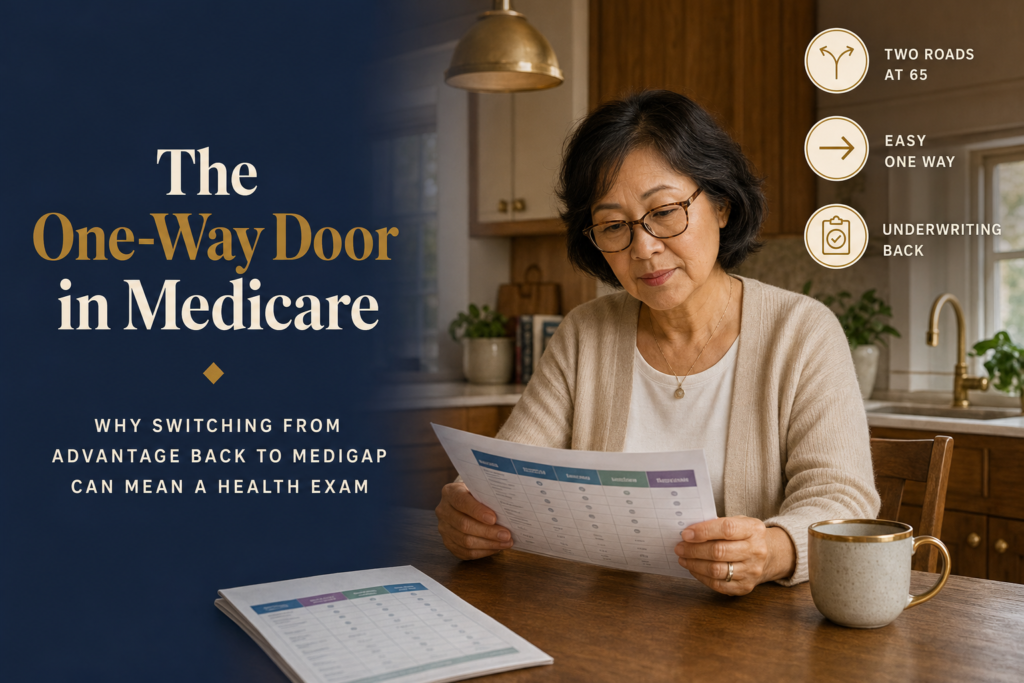
During Medicare’s fall enrollment window, most people compare plans on a single number: the monthly premium. It’s the easiest number to find and the easiest to understand, so it does most of the deciding. That’s a mistake.
The biggest choice you make in Medicare isn’t which plan costs the least next year. It’s which of two roads you travel — Original Medicare paired with a Medigap policy, or Medicare Advantage. And here’s the part almost no one explains at the kitchen table: one of those roads has a door that can quietly lock behind you.
Open Enrollment runs from October 15 to December 7, with any changes taking effect January 1. It’s the stretch of the year when the structural choice gets made or remade by millions of people. Before you pick on price, it’s worth understanding what you’re actually choosing between.
The Two Roads Through Medicare
Once you’re on Medicare, your coverage follows one of two basic structures. Understanding them is the whole game.
Road one: Original Medicare plus a Medigap policy. You keep Original Medicare (Part A for hospital, Part B for doctors), then add a Medigap policy — also called Medicare Supplement — sold by a private insurer to cover most of the deductibles and coinsurance Original Medicare leaves you holding. Because Medigap doesn’t include drug coverage, you add a standalone Part D plan too. You can see any doctor or hospital in the country that accepts Medicare, with no networks and no referrals. Medigap policies are standardized by letter — Plan G is among the most popular for people new to Medicare; Plans C and F are closed to anyone who became eligible in 2020 or later.
Road two: Medicare Advantage. Also called Part C, this is a private all-in-one plan that replaces the way Original Medicare pays your bills. It usually bundles in drug coverage and often extras like dental, vision, or a gym benefit, frequently with a $0 monthly premium on top of your Part B premium. The tradeoff is that it works like the employer insurance you probably just left: provider networks, referrals, prior authorizations, and an annual out-of-pocket maximum that caps your spending for the year. The details come straight from Medicare.gov.
Neither road is “the right one” for everybody. But they behave very differently — and the difference that matters most doesn’t show up on the premium line.
Why the Premium Is the Wrong Place to Start
A $0-premium Medicare Advantage plan is not free. You’re trading a predictable monthly bill for variable costs that show up only when you get sick — copays for each specialist, each test, each hospital stay, up to that annual out-of-pocket maximum, which in 2026 can run into the thousands of dollars before the plan covers you fully.
Medigap runs the other way. You pay a higher, steady monthly premium — and in exchange, most of what a serious illness would otherwise cost you is already handled. A good year and a terrible year look almost the same on your bank statement. That predictability is the entire point of the policy, and it’s worth real money to the right household.
One more thing the premium hides: Original Medicare by itself has no annual cap on what you pay out of pocket. That’s precisely the hole a Medigap policy — or the out-of-pocket maximum built into Medicare Advantage — is there to close. Going without either is the one genuinely risky option.
Thomas’ Take: I don’t think of Medigap as the “expensive” choice. I think of it as buying certainty — turning an unknowable medical bill into a known monthly line item. Whether that’s worth it depends on your health, your budget, and how much you value a quiet bank statement. But compare the two roads on what they do when you’re sick, not on what they cost when you’re well.
The One-Way Door Most People Don’t See
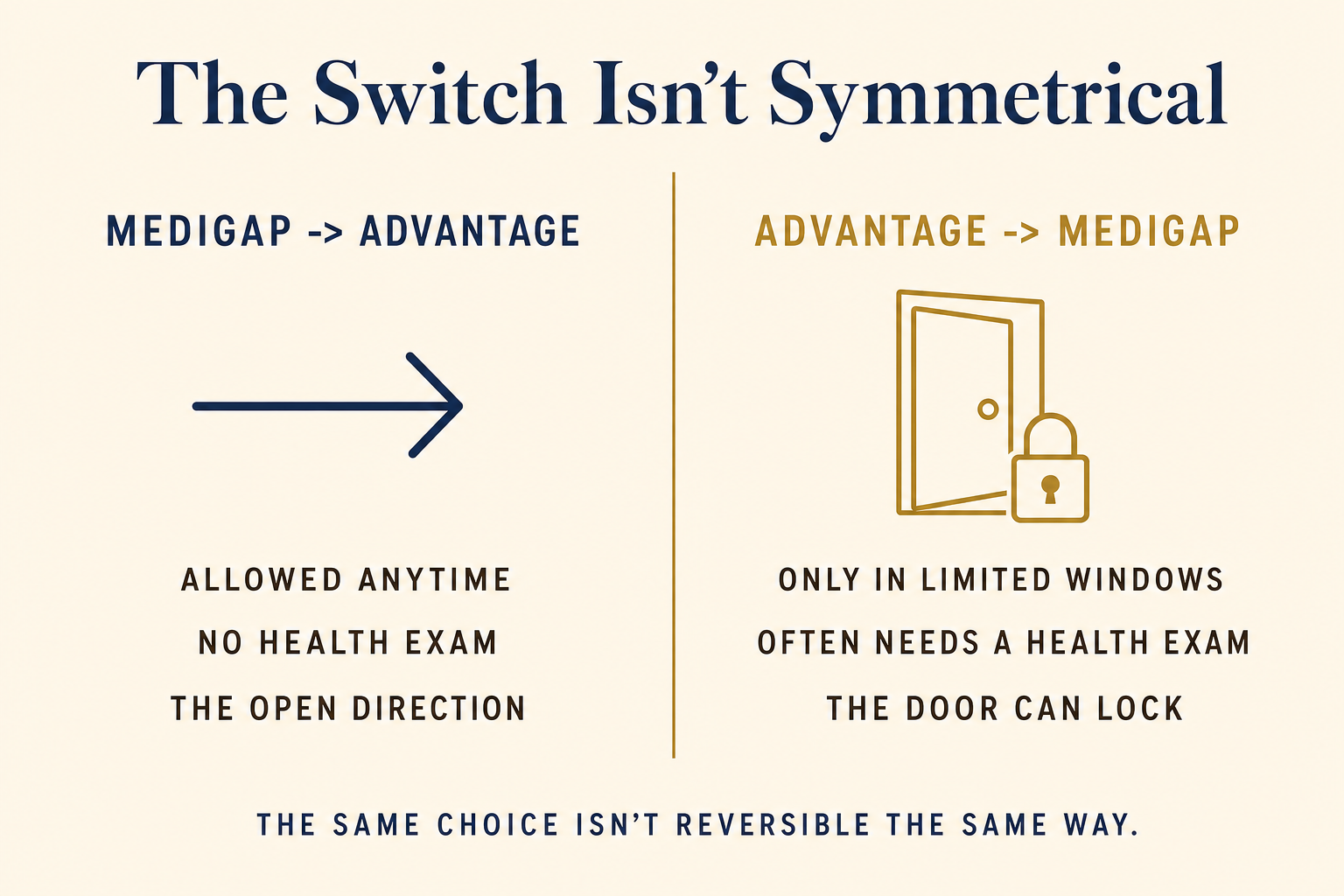
Here’s the asymmetry that makes this decision bigger than it looks. Moving from Medigap to Medicare Advantage is almost always allowed. Moving back — from Advantage to Medigap — often is not, at least not without passing a health exam.
When you first enroll in Medicare at 65, you get a one-time, six-month Medigap Open Enrollment Period. During that window, an insurer must sell you a Medigap policy at the best available rate, regardless of your health history. No questions, no denials. The timing and protections are spelled out on Medicare.gov.
Once that six-month window closes, most states let insurers use medical underwriting — they can ask about your health, charge you more, or decline to cover you at all. So the retiree who picks a $0-premium Advantage plan at 65 because they feel fine may find, at 70 or 72 after a diagnosis, that the door back to Medigap has a lock on it.
There are a handful of protected exits, and they’re worth knowing:
- The 12-month trial right. If you join a Medicare Advantage plan when you first become eligible, you generally have 12 months to switch back to Medigap with guaranteed acceptance.
- Plan departures and moves. If your Advantage plan leaves Medicare or your service area, or you move out of its coverage zone, you usually get a guaranteed-issue window of about 63 days to pick up a Medigap policy.
- A few generous states. States set their own rules on top of the federal floor. Connecticut and New York, for example, require guaranteed issue year-round, and several states have annual “birthday rule” windows. Most states, though, offer only the limited federal protections — so check yours before you count on it.
And a common trap: the Medicare Advantage Open Enrollment Period that runs January 1 to March 31 lets you leave an Advantage plan, but it does not hand you a guaranteed-issue right to buy Medigap. You can get back to Original Medicare that way; getting a supplement to go with it may still mean underwriting.
A Hypothetical That Shows the Trap
Consider a hypothetical couple: Evelyn and Martin, both 66, newly retired outside Columbus. At 65 they both felt great, and the $0-premium Advantage plan looked like an obvious win over a Medigap premium of a couple hundred dollars a month. They took it.
Four years later, Martin is diagnosed with a chronic condition that will mean regular specialist visits for the rest of his life. He’d now prefer the freedom and predictability of Original Medicare plus Medigap — no networks, no prior authorizations, a known monthly cost. But he’s past his trial year, his plan isn’t leaving the area, and Ohio uses standard federal rules. When he applies for a Medigap policy, the insurer underwrites him on his new diagnosis. (These figures and facts are illustrative, not a quote for any real plan.)
Evelyn, still healthy, could likely still qualify. Martin — the one who now needs it most — may not. Same plan, same start date, two very different doors four years on. That’s the risk the premium comparison never shows you.
Where This Fits in a Bucket Plan
Readers know I organize retirement money into three buckets — Now, Soon, and Later. Healthcare lives in the Now bucket: it’s a recurring, non-negotiable bill you’ll pay every month for the rest of your life.
The reason I pay so much attention to a guaranteed income floor in the Soon bucket is that predictable income removes a specific kind of anxiety — the fear that a bad market will force a bad decision. The Medigap-versus-Advantage choice is the same idea pointed at the expense side. Medigap converts a frightening unknown (what will a serious illness cost me?) into a line item you can plan around. For a household that wants its spending to stay steady no matter what a given year throws at it, that certainty often earns its premium.
That’s a philosophy, not a prescription. A healthy retiree on a tight budget, in an area with a strong Advantage network, may rationally choose the lower fixed cost and the extra benefits. The point isn’t that one road wins. It’s that you should choose the road deliberately, with the one-way door in full view.
How to Use This Fall’s Window
If you’re already on Medicare, Open Enrollment is your annual chance to course-correct. Even if you’re staying on your current road, the plan itself changes every year — which is the whole argument for actually reading the notice your plan mailed you instead of letting it renew unseen.
A few things are shifting for 2027 that are worth a look. The out-of-pocket cap on covered Part D drugs rises to $2,400, up from $2,100 in 2026, and the standard Part D deductible climbs to $700, per Medicare.gov. Some standalone drug-plan premiums are also rising as a temporary federal subsidy winds down. If you take regular medications, the formulary and pharmacy network on your plan matter more than the headline premium — check them before December 7.
And if you’re weighing the two roads for the first time, remember that your choice interacts with other Medicare deadlines. Enrolling in Part B at the right time is its own separate clock — one I’ve written about in why delaying Social Security doesn’t delay Medicare — and a higher income can quietly raise your premiums through the IRMAA surcharge. If you’re still navigating coverage before 65, the pre-Medicare gap is its own planning problem.
Thomas’ Take: The cheapest plan in a year you’re healthy can be the most expensive decision of your retirement if it closes a door you need later. Price the road, not just the premium.
Key Takeaways
- The core Medicare decision is structural — Original Medicare plus Medigap versus Medicare Advantage — not a premium comparison.
- Medigap trades a higher fixed premium for cost predictability; Advantage trades a low premium for networks and pay-as-you-go costs up to an annual cap.
- Switching into Medicare Advantage is easy; switching back to Medigap can require medical underwriting once your initial six-month window closes.
- Protected exits exist — a 12-month trial right, plan departures, and generous-state rules — but most people can’t count on them. Choose the road deliberately.
Frequently Asked Questions
Can I switch from Medicare Advantage to Original Medicare during Open Enrollment? Yes. You can move between Original Medicare and Advantage during the October 15–December 7 window. The catch is that getting a Medigap policy to pair with Original Medicare isn’t guaranteed after your initial enrollment window — that’s a separate approval, and in most states it can involve underwriting.
Is a $0-premium plan really free? No. A $0 premium means no extra monthly charge beyond your Part B premium, but you still pay copays and coinsurance when you use care, up to the plan’s annual out-of-pocket maximum. The cost is shifted from a fixed monthly bill to variable costs that arrive when you’re sick.
When can I buy a Medigap policy without a health exam? Your best window is the one-time, six-month Medigap Open Enrollment Period that starts when you’re 65 or older and enrolled in Part B. After it closes, guaranteed acceptance is limited to specific situations, and most states otherwise allow medical underwriting.
Medicare is one of the few retirement decisions where the default — picking the lowest sticker price while you feel fine — can quietly narrow your options for the rest of your life. Use this enrollment window to choose the road on purpose. The premium is what you pay this year. The road is what you live with.
This article is published by Confluence Media Group LLC, an independent publisher of educational financial content. Thomas Clark is a Series 65 Investment Advisor Representative. The information provided is for educational and informational purposes only and is not personalized financial, tax, or legal advice. Past performance does not guarantee future results. All investing involves risk, including potential loss of principal. Consult a qualified professional before making financial decisions.
Confluence Media Group LLC is a separate entity from Confluence Capital Management, the investment advisory practice through which Thomas Clark provides advisory services. Advisory services are not offered through this publishing platform.
About Thomas Clark
Thomas Clark is the founder of Confluence Media Group LLC and a Series 65 Investment Advisor Representative. He has spent nearly two decades working with families on retirement planning, with a focus on Social Security optimization, retirement income coordination, and the bucket planning approach to building a guaranteed income floor.
Thomas writes and publishes at thomasclarkadvisor.com and is the author of The Just in Case Binder — a 148-page printable family financial organizer for households who want to make sure the people they love know where everything is.
He lives in North Carolina with his family.
Subscribe to the weekly newsletter · Get the Just in Case Binder

Thomas Clark is a Series 65 licensed investment advisor and experienced trader. He specializes in investing, retirement planning, and market analysis, helping individuals build wealth and make informed financial decisions.
