
The 2027 Social Security COLA Is 3.6%: What to Do Now
Social Security's 2027 COLA is 3.6% — about $75 more a month for the average retiree. Here's what the raise really means, and the one number you actually control.

The number is official: Social Security benefits will rise 3.6% in 2027. The Social Security Administration announced it Wednesday, and for the roughly 76 million Americans who receive a check, it works out to about $75 more a month for the average retiree, starting with January payments.
That’s the biggest cost-of-living adjustment in four years. After 2.8% for 2026, a 3.6% bump feels like a real raise. And I understand the relief — I hear it every October from readers who watch this announcement the way they used to watch for a year-end bonus.
But here’s the thing I want you to sit with before you spend it: a bigger cost-of-living adjustment is not the same as a bigger standard of living. The COLA is designed to help you tread water, not to get ahead. And the part of that equation you can actually influence isn’t the percentage at all — it’s the number the percentage gets multiplied against.
What the 3.6% actually is
The cost-of-living adjustment, or COLA, is the annual raise built into Social Security so that inflation doesn’t quietly erode your benefit year after year. It’s automatic, it’s permanent, and it compounds — each year’s raise stacks on top of the last. That’s genuinely valuable. It’s one of the only inflation-protected income streams most households will ever own.
The 3.6% figure comes from a specific formula: the government averages the Consumer Price Index for Urban Wage Earners (CPI-W) over July, August, and September, and compares it to the same three months a year earlier. The difference is your raise. This year’s reading ran hotter than last year’s, largely on higher energy and housing costs, which is why 2027’s adjustment landed above 2026’s.
The increase takes effect with January 2027 benefits for Social Security recipients (Supplemental Security Income payments adjust a day earlier, on December 31, 2026). If you want the full walkthrough of how the formula works and why it so often lags the inflation retirees actually feel, I wrote a deep dive on how the Social Security COLA works.
Why the raise won’t feel like 3.6%
Before you pencil in the full $75, there’s a subtraction most people forget: Medicare.
For the millions of retirees who have their Medicare Part B premium deducted straight from their Social Security check, the net raise is whatever’s left after the premium goes up too. The official 2027 Part B premium won’t be announced until November, but the most recent Medicare Trustees projection puts it around $209.50 a month, up from $202.90 in 2026. Treat that as an estimate, not a quote — but the direction is not in doubt. The premium almost always rises, and it takes its bite out of the raise before the raise ever reaches your bank account.
There’s a second, quieter problem. The COLA is measured against CPI-W, a basket built around working-age wage earners — heavy on gasoline and commuting costs, lighter on the two costs that weigh on retirees most: health care and housing. So even a “good” COLA year can leave a 72-year-old a little further behind on the bills that actually dominate their budget. I unpacked that gap in detail when the 2027 number was still a projection, in the 2027 COLA and what it won’t cover. For higher-income retirees, the IRMAA surcharge can shrink the net raise even further.
None of this is a reason for alarm. It’s a reason to stop treating the COLA as the headline and start treating it as what it is: a defensive adjustment you don’t control.
The number you actually control
Here’s the reframe I want you to take from this year’s announcement. You cannot change the COLA. It’s 3.6% for everyone — the retiree with a $1,400 check and the retiree with a $3,400 check get the identical percentage.
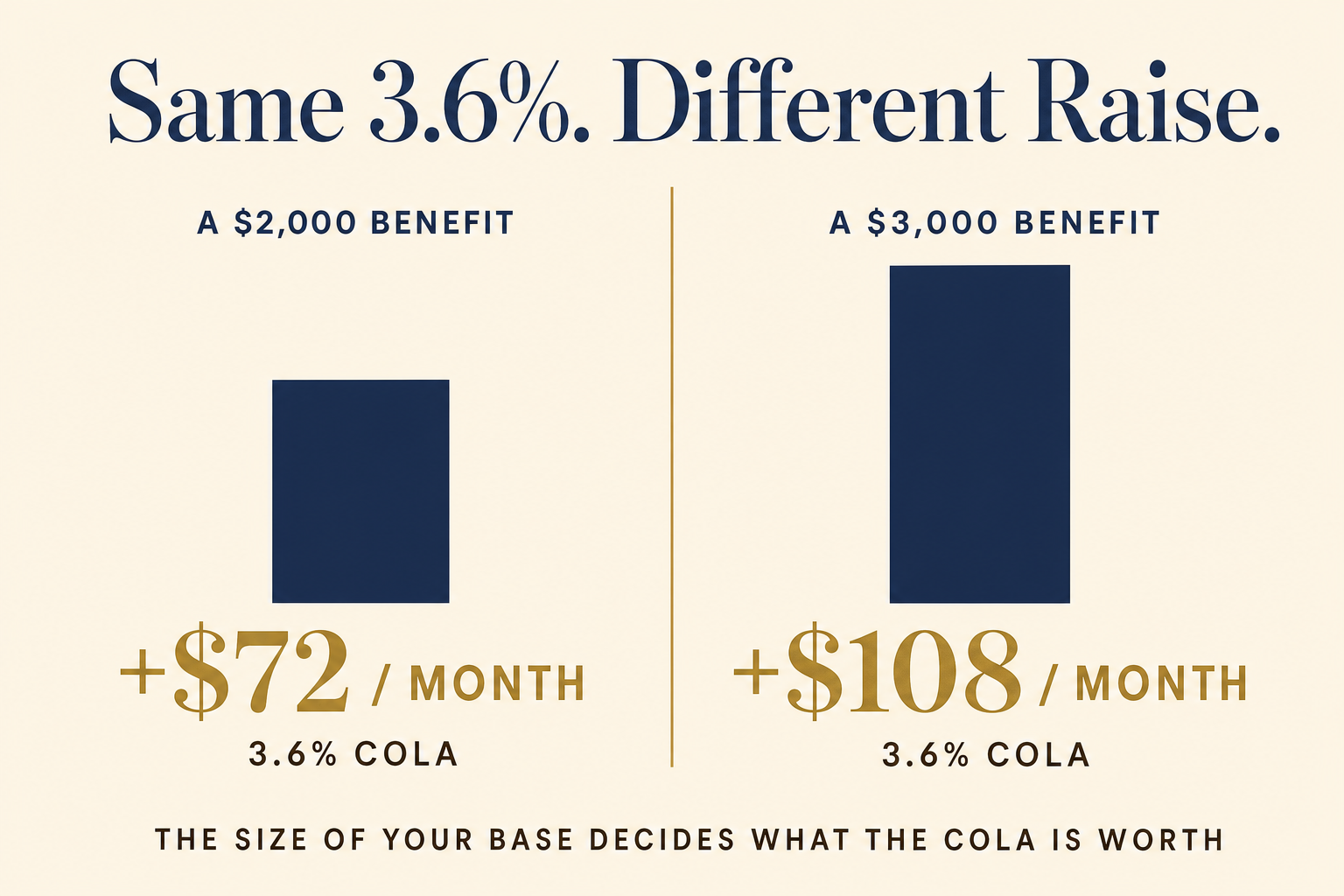
What you can change — or could have changed, and can still influence for the years ahead — is the base that percentage lands on. And that changes everything, because the same 3.6% produces wildly different dollars depending on the size of the check underneath it.
Run the math. A 3.6% raise on a $2,000 monthly benefit is about $72. The same 3.6% on a $3,000 benefit is about $108. That’s a $36 monthly gap this year alone — and because the COLA repeats and compounds every single year for the rest of your life, that gap doesn’t stay $36. It widens, annually, for as long as you live.
This is why the single highest-leverage Social Security decision happens before you ever see a COLA: your claiming age sets your base. Claiming at 62 locks in a permanently reduced benefit. Delaying past full retirement age earns delayed retirement credits of roughly 8% per year up to age 70 — a benefit that can end up about 77% larger at 70 than at 62. Every future COLA then compounds on that larger number.
Delaying isn’t free, and it isn’t right for everyone. You’re giving up checks in the years you wait, and for someone in poor health, single with no survivor to protect, or who genuinely needs the income now rather than selling investments in a down market, claiming earlier can be the sound call. The point isn’t “always wait.” It’s that the base is a decision — one worth making deliberately. If you’re still weighing it, read the traps that catch people in the final stretch of delaying before you file.
Thomas’ Take: Every October, people ask me what they should do about the new COLA. The honest answer is: nothing — you can’t do anything about it. The COLA is the one Social Security number that’s completely out of your hands. So stop watching the number you can’t change and go to work on the one you can: the size of the base it’s multiplying.
Why a bigger base keeps paying — for you and your spouse
Consider a hypothetical case: Gloria and Ron, both 66, retired outside Raleigh. Gloria claimed at 62 and locked in a $1,800 monthly benefit. Ron waited until full retirement age and started at $2,600. Same town, same program, same 3.6% COLA this year.
Gloria’s raise is about $65 a month. Ron’s is about $94. This year the difference looks like a rounding error — $29. But project it forward. Each subsequent COLA applies to an ever-larger base for Ron, so the dollar gap between their raises grows every year. Over a long retirement, that compounding can add up to tens of thousands of dollars in additional lifetime income from the same program and the same adjustment.
And there’s a part most couples never think about. When one spouse dies, the household drops to the larger of the two benefits — the survivor keeps the bigger check, not both. So the higher earner’s base, grown through delayed credits and then compounded by every COLA that follows, isn’t just that person’s income. It’s the floor the surviving spouse will live on, often for a decade or more. A bigger base is quietly the best survivor-protection decision in the whole program.
Where the COLA fits in a real plan
I build retirement income around three buckets — Now, Soon, and Later. Social Security, with its automatic COLA, is the cornerstone of the Soon bucket: your guaranteed, inflation-adjusted income floor. It’s rare and precious precisely because it keeps pace with inflation without you managing anything.
But notice what the COLA is not. It’s not a growth engine. It’s designed to keep you even, not to outrun inflation over a 30-year retirement. That job belongs to the Later bucket — the growth-oriented money that, over time, is what actually expands your purchasing power rather than just preserving it. Leaning on the COLA to grow your wealth is asking a defensive tool to play offense. It can’t, and it isn’t supposed to.
So the right response to a 3.6% COLA is to size your floor correctly and fund your growth bucket honestly. If you’ve never put real numbers to it, start with the Now, Soon, Later framework and then work through how to size your Soon bucket income floor.
The takeaway
The 3.6% COLA is good news, and I don’t want to talk anyone out of appreciating it. But a once-a-year percentage you can’t influence is the wrong thing to build a plan around. The decision that compounds in your favor for life — and for your spouse’s life after you — is the size of the base that percentage lands on.
You can’t negotiate the COLA. You can make the number it multiplies bigger. If you’re still deciding when to claim, that’s the lever worth obsessing over. Run your own claiming ages and see what a larger base does to every future raise with the Social Security calculator before you file.
Frequently asked questions
When does the 3.6% increase start?
With January 2027 Social Security payments. SSI recipients see the adjustment one day earlier, on December 31, 2026.
Does the COLA compound, or is it a one-time bump?
It compounds. Each year’s adjustment is applied to your already-adjusted benefit, so raises build on raises. That compounding is exactly why the size of your starting base matters so much over a long retirement.
Will Medicare eat my entire raise?
Usually not the whole thing, but it takes a bite. If your Part B premium is deducted from your check, your net raise is the COLA minus the premium increase. The official 2027 Part B premium is expected in November; plan on the premium rising and reducing the raise you actually keep.
This article is published by Confluence Media Group LLC, an independent publisher of educational financial content. Thomas Clark is a Series 65 Investment Advisor Representative. The information provided is for educational and informational purposes only and is not personalized financial, tax, or legal advice. Past performance does not guarantee future results. All investing involves risk, including potential loss of principal. Consult a qualified professional before making financial decisions.
Confluence Media Group LLC is a separate entity from Confluence Capital Management, the investment advisory practice through which Thomas Clark provides advisory services. Advisory services are not offered through this publishing platform.
About Thomas Clark
Thomas Clark is the founder of Confluence Media Group LLC and a Series 65 Investment Advisor Representative. He has spent nearly two decades working with families on retirement planning, with a focus on Social Security optimization, retirement income coordination, and the bucket planning approach to building a guaranteed income floor.
Thomas writes and publishes at thomasclarkadvisor.com and is the author of The Just in Case Binder — a 148-page printable family financial organizer for households who want to make sure the people they love know where everything is.
He lives in North Carolina with his family.
Subscribe to the weekly newsletter · Get the Just in Case Binder

Thomas Clark is a Series 65 licensed investment advisor and experienced trader. He specializes in investing, retirement planning, and market analysis, helping individuals build wealth and make informed financial decisions.
