
The 2027 Social Security COLA: What It Won’t Cover
The 2027 Social Security COLA is expected near 3.5% and will be announced October 14. Here's how it's calculated - and why Medicare premiums and retiree inflation quietly claw much of it back.

Sometime around October 14, the Social Security Administration will announce the 2027 cost-of-living adjustment, and the headlines will call it a raise. Early estimates put it near 3.5% — the largest in three years. But here is the uncomfortable truth about every COLA: a raise you don’t feel isn’t really a raise. It’s a patch on a leak.
I’m not saying the COLA doesn’t matter. It matters enormously — it’s one of the few features of any retirement income source that adjusts for inflation automatically, for life. What I’m saying is that the number you’ll read in the headline and the number that actually lands in your bank account are two different things, and the gap between them is where a lot of retirement plans quietly spring a leak.
Let’s walk through how the 2027 Social Security COLA is calculated, what it’s likely to be, and — the part almost nobody explains — why it so rarely keeps pace with the life you’re actually living.
How the COLA is actually calculated
The COLA isn’t a policy decision made in a room. It’s a formula, set by law, and it runs on autopilot. Each year, Social Security compares the average CPI-W — the Consumer Price Index for Urban Wage Earners and Clerical Workers — for July, August, and September against the same three months from the prior year. Whatever the percentage increase works out to, that’s the COLA. (You can read the mechanics straight from the source on the SSA’s COLA page.)
That’s why the September inflation report matters so much, and why the announcement always lands in mid-October: the government can’t finalize the number until the last of the three months is in. For 2027, the September CPI data from the Bureau of Labor Statistics is scheduled for October 14, and the COLA gets announced the same day. The adjustment then shows up in the benefit you receive in January.
One thing worth internalizing: the COLA is a genuine, guaranteed adjustment. Unlike a market return, nobody has to hope it happens. If inflation runs positive over that window, your benefit rises — no application, no election, no risk. That reliability is exactly why Social Security sits at the center of a retirement income plan. If you’ve never looked closely at how your own benefit is figured, your Social Security statement leaves out more than it tells you — and the COLA is one of the things it can’t show in advance.
What the 2027 COLA is shaping up to be
As of this writing, the official number isn’t out yet — so treat everything here as an estimate, not a promise. But the estimates have been converging. Analyses through the summer’s inflation data point to a 2027 COLA somewhere in the range of 3.2% to 3.6%. AARP’s analysis has landed near 3.6%; other trackers watching the CPI-W run through August put it around 3.5%; the most conservative estimate sits at 3.2%.
For context, the 2026 COLA came in at 2.8%. So a 3.5% adjustment would be a meaningful step up — the biggest since the inflation spike years, and a signal that prices reaccelerated a bit over 2026. If that estimate holds, a retiree collecting a $2,000 monthly benefit would see roughly $70 more per month before anything is deducted.
Thomas’ Take: Don’t build a single line of your plan around an estimate. The COLA is the one number that isn’t final until it’s final. Read the estimates for context, then wait for October 14 for the figure you can actually plan against.
Why the raise never quite feels like one
Here’s the part that gets glossed over. The COLA is indexed to CPI-W — a basket built around the spending of working-age wage earners. But you’re not a working-age wage earner. Retirees spend a very different share of their money on healthcare and housing, and a smaller share on things like gasoline and electronics.
The government even maintains an experimental index for this — CPI-E, the “E” for elderly — that weights medical care and shelter more heavily, precisely where older households spend most. In most years CPI-E runs a touch higher than CPI-W, because healthcare inflation tends to outpace the broader basket. Congress has never adopted it for the COLA. So the adjustment you receive is calibrated to someone else’s shopping cart.
This is the same dynamic I’ve written about in the context of how inflation hits each retirement bucket differently: the average inflation rate is almost never your inflation rate. And because retiree spending isn’t flat — it bends and shifts across the decades of retirement — an adjustment pegged to a national average can drift further from your reality the longer you’re retired.
The Medicare bite comes first
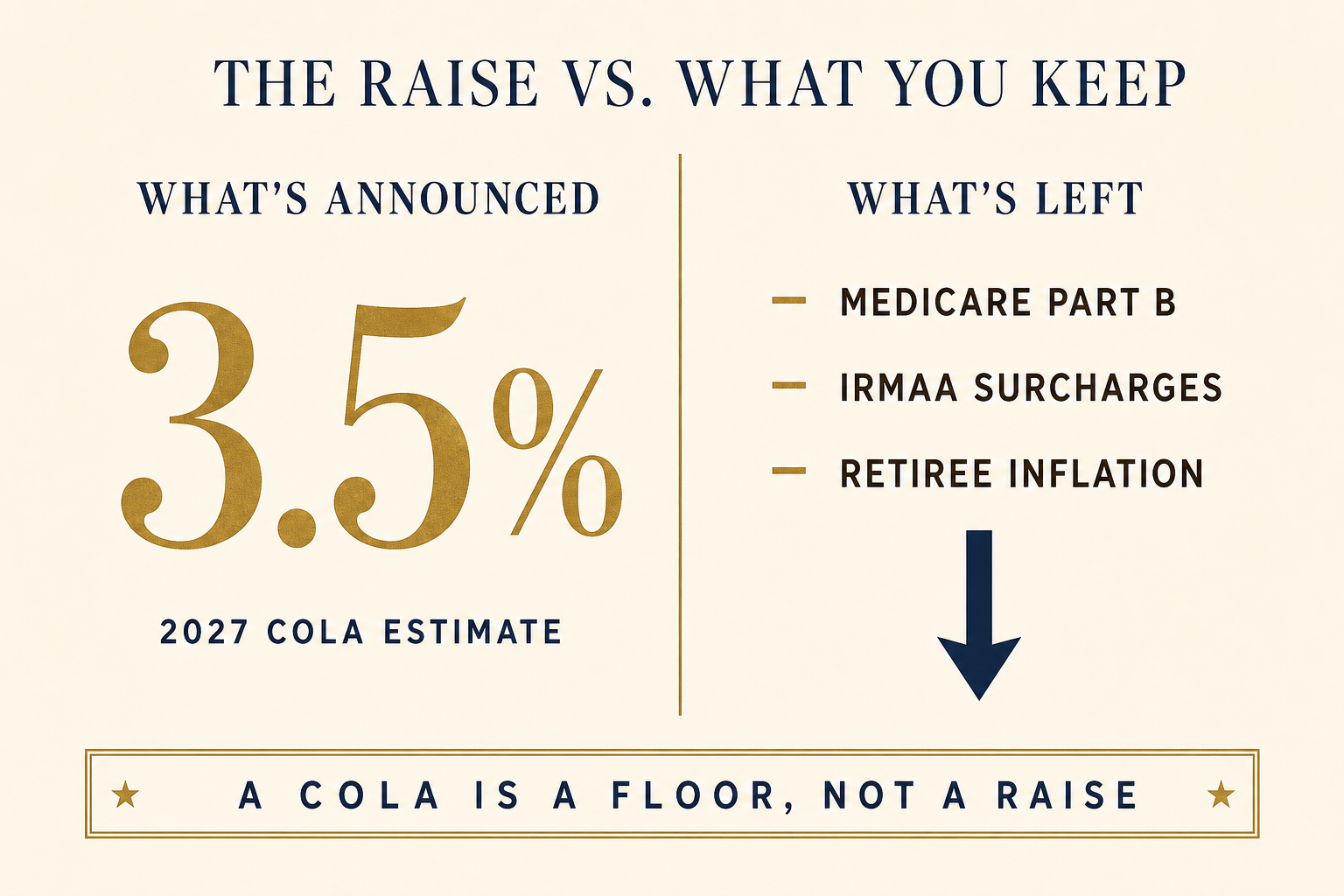
Even a healthy COLA has to survive one deduction before you ever see it: your Medicare Part B premium, which for most retirees comes straight out of the Social Security check.
The 2026 standard Part B premium rose to $202.90 per month, up from $185 in 2025 — an increase of nearly 10%. According to research from the Center for Retirement Research at Boston College, that premium jump swallowed more than a quarter of the average retiree’s 2026 COLA. You can confirm the current premium figures on Medicare.gov.
For higher-income retirees, it’s worse. If your income crosses the IRMAA thresholds, your Part B premium climbs with income-based surcharges — and in 2026, those retirees saw somewhere between half and nearly three-quarters of their COLA consumed by Medicare. If that acronym is new to you, it’s worth understanding how IRMAA quietly ambushes retirees — because it directly determines how much of any COLA actually reaches you. Whatever 2027’s Part B premium turns out to be, expect it to take its cut before your “raise” arrives.
What to actually do about it
None of this is a reason for anxiety. It’s a reason for design. The COLA does one job well — it keeps the nominal value of your Social Security check from eroding to zero over a long retirement. What it does not do is guarantee your standard of living keeps pace. Those are different promises, and a good plan doesn’t confuse them.
This is exactly where the Now, Soon, and Later bucket framework earns its keep. Social Security — COLA and all — anchors the Soon bucket: your guaranteed, inflation-adjusted income floor. It’s the most valuable piece of that floor precisely because it adjusts each year. But the COLA’s limits are the strongest argument I know for keeping a Later bucket invested for growth. The gap between what the COLA covers and what your life actually costs has to be funded by something, and over a 25- or 30-year retirement, that something is long-term growth.
Consider a hypothetical case: Diane, 68, a retired teacher in Dayton, collects about $2,000 a month from Social Security. A 3.5% COLA hands her roughly $70 more per month. But if her Part B premium climbs again and her actual grocery, insurance, and utility bills rise faster than the national average, that $70 might feel more like $40 in purchasing power. Diane’s plan works not because the COLA saves her, but because she built a Later bucket that grows over time to cover the drift the COLA leaves behind.
The practical move before the number even drops: know how the pieces fit for your own household. Running your benefit against your claiming age and your real expenses is the kind of thing our free Social Security calculator is built for — so when the 2027 figure lands on October 14, you already know what it does and doesn’t cover.
Key takeaways
- The 2027 Social Security COLA is set by a formula — the change in CPI-W across July, August, and September — and will be announced on October 14.
- Estimates cluster around 3.2%–3.6%, up from 2026’s 2.8%, but the official figure isn’t final until announcement day.
- The COLA is pegged to a working-person’s price basket (CPI-W), not the healthcare- and housing-heavy basket retirees actually spend from (CPI-E).
- Medicare Part B premiums are deducted before you see the raise — in 2026 they ate more than a quarter of the average COLA, and far more for higher-income retirees.
- Treat the COLA as a floor against inflation, not a raise. Fund the gap with a growth-oriented Later bucket.
Frequently asked questions
When exactly will the 2027 COLA be announced?
The Social Security Administration is expected to announce it on October 14, 2026, the same day the September inflation data is released. The adjustment takes effect with January 2027 benefits.
Is the 3.5% figure guaranteed?
No. It’s a third-party estimate based on inflation data through the summer. The official COLA depends on the final September CPI-W reading and can land higher or lower than current projections.
Why does my Social Security increase feel smaller than the announced percentage?
Most retirees have their Medicare Part B premium deducted directly from their benefit. When that premium rises, it offsets part of the COLA before the net amount reaches your account. Income-based IRMAA surcharges can offset even more.
The COLA is one of the best features Social Security offers — a guaranteed, annual adjustment that no private income source hands out for free. Just don’t mistake it for a raise. It’s insurance against inflation, and it’s calibrated to someone else’s basket. Build the rest of your plan to cover the difference, and October 14 becomes a data point instead of a disappointment.
This article is published by Confluence Media Group LLC, an independent publisher of educational financial content. Thomas Clark is a Series 65 Investment Advisor Representative. The information provided is for educational and informational purposes only and is not personalized financial, tax, or legal advice. Past performance does not guarantee future results. All investing involves risk, including potential loss of principal. Consult a qualified professional before making financial decisions.
Confluence Media Group LLC is a separate entity from Confluence Capital Management, the investment advisory practice through which Thomas Clark provides advisory services. Advisory services are not offered through this publishing platform.
About Thomas Clark
Thomas Clark is the founder of Confluence Media Group LLC and a Series 65 Investment Advisor Representative. He has spent nearly two decades working with families on retirement planning, with a focus on Social Security optimization, retirement income coordination, and the bucket planning approach to building a guaranteed income floor.
Thomas writes and publishes at thomasclarkadvisor.com and is the author of The Just in Case Binder — a 148-page printable family financial organizer for households who want to make sure the people they love know where everything is.
He lives in North Carolina with his family.
Subscribe to the weekly newsletter · Get the Just in Case Binder

Thomas Clark is a Series 65 licensed investment advisor and experienced trader. He specializes in investing, retirement planning, and market analysis, helping individuals build wealth and make informed financial decisions.
