
What Your Social Security Statement Doesn’t Tell You
The benefit estimate on your Social Security statement assumes you keep earning at today’s pay right up until you claim. If you plan to retire before you claim, here’s why that number can overstate your check — and how to find the real one.

Pull up your Social Security statement and the number sitting next to age 70 looks like a promise. Wait until then, it seems to say, and this is the check you’ll get. But that number isn’t a promise. It’s a forecast — and it rests on one quiet assumption that most people never notice until the day they file.
The assumption is simple: the statement estimates assume you keep working, at roughly today’s pay, right up until the age you claim. For a lot of people that’s fine. For anyone planning to retire before they claim — which describes a huge share of the pre-retirees I hear from — it can quietly overstate the benefit by more than they’d guess. Here’s how the estimate actually works, who it misleads, and how to find the number that matches your real plan.
Your statement shows a projection, not a guarantee
The Social Security Administration builds your benefit from your 35 highest-earning years, indexed for wage growth, run through a formula. (I walked through that machinery in how your Social Security benefit is actually calculated — the 35-year average and the bend points behind your check.) The catch is that when it prints the estimates on your statement, it can’t know what you’ll earn next year, so it has to assume something.
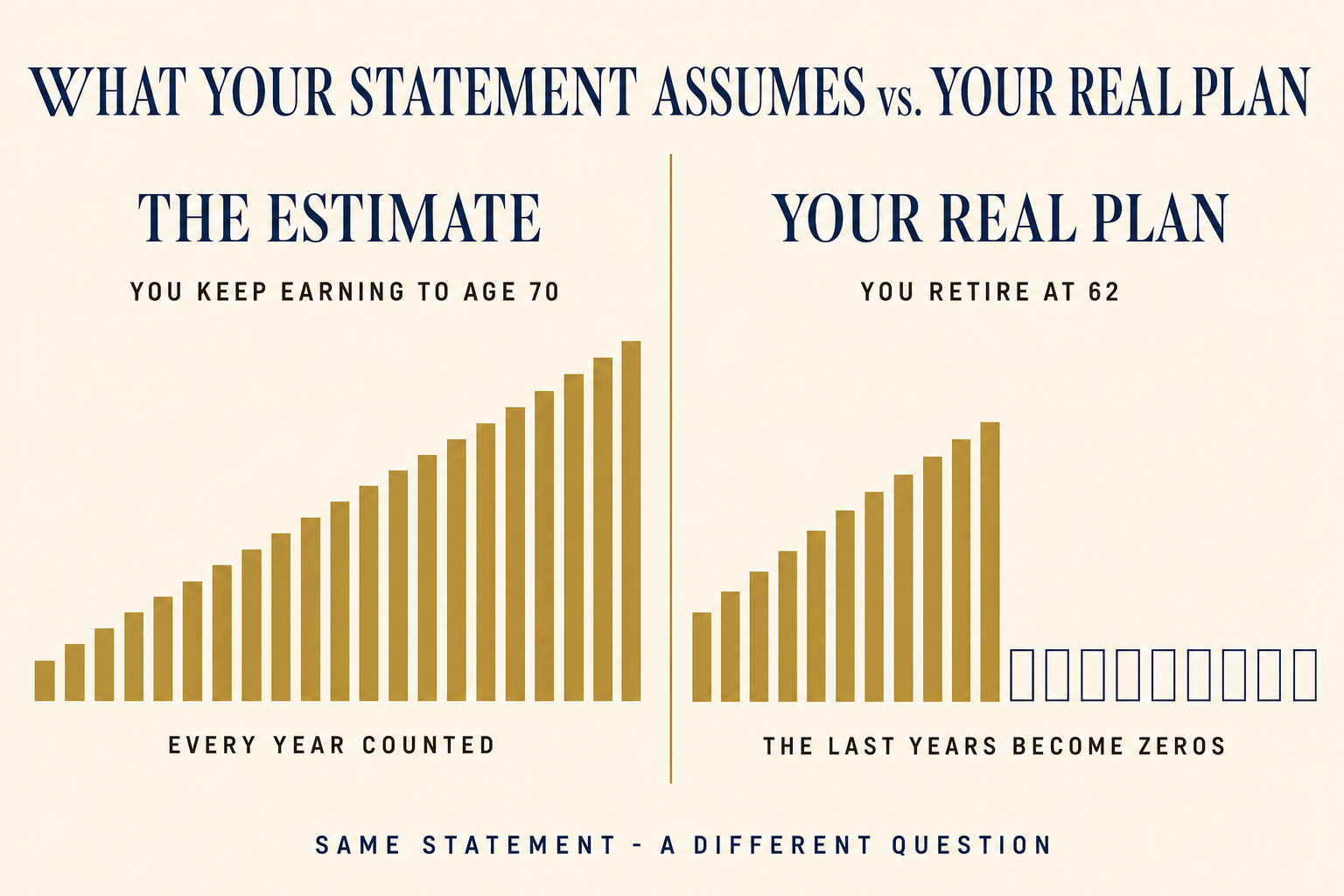
What it assumes is that you’ll keep earning about what you earned last year, every year, until you start benefits. The SSA says this plainly in its own analysis of the statement estimates: it projects your future earnings by continuing your most recent year’s earnings forward to each claiming age. So the number beside age 70 assumes you work and pay into the system for every year between now and 70. The number beside 62 assumes you work until 62. Each estimate has its own baked-in work history that hasn’t happened yet.
That’s not a flaw, exactly. It’s a reasonable default for someone who plans to work straight through. It becomes a problem only when your real plan looks different from the default — and for pre-retirees, it usually does.
The assumption most pre-retirees are about to break
Think about the classic delay strategy: retire in your early sixties, live on savings for a few years, and let your Social Security benefit grow by roughly 8% a year in delayed retirement credits until you claim at 70. It’s often a smart move, and I’ve made the case for it before. But watch what it does to your statement estimate.
The age-70 number on your statement assumed you’d keep earning right up to 70. If you actually stop at 62, those eight years between 62 and 70 aren’t the earnings the estimate penciled in — they’re zeros. Whether that matters depends entirely on your record, and this is the part worth slowing down for.
If you already have 35 strong earning years in the bank, the zeros don’t hurt you. Your top 35 is already set; a few empty years at the end don’t crack the lineup, and your real benefit lands close to the estimate. But if you have fewer than 35 years of solid earnings — because of time out of the workforce, a late start, years of part-time work, or a stretch of low pay early on — then the years the estimate assumed you’d work were quietly replacing zeros or small numbers in your top 35. Skip them, and those low years stay in the average. Your real benefit comes in under the printed estimate.
The overstatement bites in exactly one situation: when the future years the statement assumed would have counted toward your top 35. That’s more common than people think, especially for anyone who took time off to raise kids or care for a parent, changed careers midstream, or is simply looking at their peak earning years right now.
A hypothetical to make it concrete
Consider a hypothetical case: Ellen, 58, a marketing manager outside Raleigh. Her statement shows an estimated $3,100 a month at 70, and she’s built her whole plan around that number. She intends to leave her job at 61, coast on savings, and claim at 70 for the biggest possible check.
Here’s what she didn’t catch. Ellen took nine years mostly out of the workforce in her thirties, so she has about 31 years of real earnings, not 35. The $3,100 estimate assumed she’d keep earning her current salary — her highest-ever pay — every year until 70. Those assumed years were filling four empty slots and replacing several low early-career years. Stop at 61, and roughly nine of the assumed high-earning years never happen. Her actual benefit at 70 could land noticeably below $3,100 — not because Social Security shortchanged her, but because the estimate was answering a different question than the one her life was about to ask.
Ellen’s numbers are illustrative, not a projection of what any specific person will receive. The point isn’t the exact dollar figure. It’s that she was building a retirement income floor on a number that assumed a future she had no intention of living.
Why a small gap here compounds into a real one
You might think a modest overstatement isn’t worth losing sleep over. But a gap in your Social Security benefit doesn’t sit still — it compounds in two directions at once.
First, the benefit formula is progressive, so a lower lifetime average earnings figure can pull a meaningful slice off your monthly check. Second, every future cost-of-living adjustment is a percentage of that check. A smaller base means smaller raises, every year, for the rest of your life — and for a surviving spouse after that. A difference that looks like a rounding error at 70 becomes real money spread across a 25- or 30-year retirement.
This is why I treat the Social Security number as load-bearing. In the Now, Soon, Later framework I use for retirement income, your guaranteed benefits are the anchor of the Soon bucket — the floor that covers your essential bills for life. Size that floor on an inflated estimate and you build the whole structure on a number that shrinks the day you actually file.
Thomas’ Take: The most dangerous number in retirement planning is a confident one you never checked. Your statement estimate isn’t wrong — it’s just answering “what if you keep doing exactly what you’re doing?” If your plan is to stop early, you’re asking a different question, and you deserve the answer that matches it.
How to find your real number in about 30 minutes
The fix isn’t complicated, and it’s worth doing before you lock any big decision to that estimate.
1. Verify the record the estimate is built on. Every projection starts from your earnings history, and that history has errors more often than you’d expect — a missing year, a name-change gap, self-employment income that reached the IRS but never reached the SSA. I laid out the full checklist in how to audit your Social Security earnings record. Fix the record before you trust any number it produces.
2. Re-run the estimate with your actual plan. The mailed statement is rigid, but your online my Social Security account is not. Inside it you can enter different future earnings — including zero — and see how your benefit changes if you stop working at 60, 62, or 65 instead of grinding to your claiming age. This is the single most useful button on the site, and almost nobody presses it. Enter the year you actually plan to stop, and watch what happens to the number.
3. Size your income floor on the real figure. Once you have a benefit estimate that reflects your real retirement date, use it to build your plan — not the optimistic default. That’s the number that belongs in sizing your Soon bucket and in any decision about when to claim. If you’re weighing claiming ages, remember the break-even question is the wrong lens — but that’s a separate discussion from making sure the underlying number is honest in the first place.
The bottom line
Your Social Security statement is a good tool being read the wrong way. It’s showing you a forecast dressed up as a fact — the check you’d get if you keep working right up to the day you claim. For plenty of people that’s close enough. But if you’re planning to retire before you file, take the ten minutes to run your own number with your real earnings. The gap between the estimate and reality is exactly the gap you’d otherwise discover on the day it’s too late to fix.
Key takeaways
- The estimates on your Social Security statement assume you keep earning at roughly your current pay until the age you claim.
- If you retire before you claim and you have fewer than 35 strong earning years, the estimate can overstate your actual benefit.
- The overstatement bites when the assumed future years would have counted toward your top 35 — common for career-changers and anyone who took time out of the workforce.
- A smaller base benefit compounds through every future cost-of-living adjustment, so a gap at claiming becomes real money over a long retirement.
- Verify your earnings record, then re-run the estimate in your my Social Security account using your real retirement date before you build a plan on it.
Frequently asked questions
Does the age-62 estimate also assume I keep working? Yes. Each age shown on your statement assumes you keep earning at your recent level right up to that age. The age-62 figure assumes you work until 62, the age-70 figure assumes you work until 70.
If I already have 35 high-earning years, does stopping early hurt my benefit? Generally no. Once your top 35 years are strong, additional years or missing years at the end don’t change the average much, so your real benefit lands close to the estimate. The gap shows up mainly when you have fewer than 35 solid years.
Where do I enter a different retirement date? Log in to your my Social Security account at ssa.gov and use the retirement estimate tool, which lets you enter different future earnings — including zeros for the years you plan to be retired — and recalculates your benefit at each claiming age.
Before you build your retirement plan around a single number, run your own claiming scenarios with the TCA Social Security Calculator and see how the timing choices actually stack up for your situation.
This article is published by Confluence Media Group LLC, an independent publisher of educational financial content. Thomas Clark is a Series 65 Investment Advisor Representative. The information provided is for educational and informational purposes only and is not personalized financial, tax, or legal advice. Past performance does not guarantee future results. All investing involves risk, including potential loss of principal. Consult a qualified professional before making financial decisions.
Confluence Media Group LLC is a separate entity from Confluence Capital Management, the investment advisory practice through which Thomas Clark provides advisory services. Advisory services are not offered through this publishing platform.
About Thomas Clark
Thomas Clark is the founder of Confluence Media Group LLC and a Series 65 Investment Advisor Representative. He has spent nearly two decades working with families on retirement planning, with a focus on Social Security optimization, retirement income coordination, and the bucket planning approach to building a guaranteed income floor.
Thomas writes and publishes at thomasclarkadvisor.com and is the author of The Just in Case Binder — a 148-page printable family financial organizer for households who want to make sure the people they love know where everything is.
He lives in North Carolina with his family.
Subscribe to the weekly newsletter · Get the Just in Case Binder

Thomas Clark is a Series 65 licensed investment advisor and experienced trader. He specializes in investing, retirement planning, and market analysis, helping individuals build wealth and make informed financial decisions.
