
Inflation Hits Each Retirement Bucket Differently
Inflation doesn't hit your retirement savings evenly. It works on each bucket differently, and the fix for one is the wrong fix for another. Here's how the Now, Soon, and Later buckets each meet inflation, and which one is your real hedge.

Most retirement advice treats inflation as one problem: your money buys less over time, so own something that keeps up. Buy stocks. Maybe add some TIPS. Done.
That framing is comfortable, and it’s wrong. Inflation doesn’t hit your retirement savings evenly. It hits each part of your plan on a different timeline, with different force, and the fix for one part is the wrong fix for another. If you run a Now, Soon, and Later bucket plan, that’s actually good news — because it means you can stop trying to inflation-proof your whole portfolio at once and instead solve three smaller, clearer problems.
Here’s the part most people get backwards: the bucket where inflation feels scariest is the one where it barely matters, and the bucket everyone treats as “safe” is where inflation does its quiet damage.
The mistake: solving inflation once, for everything
When someone asks me how to protect a retirement plan from inflation, they’re usually picturing a single dial — one allocation, one hedge, one decision. The instinct is to armor the cash, because cash is what you can see losing value.
But inflation is a function of time. A dollar sitting in your checking account for eighteen months loses almost nothing to a 3% inflation rate. That same dollar, if it has to keep its purchasing power for twenty-five years, is in real trouble. Even a mild 3% inflation rate roughly cuts purchasing power in half over about 24 years — that’s just the math of compounding, using the rule of 72 (divide 72 by the inflation rate to get the years to halve). The 2026 Social Security cost-of-living adjustment came in at 2.8%, and the 2027 figure lands in October, so this isn’t a runaway-inflation scare. It’s the ordinary erosion that a long retirement bakes in.
So the right question isn’t “how do I beat inflation.” It’s “how long does each dollar need to hold its value?” Answer that bucket by bucket and the strategy sorts itself out.

The Now bucket: where inflation barely matters
Your Now bucket holds one to two years of living expenses in cash and cash equivalents. Its job is stability and immediate access, not growth. This is the money that pays the mortgage and the grocery bill this year and next.
Because the time horizon is so short, inflation’s effect here is trivial. Losing 3% of purchasing power on money you’ll spend within a year is a rounding error against the reason you hold it — you hold it so a bad market never forces you to sell your growth assets at the wrong time.
The mistake I see is people over-arming this bucket against inflation. They chase yield with the Now money, reach into longer-duration bonds or dividend stocks to “keep up,” and in doing so they reintroduce exactly the volatility the Now bucket exists to eliminate. Cash losing a little to inflation is the price of admission for liquidity. Pay it without flinching.
Thomas’ Take: The Now bucket is not where you win the inflation fight. It’s where you refuse to fight it, on purpose, so the rest of the plan can do its job.
The Soon bucket: where you actually choose your inflation exposure
This is the bucket that deserves the most thought, and it’s the one almost nobody thinks about correctly. Your Soon bucket is your guaranteed income floor — Social Security, any pension, and income-focused instruments layered to cover your essential bills for life.
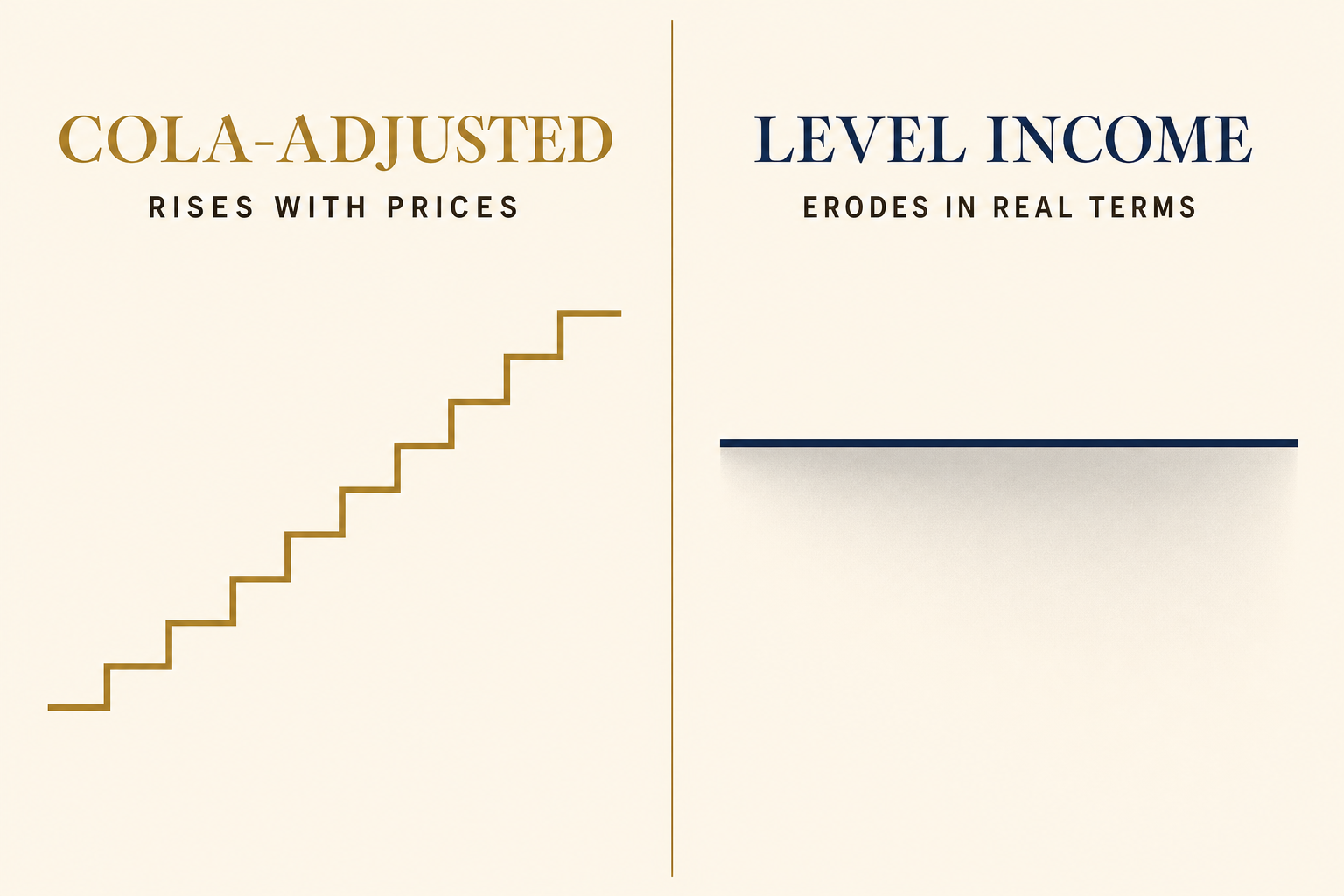
Here’s the thing about guaranteed income and inflation: not all guarantees are created equal. Social Security is inflation-adjusted. In most years it gets a cost-of-living adjustment tied to the Consumer Price Index — the COLA only stalls at 0% when consumer prices are flat, as happened in 2010, 2011, and 2016 — which means the largest piece of most people’s income floor keeps pace with prices automatically. That is an enormous and underappreciated feature — it’s the main reason claiming strategy matters so much, because a larger starting benefit means a larger base for every future COLA to compound on.
Most other guarantees don’t work that way. A traditional pension is usually a level payment — the same dollar amount at 90 that it was at 65. A basic fixed annuity pays a level income too. That “guaranteed” income is guaranteed in nominal dollars, and its real value quietly shrinks every single year. A pension that covers your bills comfortably at 66 may cover only two-thirds of them, in today’s terms, by your mid-80s.
This is where the Soon bucket forces a conscious decision, and where I’ll take a clear position. When you’re building the floor beyond Social Security, you have to decide how much level (non-inflating) income you’re willing to lock in, and you should size that deliberately rather than by accident. A Fixed Index Annuity used for income — which is the only job I think annuities should do in a retirement plan — can be a legitimate tool for building a floor, but you have to go in clear-eyed that a level payout doesn’t keep pace with prices on its own. Variable annuities, for the record, don’t solve this; they stack market risk and high fees on top of the problem, which is exactly why they have no place in how I build an income floor.
The practical move is to let inflation-adjusted Social Security carry as much of the essential-expense load as possible, and to treat level guaranteed income as a supplement you size with your eyes open — not as the whole floor.
The Later bucket: your only real inflation hedge
Now we get to the bucket everyone was trying to use to solve the whole problem — and the one where it actually belongs. Your Later bucket is your growth money: the portion invested for the back half of a long retirement, aligned to your risk tolerance and legacy goals.
This is the money with a fifteen-, twenty-, or thirty-year time horizon, and that horizon is precisely what makes equities the most reliable long-run hedge against inflation available to an ordinary retiree. Over long stretches, a broadly diversified stock allocation has historically grown faster than prices. There’s no guarantee in any given year — and the loss of principal is real — but time is the ingredient that lets growth assets outrun inflation, and the Later bucket is the only bucket with enough time.
If you want a direct inflation link inside this bucket without full equity exposure, Treasury Inflation-Protected Securities (TIPS) adjust their principal with the CPI by design. They’re a category worth understanding for the more conservative slice of long-horizon money.
The mistake here is the mirror image of the Now-bucket mistake: people under-build the Later bucket because growth assets feel risky, then wonder why their plan can’t keep up with prices two decades in. The volatility you’re avoiding in the Later bucket is the exact thing you’re being paid to accept in exchange for inflation protection you can’t get anywhere else.
A hypothetical: Margaret at 66
Consider a hypothetical case. Margaret, 66, just retired from a career in hospital administration in Ohio. She has about $600,000 across her accounts, a small pension of $1,400 a month, and Social Security of roughly $2,600 a month. Her essential expenses run about $4,500 a month.
Watch how differently inflation touches her three buckets. Her Now bucket, say $90,000 in cash, will lose a little to inflation over the next year or two, and it doesn’t matter, because she’ll have spent it by then. Her Soon bucket is where the real design happens: her Social Security ($2,600) rises with COLAs in the years prices climb, but her pension ($1,400) is level and will feel smaller in real terms as the years pass. Her inflation-protected income covers a shrinking-but-still-substantial share of her essentials, and she knows the pension is the piece that erodes. That tells her the Later bucket has a job to do: grow enough, over 20-plus years, to backfill the ground the level pension loses. Her growth allocation isn’t a nice-to-have. It’s the specific answer to the specific inflation gap her floor leaves open.
Notice what the bucket structure gave Margaret: not a single inflation number to fear, but three clear, separate assignments. That’s the whole point.
What to actually do with this
You don’t need to forecast inflation to protect against it. You need to stop treating it as one problem and start matching each bucket’s inflation strategy to its time horizon.
First, quit trying to inflation-proof the Now bucket. Accept the small erosion as the cost of stability and keep that money boring.
Second, look hard at your Soon bucket and separate the inflation-adjusted income (Social Security) from the level income (most pensions and basic annuities). Know exactly how much of your floor rises with prices and how much doesn’t. That number should drive your claiming decision and how much level income you’re willing to add.
Third, respect the Later bucket as the engine that has to outrun prices for the back half of your life — and resist the urge to shrink it into safety it doesn’t need. If you want to see how these pieces hold up under your own inflation assumptions instead of a rule of thumb, this is worth modeling against your real numbers. A planning tool like ProjectionLab lets you set your own inflation rate, separate COLA’d income from level income, and watch whether your floor and your growth reserve actually hold across a 30-year retirement. (ProjectionLab is a paid tool; the link is an affiliate link, which means I may earn a small commission at no extra cost to you. I only recommend tools I’d use myself.)
Inflation is real, and over a long retirement it’s relentless. But it’s not a wall you hit all at once. It’s three different currents pulling on three different buckets — gentle on the Now money, quiet and cumulative on the level part of your floor, and answerable, over time, by the growth bucket you were tempted to make too small. Build the plan that way and inflation stops being a vague fear and becomes what it actually is: a set of problems you’ve already assigned to the right places.
Key takeaways
- Inflation isn’t one portfolio-wide problem — it hits each bucket on a different timeline, so each bucket needs a different response.
- The Now bucket’s short horizon makes inflation nearly irrelevant there; don’t add risk chasing yield on money you’ll spend within a year or two.
- In the Soon bucket, separate inflation-adjusted income (Social Security’s COLA) from level income (most pensions and basic annuities) — the level part erodes every year.
- The Later bucket is your real long-run inflation hedge, because only it has the time horizon for growth assets to outrun prices.
- A larger starting Social Security benefit means a larger base for every future COLA — one more reason claiming strategy is high-leverage.
This article is published by Confluence Media Group LLC, an independent publisher of educational financial content. Thomas Clark is a Series 65 Investment Advisor Representative. The information provided is for educational and informational purposes only and is not personalized financial, tax, or legal advice. Past performance does not guarantee future results. All investing involves risk, including potential loss of principal. Consult a qualified professional before making financial decisions.
Confluence Media Group LLC is a separate entity from Confluence Capital Management, the investment advisory practice through which Thomas Clark provides advisory services. Advisory services are not offered through this publishing platform.
About Thomas Clark
Thomas Clark is the founder of Confluence Media Group LLC and a Series 65 Investment Advisor Representative. He has spent nearly two decades working with families on retirement planning, with a focus on Social Security optimization, retirement income coordination, and the bucket planning approach to building a guaranteed income floor.
Thomas writes and publishes at thomasclarkadvisor.com and is the author of The Just in Case Binder — a 148-page printable family financial organizer for households who want to make sure the people they love know where everything is.
He lives in North Carolina with his family.
Subscribe to the weekly newsletter · Get the Just in Case Binder

Thomas Clark is a Series 65 licensed investment advisor and experienced trader. He specializes in investing, retirement planning, and market analysis, helping individuals build wealth and make informed financial decisions.
