
How Tax Brackets Actually Work — and the Raise Myth
A raise can't “bump you into a higher bracket” and leave you with less — that's not how marginal tax brackets work. Here's the real math, plus the income cliffs (IRMAA, Social Security taxation, the ACA subsidy cliff) where crossing a line actually does cost you.

Somewhere right now, a hardworking person is turning down an extra shift. The logic sounds airtight: “If I earn more, it’ll push me into the next tax bracket, and I’ll actually take home less.” I’ve heard a version of this in break rooms, at kitchen tables, and from readers who otherwise know their stuff — because almost everyone was taught it, and almost no one was taught why it’s wrong.
Here’s the short version: a raise cannot leave you with less take-home pay because of tax brackets. That’s not how brackets work. Not approximately, not “in some cases” — not at all.
But the myth survives because it’s wearing a disguise. There really are a handful of places in the tax code where earning one more dollar can cost you real money. They aren’t tax brackets, though — they’re cliffs, and most of them show up in retirement. Let’s clear up how brackets actually work, then look at the cliffs that do deserve your attention.
The myth, stated plainly
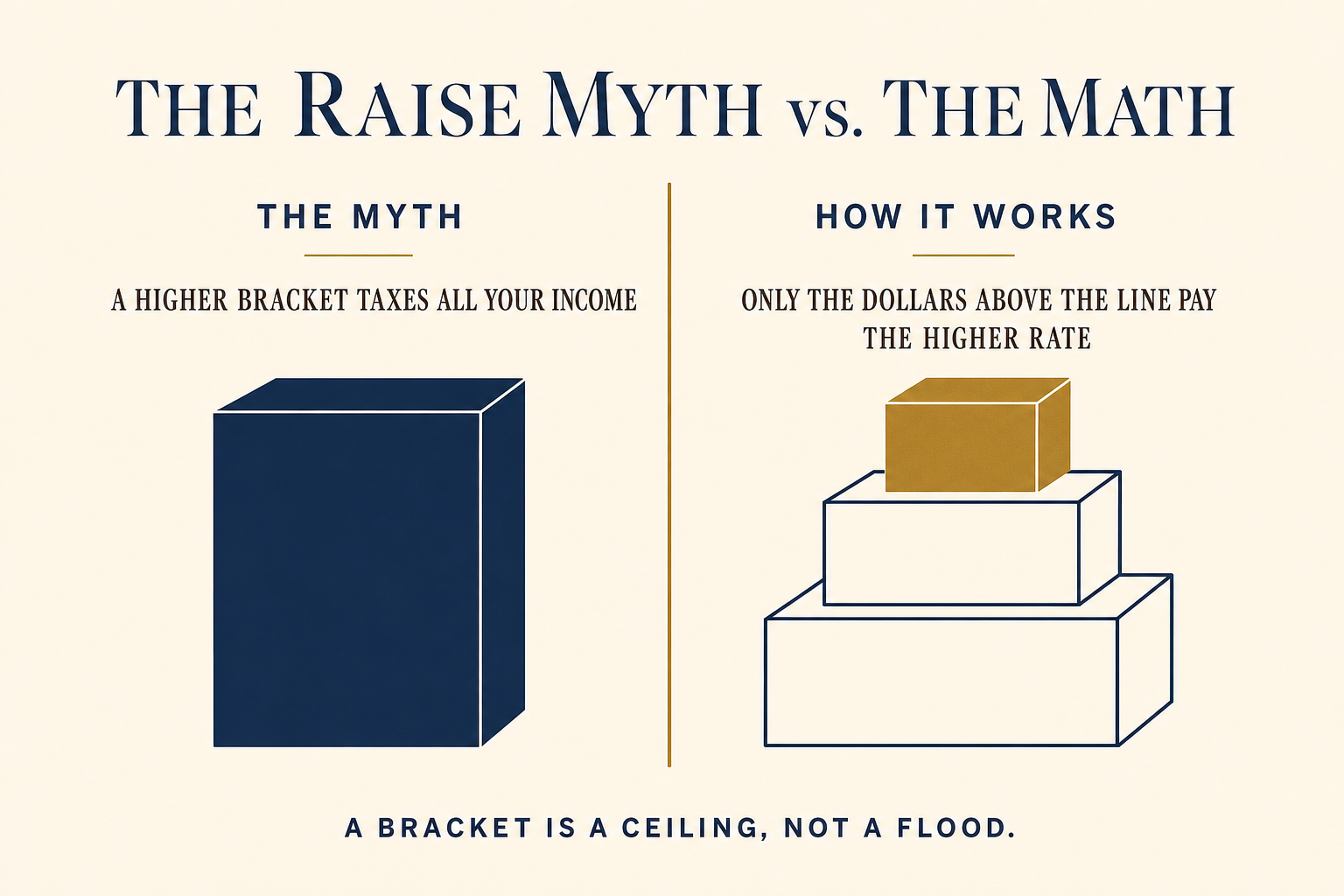
The fear goes like this: tax brackets are light switches. Cross from the 12% bracket into the 22% bracket, and suddenly all of your income gets taxed at 22% — so the raise that nudged you over the line could leave you worse off than before.
If that were true, no one would ever want a raise that crossed a threshold. It isn’t true. The United States uses a marginal tax system, and the word “marginal” is the whole story.
How a tax bracket actually works
Picture your income flowing into a series of buckets stacked on top of each other. Each bucket has a fill line and its own tax rate. You fill the bottom bucket first, and only when it’s full does income spill up into the next one. Here’s the part the myth misses: each bucket is taxed at its own rate — not at the rate of the highest bucket you happen to reach.
Here are the 2026 brackets for a single filer, from the IRS inflation adjustments in Revenue Procedure 2025-32. They apply to taxable income — what’s left after your standard deduction, which is $16,100 for a single filer in 2026:
- 10% on taxable income up to $12,400
- 12% from $12,400 to $50,400
- 22% from $50,400 to $105,700
- 24% from $105,700 to $201,775
- and higher rates above that
“Being in the 22% bracket” doesn’t mean you pay 22% on your income. It means 22% is the rate on your next dollar — the top bucket you’ve reached. Everything underneath keeps its lower rate.
The math, on an actual raise
Consider a hypothetical worker: Jordan, 38, single, with about $50,000 in taxable income — right at the top of the 12% bucket. Jordan’s boss offers a $10,000 raise. The myth says the whole $60,000 now gets taxed at 22%. Watch what actually happens.
Before the raise, Jordan’s federal income tax on $50,000 is roughly $5,750 — 10% on the first $12,400, then 12% on the rest. After the raise, taxable income is $60,000. The first $50,400 is taxed exactly as it was before. Only the $9,600 above that line gets the 22% rate. The new total is about $7,900.
So the $10,000 raise cost roughly $2,160 in additional federal tax and delivered about $7,840 in extra take-home pay. Jordan is unambiguously better off. The only dollars that ever saw 22% were the dollars above the line — and there is no version of this math where the raise makes Jordan poorer. (Jordan is hypothetical and the figures are rounded for illustration; your own numbers will differ.)
Thomas’ Take: I spent years on the trading side, where the only number that matters is what the next trade does — not the average of everything before it. Taxes work the same way. Your bracket is an average story people tell at parties. Your marginal rate — the tax on the next dollar — is the number that actually decides whether a move is worth making.
Marginal rate vs. effective rate
This is where two terms earn their keep. Your marginal rate is the rate on your next dollar — 22% for Jordan. Your effective rate is the tax you actually paid divided by your total income. For Jordan after the raise, that’s about $7,900 on $60,000, or roughly 13% — nowhere near 22%.
Almost no one pays their top bracket’s rate on their whole income. The effective rate is always lower, often much lower, because all those bottom buckets were taxed at 10% and 12% along the way. When someone says “I’m in the 24% bracket,” their effective rate might be 16%. The bracket is the ceiling on your last dollar, not the rate on all of them.
One honest footnote: a single paycheck can look smaller right after a raise if your employer’s payroll system briefly over-withholds. But over-withholding comes back to you as a refund — it’s a cash-flow timing quirk, not a real loss. The losses that are real come from something else entirely.
The cliffs that actually bite
Here’s the grain of truth the myth is built on. There are spots in the tax-and-benefits code where crossing an income line by a single dollar costs you real money. They aren’t brackets — they’re cliffs. A bracket taxes only the dollars above the line; a cliff can change the treatment of an entire benefit the moment you cross it. Three are worth knowing, especially as you approach and enter retirement.
1. The Medicare IRMAA surcharge. Once you’re on Medicare, your Part B and Part D premiums rise in steps based on your income from two years earlier — and those steps are true cliffs. In 2026, a single filer whose income two years prior was $109,000 or less pays the standard $202.90 a month for Part B. One dollar over — $109,001 — and the premium jumps to $284.10, about $970 more for the year, with a separate Part D surcharge stacked on top. That’s the full jump for a single dollar of income. I walked through this trap in detail in IRMAA: the Medicare surcharge that ambushes retirees; the premium figures come straight from Medicare.gov.
2. The Social Security “tax torpedo.” This one isn’t a clean cliff, but it’s sneakier. How much of your Social Security is taxed depends on your “provisional income” — roughly your other income plus half your benefits — and as that figure rises past certain thresholds ($25,000 for singles, $32,000 for couples, per the Social Security Administration), more of your benefit becomes taxable. In the phase-in zone, a single extra dollar from an IRA withdrawal can pull up to 85 cents of Social Security into your taxable income alongside it. Suddenly you’re taxed on $1.85 for every $1 you took out — which can push the real rate on that dollar well above the bracket you think you’re in. And as I explained in why the 2025 law didn’t make Social Security tax-free, those thresholds aren’t indexed for inflation, so more people drift into them every year.
3. The ACA premium subsidy cliff. If you retire before 65 and buy health coverage on the marketplace, your premium subsidy phases down as income rises — and for 2026 the “subsidy cliff” at 400% of the federal poverty level is back. The enhanced subsidies that had smoothed that edge expired at the end of 2025, and as of this writing Congress had not restored them. Cross the 400% line by a dollar and you can lose thousands in premium assistance for the year. This one is a live policy question, so confirm the current rules at HealthCare.gov before you plan around it.
Notice what these three have in common: they’re all driven by a measure of income you have more control over than you might think — especially in retirement, when you often choose how much to withdraw and from which account. That’s exactly the kind of thing worth modeling before you act. A planning tool like ProjectionLab lets you test how an extra slice of income — a Roth conversion, a larger withdrawal, a part-time paycheck — lands across your brackets, your IRMAA tier, and your Social Security taxation, using your own numbers instead of a stranger’s example.
Disclosure: the ProjectionLab link above is an affiliate link. If you subscribe through it, I may earn a commission at no additional cost to you. I only point to tools I’d actually sit down and use.
What this means for you
Two takeaways, pulling in opposite directions but both true.
First: take the raise. Work the overtime. Accept the bonus. The bracket myth has quietly cost people real money by talking them out of income that would have left them better off every single time. No bracket crossing ever turns an extra dollar of earned income into a net negative. (If you’d like to blunt the tax on new income, pre-tax retirement contributions lower your taxable income directly — just don’t front-load them so hard you leave an employer match on the table, a trap I covered in maxing out your 401(k) early can cost you the match.)
Second: respect the cliffs — and plan around the income you control. The cliffs are almost entirely a retirement-era concern, and the good news is that in retirement you often get to decide how much income shows up on your return in a given year. That’s where bucket planning earns its keep. When your essential expenses are covered by a guaranteed income floor, you’re free to manage the rest of your income deliberately — filling a low bracket with a Roth conversion in a quiet year, or holding a withdrawal back to stay under an IRMAA line. The order in which you draw from your accounts, which I covered in the retirement withdrawal order most people get wrong, is one of the main levers. Giving directly from an IRA, as I described in this year’s charitable-giving breakdown, is another.
Key takeaways
- A raise can never reduce your take-home pay through tax brackets. The U.S. uses a marginal system, so only the dollars above a bracket line are taxed at the higher rate.
- Your marginal rate is the tax on your next dollar; your effective rate — what you actually pay across all your income — is always lower.
- The myth survives because real income cliffs exist, but they aren’t brackets. IRMAA, Social Security taxation, and the ACA subsidy cliff can each cost real money at a specific income line.
- Those cliffs are mostly a retirement-era issue, and retirement is also where you have the most control over how much income lands on your return.
- Bucket planning and a deliberate withdrawal order are how you manage income around the cliffs — without ever turning down a raise to do it.
Frequently asked questions
Can earning more ever actually lower my take-home pay? Not through tax brackets — never. The only ways it happens are the cliffs above (losing a benefit like an ACA subsidy, or crossing an IRMAA line) or a temporary payroll over-withholding that you get back at tax time. Ordinary earned income is always worth taking.
What’s the difference between my tax bracket and my tax rate? Your bracket is the rate applied to your last dollar of taxable income — your marginal rate. Your actual tax rate — the effective rate — is the total tax you pay divided by your total income, and it’s always lower, because your first dollars were taxed at lower rates.
Do these income cliffs matter before retirement? Mostly the ACA subsidy cliff, which affects anyone buying marketplace coverage — including early retirees and the self-employed. IRMAA and Social Security taxation arrive once you’re on Medicare and collecting benefits. All three reward the same habit: knowing what your next dollar of income actually triggers.
The next time someone tells you a raise could cost them money, you’ll know the real answer. A bracket is a ceiling on your last dollar, not a flood that soaks all of them. Take the income — then, when the cliffs come into view in retirement, manage the dollars you control with intention. That’s the whole game: earn freely, withdraw deliberately.
This article is published by Confluence Media Group LLC, an independent publisher of educational financial content. Thomas Clark is a Series 65 Investment Advisor Representative. The information provided is for educational and informational purposes only and is not personalized financial, tax, or legal advice. Past performance does not guarantee future results. All investing involves risk, including potential loss of principal. Consult a qualified professional before making financial decisions.
Confluence Media Group LLC is a separate entity from Confluence Capital Management, the investment advisory practice through which Thomas Clark provides advisory services. Advisory services are not offered through this publishing platform.
About Thomas Clark
Thomas Clark is the founder of Confluence Media Group LLC and a Series 65 Investment Advisor Representative. He has spent nearly two decades working with families on retirement planning, with a focus on Social Security optimization, retirement income coordination, and the bucket planning approach to building a guaranteed income floor.
Thomas writes and publishes at thomasclarkadvisor.com and is the author of The Just in Case Binder — a 148-page printable family financial organizer for households who want to make sure the people they love know where everything is.
He lives in North Carolina with his family.
Subscribe to the weekly newsletter · Get the Just in Case Binder

Thomas Clark is a Series 65 licensed investment advisor and experienced trader. He specializes in investing, retirement planning, and market analysis, helping individuals build wealth and make informed financial decisions.
