
The Retirement Withdrawal Order Most People Get Wrong
The standard retirement withdrawal order — taxable first, Roth last — optimizes this year's tax bill and quietly inflates it for decades. Here's the tax-smart way to sequence.

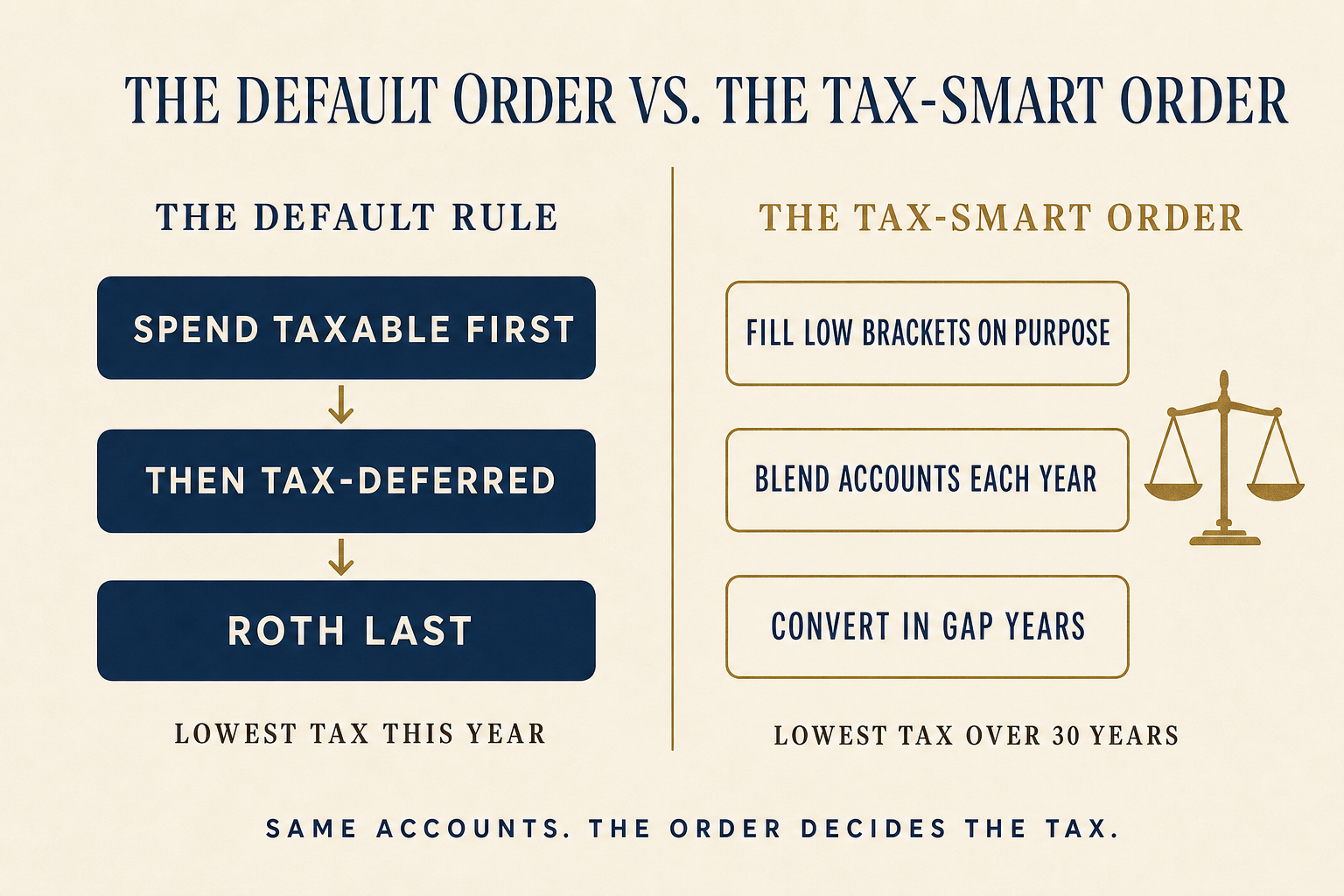
Almost every retiree hears the same rule of thumb: spend your taxable accounts first, your tax-deferred accounts — traditional IRA, 401(k) — next, and your Roth last. It’s tidy, it’s easy to remember, and for a lot of people it quietly builds a tax problem that doesn’t show up until their 70s.
I don’t think the rule is wrong so much as it’s incomplete. It optimizes for this year’s tax bill and ignores the thing that actually drives lifetime taxes in retirement: which bracket your income lands in, year after year, for three decades. Sequence your withdrawals well and you can smooth your taxes across your whole retirement. Sequence them by rote and you spend your low-tax years doing nothing, then get hit with oversized required withdrawals, higher Medicare premiums, and more of your Social Security taxed — all at the same time.
This is one of those retirement decisions where the obvious answer and the right answer aren’t the same. Let’s walk through why.
The rule you’ve probably been told
The conventional withdrawal order goes like this: tap your taxable brokerage account first, then your tax-deferred accounts, and save your Roth for last. The logic isn’t crazy. Money in a taxable account is only taxed on its gains — often at lower long-term capital gains rates — so spending it first keeps your reported income low early on. Leaving the Roth untouched lets it keep growing tax-free for as long as possible.
If your only goal were to pay the least tax in the first few years of retirement, this order would be close to perfect. But retirement isn’t a few years, and the tax code has a long memory. The traditional IRA and 401(k) dollars you carefully leave alone don’t disappear. They keep compounding — and every one of them is still fully taxable when it finally comes out.
Why the “obvious” order backfires
Here’s the part the rule of thumb skips. When you drain your taxable account first and defer everything else, you often coast through your 60s in a very low tax bracket. That feels like a win. It isn’t. Those low-income years are the most valuable tax real estate you’ll ever own, and the default order spends them on nothing.
Then you turn 73, and the bill arrives. At that age the IRS requires you to start taking required minimum distributions (RMDs) from your traditional accounts, whether you need the money or not. On a $1 million traditional balance, the first RMD is roughly $37,700 — and it climbs every year after that as the required percentage rises. If you spent two decades letting that account grow untouched, the RMD can be large enough to push you into a higher bracket than you were ever in while working.
And it doesn’t stop at the bracket. A big required withdrawal ripples outward:
- Medicare premiums. Medicare’s income-related surcharge, IRMAA, is based on your income from two years prior (see Medicare.gov). A large RMD today can quietly raise your Part B and Part D premiums two years down the road.
- Social Security taxation. The more ordinary income you report, the more of your Social Security benefit becomes taxable — up to 85% of it.
- The survivor’s squeeze. When one spouse passes, the survivor files as a single taxpayer — narrower brackets, same big IRA. The withdrawal that was comfortable for a couple can be punishing for one person.
Thomas’ Take: The default order isn’t a tax strategy. It’s a tax deferral strategy dressed up as one. Deferring a tax isn’t the same as lowering it — and if you defer long enough, you can hand yourself a bigger bill and a fistful of side effects to go with it.
The reframe: fill your brackets on purpose
The tax-smart approach flips the mindset. Instead of asking “which account do I empty first,” you ask “what’s the smoothest income I can report every year for the rest of my life?” That’s a different question, and it produces a different answer.
The core move is to stop treating your accounts as a strict order and start treating them as ingredients you blend each year. In a typical year that means pulling some income from more than one bucket — enough from your traditional accounts to deliberately fill up your low tax brackets, topped off with tax-free Roth or already-taxed cash so your total taxable income stays where you want it. You’re not avoiding the taxable account; you’re using all three on purpose.
The most powerful version of this happens in the “gap years” — the stretch after you stop working but before RMDs and, often, before you’ve claimed Social Security. In those years your income can be unusually low, which means you can voluntarily pull from your traditional IRA (or do partial Roth conversions) at a low tax rate. You’re paying a little tax now, on purpose, to shrink the traditional balance that would otherwise detonate as an RMD later. Done steadily, this is how you keep the RMD, the Medicare surcharge, and the Social Security tax hit all smaller at once.
None of this requires guessing where markets go. It’s a structural decision about where your income comes from, not a bet on returns — which is exactly why I like it. It’s the same reason order matters more than average when it comes to your returns: the sequence you can control often matters more than the numbers you can’t.
A hypothetical, walked start to finish
Consider a hypothetical couple, Ray and Diane, both 66 and newly retired. (They’re illustrations, not real people, and the figures are round on purpose.) They have $1.2 million in traditional 401(k) and IRA accounts, $300,000 in a taxable brokerage account, and $150,000 in a Roth. They need about $5,500 a month to live, and they’ve decided to delay Social Security until 70 to lock in the larger benefit.
The default path: They spend the taxable $300,000 first. For four or five years their reported income is tiny — barely any tax at all. It feels great. But the $1.2 million traditional balance keeps compounding untouched, and by the time RMDs begin at 73, it may have grown well past $1.4 million. Now they’re forced to withdraw large amounts every year, on top of two Social Security checks, and a chunk of it lands in a higher bracket — with IRMAA surcharges and Social Security taxation stacked on top.
The tax-smart path: They still use the taxable account, but they don’t empty it in a vacuum. During those same low-income gap years, they also pull from the traditional accounts — or convert a slice to Roth — deliberately filling their lower brackets each year. Their income is a little higher in their late 60s and a little lower in their 70s. The traditional balance is smaller when RMDs hit, so the required withdrawals are smaller, the Medicare surcharge is less likely to trigger, and less of their Social Security gets taxed. Same accounts, same spending — a flatter, lower tax bill spread across the whole of retirement.
How this maps onto bucket planning
If you’ve read much of what I write, you know I organize retirement money into Now, Soon, and Later buckets — cash for near-term spending, a guaranteed income floor for the essentials, and growth for the long haul. Withdrawal sequencing is the tax layer that sits on top of that structure.
Your buckets tell you how much to pull and how much risk to take with what’s left. Your withdrawal order tells you which account to pull it from so the tax bill stays smooth. The two work together: a stable spending plan from your buckets makes it far easier to run the deliberate, bracket-by-bracket withdrawals that keep lifetime taxes down. A guaranteed income floor also means you’re never forced to sell or withdraw at the worst possible moment just to eat — which is what lets you make withdrawal decisions for tax reasons instead of panic reasons.
Where to start
You don’t need to solve thirty years of taxes this afternoon. You need to stop wasting your low-bracket years. A reasonable starting sequence:
- Map your accounts by tax type — taxable, tax-deferred, Roth. Most people have all three and have never looked at them side by side.
- Find your gap years — the low-income window between retiring and RMDs (and Social Security). That’s where the opportunity lives.
- Fill, don’t drain. Each year, pull enough from tax-deferred accounts to use up your low brackets, then top off from Roth or cash.
- Watch the two-year shadow. Because IRMAA looks back two years, the income you report today sets your Medicare premium the year after next. Plan the whole runway, not just this April.
This is exactly the kind of decision worth modeling before you commit to it, because the tradeoffs play out over decades and small changes compound. A planning tool like ProjectionLab lets you test different withdrawal orders and Roth-conversion amounts and watch how each one moves your lifetime taxes, your RMDs, and your Medicare surcharges — instead of guessing. (ProjectionLab is a paid tool; the link is an affiliate link, which means I may earn a small commission at no extra cost to you. I only recommend tools I’d use myself.)
The retirees who pay the least tax over their lifetimes aren’t the ones who paid the least last year. They’re the ones who stopped chasing the lowest bill in front of them and started managing the bracket they land in every year for the rest of their lives. The withdrawal order is where that starts — and the “obvious” one is rarely the answer.
If it’s useful, I break down one retirement decision like this every week in the newsletter. You can subscribe here — it’s free, and it’s the plain-English version of exactly this.
This article is published by Confluence Media Group LLC, an independent publisher of educational financial content. Thomas Clark is a Series 65 Investment Advisor Representative. The information provided is for educational and informational purposes only and is not personalized financial, tax, or legal advice. Past performance does not guarantee future results. All investing involves risk, including potential loss of principal. Consult a qualified professional before making financial decisions.
Confluence Media Group LLC is a separate entity from Confluence Capital Management, the investment advisory practice through which Thomas Clark provides advisory services. Advisory services are not offered through this publishing platform.
About Thomas Clark
Thomas Clark is the founder of Confluence Media Group LLC and a Series 65 Investment Advisor Representative. He has spent nearly two decades working with families on retirement planning, with a focus on Social Security optimization, retirement income coordination, and the bucket planning approach to building a guaranteed income floor.
Thomas writes and publishes at thomasclarkadvisor.com and is the author of The Just in Case Binder — a 148-page printable family financial organizer for households who want to make sure the people they love know where everything is.
He lives in North Carolina with his family.
Subscribe to the weekly newsletter · Get the Just in Case Binder

Thomas Clark is a Series 65 licensed investment advisor and experienced trader. He specializes in investing, retirement planning, and market analysis, helping individuals build wealth and make informed financial decisions.
