
Year-End Giving in 2026: What the New Tax Law Changed
The 2025 tax law rewrote how charitable giving is taxed starting in 2026 — a new deduction for non-itemizers, a new floor for itemizers, and a trimmed top-bracket benefit. For most retirees, though, the move that matters most isn't a deduction at all: it's which account your gift comes from.

When the 2025 tax law passed, a lot of the coverage aimed at retirees led with the same cheerful headline: people who take the standard deduction can finally write off charitable gifts again. That part is true. Starting with the 2026 tax year, you can claim the standard deduction and deduct up to $1,000 in cash gifts to charity — $2,000 if you’re married filing jointly.
It’s a welcome change. It’s also the smallest part of the story.
Three things changed about charitable giving for 2026, and the one that matters most to the typical retiree isn’t a deduction at all — it’s which account your gift comes out of. Give the way you’ve always given, out of your checking account, and you may be handing back the single biggest tax break available to you. Here’s what actually changed, and the year-end move that sidesteps most of it.
What actually changed for 2026
The 2025 law — the same one I wrote about when I explained why it didn’t make Social Security tax-free — made three changes to charitable giving, all taking effect for the 2026 tax year.
1. A small deduction came back for non-itemizers. If you don’t itemize, you can now deduct up to $1,000 ($2,000 married filing jointly) of cash gifts given directly to public charities. The IRS lays out the new provision in its rundown of enhanced deductions for individuals. The catches: it’s cash only, and gifts to donor-advised funds don’t count.
2. Itemizers now face a floor. If you do itemize, you can only deduct charitable gifts to the extent they exceed 0.5% of your adjusted gross income (AGI). On $150,000 of AGI, that’s the first $750 of giving that no longer counts, and the disallowed slice doesn’t carry forward to a future year. The nonpartisan Tax Foundation has a clear breakdown of how the new floor works.
3. The top-bracket deduction got trimmed. For the highest earners, each dollar of itemized deductions is now worth at most 35 cents instead of 37. Most retirees won’t feel this one — but it fits the pattern. The law gives a little at the bottom and takes a little at the top.
Why this matters more for retirees than it looks
Here’s the piece most of the coverage skipped. That shiny new non-itemizer deduction only helps if your giving was invisible on your tax return to begin with — and for most retirees, it already was.
Look at the 2026 standard deduction, confirmed in the IRS inflation adjustments: $32,200 for a married couple filing jointly, $16,100 for a single filer. Add the age-65 bump — $1,650 per spouse, or $2,050 for a single filer — and the temporary senior bonus deduction the new law created, up to $6,000 per person age 65 and older through 2028. A married couple in their seventies can be standing on more than $47,000 of deductions before they give a single dollar to charity.
That’s the whole reason itemizing fell out of reach for most retirees. If your total deductions don’t clear the standard amount, the charitable gifts you write checks for all year produce exactly zero tax benefit. The new $1,000 / $2,000 break softens that — a little. But it caps at cash, caps at $2,000, and does nothing for the larger, recurring gifts a lot of retirees make.
The move that sidesteps all of it
If you’re 70½ or older, there’s a way to give that skips this entire deduction conversation: the qualified charitable distribution, or QCD. I wrote a full walkthrough of how a QCD works — here’s why it matters against the new rules.
A QCD is money sent directly from your IRA to a qualifying charity. Because those dollars never land in your income in the first place, you don’t need to itemize, you never trip the new 0.5% floor, and you’re not capped at $2,000. For 2026 you can give up to $111,000 this way, per person, and the IRS confirms a QCD counts toward your required minimum distribution.
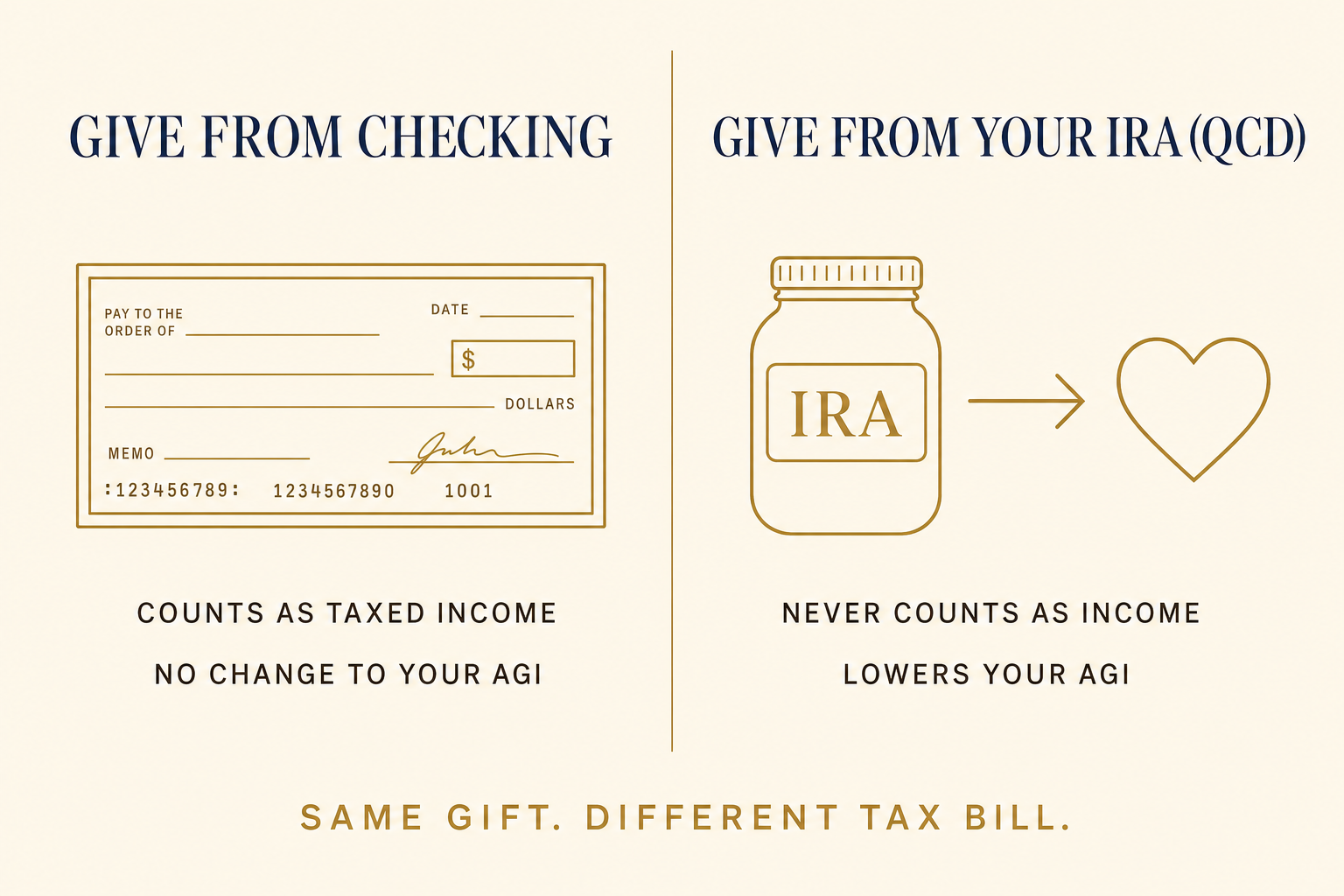
The quiet power is what it does to your AGI. A deduction lowers your taxable income after AGI is set. A QCD lowers AGI itself — and AGI is the number that drives how much of your Social Security gets taxed and whether you cross an IRMAA threshold that raises your Medicare premiums two years later. Giving from the right account can lower three bills at once.
It isn’t a free-for-all. A QCD has to come from an IRA — not a 401(k), and not an active SEP or SIMPLE plan — and the money has to move directly from your custodian to the charity. Donor-advised funds and private foundations don’t qualify. And you can’t double-dip: if you exclude the gift from income as a QCD, you can’t also deduct it. You pick one lane.
Thomas’ Take: For a retiree already taking required distributions, the question isn’t how much you give — it’s which account you give from. A $5,000 check from checking and a $5,000 QCD from the IRA send the charity the exact same money. One of them also quietly shrinks your tax bill, your Social Security taxation, and maybe your Medicare premium. Same generosity, very different receipt.
A hypothetical, start to finish
Consider a hypothetical couple: Elena and Marcos, both 74, retired near Charlotte. Between Social Security, a pension, and their IRA withdrawals, they land comfortably in standard-deduction territory. Every year they give about $8,000 — some to their church, some to a local food bank.
Written as checks from their bank account, that $8,000 used to do nothing on their return. Under the 2026 rules, $2,000 of it now clears as the non-itemizer deduction. Better than zero, but they’re taking an $8,000 action for a $2,000 benefit.
Now run the same gift as a QCD. Elena and Marcos are already required to pull money from their IRAs this year. They direct $8,000 of those required distributions straight to the two charities. The full $8,000 satisfies part of their RMD and never shows up as income — which drops their AGI by $8,000. That lower AGI can mean a smaller share of their Social Security is taxed, and it keeps them further from the next IRMAA bracket. Same $8,000 to the same charities. A meaningfully smaller tax bill. (Elena and Marcos are hypothetical, and the figures are round for illustration — your own numbers will differ.)
The honest way to see what this does for you is to put it on your actual numbers. Map your income, your required distributions, and what you plan to give, then compare a regular withdrawal against a QCD and watch what each does to your AGI, your taxable Social Security, and your IRMAA bracket. A planning tool like ProjectionLab lets you build that side-by-side with your own figures — seeing it on your own plan lands differently than reading someone else’s example.
Disclosure: the ProjectionLab link above is an affiliate link. If you subscribe through it, I may earn a commission at no additional cost to you. I only point to tools I’d actually sit down and use.
What to do before December 31
Year-end giving runs on a hard deadline. For a QCD to count toward 2026, the money has to leave your IRA by December 31 — and “leave” means actually completed, not merely requested. A few things to handle now rather than in the last week of the year:
- Call your IRA custodian early. A QCD check mailed to a charity has to clear by year-end. Custodians get buried in December, and a transfer that doesn’t complete in time counts for the wrong year.
- Keep it direct. The funds must go from the custodian to the charity. If the money passes through your own hands first, it’s an ordinary taxable withdrawal, not a QCD.
- Get the acknowledgment letter. You need the same written confirmation from the charity you’d need for any deductible gift.
- Coordinate with your withdrawal order. A QCD changes which account your charitable dollars come from, so it fits inside the larger question of which accounts you draw from first.
Key takeaways
- Three charitable-giving changes took effect for 2026: a small deduction for non-itemizers ($1,000 single / $2,000 joint, cash only), a new 0.5%-of-AGI floor for itemizers, and a 35-cent cap on the top-bracket deduction value.
- Because most retirees take the standard deduction — often $47,000+ once age and senior add-ons are counted — ordinary charitable gifts produce little or no tax benefit.
- A qualified charitable distribution (QCD) sidesteps all of it: at 70½+, you can send up to $111,000 (2026) directly from an IRA to charity, counting toward your RMD and never hitting your income.
- Because a QCD lowers AGI itself, it can also reduce how much Social Security is taxed and keep you under an IRMAA threshold.
- QCDs must come from an IRA, move directly to a qualifying public charity, and can’t also be deducted — and the money must leave by December 31.
Frequently asked questions
Can I do a QCD if I’m not taking RMDs yet? Yes. QCD eligibility begins at age 70½, which is earlier than the age-73 start for required minimum distributions. In those in-between years you can give from your IRA this way even though no RMD is due yet.
Does the new $2,000 non-itemizer deduction stack with a QCD on the same gift? No. You can’t exclude a gift from income as a QCD and also deduct the same dollars — that’s the no-double-dipping rule. They’re two separate tools for two separate gifts.
Which charities qualify for a QCD? Qualifying public charities. Donor-advised funds, private foundations, and supporting organizations are not eligible recipients, per IRS Publication 590-B.
The 2026 rules quietly reward people who treat giving as a tax decision, not only a generosity decision. The gift is the same either way. The difference is whether the IRS treats it as income you happened to give away — or money that never counted as yours at all. Before you write this year’s checks, ask one question: is this coming from the right account?
This article is published by Confluence Media Group LLC, an independent publisher of educational financial content. Thomas Clark is a Series 65 Investment Advisor Representative. The information provided is for educational and informational purposes only and is not personalized financial, tax, or legal advice. Past performance does not guarantee future results. All investing involves risk, including potential loss of principal. Consult a qualified professional before making financial decisions.
Confluence Media Group LLC is a separate entity from Confluence Capital Management, the investment advisory practice through which Thomas Clark provides advisory services. Advisory services are not offered through this publishing platform.
About Thomas Clark
Thomas Clark is the founder of Confluence Media Group LLC and a Series 65 Investment Advisor Representative. He has spent nearly two decades working with families on retirement planning, with a focus on Social Security optimization, retirement income coordination, and the bucket planning approach to building a guaranteed income floor.
Thomas writes and publishes at thomasclarkadvisor.com and is the author of The Just in Case Binder — a 148-page printable family financial organizer for households who want to make sure the people they love know where everything is.
He lives in North Carolina with his family.
Subscribe to the weekly newsletter · Get the Just in Case Binder

Thomas Clark is a Series 65 licensed investment advisor and experienced trader. He specializes in investing, retirement planning, and market analysis, helping individuals build wealth and make informed financial decisions.
