The QCD: The Smartest Way to Give From Your IRA in 2026
New 2026 tax rules made the charitable deduction harder to use. If you're 70 and a half or older, a qualified charitable distribution lets you give straight from your IRA, counting toward your RMD and staying off your tax return entirely.

Here is a tax break that just got worse in 2026, and almost nobody is talking about the workaround. Starting this year, the charitable deduction is harder to use than it has been in decades: most retirees do not itemize, and the ones who do now have to clear a new floor before a single dollar of giving counts. If your plan for tax-smart generosity was “give the money and write it off,” 2026 quietly moved the goalposts.
But there is one giving strategy the new rules do not touch, because it was never a deduction in the first place. It is called a qualified charitable distribution, or QCD, and if you are 70½ or older with money in a traditional IRA, it is very likely the most tax-efficient way you can give. Let me show you why.
What a qualified charitable distribution actually is
A qualified charitable distribution is a direct transfer of money from your IRA to a qualified charity. The key word is direct: the custodian sends the check straight to the charity, and the money never lands in your bank account or on your tax return as income.
The rules are specific, and they matter:
- You must be at least 70½ years old on the date of the transfer. Not the year you turn 70½ — the actual date.
- The money must come from an IRA (traditional, rollover, or inherited). Active 401(k)s and SEP or SIMPLE IRAs you are still contributing to do not qualify.
- It has to go directly from the custodian to a public 501(c)(3) charity. Donor-advised funds and private foundations are excluded.
- In 2026, you can give up to $111,000 per person this way (a figure now indexed to inflation, up from $108,000 in 2025). A married couple with separate IRAs can each do their own, for up to $222,000 combined.
Here is the part that makes it powerful: a QCD counts toward your required minimum distribution for the year, but the amount is excluded from your taxable income entirely (the IRS spells out the mechanics in its RMD guidance). You satisfy the requirement to pull money out of the account without adding a dollar to your income.
One timing detail trips people up. Once RMDs begin at 73, the first dollars out of your IRA each year are considered your RMD. So if you want a QCD to offset your RMD, you have to do the QCD before you take any other withdrawals for the year. And you can start QCDs at 70½ — a full two and a half years before RMDs even begin — which is a quietly useful way to shrink the balance that will eventually be forced out.
Why skipping your income beats taking a deduction
This is the distinction that separates the QCD from ordinary charitable giving, and it is worth slowing down on.
A deduction reduces your taxable income after it has already been counted. A QCD keeps the money out of your income in the first place. That sounds like the same thing. It is not — because a whole series of retirement costs are calculated off your income, not your deductions.
Lower your reported income and you can:
- Reduce the share of your Social Security benefits that gets taxed. As I explained in how Social Security actually gets taxed, the taxable portion rises with your other income — and a QCD keeps that other income down.
- Stay under an IRMAA threshold. The Medicare surcharge is a cliff: cross a line by a dollar and your Part B and Part D premiums jump for the whole year. A QCD lowers the income that IRMAA is measured against.
A deduction does none of that. Even a fully deductible gift still shows up in your adjusted gross income first, so it can leave your Social Security taxation and your Medicare premiums exactly where they were. The QCD is the only common giving move that lowers the number every one of those calculations depends on.
What changed in 2026 — and why it tilts toward the QCD
The 2025 tax law reshaped charitable deductions in three ways, all effective in 2026, and each one makes the QCD look better by comparison.
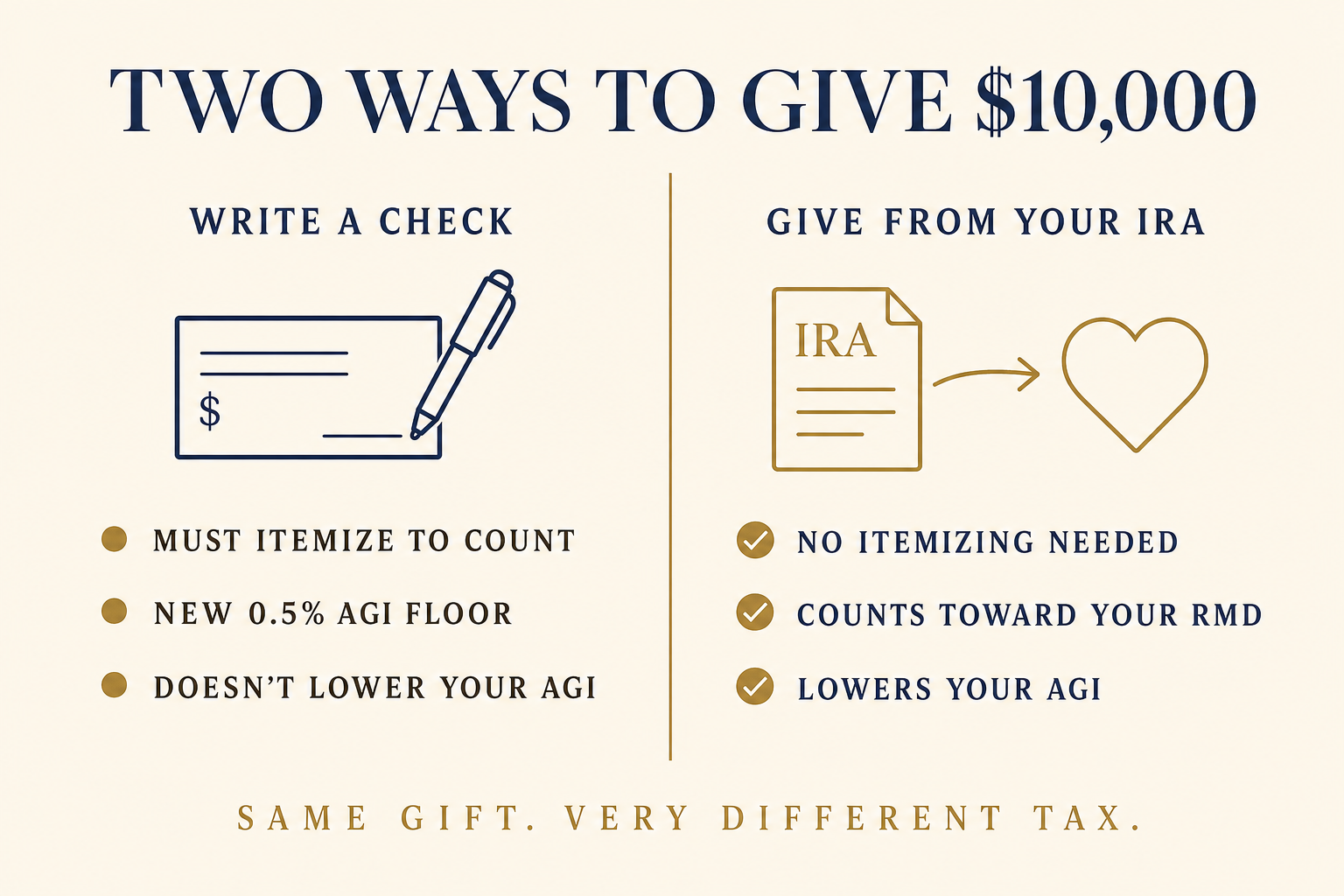
Most people never itemize anyway. Since the standard deduction roughly doubled in 2018, close to nine in ten households take it — and if you take the standard deduction, a check to your church has historically done nothing for your taxes. There is now a modest exception, a new above-the-line deduction of up to $1,000 for single filers and $2,000 for couples, but it is a small window and it does not touch your Social Security or Medicare math.
Itemizers face a new floor. Beginning in 2026, only charitable contributions above 0.5% of your adjusted gross income are deductible. On a $120,000 AGI, the first $600 of giving no longer counts — a permanent annual haircut for the retiree who gives steadily.
The top-bracket write-off shrank. Donors in the highest bracket now have the value of their itemized deductions capped at 35 cents on the dollar rather than 37 — not enormous, but it points the same direction.
The QCD sidesteps all three. There is no itemizing to worry about, no 0.5% floor to clear, and no cap on the benefit — because a QCD was never a deduction. It simply removes the money from your income. The rules that got tougher this year do not apply to it.
A hypothetical: Eleanor’s $8,000
Consider a hypothetical case. Eleanor, 74, is retired near Asheville. She lives on Social Security, a small pension, and withdrawals from a $600,000 traditional IRA, and she takes the standard deduction like most of her neighbors. Every year she gives about $8,000 — split between her church and the regional food bank — and she has an RMD of roughly $24,000 to take regardless.
If Eleanor writes checks the way she always has, that $8,000 does almost nothing for her taxes. She does not itemize, so the gift is invisible to the IRS, and she still has to pull the full $24,000 RMD into her income, which pushes up the taxable slice of her Social Security along the way.
If instead she asks her IRA custodian to send $8,000 directly to those same charities as a QCD, the picture changes. That $8,000 counts toward her RMD, so she only needs to take another $16,000 herself. Her reported income falls by $8,000 compared with the check-writing version — which can trim the taxable portion of her Social Security and help keep her comfortably below her Medicare surcharge tier. Same charities. Same $8,000. A materially lower tax bill. (Figures are rounded and illustrative, not a projection of any specific result.)
Nothing about Eleanor’s generosity changed. Only the plumbing did.
The rules that trip people up
The QCD is simple in concept and unforgiving in execution. A few traps to know:
- It has to be a direct transfer. If the custodian sends the money to you and you write the check, it is a normal taxable withdrawal — the QCD treatment is gone. Have the custodian pay the charity directly, or use an IRA checkbook that pays the charity, not you.
- Get the acknowledgment. Just like any gift, you need a written receipt from the charity confirming no goods or services were received in exchange.
- Report it correctly. Your 1099-R will show the full distribution as if it were taxable — the custodian does not flag QCDs. You (or your preparer) subtract the QCD amount on your return and write “QCD” next to the taxable line. Miss this step and you pay tax on money you gave away.
- Watch the still-working contribution offset. If you are 70½-plus and still making deductible IRA contributions, those contributions reduce the amount you can exclude as a QCD, dollar for dollar. This mostly affects people with earned income who keep funding an IRA.
- Donor-advised funds do not count. The single most common disqualifier. A QCD cannot go to a DAF or a private foundation. There is a separate one-time option to fund a charitable gift annuity or trust with a QCD, up to its own inflation-adjusted limit — worth asking about, but confirm the current-year figure before you rely on it.
Where the QCD fits in a bucket plan
If you have read my work on the Now, Soon, and Later framework, you know I think about every retirement dollar in terms of the job it does and how it is taxed. The traditional IRA is the bucket the IRS has a lien on — every dollar comes out as ordinary income, and RMDs eventually force the issue whether you need the money or not.
That makes the IRA the single best place to give from, if you are giving anyway. You spend down the most heavily taxed money you own, satisfy a withdrawal you were required to take, and do it without the income showing up to raise your Social Security taxes or Medicare premiums. It is the same logic behind tax-aware bucketing: match the right account to the right job. For charitable giving in your seventies, the right account is almost always the traditional IRA.
Here is my honest take. The QCD is not a reason to give more than you would have — generosity should never be a tax strategy dressed up as charity. But if you are already giving, and you are over 70½, giving any other way is usually leaving money on the table. Most retirees I talk to have simply never been told the option exists.
The one thing worth doing before you act is to see how a QCD moves your specific numbers — your RMD, your AGI, the taxable share of your Social Security, and your Medicare tier two years out. This is worth modeling rather than eyeballing. A planning tool like ProjectionLab lets you map your income sources and see what routing part of your RMD to charity does to your full-year tax picture — so you know the payoff before you ever call the custodian. (ProjectionLab is a paid tool; the link is an affiliate link, which means I may earn a small commission at no extra cost to you. I only recommend tools I’d use myself.)
Key takeaways
- A qualified charitable distribution (QCD) sends money straight from your IRA to charity and keeps it out of your taxable income — you must be 70½ or older, and the 2026 limit is $111,000 per person.
- A QCD counts toward your required minimum distribution but, unlike a deduction, actually lowers your adjusted gross income — which can reduce the tax on your Social Security and help you dodge an IRMAA cliff.
- New 2026 rules made the charitable deduction weaker (a 0.5%-of-AGI floor for itemizers, a lower cap for top earners, and the reality that most people don’t itemize) — none of which apply to a QCD.
- It must be a direct custodian-to-charity transfer, it can’t go to a donor-advised fund, and you have to report it yourself because the 1099-R won’t flag it.
- If you’re already giving and you’re over 70½, giving from your IRA is usually the most tax-efficient way to do it.
Frequently asked questions
Do I have to wait until my RMDs start at 73 to do a QCD?
No. QCD eligibility begins at 70½, which is before RMDs start at 73. Those two-plus years are a good window to start shrinking the IRA balance that will eventually be forced out as taxable income.
Can I still take the standard deduction and do a QCD?
Yes — and that’s exactly the point. A QCD works whether or not you itemize, because it reduces your income directly instead of running through your deductions.
Does the QCD lower my required minimum distribution?
It counts toward it. If your RMD is $24,000 and you do an $8,000 QCD before any other withdrawal, you only need to take the remaining $16,000 yourself — and only that $16,000 is taxable.
Can my spouse and I both do one?
Yes, if you each have your own IRA and each meet the age rule. Each of you can give up to the $111,000 annual limit from your own account.
Charitable giving is one of the few places in the tax code where doing the generous thing and the smart thing line up perfectly. In 2026, with the deduction harder to use than ever, the qualified charitable distribution is where they line up best.
This article is published by Confluence Media Group LLC, an independent publisher of educational financial content. Thomas Clark is a Series 65 Investment Advisor Representative. The information provided is for educational and informational purposes only and is not personalized financial, tax, or legal advice. Past performance does not guarantee future results. All investing involves risk, including potential loss of principal. Consult a qualified professional before making financial decisions.
Confluence Media Group LLC is a separate entity from Confluence Capital Management, the investment advisory practice through which Thomas Clark provides advisory services. Advisory services are not offered through this publishing platform.
About Thomas Clark
Thomas Clark is the founder of Confluence Media Group LLC and a Series 65 Investment Advisor Representative. He has spent nearly two decades working with families on retirement planning, with a focus on Social Security optimization, retirement income coordination, and the bucket planning approach to building a guaranteed income floor.
Thomas writes and publishes at thomasclarkadvisor.com and is the author of The Just in Case Binder — a 148-page printable family financial organizer for households who want to make sure the people they love know where everything is.
He lives in North Carolina with his family.
Subscribe to the weekly newsletter · Get the Just in Case Binder

Thomas Clark is a Series 65 licensed investment advisor and experienced trader. He specializes in investing, retirement planning, and market analysis, helping individuals build wealth and make informed financial decisions.
