
No, the 2025 Tax Law Didn’t Make Social Security Tax-Free
The 2025 tax law added a temporary senior deduction, but it did not make Social Security benefits tax-free. Here is what actually changed, how your benefits are really taxed, and the decisions that move the needle.

Since the summer, a version of the same question keeps landing in my inbox: “I heard Social Security isn’t taxed anymore — is that true?” I understand why people believe it. The headlines after the 2025 tax law were everywhere, and more than a few of them read like Congress had finally made Social Security benefits tax-free.
It didn’t. The 2025 law added a new deduction that helps some retirees a little and others not at all — and it left the rules for taxing your benefits exactly where they were. If you plan your retirement income around the belief that your check is now untouchable, you’re going to be surprised in April. So let’s walk through what actually changed, how your benefits are really taxed, and the handful of decisions that move the needle.
What the 2025 law actually changed
The law often called the “One Big Beautiful Bill Act,” signed in July 2025, created a new temporary deduction for people age 65 and older. It’s worth up to $6,000 per qualifying filer — so up to $12,000 for a married couple where both spouses are 65 or older — and it’s available whether you itemize or take the standard deduction.
Two details matter. First, it’s temporary: it applies to tax years 2025 through 2028 and then expires unless Congress extends it. Second, it phases out as income rises, starting around $75,000 of modified adjusted gross income for a single filer and $150,000 for a married couple, and disappearing entirely by roughly $175,000 and $250,000. Higher-income retirees get little or nothing.
Here’s the part the headlines skipped: this is a deduction against your taxable income, not an exemption of your Social Security benefit. A proposal to actually stop taxing benefits was floated during the debate and left out of the final law. The deduction can lower your overall tax bill, and for someone sitting right at the edge of a threshold it can even reduce the tax on their benefits indirectly. But it does not change how your benefits are taxed. The machinery underneath is untouched.
How your Social Security is actually taxed
Whether your benefits get taxed comes down to a number the IRS calls your combined income — often called provisional income. The formula is straightforward:
Provisional income = your adjusted gross income + any tax-exempt interest + half of your annual Social Security benefits.
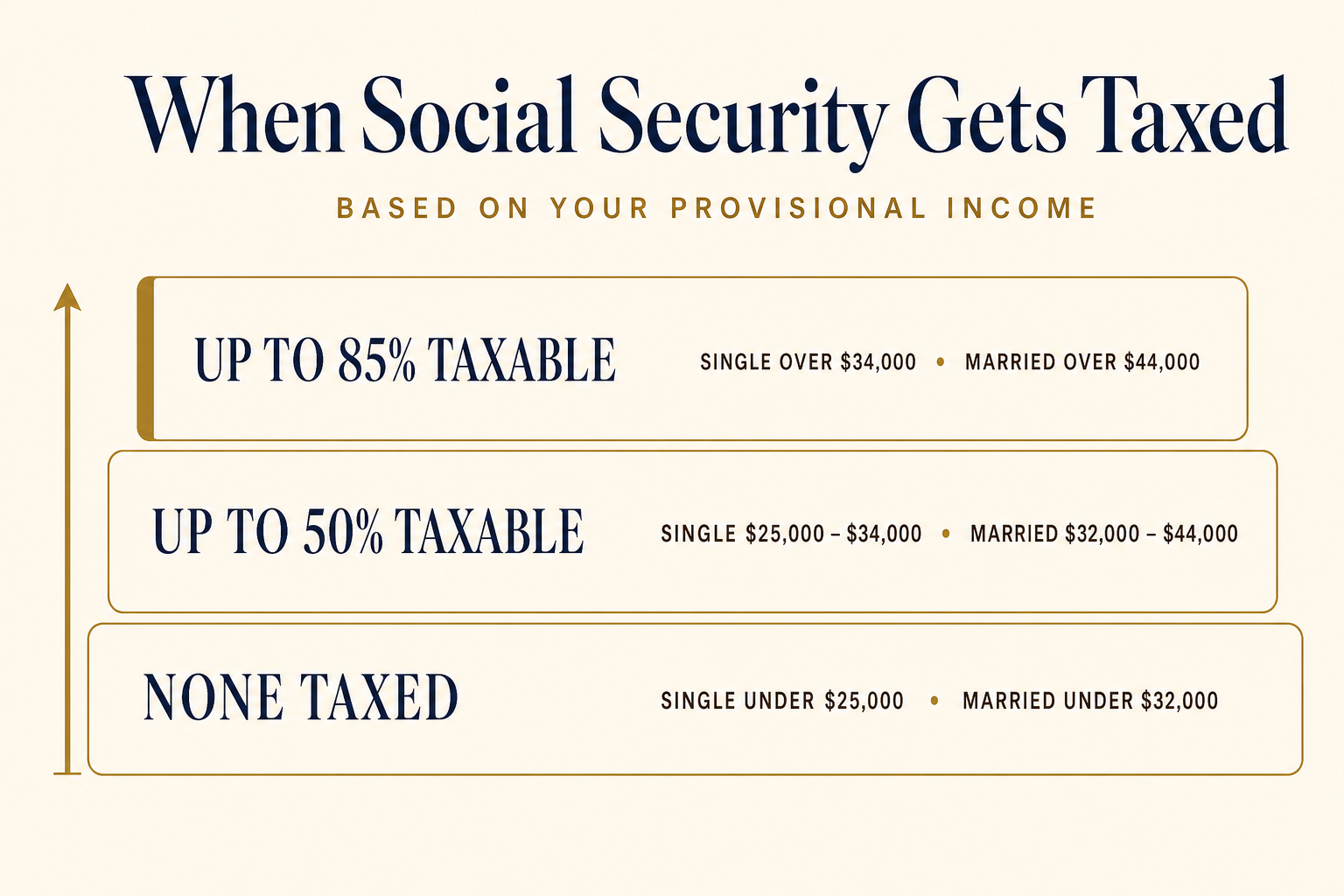
Once you have that number, it gets compared against two thresholds that decide how much of your benefit becomes taxable:
- Single filers: below $25,000, your benefits aren’t taxed. Between $25,000 and $34,000, up to 50% of your benefits can be taxed. Above $34,000, up to 85% can be taxed.
- Married filing jointly: below $32,000, no tax. Between $32,000 and $44,000, up to 50%. Above $44,000, up to 85%.
One point I have to stop and explain, because almost everyone misreads it: “up to 85% taxable” does not mean your benefits are taxed at an 85% rate. It means up to 85 cents of every benefit dollar gets counted as ordinary income, which is then taxed at your regular income-tax rate. For most retirees that’s the 10%, 12%, or 22% bracket — not 85%. The Social Security Administration and the IRS both lay out the mechanics if you want the primary source.
Why more retirees get caught every year
Now look at those threshold numbers again: $25,000 and $34,000 for singles, $32,000 and $44,000 for couples. They were written into law in 1983 and 1993 — and they have never been adjusted for inflation. Not once in more than forty years.
Think about what that means. Nearly every other number in the tax code — standard deductions, bracket cutoffs, contribution limits — climbs each year with inflation. These thresholds sit frozen in the Reagan and Clinton administrations. So every year, as benefits rise with cost-of-living adjustments and modest withdrawals push incomes up, more retirees drift across lines that haven’t moved. When taxation of benefits began, fewer than one in ten recipients owed anything on them. Today it’s roughly half.
That’s the quiet truth the “tax-free” headlines bury: the real story of Social Security taxation is a stealth tax increase that happens automatically, by Congress doing nothing. And the new senior deduction, helpful as it is for some, doesn’t touch those frozen thresholds at all.
The tax torpedo most retirees never see coming
Here’s where it gets genuinely surprising. Because crossing a provisional-income threshold pulls more of your benefit into the taxable column, an extra dollar of ordinary income can create far more than a dollar of new taxable income. Planners call this the “tax torpedo.”
Consider a hypothetical case. Dan and Carol, both 67, are married and collect $40,000 a year in combined Social Security benefits. Their other income lands them right in that middle zone where more of each benefit dollar is starting to be taxed. In December, Dan takes an extra $1,000 out of his traditional IRA to cover a home repair.
That $1,000 is taxable on its own. But it also nudges their provisional income up enough that another $850 of their Social Security benefits becomes taxable too. So a $1,000 withdrawal produced $1,850 of taxable income. If they’re in the 12% bracket, the real marginal cost of that withdrawal isn’t 12% — it’s closer to 22% once the torpedoed benefit is counted. (These figures are illustrative and rounded; the exact effect depends entirely on your own numbers.) Most people never see this coming because it doesn’t show up until the return is filed — long after the withdrawal decision was made.
What you can actually do about it
The encouraging part: provisional income is one of the few things in retirement you have real control over. But the levers get pulled during the year — not in April when you file. A few of the big ones:
Mind the order you draw your accounts. Which account you tap first — taxable, tax-deferred, or Roth — changes your provisional income, sometimes dramatically. This is the single most overlooked retirement decision, and I’ve written about the withdrawal order most people get wrong in detail.
Use the low-income “gap years.” The stretch between retiring and starting required minimum distributions is often a window of unusually low income. Partial Roth conversions in those years can move money out of accounts that will later inflate your provisional income — because qualified Roth withdrawals don’t count toward it at all.
Give from your IRA if you’re charitable. After 70½, a qualified charitable distribution lets you satisfy some or all of your required distribution without it ever hitting your adjusted gross income — which keeps it out of the provisional-income formula. Here’s how the QCD works.
Build a steadier income floor. Retirees get torpedoed most often when a bad market forces a large, lumpy withdrawal in a single year. A guaranteed income floor in the Soon bucket smooths that out, which makes it far easier to keep provisional income under control year to year. Steady beats lumpy when thresholds are frozen.
Watch the knock-on effects. The same modified adjusted gross income that taxes your benefits also sets your Medicare premiums through the IRMAA surcharge. One high-income year can hit you in two places at once, so these decisions deserve to be made together, not in isolation.
If you want a rough sense of where your own provisional income lands before you make any year-end moves, our free Social Security calculator is a sensible place to start.
The bottom line
“Social Security is tax-free now” is a comforting headline and a wrong one. The truth is more useful: the taxation rules didn’t change, the thresholds still aren’t indexed to inflation, and the one new break is temporary and phases out as income climbs. The retirees who come out ahead aren’t the ones waiting for Congress to exempt their benefits. They’re the ones who treat provisional income as something to manage — a few deliberate decisions each year, made before December 31. Do that, and the next “tax-free” headline is just noise.
This article is published by Confluence Media Group LLC, an independent publisher of educational financial content. Thomas Clark is a Series 65 Investment Advisor Representative. The information provided is for educational and informational purposes only and is not personalized financial, tax, or legal advice. Past performance does not guarantee future results. All investing involves risk, including potential loss of principal. Consult a qualified professional before making financial decisions.
Confluence Media Group LLC is a separate entity from Confluence Capital Management, the investment advisory practice through which Thomas Clark provides advisory services. Advisory services are not offered through this publishing platform.
About Thomas Clark
Thomas Clark is the founder of Confluence Media Group LLC and a Series 65 Investment Advisor Representative. He has spent nearly two decades working with families on retirement planning, with a focus on Social Security optimization, retirement income coordination, and the bucket planning approach to building a guaranteed income floor.
Thomas writes and publishes at thomasclarkadvisor.com and is the author of The Just in Case Binder — a 148-page printable family financial organizer for households who want to make sure the people they love know where everything is.
He lives in North Carolina with his family.
Subscribe to the weekly newsletter · Get the Just in Case Binder

Thomas Clark is a Series 65 licensed investment advisor and experienced trader. He specializes in investing, retirement planning, and market analysis, helping individuals build wealth and make informed financial decisions.
