
Is Bucket Planning Just Mental Accounting?
Critics say bucket planning is just mental accounting — the same investments wearing different labels. They are right about the math, and completely wrong about why it works.

Every few weeks, someone sends me an article arguing that bucket planning is a gimmick. The argument is always some version of the same sharp point: if you split your money into a Now bucket, a Soon bucket, and a Later bucket, you end up holding the exact same investments you’d hold in one well-built portfolio. The buckets, the critics say, are just mental labels. A dollar is a dollar, no matter which tray you put it in.
Here’s the uncomfortable part. On the math, they’re right.
And it still doesn’t change my mind. Because the spreadsheet was never the thing that fails in a bear market. The person holding it is. Let me show you exactly where the critique is correct, and exactly where it falls apart.
What the critics get right
The technical name for the thing they’re describing is mental accounting — a term the economist Richard Thaler won a Nobel Prize for studying. Mental accounting is our habit of treating money differently depending on the mental box we file it in, even when the dollars are identical. We’ll splurge a $1,000 “bonus” we’d never have spent from our “savings,” though both are just money.
Apply that lens to buckets and the critique writes itself. Imagine a retiree with two years of cash, a guaranteed income floor, and a diversified stock portfolio for later. Now imagine the same retiree holding one blended portfolio with the same overall mix of cash, bonds, and stocks. Same holdings. Same expected return. The three labeled trays don’t earn a penny more than the single account. In a pure spreadsheet, bucket planning and a single rebalanced portfolio are often indistinguishable.
I won’t pretend otherwise. If you came to bucket planning expecting it to beat a sensible three-fund portfolio on raw returns, you came for the wrong reason. It won’t, and it was never supposed to.
Why the math isn’t the point
Retirement income isn’t a spreadsheet problem. It’s a behavior problem. And the two produce wildly different results.
There’s a well-known body of research on what Morningstar’s “Mind the Gap” study calls the behavior gap — the stubborn finding that the returns real investors actually earn tend to trail the returns of the very funds they own. The money doesn’t underperform. The people do, by buying after things go up and selling after they go down. The gap isn’t caused by bad investments. It’s caused by bad timing driven by fear.
That’s the whole game. The best allocation you abandon at the bottom loses to the decent allocation you hold through. A structure that changes your behavior in the one moment that matters — a deep market drop — is worth more than a structure that’s optimal on paper and gets abandoned in practice.
Bucket planning is that structure. Its job is not to raise your return. Its job is to keep you from becoming a forced seller at the worst possible time.
The crash is where the structure pays
Consider a hypothetical case — an illustration, not a projection, with round numbers. Two retirees, Diane and Carol, are both 67. Each has $800,000 invested in a 60/40 mix, and each spends about $65,000 a year, with Social Security covering roughly $35,000 of it. Same money, same spending, same portfolio. Then the market falls 25% in a single year.
Carol holds everything in one account. She logs in, sees “retirement savings” down nearly $200,000, and does the math every frightened retiree does: I can’t keep pulling $30,000 a year out of an account that’s bleeding. So she sells into the decline to raise cash and cuts her spending out of fear. She has converted a paper loss into a permanent one, which is the exact mechanism behind sequence-of-returns risk.
Diane holds the identical investments — but sorted into buckets. She knows her Now bucket holds about two years of spending in cash, and her Soon bucket (Social Security plus a small guaranteed layer) covers most of her essentials no matter what the market does. So when the drop comes, she spends from the Now bucket, leaves the stock-heavy Later bucket completely alone, and waits. The same 25% decline that panicked Carol is, to Diane, a year she simply doesn’t touch her growth money.
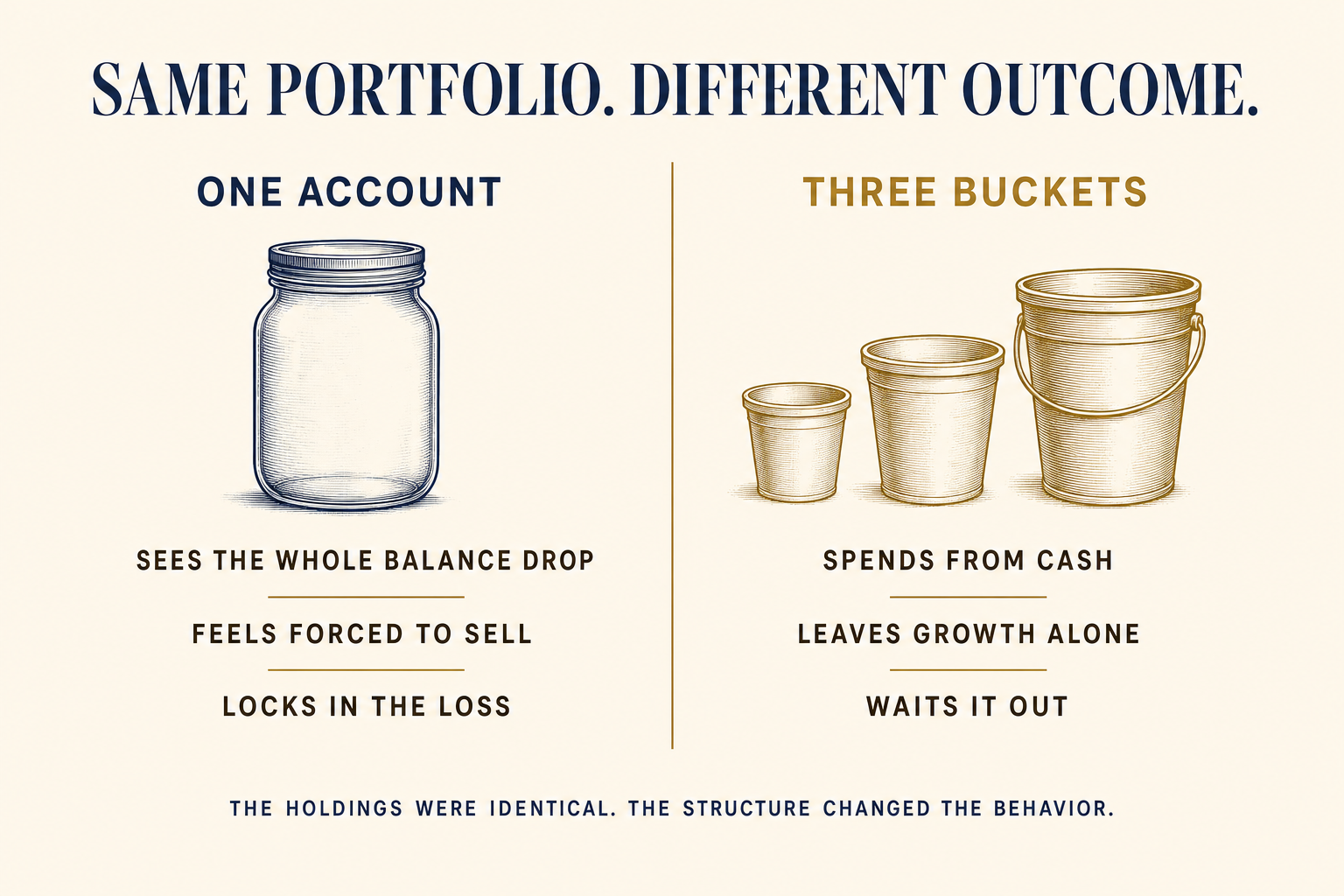
Nothing about their investments differed. Everything about their behavior did. And behavior is where retirement outcomes are actually won or lost.
Mental accounting, used on purpose
So yes — bucket planning is mental accounting. I’ll go further: that’s the feature, not the bug.
The same quirk of the mind that makes people blow a windfall can be pointed in the other direction and used to protect them. A labeled Soon bucket of guaranteed income does something no blended portfolio can do: it tells your nervous system that the mortgage and the groceries are covered this month regardless of what the S&P 500 did. That psychological certainty is not a rounding error. It’s the thing that lets a retiree leave the growth money invested long enough to give it a chance to recover, as markets historically have — though never on a schedule anyone can promise.
This is why I keep coming back to the Now, Soon, and Later framework. A guaranteed income floor doesn’t just change your spreadsheet. It changes how you experience a down market — and that changes what you do, which finally changes your actual results. The critics measure the plan on a calm afternoon. It gets spent in a crisis.
Thomas’ Take: I don’t use buckets because they beat a rebalanced portfolio on a spreadsheet. They don’t. I use them because the spreadsheet isn’t what breaks in a bear market — the person holding it is. A plan you can actually live through beats a better plan you bail on.
When the critics are actually right
Here’s where I’ll hand the skeptics a real win: bucket planning can absolutely be done badly, and when it is, their critique lands.
The most common failure is hoarding cash. If the comfort of a labeled Now bucket tempts you into holding eight years of spending in savings, mental accounting has turned against you — that idle cash quietly loses ground to inflation, which erodes each bucket differently. A Now bucket is meant to be sized to a job, not stuffed for emotional padding.
The second failure is using “buckets” as an excuse to never rebalance, so the Later bucket drifts to whatever the market made it. And the third is paying up for an expensive, complicated product sold under the “bucket strategy” banner when a plain cash reserve and your existing accounts would do the same work for free. Buckets are a way to organize money you already have — not a thing you buy.
The structure is a behavior tool. Treat it as a performance strategy, and you’ll be disappointed. Treat it as a way to govern your own worst instincts, and it earns its place.
How to pressure-test it on your own numbers
The honest way to settle this for yourself is to stop arguing in the abstract and model it. Run your real spending, your real income floor, and a genuinely bad early market against your own plan, then watch what happens when you spend from a cash bucket versus selling stocks in the same downturn. A planning tool like ProjectionLab lets you build that scenario with your actual figures and see the difference the structure makes — or doesn’t — in your specific situation. Seeing it on your own numbers lands differently than reading someone else’s example.
Disclosure: the ProjectionLab link above is an affiliate link. If you subscribe through it, I may earn a commission at no additional cost to you. I only point to tools I’d actually sit down and use.
Key takeaways
- On pure math, bucket planning and a single rebalanced portfolio with the same mix are often identical — the critics are right about that.
- Retirement outcomes are driven less by the allocation and more by whether you hold it through a downturn. The “behavior gap” is real.
- The structure earns its keep in a crash: knowing the bills are covered by cash and guaranteed income keeps you from selling growth assets at the bottom.
- Yes, it’s mental accounting — used on purpose, to protect you from your own fear.
- It fails when it becomes an excuse to hoard cash, skip rebalancing, or buy an expensive product. Buckets organize money you have; they aren’t something you purchase.
Frequently asked questions
Do I need to open three separate accounts? No. Buckets are jobs you assign to money, not necessarily accounts at a bank. You can run them notionally inside the accounts you already have. Some people do keep the Now bucket in a separate high-yield savings account simply because seeing it helps them stay calm — that’s a valid reason, but it’s a behavioral choice, not a requirement.
Does bucket planning lower my returns? It shouldn’t, if you hold a sensible overall mix and keep the Later bucket invested. It only drags on returns if fear pushes you into far more cash than your Now bucket actually needs.
If the math is the same, why bother at all? Because the math assumes you behave perfectly, and almost no one does during a 30% decline. Bucket planning is a system for behaving well when it’s hardest to.
Bucket planning won’t win a spreadsheet contest, and I’ve never claimed it would. What it does is quieter and more valuable: it makes it possible to leave your growth money alone when every instinct is screaming at you to sell. If a spreadsheet could do that, I’d hand you a spreadsheet. It can’t — so we build the buckets instead.
This article is published by Confluence Media Group LLC, an independent publisher of educational financial content. Thomas Clark is a Series 65 Investment Advisor Representative. The information provided is for educational and informational purposes only and is not personalized financial, tax, or legal advice. Past performance does not guarantee future results. All investing involves risk, including potential loss of principal. Consult a qualified professional before making financial decisions.
Confluence Media Group LLC is a separate entity from Confluence Capital Management, the investment advisory practice through which Thomas Clark provides advisory services. Advisory services are not offered through this publishing platform.
About Thomas Clark
Thomas Clark is the founder of Confluence Media Group LLC and a Series 65 Investment Advisor Representative. He has spent nearly two decades working with families on retirement planning, with a focus on Social Security optimization, retirement income coordination, and the bucket planning approach to building a guaranteed income floor.
Thomas writes and publishes at thomasclarkadvisor.com and is the author of The Just in Case Binder — a 148-page printable family financial organizer for households who want to make sure the people they love know where everything is.
He lives in North Carolina with his family.
Subscribe to the weekly newsletter · Get the Just in Case Binder

Thomas Clark is a Series 65 licensed investment advisor and experienced trader. He specializes in investing, retirement planning, and market analysis, helping individuals build wealth and make informed financial decisions.
