
Volatility Isn’t Risk. Being a Forced Seller Is.
Volatility and risk are not the same thing — and confusing them is the costliest mistake a retirement investor can make. A trader's-eye view of why a falling market only hurts if it forces you to sell, and how to build a plan that never does.
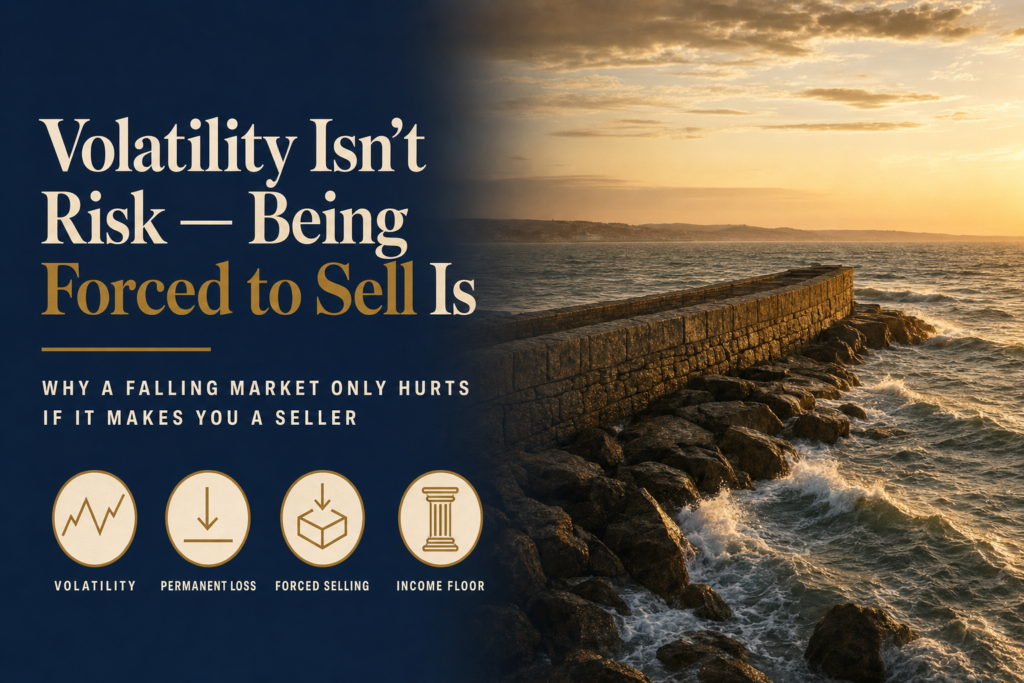
The market just closed out a losing September and walked straight into October — historically its most volatile month — with fewer and fewer stocks doing the heavy lifting. Roughly three-quarters of the S&P 500 actually fell last month, even as the index held up. You are going to read a hundred pieces this October trying to guess whether the drop finally comes.
That is the wrong question. I spent years trading for a living, and the single most useful thing the desk taught me has nothing to do with predicting the next move. It is this: volatility and risk are not the same thing. Confusing the two is the most expensive mistake a retirement investor can make — and almost everyone makes it.
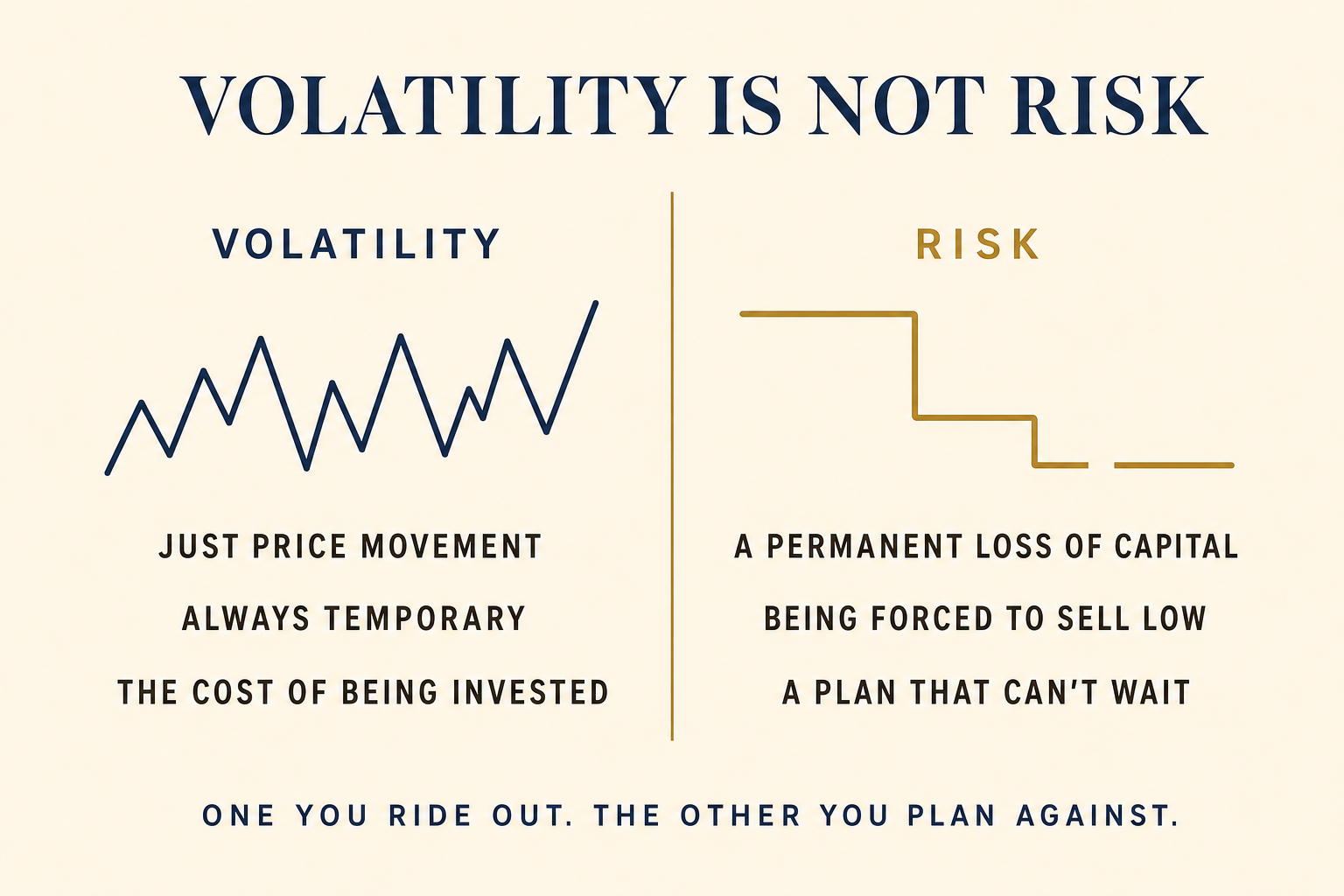
Volatility is the price chart jumping around. Risk is something much narrower, and much more dangerous. Here is the difference, and why it should decide how you build your plan.
On the desk, volatility was the raw material — not the enemy
When you trade for a living, a market that does not move is a market you cannot make a living in. Volatility is simply the measure of how much a price swings around its own average. It is motion. Noise. The day-to-day and month-to-month up-and-down that comes with owning anything whose price is set in public every day.
A jumpy market is not good or bad on its own. It is weather. Some stretches are calm, some are stormy, and October tends to be stormy — Wall Street’s “fear gauge,” the VIX, has historically drifted higher into the fall even in quiet years. None of that tells you whether you have actually lost anything.
New traders flinch at every tick. The ones who last learn to feel volatility the way a sailor feels chop: uncomfortable sometimes, worth respecting always, but not the thing that sinks the boat. The thing that sinks the boat is something else entirely.
Risk is the one that can actually sink you
Risk is not price movement. Risk is the probability of a permanent loss of capital — money that does not come back. That is a genuinely different concept from volatility, and the gap between them is where fortunes are made and lost. Every regulator who writes about this is blunt about the baseline: all investing involves risk, including the possible loss of principal. The job is not to pretend risk away. It is to know which kind you are actually facing.
A paper loss only becomes a permanent one in two ways. The first is that the thing you own is genuinely, permanently impaired — the company fails, the story was broken all along, the value does not recover. The second is far more common and almost entirely avoidable: you sell. You convert a temporary decline into a realized loss by turning your shares into cash at the bottom.
That second one is the whole game. Markets have delivered plenty of terrifying drops. Every bear market in modern U.S. history has also ended, and the recoveries more than made back the declines — by one widely cited count of the biggest drops since the Great Depression, the market was higher five years later every single time. That is history, not a promise; past recoveries do not guarantee the next one, and some took years. But it points at something important: the people who were hurt permanently in those episodes were overwhelmingly the ones who sold and locked it in. The regulators’ own investor guidance lands in the same place — the hard discipline is riding out the ups and downs rather than selling in a panic.
Thomas’ Take: In all my years trading, I cannot point to a single position that fell, recovered, and still cost me money. The losses that actually hurt were the ones I was forced to close — a margin call, cash I suddenly needed, a trade I could not hold long enough to be right about. The chart never beat me. The timing of my exit did.
In retirement, “risk” has a specific name: the forced seller
Here is where this stops being a trading-desk abstraction and starts mattering for anyone near or in retirement. The exact same 25% drop is a completely different event for two different people.
For a 40-year-old still contributing every payday, a 25% drop is a sale. They keep buying at lower prices, and the volatility quietly works for them. Being right about the market’s direction was never the point; surviving long enough for the math to work was.
For a retiree pulling monthly income out of that same account, the identical drop can become permanent — because they are selling shares every month to cover groceries, and selling into a decline locks in losses the portfolio may never recover from. That is sequence-of-returns risk, and it is the quiet reason two retirees with identical average returns can end up in completely different places. The order the returns arrive in matters enormously when you are withdrawing.
Notice what the retiree’s real enemy was. It was never volatility. It was being a forced seller at the wrong moment.
The same market, two different outcomes
Consider a hypothetical case — the numbers are illustrative, not a projection. Ellen, 68, just retired near Raleigh. She has $600,000 invested and needs about $3,000 a month on top of her Social Security.
In version one, it is all in a single market portfolio. October turns ugly, the account falls 25% to $450,000, and Ellen still needs her $3,000 every month — so she sells shares into the decline. Every withdrawal in a down market is a forced sale, crystallizing losses at the worst possible time. The drop did real, lasting damage.
In version two, Ellen holds about two years of spending — roughly $72,000 — in a cash-and-short-term-bond “Now” bucket, with Social Security covering part of her baseline. When the market drops the same 25%, she simply spends from the Now bucket and does not touch the invested money. Same market. Same portfolio. Same decline. But Ellen is not a forced seller — so for her, the 25% is just volatility she waits out. The structure converted a risk back into mere weather. (How much to hold there is its own worthwhile question.)
How to make volatility stop being your risk
You do not beat volatility by predicting it. Almost nobody does it reliably, and the people selling you that certainty this October are precisely the ones to tune out. You beat it by building a plan that is never forced to sell at the bottom. A few principles, straight from the desk and translated for a retirement account:
Size your cash buffer to your withdrawals, not your anxiety. Two-ish years of spending in the Now bucket means a bad market is a year you skip selling — not a year you sell low. This is the whole job of the Now, Soon, Later framework: match each dollar to when you will actually need it.
Build a guaranteed income floor for the essentials. When Social Security, a pension, or an income-focused instrument covers the bills that simply have to be paid, a falling market stops threatening your groceries. When your grocery money does not depend on the S&P 500, you make calmer, better decisions about everything else.
Keep only long-runway money in the market. The growth bucket’s entire job is money you will not touch for years — which is exactly the money that can ride out a storm without you having to flinch.
Rebalance on a rule, not a feeling. A simple rebalancing rule quietly does the thing forced sellers cannot: it trims what has held up and buys what has fallen. Deciding those rules before you retire — and before the storm — is half the battle. Traders write the exit before the entry for one reason: everyone makes worse decisions when the screen is red.
What October is really asking you
October will be volatile. So will plenty of months after it — that is not a flaw in the system, it is the admission price for returns that outrun inflation over time. We have 80 years of data telling us the chop is normal and the predictions are mostly noise.
The risk is not the drop. The risk is a plan that turns an ordinary market decline into a permanent loss by making you sell at the bottom. Volatility is what you feel. Risk is what you realize. Build the plan so you never have to realize it, and you can let the market do what markets do — without it doing anything lasting to you.
If you want to see whether your own plan could sit through a rough stretch without forcing a sale, that is worth modeling before you ever need to know. A planning tool like ProjectionLab lets you run your actual spending, your cash buffer, and your time horizon against bad-sequence scenarios and watch what holds up. Seeing it on your own numbers lands differently than reading someone else’s example.
Disclosure: the ProjectionLab link above is an affiliate link. If you subscribe through it, I may earn a commission at no additional cost to you. I only point to tools I’d actually sit down and use.
This article is published by Confluence Media Group LLC, an independent publisher of educational financial content. Thomas Clark is a Series 65 Investment Advisor Representative. The information provided is for educational and informational purposes only and is not personalized financial, tax, or legal advice. Past performance does not guarantee future results. All investing involves risk, including potential loss of principal. Consult a qualified professional before making financial decisions.
Confluence Media Group LLC is a separate entity from Confluence Capital Management, the investment advisory practice through which Thomas Clark provides advisory services. Advisory services are not offered through this publishing platform.
About Thomas Clark
Thomas Clark is the founder of Confluence Media Group LLC and a Series 65 Investment Advisor Representative. He has spent nearly two decades working with families on retirement planning, with a focus on Social Security optimization, retirement income coordination, and the bucket planning approach to building a guaranteed income floor.
Thomas writes and publishes at thomasclarkadvisor.com and is the author of The Just in Case Binder — a 148-page printable family financial organizer for households who want to make sure the people they love know where everything is.
He lives in North Carolina with his family.
Subscribe to the weekly newsletter · Get the Just in Case Binder

Thomas Clark is a Series 65 licensed investment advisor and experienced trader. He specializes in investing, retirement planning, and market analysis, helping individuals build wealth and make informed financial decisions.
