
Being Right About the Market Won’t Make You Money
Being right about the market and making money are two different skills. Here's why prediction is the wrong job, and what position sizing, exits, and discipline actually do for your results.

A month ago, the crowd was certain rate cuts were coming. The Federal Reserve hiked instead — and stocks climbed anyway. If you had bet your account on the forecast, or on the “obvious” reaction to it, there’s a good chance you lost money while being right.
That’s the part almost nobody tells you about markets. Predicting what happens next is not the job. It feels like the job. It’s what fills the financial news and gets argued about at dinner. But being right about the news and making money are two completely different skills, and confusing them is the most expensive mistake I see traders and investors make.
I spent years trading actively before I ever sat across a table from a family planning their retirement. The most useful thing that experience taught me had nothing to do with picking direction. It was this: your results come from how you size and manage a position, not from how good your call was.
The forecast trap
Here’s the uncomfortable math. A trader who calls direction correctly 60% of the time — which would be exceptional — is still wrong four times out of ten. If those four wrong trades are large and the six right trades are small, that “great” forecaster loses money anyway. The scoreboard doesn’t care how smart the thesis was.
The last few weeks are a live example. Not long ago, most of the market expected the Fed’s next move to be a rate cut, and a hike looked like a long shot. Instead the Fed hiked — and futures now lean toward still more tightening ahead. Traders who flipped their view late paid for the whiplash. And the ones who correctly called “higher for longer” months ago still had to watch equities rise into the decision — the opposite of the textbook reaction. Being early, being right, and being paid are three separate things.
Markets are not a trivia contest. You are not graded on whether your macro view was correct. You are graded on the dollars in your account at the end of the year. Those two scorecards diverge far more often than the forecasting industry wants you to believe.
What actually moves your account
If prediction isn’t the job, what is? Risk management. Specifically, three things you fully control while the market controls everything you can’t:
Position size. How much you put on a single idea decides how much a single mistake can cost you. A right-sized position lets you be wrong and live to trade the next one. An oversized position turns one bad call into a hole you spend months climbing out of.
Your exit when you’re wrong. Deciding in advance where a trade is broken — and honoring that line — is what separates a small loss from a catastrophic one. The plan is worthless the moment you renegotiate it because you’re sure the market will come back.
Consistency. Doing the same disciplined thing across dozens of decisions is what lets probability actually work in your favor. One heroic call proves nothing. A repeatable process is the entire edge.
Notice that none of this requires you to know what the Fed will do next. It requires you to accept that you don’t — and to build a process that survives being wrong. That’s also why I keep a trading journal that measures process instead of predictions.
The best traders are the best losers
Thomas’ Take: Amateurs obsess over their win rate. Professionals obsess over the size of their losers. Once you understand that one small loss is just the cost of doing business — and one large loss can end the business — you start playing the game the way it’s actually scored. The whole point is to still be standing after you’re wrong, because you will be wrong, often.
Cutting a loss quickly feels like admitting a mistake, and most people would rather be right than be profitable. So they hold the loser, hoping it recovers, and let it grow until it does real damage. Meanwhile they take profits on winners early — locking in small gains to feel the relief of a win. Small winners and big losers is the exact recipe for going broke slowly, and it comes straight from the need to be right.
The professional flips it. Risk a fixed, small slice of capital on any single idea, cut it fast when it’s wrong, and give the winners room to run. That’s it. It’s not complicated, but it’s psychologically brutal, which is why so few people do it. The mechanics of active trading — leverage, margin, the speed of it all — punish the undisciplined ruthlessly, a reality the regulators spell out plainly for anyone considering day trading.
A tale of two traders
Consider a hypothetical case. Marcus and Dana, both 45, both read the same research and reach the same conclusion about where a stock is headed. Their call turns out to be correct. But they don’t get the same result — not even close.
Marcus is so confident he puts 40% of his account into the position and sets no exit plan. Dana takes the identical trade but risks only 2% of her account and decides in advance where she’ll get out if she’s wrong. Then the stock does what stocks usually do before they prove you right: it drops first. Marcus, staring at a loss large enough to threaten his whole account, panics and sells near the bottom. Dana’s small position rides through the dip untouched and captures the move when it finally comes.
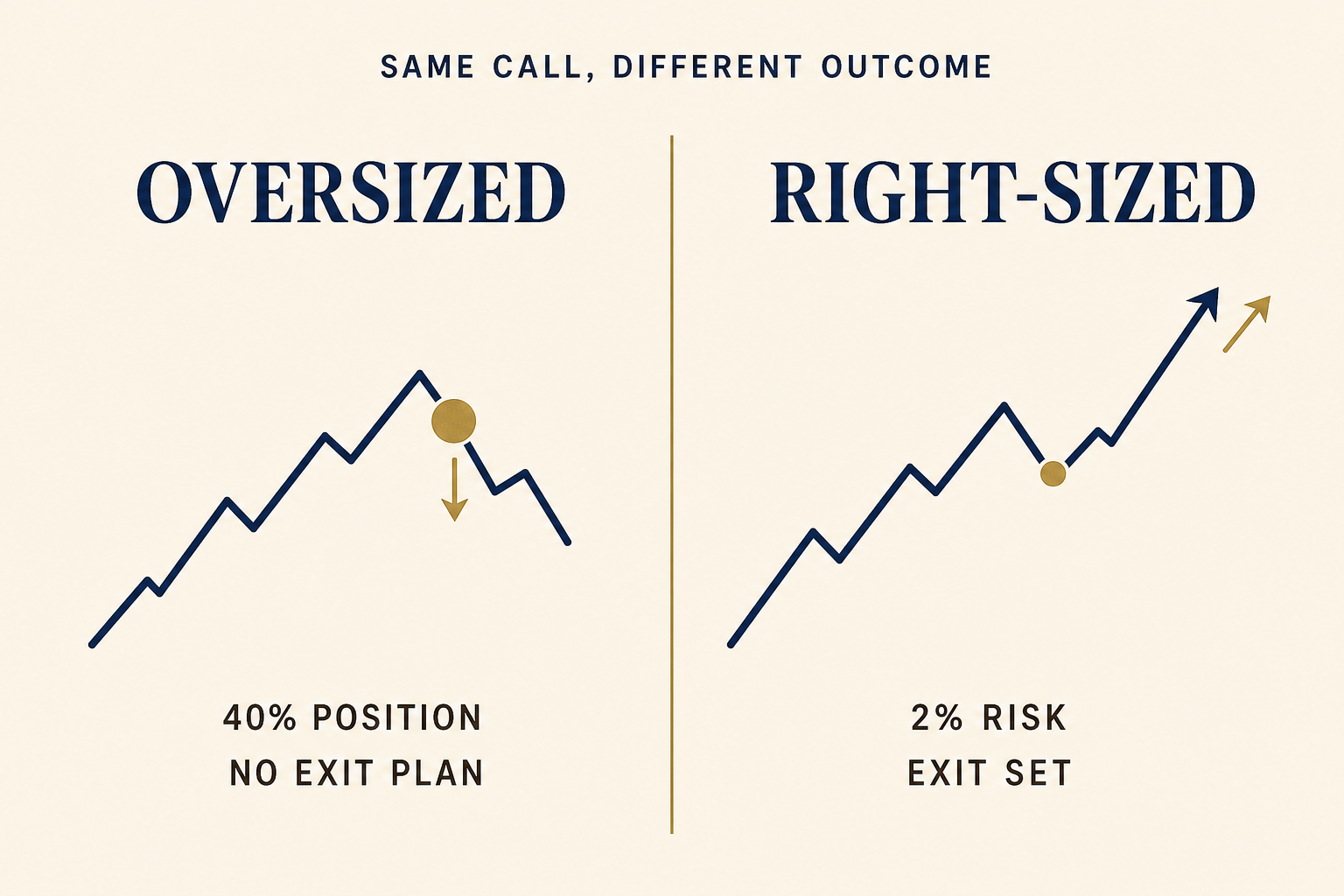
Same research. Same correct call. Opposite outcomes. The difference was never the forecast — it was position size and a predefined exit. This is the same tension I wrote about in why most traders lose money: the account rarely dies from bad analysis. It dies from good analysis carried by a position too big to survive being early.
What this means if you never place a trade
Most readers here aren’t day traders — you’re planning a retirement. The lesson transfers directly, and it’s the foundation of how I think about bucket planning. You build Now, Soon, and Later buckets precisely because you cannot reliably predict the market’s direction or timing.
The Now bucket holds near-term spending in cash so a bad year in stocks doesn’t force you to sell at the worst moment. The Soon bucket builds a guaranteed income floor from sources like Social Security, pensions, and income-focused annuities — income that doesn’t depend on being right about markets at all. The Later bucket takes market risk on purpose, with money you won’t touch for years, sized so a downturn is survivable rather than ruinous. It’s position sizing and predefined exits, applied to a thirty-year time horizon instead of a thirty-minute one.
That’s also why trading and investing are two different jobs, and why the same person needs different rules for each. But underneath both sits one idea: match the size of any risk to what you can afford to be wrong about. If you want a formal way to think about that, start with the gap between your risk tolerance and your risk capacity — how much volatility you can stomach versus how much your plan can actually absorb.
Whether you’re managing a single trade or a three-decade retirement, the principle is identical. Don’t build anything on a prediction. Build it to survive the prediction being wrong — because sooner or later, it will be.
Key takeaways
- Being right about the market and making money are different skills. A correct forecast carried by a reckless position still loses.
- The variables you control — position size, a predefined exit, and consistency — determine your results far more than the accuracy of your call.
- Small winners paired with big losers is the classic path to going broke. Cut losses fast; let winners run.
- The same discipline underpins bucket planning: size every risk to what your plan can afford to be wrong about.
Frequently asked questions
Isn’t research still worth doing if forecasts don’t pay?
Yes — research improves the quality of your decisions, and over many trades a genuine edge shows up. The point isn’t that analysis is useless; it’s that analysis without risk management can’t protect you, and risk management without a perfect forecast still can. Securities regulators publish a great deal on managing investment risk, and the recurring theme is the same one: control what you can, and don’t count on predicting the rest (see the SEC’s investor bulletins).
How much should I risk on a single trade?
There’s no universal number, and this isn’t a recommendation for your situation — but many disciplined active traders cap the risk on any one idea at a small, fixed percentage of their capital specifically so that no single loss can do lasting damage. The exact figure matters less than having a firm limit and honoring it.
This article is published by Confluence Media Group LLC, an independent publisher of educational financial content. Thomas Clark is a Series 65 Investment Advisor Representative. The information provided is for educational and informational purposes only and is not personalized financial, tax, or legal advice. Past performance does not guarantee future results. All investing involves risk, including potential loss of principal. Consult a qualified professional before making financial decisions.
Confluence Media Group LLC is a separate entity from Confluence Capital Management, the investment advisory practice through which Thomas Clark provides advisory services. Advisory services are not offered through this publishing platform.
About Thomas Clark
Thomas Clark is the founder of Confluence Media Group LLC and a Series 65 Investment Advisor Representative. He has spent nearly two decades working with families on retirement planning, with a focus on Social Security optimization, retirement income coordination, and the bucket planning approach to building a guaranteed income floor.
Thomas writes and publishes at thomasclarkadvisor.com and is the author of The Just in Case Binder — a 148-page printable family financial organizer for households who want to make sure the people they love know where everything is.
He lives in North Carolina with his family.
Subscribe to the weekly newsletter · Get the Just in Case Binder

Thomas Clark is a Series 65 licensed investment advisor and experienced trader. He specializes in investing, retirement planning, and market analysis, helping individuals build wealth and make informed financial decisions.
