
The Fed Hiked Rates. Stocks Rose Anyway. Here’s Why.
The Fed raised interest rates for the first time in three years — and stocks rallied anyway. Here's why markets trade expectations, not headlines, and what that means for how you handle a Fed day.
On Wednesday, the Federal Reserve did something it hadn’t done in three years: it raised interest rates. The target range moved up a quarter point, to 3.75%–4.00%, on a unanimous vote. The textbook says higher rates are supposed to pull stocks down.
Then the market went the other way. By Monday the S&P 500 closed near 7,765, up about 1.5% on the day and back within striking distance of its record high.
If that combination feels backwards, it isn’t. It’s one of the most dependable lessons the market teaches — and once it clicks, you stop getting whipsawed by headlines you could have safely ignored. I learned it at a trading desk years before I ever built a retirement plan around it.
What Actually Happened
The Federal Open Market Committee raised its benchmark rate by a quarter of a percentage point and, in its official statement, signaled that borrowing costs could climb further. It was the first hike in three years, and the vote was unanimous. The Committee’s reasoning was plain: inflation “remains elevated,” and the economy is expanding at a solid pace, so it wanted to support a timelier return to its 2% inflation target.
In other words, this wasn’t a rate hike to fight a fire. It was a hike into strength — a resilient economy, firm consumer spending, and prices that have stayed stickier than anyone wanted.
And the market’s response? A rally. Instead of selling off, stocks pushed higher, led by technology and artificial-intelligence names. Oil prices slipped, Treasury yields eased back, and August retail sales had already come in strong. The “bad news” of higher rates was swamped by everything else going right.
Markets Trade Expectations, Not Events
Here’s the piece most headlines miss. By the time the Fed actually moves, the decision has been debated, forecast, and bet on for weeks. Interest-rate futures had this hike largely accounted for long before the meeting. A move everyone sees coming is already baked into prices before the gavel comes down.
So what actually moves a market on decision day? The surprise — the gap between what happened and what was expected. When there’s no surprise, there’s not much left to react to, and the market goes back to trading everything else: earnings, oil, the outlook for next quarter.
Traders have an old name for this: “buy the rumor, sell the news.” The price does its real work during the rumor phase — the weeks of speculation and positioning — not at the announcement. By the time the news is official, it’s usually old information dressed up as a fresh event.
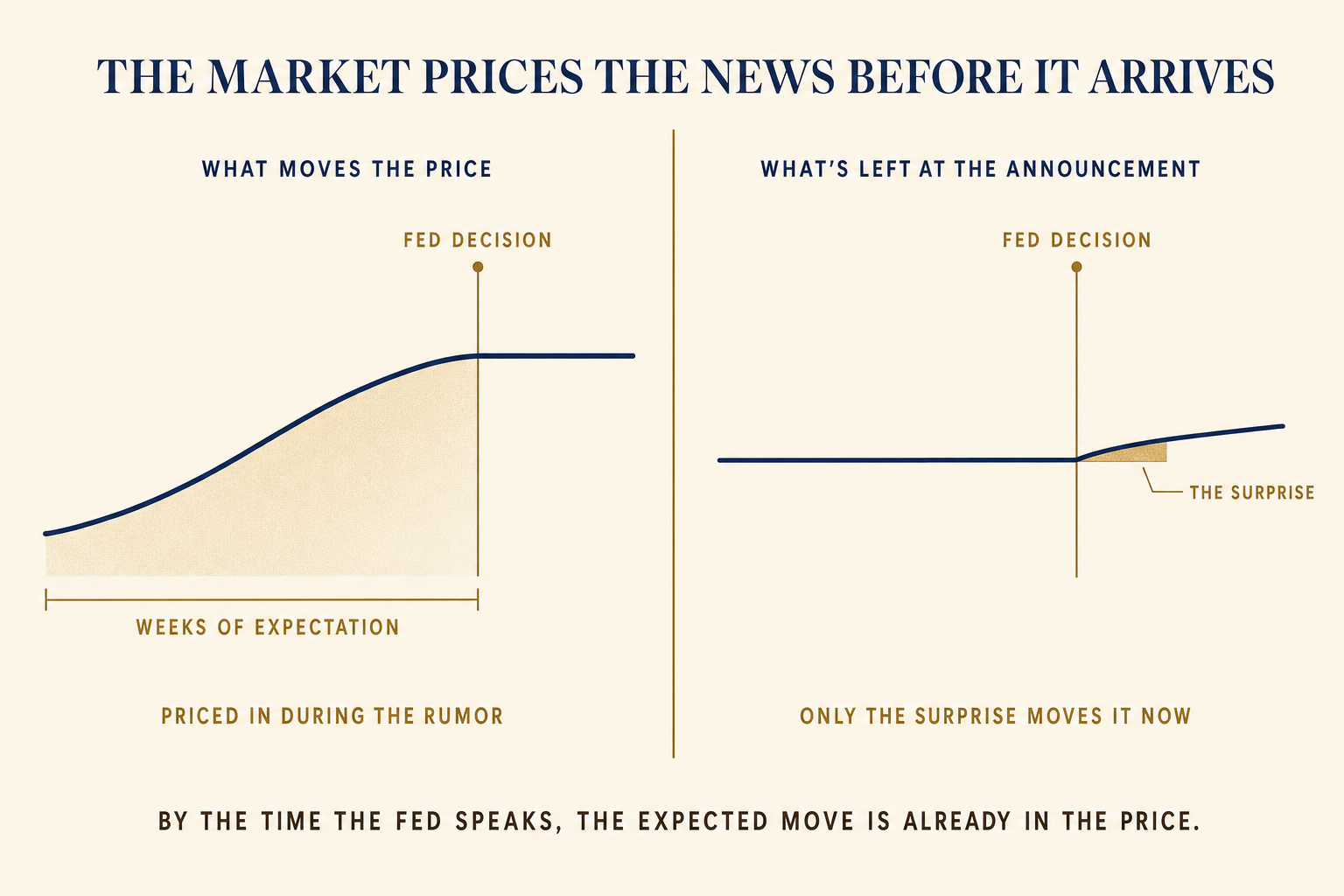
This is why a rate hike and a rising market are not a contradiction. The hike was expected, so it was already in the price. The rally came from the things that weren’t fully priced — cooling oil, steadier yields, and a fresh wave of enthusiasm for AI stocks.
The Reaction Tells You More Than the Headline
If you take one trading lesson into your investing life, make it this: the headline is the least useful part of any market event. What matters is how the market reacts to it.
When a market shrugs off news that “should” have hurt it — or rallies on it — that isn’t luck. It’s information about how investors are positioned and what they already expected. A market that climbs on a rate hike is quietly telling you the hike was no surprise, and that something else matters more right now. It’s the same reason a scary calendar statistic — like September’s reputation as the market’s worst month — tells you far less than how the market is actually behaving in front of you.
Thomas’ Take: Amateurs trade the news. Professionals trade the distance between the news and what everyone already assumed. You don’t have to trade at all — but if you’re going to react to a headline, at least react to the right one. Most of the time, the right one tells you to sit still.
What This Looks Like From the Kitchen Table
Consider a hypothetical case: Ron, 66, retired last year in Ohio. In the days before the Fed meeting, he watched the coverage pile up — “rate hike ahead,” “markets on edge” — and the drumbeat got to him. The Friday before the announcement, he was one click away from moving a big slice of his portfolio to cash to “get ahead of it.”
Had he done it, Ron would have sold into the very rally he was afraid of missing. He’d have triggered taxes on his gains, and then faced the harder question every market-timer eventually meets: when, exactly, do you buy back in? The honest answer is usually “after it has already gone up.”
Ron’s mistake wasn’t a bad forecast. It was reacting to an event everyone already saw coming. That’s the losing game — you’re not front-running the news, you’re chasing your own anxiety.
The retirees who slept soundly through the Fed meeting weren’t better forecasters. They simply had a plan that didn’t require a forecast. This is where bucket planning earns its keep. When your essential expenses are already covered by guaranteed income — Social Security, a pension, an income-focused annuity in your Soon bucket — and you’re holding a couple of years of cash in your Now bucket, the Later bucket is free to do whatever the market does this week. You’re not spending it this week, so its Wednesday-afternoon price doesn’t get to run your life.
How to Treat a Fed Day
You don’t need a view on the next rate decision to have a sound plan. A few principles hold up better than any prediction:
- Don’t trade the meeting. The expected part is already priced, and the surprise part is, by definition, the part you can’t predict. That’s a bad hand to bet on.
- Know what you own and why. If your income floor covers the essentials, a Fed announcement is a spectator sport, not a call to action. That’s the same reason a scary jobs number or a rough month doesn’t have to change anything — a point worth keeping in mind the next time the data looks alarming.
- Separate two questions people constantly blur: “What will the Fed do?” and “What should I do?” The first is a guess. The second should already be answered by your plan, long before the meeting starts.
- If you’re still building wealth, the same discipline applies in reverse: a rate headline is not a reason to pause steady, scheduled investing. Reacting to macro noise is market timing by another name, and it’s a game even the professionals rarely win.
Fed decisions matter enormously for the economy. They matter far less for the person who has already built a plan that doesn’t hinge on getting the next one right — which is exactly why the smart response to a Fed week is often to do nothing at all.
The Bottom Line
The market’s entire job is to price the future before it arrives. That’s what it was doing in the weeks before the Fed spoke, and it’s what it’ll be doing before the next meeting too. Your job isn’t to out-guess a machine built to discount the future faster than you can read the headline — it’s to build a plan sturdy enough that you don’t have to.
Get that right, and a Fed day becomes what it should be: a headline you read with your morning coffee, not a reason to touch a single dollar. Last week handed us the cleanest possible reminder — the Fed hiked, stocks rose, and the investors who did nothing did exactly the right thing.
Key Takeaways
- A widely expected Fed move is usually priced in before it’s announced. Markets react to surprises, not scheduled events.
- Stocks rising on a rate hike means the hike was expected — and other forces (oil, yields, sentiment) mattered more that day.
- “Buy the rumor, sell the news” describes how prices adjust during the speculation phase, not at the announcement.
- Reacting to a predictable event is chasing anxiety, not acting on new information.
- A guaranteed income floor plus a cash cushion turns Fed day into a spectator event.
Frequently Asked Questions
Doesn’t raising interest rates always hurt stocks?
Not reliably. Whether a hike weighs on stocks depends heavily on whether the move was expected and why the Fed is acting. A hike that markets fully anticipated, in an economy the Fed considers strong, can easily coincide with rising stocks — as it did this past week. The link between rates and markets is real, but it runs through expectations, not mechanics.
Should I move money around before a Fed meeting?
This is educational information, not personalized advice, so take it as a general principle: trying to trade around a scheduled, heavily anticipated announcement is a form of market timing, and even professionals struggle to do it consistently. A plan built around your income needs rather than the Fed’s calendar tends to make the question disappear. If a single meeting could derail your retirement, the issue usually isn’t the meeting — it’s the plan.
This article is published by Confluence Media Group LLC, an independent publisher of educational financial content. Thomas Clark is a Series 65 Investment Advisor Representative. The information provided is for educational and informational purposes only and is not personalized financial, tax, or legal advice. Past performance does not guarantee future results. All investing involves risk, including potential loss of principal. Consult a qualified professional before making financial decisions.
Confluence Media Group LLC is a separate entity from Confluence Capital Management, the investment advisory practice through which Thomas Clark provides advisory services. Advisory services are not offered through this publishing platform.
About Thomas Clark
Thomas Clark is the founder of Confluence Media Group LLC and a Series 65 Investment Advisor Representative. He has spent nearly two decades working with families on retirement planning, with a focus on Social Security optimization, retirement income coordination, and the bucket planning approach to building a guaranteed income floor.
Thomas writes and publishes at thomasclarkadvisor.com and is the author of The Just in Case Binder — a 148-page printable family financial organizer for households who want to make sure the people they love know where everything is.
He lives in North Carolina with his family.
Subscribe to the weekly newsletter · Get the Just in Case Binder

Thomas Clark is a Series 65 licensed investment advisor and experienced trader. He specializes in investing, retirement planning, and market analysis, helping individuals build wealth and make informed financial decisions.
