
A Strong Jobs Report Is ‘Bad News.’ Not for Retirees.
August's jobs report beat expectations by roughly threefold, and Wall Street called the strong number "bad news." Here's why a retiree should read a healthy labor market — and higher-for-longer rates — the opposite way.

On Friday, the government reported that American employers added 162,000 jobs in August — roughly three times what forecasters expected. The unemployment rate held at 4.1%. Wages kept climbing. By any plain reading, that describes a healthy labor market.
Wall Street’s response? Stocks slipped, and a wave of headlines framed the strong report as a problem. Too hot. Complicates the Fed. Bad news for rate cuts.
If you’re planning for retirement or already living in it, I want you to notice how strange that is — and then I want you to stop reading your own economy through a trader’s dictionary. The market is closed today for Labor Day, which gives us a quiet morning to do exactly that.
The report itself, in plain numbers
The Bureau of Labor Statistics said nonfarm payrolls rose by 162,000 in August, against a consensus estimate closer to 53,000. The unemployment rate stayed at 4.1%. Average hourly earnings rose 0.3% for the month and are up about 3.1% over the past year — still running a step ahead of consumer prices. Revisions to the prior two months were modestly positive.
That’s not an overheating boom, and it’s not a stall. It’s a labor market cooler than the frenzy of a few years ago but still putting people to work and still paying them a little more each year. Boring, in the best sense of the word.
Why a good number gets called “bad”
Here’s the machinery behind those headlines. For most of the past two years, markets have wanted the Federal Reserve to cut interest rates, because lower rates tend to lift stock and bond prices. So traders started rooting for weaker economic data — weak data hands the Fed a reason to cut. Flip that around and a strong jobs report reduces the odds of a cut, which is why a healthy number can knock stocks down for a day.
The Fed meets again on September 16 and 17, and Friday’s report made a September cut less likely. The current target range sits at 3.50% to 3.75%, and you can watch the schedule yourself on the Federal Reserve’s calendar. That is the entire story behind “good news is bad news.” It’s shorthand for good for the economy, inconvenient for people betting on the next rate cut.
I’ve written before that you don’t have to watch the Fed the way a day trader does. This is that same idea walking in through a different door. The market has already spent months guessing what the Fed will do; by the time the decision is announced, most of it is already sitting in prices. Trading around it after the fact is mainly how amateurs hand their money to professionals.
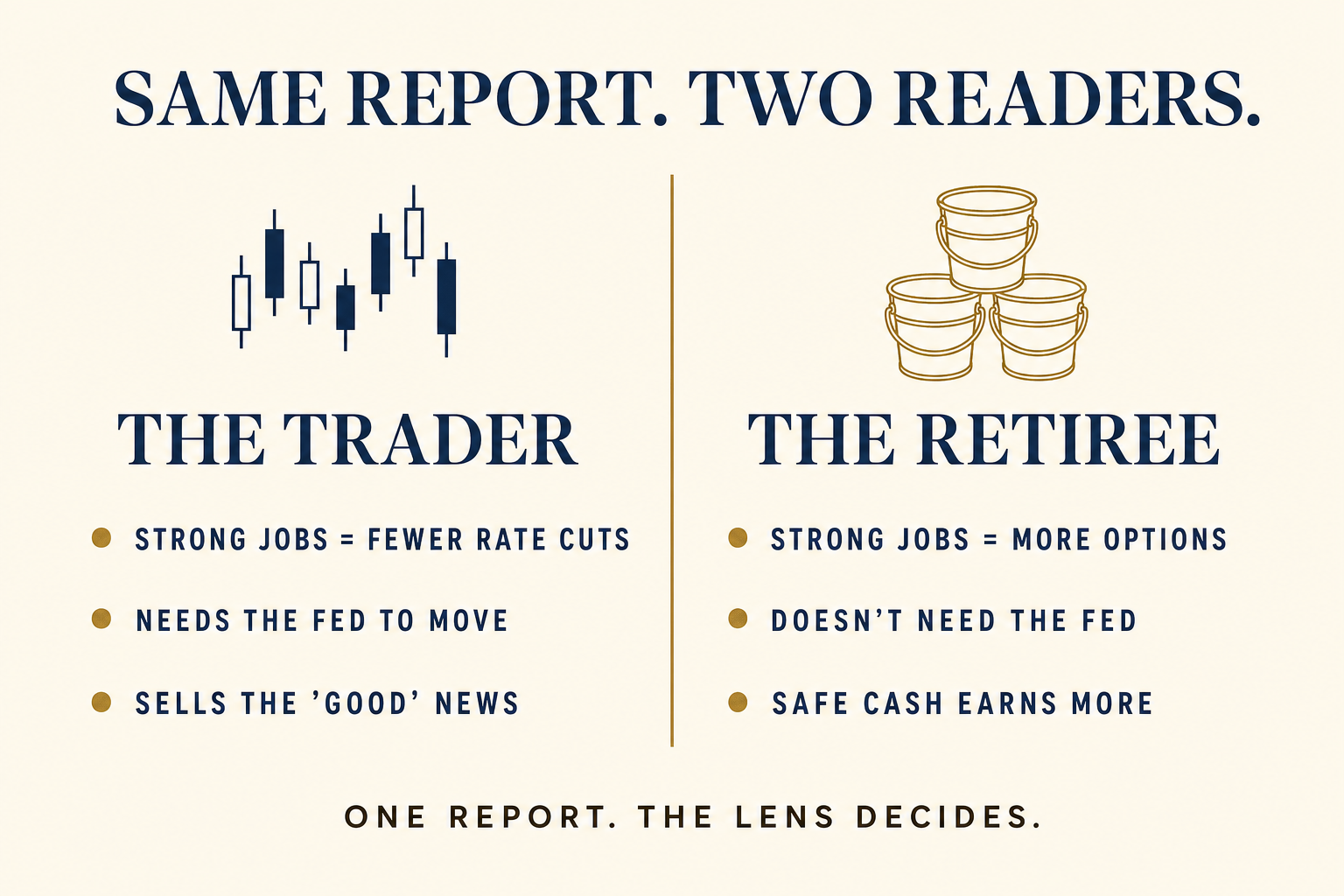
The same report, read from a retiree’s chair
Now set the trader’s dictionary down and read Friday’s report as someone five years from retirement, or five years into it. Three things stand out — and not one of them is bad.
First, a still-solid job market protects your options. A lot of the Social Security claiming strategy I write about depends on being able to work a little longer, or part-time, to bridge the years before you switch your benefit on. When employers are still hiring, that bridge is actually there. A 4.1% unemployment rate is the backdrop that turns “work two more years and delay your benefit” from wishful thinking into a real choice.
Second, wages rising faster than prices quietly helps the thing that funds retirement: income that keeps up. Social Security’s annual cost-of-living adjustment is tied to inflation — the SSA publishes exactly how — and your household’s purchasing power depends on whether paychecks, yours or a spouse’s part-time work, keep pace with the checkout line. Earnings up about 3.1% against slower price growth means the average worker’s dollar is holding its ground rather than quietly losing it.
Third — and almost nobody says this out loud — “fewer rate cuts” is a raise for the money you keep safe. The cash in your Now bucket, the short Treasury bills, the high-yield savings that covers this year’s groceries: those instruments pay you more when rates stay higher for longer. A retiree with a real cash cushion sits on the opposite side of that trade from the leveraged trader who needs cuts to survive. What reads as “bad news” on the ticker is a pay bump for your safe money. I made the fuller case for that in why your savings rate beats your returns.
Thomas’ Take: The financial press optimizes its coverage for the people who make money from motion — traders, market-makers, anyone who needs you to do something today. Retirement runs on the opposite engine. A good plan is built so a strong economy is good for you and a weak economy is survivable, which means a single jobs report on the first Friday of the month is a data point, not a decision. When a headline makes you want to move money, that’s usually the headline doing its job — not your plan telling you something.
A hypothetical, to make it concrete
Consider a hypothetical case: Robert, 66, retired last year from a logistics job outside Phoenix. He keeps about two years of spending in cash and short-term Treasuries (his Now bucket), a guaranteed income floor from Social Security plus a small pension (his Soon bucket), and the rest invested for growth he won’t touch for years (his Later bucket). The figures here are illustrative, not a recommendation or a forecast.
On Friday, Robert saw the same “strong jobs, stocks slip, rate cut in doubt” headlines you did. Here’s what actually changed for him: nothing he needs to act on. His grocery money does not care what the Fed decides on September 16. His safe cash is earning a little more, not less. And the growth he won’t spend for a decade has ten years to shrug off a slow news week — the very sequence-of-returns risk that punishes reactive selling is the risk his bucket structure was built to absorb. Robert’s plan already answered the question the headline was trying to make him ask.
What to do before Tuesday’s open
Almost nothing — and that restraint is the skill, not a cop-out. If you want a productive use of a market holiday, it isn’t repositioning ahead of the Fed. It’s confirming the machine is built:
- Check that your Now bucket still holds one to two years of essential spending in cash and short-term instruments, so you are never a forced seller in a down week.
- Know your Social Security claiming plan well enough that a jobs report can’t tempt you to change it.
- Write down, on paper, what would have to happen in your life — not in the market — for you to change the plan. Then let this week’s headlines fail that test on their own.
That’s the whole to-do list. The exchanges reopen Tuesday, everyone will re-litigate the September 16 meeting, and you’ll already have your answer: read correctly, a strong jobs report was good news.
Key takeaways
- August payrolls rose 162,000 — roughly triple expectations — and unemployment held at 4.1%; Wall Street called the strong report “bad” only because it lowered the odds of a September rate cut.
- “Good news is bad news” is a trader’s translation, built for people who profit from the Fed’s next move — not a framework for a retirement plan.
- A healthy labor market protects your ability to bridge to a later Social Security claim, and wage growth ahead of inflation supports your purchasing power.
- Higher-for-longer rates are a raise for the safe cash in your Now bucket, not a loss.
- The productive move on a market holiday is confirming your plan is built — not repositioning ahead of a Fed meeting.
The exchanges are dark today, and your net worth is exactly where Friday left it. That’s worth sitting with. The strongest retirement plans spend most of their time doing nothing on purpose — and the surest sign yours is working is that a “too good” jobs report and a Fed meeting nine days out feel like someone else’s emergency. Because they are.
This article is published by Confluence Media Group LLC, an independent publisher of educational financial content. Thomas Clark is a Series 65 Investment Advisor Representative. The information provided is for educational and informational purposes only and is not personalized financial, tax, or legal advice. Past performance does not guarantee future results. All investing involves risk, including potential loss of principal. Consult a qualified professional before making financial decisions.
Confluence Media Group LLC is a separate entity from Confluence Capital Management, the investment advisory practice through which Thomas Clark provides advisory services. Advisory services are not offered through this publishing platform.
About Thomas Clark
Thomas Clark is the founder of Confluence Media Group LLC and a Series 65 Investment Advisor Representative. He has spent nearly two decades working with families on retirement planning, with a focus on Social Security optimization, retirement income coordination, and the bucket planning approach to building a guaranteed income floor.
Thomas writes and publishes at thomasclarkadvisor.com and is the author of The Just in Case Binder — a 148-page printable family financial organizer for households who want to make sure the people they love know where everything is.
He lives in North Carolina with his family.
Subscribe to the weekly newsletter · Get the Just in Case Binder

Thomas Clark is a Series 65 licensed investment advisor and experienced trader. He specializes in investing, retirement planning, and market analysis, helping individuals build wealth and make informed financial decisions.
