
Everyone’s Watching Jackson Hole. You Don’t Have To.
The Fed meets at Jackson Hole this week and the whole market is hanging on every word. Here's the retirement-planning reason a well-built plan lets you look away — and what to build so a Fed meeting becomes a headline instead of a verdict.

The most-watched event in finance this week isn’t an earnings report or a jobs number. It’s a speech. The Federal Reserve is holding its annual symposium in Jackson Hole, Wyoming, and Friday morning’s headline remarks from the Fed Chair will be dissected word by word by every trader, economist, and financial pundit in the country.
If you’re retired, or close to it, here’s my contrarian take for the weekend: you have my permission to skip it.
I don’t mean stick your head in the sand. I mean something more specific, and more freeing: a retirement plan built the right way makes the Fed’s next move interesting instead of urgent. Let me explain the difference, because it’s the whole game.
What’s actually happening this week
The Jackson Hole Economic Symposium, hosted by the Kansas City Fed, runs from August 21 to 23. This year’s theme is “Labor Markets in Transition.” The event always ends with a closely watched address from the Fed Chair, and this year the stakes feel high because the market has already made up its mind about what comes next.
Futures traders are currently pricing in roughly an 85% chance that the Fed cuts interest rates at its September meeting, and they see a strong chance of at least one more cut before year-end. That expectation has helped push stocks near record territory — the S&P 500 and Nasdaq just logged a third straight weekly gain. Underneath the optimism, the picture is mixed: inflation readings have cooled, but retail sales contracted and consumer sentiment slipped.
So the whole financial world is leaning in, waiting to see whether Friday’s speech confirms the rate cut everyone’s betting on. That’s a perfectly rational thing for a trader to do. It’s a much less rational thing for a retiree to build a weekend around.
Watching the Fed used to be your job. Now it isn’t.
I spent years trading actively, and I can tell you exactly why traders care so much about a single speech. When you’re managing positions, the next macro headline can move your profit and loss in minutes. Reading the Fed, front-running the reaction, sizing your risk around it — that’s not anxiety, that’s the job. You watch the tape because your outcome is tied to the very next print.
Retirement is a deliberate exit from that job. The goal of a retirement income plan is to disconnect your monthly reality from the next macro headline — to make it so that whether the Fed cuts 25 basis points in September or waits until October has almost nothing to do with whether your bills get paid.
Most financial commentary this week will do the opposite. It will tell you how to “position for the cut” — which sectors to rotate into, which bonds to buy, how to play the move. For someone still in the accumulation-and-trading seat, fine. For someone who has retired from that seat, it’s a quiet invitation to pick the job back up. Don’t take it.
The Fed controls the short end. Your plan controls the rest.
Here’s the part that gets lost in the noise. The Fed directly sets very short-term interest rates. When it cuts, the yields on the safest, most liquid places you park money — savings accounts, money market funds, short-term Treasury bills, new CDs — tend to drift down with it. In bucket-planning terms, that’s your Now bucket: the cash you’re living on over the next year or two.
That’s a real effect, and it’s worth understanding — I wrote about exactly how a rate cut changes the deal on your cash recently. But notice how narrow it is. A September cut nudges the yield on your emergency cash. It does not decide whether your retirement works. It doesn’t set your Social Security benefit, it doesn’t change your pension, and — as we saw when long-term rates hit a 19-year high — it doesn’t even reliably control the long end of the curve.
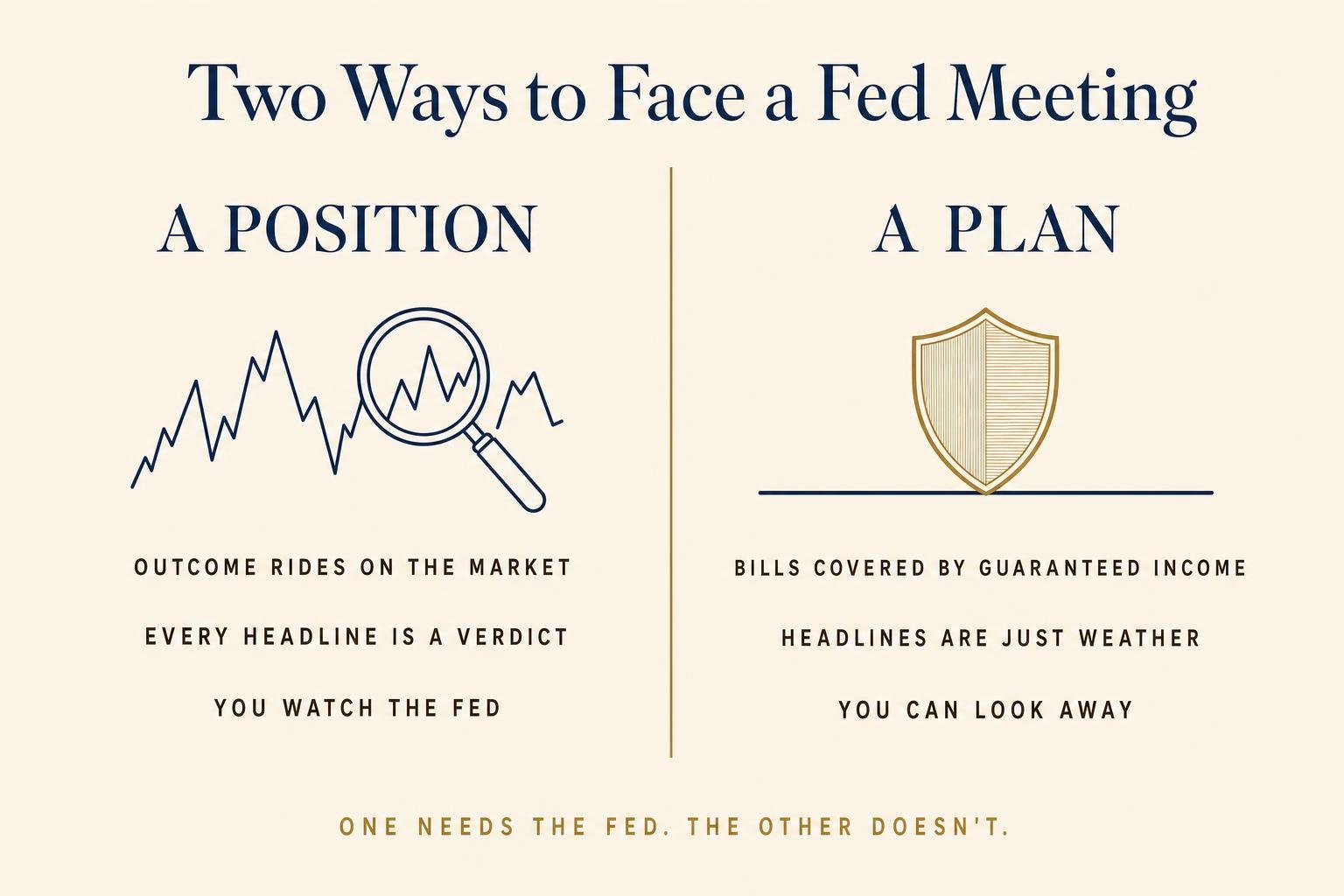
When your entire financial well-being is riding on the market, every Fed meeting feels like a verdict. When most of your essential income comes from somewhere the Fed can’t touch, a Fed meeting is just weather.
The thing that lets you look away: a guaranteed income floor
This is where bucket planning earns its keep. The idea is simple. You divide your money by job, not by account. The Now bucket holds near-term cash. The Later bucket holds market growth for the years far out. And in between sits the Soon bucket — the guaranteed income floor.
The floor is built from sources that pay you regardless of what the market or the Fed does: Social Security, a pension if you have one, and for many households an income-focused fixed index annuity used specifically for its guaranteed income, not as a growth play. The goal is to cover most or all of your essential monthly bills — housing, food, insurance, utilities — from that guaranteed layer.
When that floor is in place, something changes psychologically that’s hard to overstate. The market can have a bad week and your groceries are still covered. The Fed can surprise everyone and your mortgage payment doesn’t flinch. You’ve converted a portfolio that has to perform into a paycheck that just shows up. And a paycheck that just shows up does not need you to watch Jackson Hole.
Thomas’ Take: The real product of a good retirement plan isn’t a rate of return. It’s the ability to read a market headline, find it mildly interesting, and go back to your Saturday. If a Fed meeting can ruin your weekend, you don’t have a plan — you have a position.
A tale of two retirees this weekend
Consider a hypothetical. Two neighbors, both 66, both retired last year, both with about $600,000 saved. Same numbers, completely different weekends.
The first retiree, call him Dan, is drawing everything from his investment portfolio. There’s no guaranteed layer beyond Social Security, and he’s leaning on the market to fund most of his spending. So this weekend Dan has the financial news on in the background, refreshing the odds of a September cut, wondering whether to shift money before Monday. The Fed Chair’s speech isn’t background noise to Dan. It’s a referendum on his year.
The second retiree, call her Carol, spent her first years before retirement building a floor. Between Social Security and an income-focused annuity, her essential bills are covered by guaranteed sources. Her portfolio is still invested, still exposed to the market — but it funds travel and extras, not the light bill. Carol might glance at the Jackson Hole headline out of curiosity. Then she goes back to the garden. Same net worth as Dan. A completely different nervous system.
The difference between Dan and Carol isn’t intelligence, luck, or how well either one predicts the Fed. It’s structure. Carol built something that let her stop watching.
What to actually do this weekend
If you feel the pull to watch every minute of this, channel it into three things that will matter far longer than Friday’s speech.
Know which bucket every dollar is in. Not the account — the job. Which money is for the next two years, which is your guaranteed floor, and which is long-term growth you shouldn’t be touching or watching daily.
Make sure your Now bucket is actually full. The single worst outcome around any market or Fed event is being forced to sell investments at a bad moment to cover this month’s expenses. A well-stocked cash bucket is what buys you the freedom to ignore the headline. Yes, a rate cut may trim its yield — that’s a fair price for not being a forced seller.
Build a plan you can see. Most Fed anxiety is really just uncertainty about whether the whole thing holds together. The cure isn’t a better forecast; it’s a clearer picture. Before you move a dollar based on anything said in Wyoming this week, run your own numbers rather than reacting to a headline — mine included. A planning tool like ProjectionLab lets you model how much of your income floor is actually covered and what a range of rate and market scenarios does to the odds your money lasts, instead of guessing. (ProjectionLab is a paid tool; the link is an affiliate link, which means I may earn a small commission at no extra cost to you. I only recommend tools I’d use myself.)
The point of a plan is to make the Fed boring
There is real value in understanding what the Fed does — I’ve spent a career paying attention to it, and I’ll keep writing about it. But paying attention and being at its mercy are two very different states, and the entire purpose of a retirement income plan is to move you from the second to the first.
You already retired from the job of watching the tape. The Fed’s decision in September is a headline you get to read, not a verdict you have to survive. Build the floor that makes that true — and then enjoy your weekend. Jackson Hole will be fine without you.
Want more plain-English retirement thinking like this? Subscribe to the weekly newsletter — one calm, useful email a week, no market panic included.
This article is published by Confluence Media Group LLC, an independent publisher of educational financial content. Thomas Clark is a Series 65 Investment Advisor Representative. The information provided is for educational and informational purposes only and is not personalized financial, tax, or legal advice. Past performance does not guarantee future results. All investing involves risk, including potential loss of principal. Consult a qualified professional before making financial decisions.
Confluence Media Group LLC is a separate entity from Confluence Capital Management, the investment advisory practice through which Thomas Clark provides advisory services. Advisory services are not offered through this publishing platform.
About Thomas Clark
Thomas Clark is the founder of Confluence Media Group LLC and a Series 65 Investment Advisor Representative. He has spent nearly two decades working with families on retirement planning, with a focus on Social Security optimization, retirement income coordination, and the bucket planning approach to building a guaranteed income floor.
Thomas writes and publishes at thomasclarkadvisor.com and is the author of The Just in Case Binder — a 148-page printable family financial organizer for households who want to make sure the people they love know where everything is.
He lives in North Carolina with his family.
Subscribe to the weekly newsletter · Get the Just in Case Binder

Thomas Clark is a Series 65 licensed investment advisor and experienced trader. He specializes in investing, retirement planning, and market analysis, helping individuals build wealth and make informed financial decisions.
