
The Fed Meets Next Week. Don’t Try to Time the Market.
The Fed meets September 15–16, and for the first time in a while a rate hike is on the table. Here's why trying to time the market around the decision backfires — and the simple structure that lets you ignore it.

The Federal Reserve meets next Tuesday and Wednesday, September 15–16. For the first time in a long while, a rate hike is genuinely on the table — markets are split roughly down the middle on whether the Fed raises a quarter point or holds, after a hotter-than-expected jobs report and inflation that refuses to cool on schedule. By the time the decision lands, someone you know will have moved money to cash “just until the dust settles.”
I want to talk you out of that, and I want to do it with numbers rather than a pep talk. The Fed meeting is not the risk to your retirement. Reacting to it is. And the reason so many people react anyway has almost nothing to do with willpower — it’s a structural problem, and it has a structural fix.
What’s actually happening
The Fed’s rate-setting committee meets September 15–16. Heading in, the economic picture is genuinely mixed: payrolls came in far stronger than forecasters expected, underlying inflation has been sticky, and several Fed officials have leaned hawkish in their recent remarks. That combination has pushed market pricing toward a real possibility of a rate increase — a reversal from the “when do they cut?” mood that dominated most of the past two years.
Meanwhile, the S&P 500 is sitting near record territory, up sharply from a year ago. So the setup is the one that makes people most nervous: an expensive-feeling market heading into a policy decision that could go either way. If you want the full calendar, the Fed publishes it at federalreserve.gov. But knowing the date is not the same as needing to trade around it.
The instinct to “get out before the news” — and the trap inside it
The urge is understandable. If the market might drop when the decision lands, why not step aside until it’s over? The problem is that the market’s best days and worst days live in the same neighborhood, and they don’t send an invitation.
Research from J.P. Morgan Asset Management has found that seven of the ten best trading days over a recent 20-year stretch occurred within two weeks of the ten worst days. Roughly three-quarters of the market’s strongest single days happened during a bear market or in the first two months of a new bull market — precisely when a nervous investor is most likely to be sitting in cash. You don’t get to skip the bad day and keep the good one. They’re a package deal.
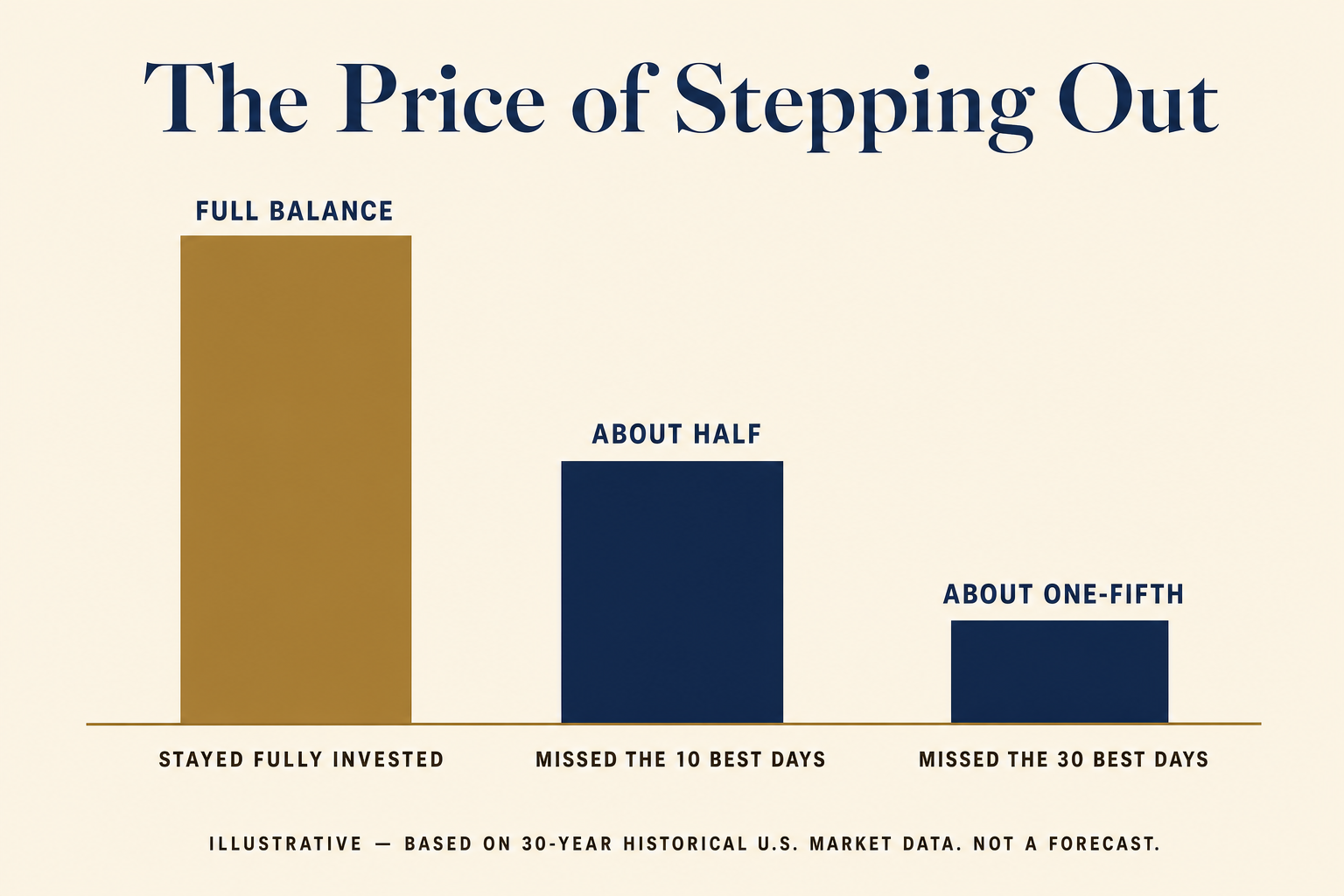
The cost of guessing wrong compounds fast. Hartford Funds, drawing on decades of market data, illustrates it plainly: an investor who stayed fully invested over the past 30 years but happened to miss just the ten single best days would have ended with roughly half the money of someone who never stepped out. Miss the best 30 days and the damage runs to around 80%. You can read their full breakdown in the whitepaper “Timing the Market Is Impossible.” None of this is a forecast of what the next 30 years will do. It’s a description of how the last several decades actually behaved — and the pattern is remarkably consistent.
“Stay invested” is right advice that still gets people hurt
Here’s where most market commentary stops — with a scolding “just stay the course.” I think that advice is correct and incomplete, and the incomplete half is the reason it so often fails the people who need it.
Think about why someone actually sells at the bottom. It’s rarely because they woke up and decided to abandon a 30-year plan. It’s because a scary headline arrived at the same moment they needed money — a roof, a tax bill, next month’s groceries — and every dollar they had was riding on the market. When your spending money and your growth money are the same money, a downturn stops being a paper loss and becomes a forced sale. You’re not timing the market by choice. You’re timing it because you have to.
Willpower doesn’t solve that. Structure does. The investors who genuinely ignore a Fed meeting aren’t calmer by temperament. They’ve arranged their money so that no single week’s headline can reach the part of the portfolio that needs to stay put.
Thomas’ Take: The people who “stay the course” through scary markets almost never do it on nerve. They do it because their next two years of spending was never in the market to begin with. Calm is a byproduct of structure, not a personality trait.
The structure that lets you ignore the Fed
This is the whole point of the bucket approach I write about constantly — the Now, Soon, Later framework. Split the money by job, not by mood:
- The Now bucket holds your near-term spending — roughly one to two years of the cash you’ll actually draw — in genuinely safe, liquid places. In today’s rate environment, that cash is finally paying you something real to sit there. That’s a feature, not a consolation prize. (How much belongs here is its own question, and I walked through it in how much cash your Now bucket should hold.)
- The Soon bucket is your guaranteed income floor — Social Security, a pension, or an income annuity built to cover the essentials that have to get paid no matter what the market does.
- The Later bucket is the money that stays invested — through this Fed meeting, and the next two hundred of them. It’s allowed to fall on Wednesday because you are not going to touch it on Thursday.
When your grocery money doesn’t depend on the S&P 500, the Fed’s decision becomes what it should be: a headline, not an emergency. This is also why chronic sequence-of-returns risk — the danger of a bad market early in retirement — is so much about cash runway and so little about predicting the Fed.
What this looks like in practice
Consider a hypothetical case. Robert is 64, recently retired, with about $700,000 in a 401(k) and Social Security still a year or two away. He reads that the Fed might raise rates and the market might fall, and he’s staring at the “move to money market” button.
In the version where his entire $700,000 is invested, that button is a real temptation — because if the market drops 15% and he needs $40,000 for the year, he’s selling into the decline whether he likes it or not. In the version where he’s already carved out two years of spending — say $80,000 — into his Now bucket, the button is irrelevant. His next 24 months are covered. The remaining $620,000 can do whatever it’s going to do over the next couple of weeks, because he doesn’t need it now. Same market, same Fed, completely different experience. (These are round, illustrative figures, not a projection of anyone’s actual results.)
Before you make any move ahead of the meeting, this is exactly the kind of decision worth modeling against your real numbers rather than your nerves. A tool like ProjectionLab lets you run your own version — different cash cushions, withdrawal orders, and market scenarios — and watch how your “will I run out” risk actually changes when you build a runway versus when you try to dodge downturns. (ProjectionLab is an affiliate partner; if you subscribe through that link, Confluence Media Group may earn a commission at no additional cost to you.)
What to actually do before the meeting
Nothing dramatic. Three quiet things:
Confirm your Now bucket covers your near-term spending. If the next year or two of withdrawals is sitting in cash and short-term instruments, you are already positioned for whatever the Fed does. That’s the work — and most of it was done long before the meeting.
If it doesn’t, fix that — not your equity exposure. The correct response to feeling nervous about a Fed meeting is almost never “sell my stocks.” It’s “make sure my spending money was never in stocks.” Those are very different trades, and only one of them helps.
Then turn off the meeting coverage. Nobody rearranges a retirement plan better for having watched a press conference live. If you want the broader case for tuning out the macro noise, I made it around Jackson Hole: you don’t have to watch the Fed.
The decision that will actually protect your retirement next week wasn’t made next week. It was made whenever you did — or didn’t — build a cash runway. If you built one, the Fed meeting is just Tuesday and Wednesday. If you didn’t, no amount of market timing will save you, and this is your reminder to fix the real thing.
Key takeaways
- The Fed meets September 15–16 with a rate hike genuinely possible — but the meeting isn’t the risk to your plan; reacting to it is.
- The market’s best and worst days cluster together; historically, missing just a handful of the best days has cut long-run returns roughly in half.
- People sell at the bottom mostly because their spending money and their growth money are the same money — a structural problem, not a discipline problem.
- A one-to-two-year Now bucket in cash lets the Later bucket stay invested through any single week’s headlines.
- Before the meeting, check that your near-term spending is covered — then stop watching.
This article is published by Confluence Media Group LLC, an independent publisher of educational financial content. Thomas Clark is a Series 65 Investment Advisor Representative. The information provided is for educational and informational purposes only and is not personalized financial, tax, or legal advice. Past performance does not guarantee future results. All investing involves risk, including potential loss of principal. Consult a qualified professional before making financial decisions.
Confluence Media Group LLC is a separate entity from Confluence Capital Management, the investment advisory practice through which Thomas Clark provides advisory services. Advisory services are not offered through this publishing platform.
About Thomas Clark
Thomas Clark is the founder of Confluence Media Group LLC and a Series 65 Investment Advisor Representative. He has spent nearly two decades working with families on retirement planning, with a focus on Social Security optimization, retirement income coordination, and the bucket planning approach to building a guaranteed income floor.
Thomas writes and publishes at thomasclarkadvisor.com and is the author of The Just in Case Binder — a 148-page printable family financial organizer for households who want to make sure the people they love know where everything is.
He lives in North Carolina with his family.
Subscribe to the weekly newsletter · Get the Just in Case Binder

Thomas Clark is a Series 65 licensed investment advisor and experienced trader. He specializes in investing, retirement planning, and market analysis, helping individuals build wealth and make informed financial decisions.
