
Trading vs. Investing: Two Different Jobs Entirely
Trading and investing get used as if they mean the same thing. They don't — and confusing the two is where retirement money quietly gets hurt.
Someone told me last week they were “investing in a chip stock for the earnings pop.” I knew what they meant. But that one sentence contained a contradiction that quietly costs people real money.
You cannot invest for the earnings pop. You can trade for it. The two words point at two different activities, and using them interchangeably is how a short-term bet turns into a long-term regret — and how a decades-long plan gets torn up after one bad week.
I’ve spent years on both sides of that line, trading actively and building long-term retirement plans. They are not two points on the same spectrum. They are two different jobs. Here is how to tell them apart, and why the difference matters more for your retirement money than almost anything else you’ll read about the market.
The difference isn’t the asset. It’s the job.
Here’s the part most people get backwards: whether something is a trade or an investment has nothing to do with what you buy. The same share of the same company can be either one. What separates them is the job you’re asking the money to do.
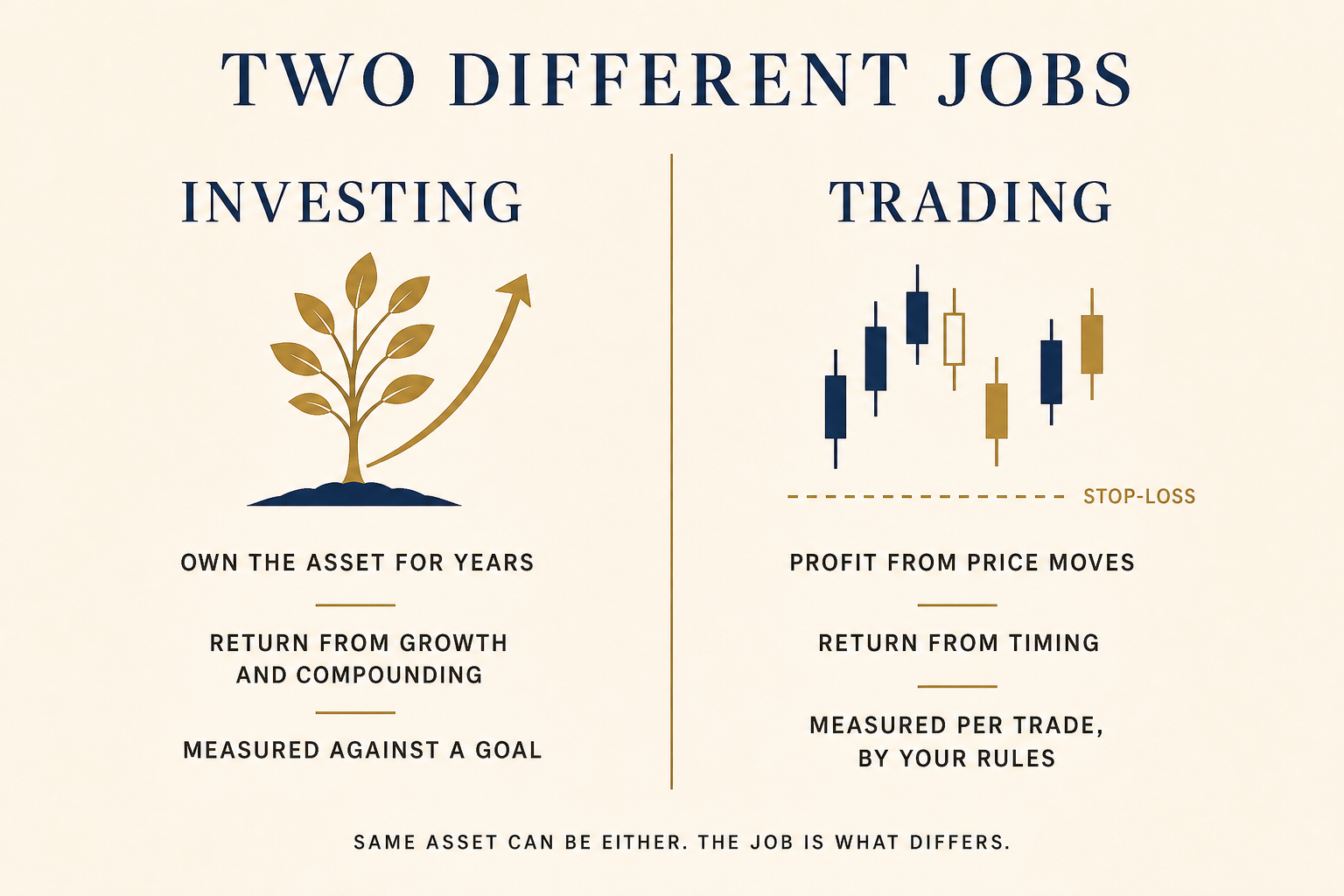
Investing means buying a stake in a productive asset and holding it long enough — years, often decades — that the underlying thing grows your money for you. A business earns profits. A broad index captures the growth of the whole economy. Dividends get reinvested and compound. Your job is to own the asset and stay out of the way.
Trading means taking a position to profit from a price move over a shorter window, anywhere from minutes to a few months. You’re not waiting for the business to compound. You’re trying to be right about direction and get out. The holding period is short because the whole point is the move, not the ownership.
Time horizon, and the source of the return, are the real dividing lines. Everything else follows from those two.
Where the money actually comes from
Follow the money and the two activities separate cleanly.
An investor’s return comes from the asset itself doing well — earnings growth, dividends, reinvestment, the economy expanding over time. That’s why investing can be a game everyone wins at once. When the economy grows over 20 years, every long-term owner of a diversified basket can come out ahead. It’s a rising tide, not a fight over a fixed pot.
A trader’s return comes from price movement, and for every trade there is someone on the other side taking the opposite view. That makes trading close to a zero-sum contest before costs — and after commissions, the bid-ask spread, and short-term taxes, it’s a losing game for the average participant. The regulators say this plainly: the Financial Industry Regulatory Authority (FINRA) and the SEC’s investor.gov both warn that active, short-term trading is high-risk and that most people who try it lose money.
This is my trading background talking, so hear me on it: what makes a good trader isn’t picking direction. Everyone obsesses over direction, and it’s the part that matters least to whether you survive. The edge, when it exists, lives in risk management and position sizing — and in the fact that most people who lose at trading lose to costs and their own behavior, not to a bad forecast.
Two different scoreboards
Because the jobs are different, the way you keep score is different — and this is where the real damage happens.
An investor’s scoreboard is progress toward a goal measured in years. A 20% drawdown along the way is noise if the plan is 25 years long and the thesis hasn’t changed. Checking it daily doesn’t make it grow faster; it just tempts you to trade something you were supposed to be investing in.
A trader’s scoreboard is per-trade discipline, measured in units of risk and in one honest question: did I follow my rules? The trading journal exists to answer exactly that, trade by trade.
The expensive mistake is using the wrong scoreboard for the job. Watching a retirement portfolio like a trade invites you to tinker with money that only works if you leave it alone — one of the oldest behavioral traps that derail retirement plans. And the reverse is worse: holding a losing trade and calling it “a long-term investment now” is the most expensive sentence in the market. You didn’t invest. You got trapped and relabeled it.
Same stock, same week, two different activities
Consider a hypothetical. Omar and Dana, both 46, each put $50,000 into the same well-known company’s stock in the same week. Same asset, same entry, same price. On paper it looks like they did the identical thing. They didn’t.
Omar is investing. The position is one slice of a diversified long-term portfolio — part of the money he won’t touch for 20 years. When the stock drops 30% three months later, nothing changes for him, because nothing about his 20-year thesis changed. The drawdown is weather, not a reason to act.
Dana is trading. She entered on a specific setup with a predefined exit written down before she bought. When the price drops through her stop, she’s out at a small, planned loss and moves on to the next idea. Taking the loss isn’t failure — it’s the plan working exactly as designed.
Same stock, same week, opposite jobs, opposite definitions of winning. The trouble starts only in one scenario: if Dana refuses to take her stop and tells herself she’s “a long-term investor now.” That isn’t investing. It’s a trade that broke its own rules, wearing an investor’s coat.
Why this matters for your retirement money
This is where bucket planning does the sorting for you. In the Now, Soon, Later framework, your Later bucket is investing money — decades-long, goal-driven, meant to grow through the economy rather than through your timing. Your Now and Soon buckets, the cash and the guaranteed income floor, are neither trading nor investing in this sense. Their job is safety and income, and you don’t put either one at the mercy of a price chart.
If you want to trade, trade. But do it with ring-fenced money you’ve decided in advance you can afford to lose, kept structurally separate from the retirement plan. I’ve made the case before for why trading and retirement planning should never share an account, and the principle is simple: different jobs get different money.
The tax code even takes a side. The IRS taxes gains on anything you held a year or less as ordinary income, at rates up to 37%, while assets held longer than a year qualify for preferential long-term capital gains rates of 0%, 15%, or 20% (IRS Topic No. 409). The system is literally built to reward the investor’s time horizon and penalize the trader’s. That doesn’t make trading wrong. It makes the distinction real enough that the government wrote it into the rulebook.
Thomas’s Take: The most expensive move in the market isn’t a bad trade or a bad investment. It’s a trade you refuse to close, relabeled as an investment so you never have to admit you were wrong.
Key Takeaways
- Same asset, different job. The same stock can be a trade or an investment. What separates them is the time horizon and the job you’re asking the money to do, not the ticker.
- The return comes from different places. Investing profits from the asset growing; trading profits from price movement, with someone on the other side of every position.
- Use the right scoreboard. Investments are measured in years against a goal; trades are measured per position against your own rules. Mixing the two is where people get hurt.
- Ring-fence trading capital. If you trade, use separate money you can afford to lose — never the retirement plan.
- The tax code takes sides. Held a year or less, gains are taxed as ordinary income; held longer, they get preferential rates. The rules reward the investor’s patience.
Frequently Asked Questions
Is one better than the other?
That’s not the right question. Investing is what builds most people’s retirement. Trading is a skill-and-risk activity a small minority do well, and only after a lot of work. For retirement money, investing is the job. Whether to trade at all is a separate decision, made with separate money.
Can the same person do both?
Yes — if the two pools are kept genuinely separate, with different rules and different scoreboards. A trader can also be a patient long-term investor. The problems start when the two blur together and one account tries to do both jobs at once.
How do I know which one I’m actually doing?
Ask what has to happen for you to sell. If the answer is “the price moves,” you’re trading. If it’s “I reach a goal, or the long-term reason I bought it stops being true,” you’re investing. The holding period follows from that answer — not the other way around.
The bottom line
Trading and investing both have their place. The mistake is treating them as the same activity with a different holding period. They are different jobs, with different tools, different measures of success, and different money.
Decide which one you’re doing before you buy. Because the market will eventually make you find out either way — and it charges a lot more for the lesson than it would have for the label.
This article is published by Confluence Media Group LLC, an independent publisher of educational financial content. Thomas Clark is a Series 65 Investment Advisor Representative. The information provided is for educational and informational purposes only and is not personalized financial, tax, or legal advice. Past performance does not guarantee future results. All investing involves risk, including potential loss of principal. Consult a qualified professional before making financial decisions.
Confluence Media Group LLC is a separate entity from Confluence Capital Management, the investment advisory practice through which Thomas Clark provides advisory services. Advisory services are not offered through this publishing platform.
About Thomas Clark
Thomas Clark is the founder of Confluence Media Group LLC and a Series 65 Investment Advisor Representative. He has spent nearly two decades working with families on retirement planning, with a focus on Social Security optimization, retirement income coordination, and the bucket planning approach to building a guaranteed income floor.
Thomas writes and publishes at thomasclarkadvisor.com and is the author of The Just in Case Binder — a 148-page printable family financial organizer for households who want to make sure the people they love know where everything is.
He lives in North Carolina with his family.
Subscribe to the weekly newsletter · Get the Just in Case Binder

Thomas Clark is a Series 65 licensed investment advisor and experienced trader. He specializes in investing, retirement planning, and market analysis, helping individuals build wealth and make informed financial decisions.
