
One More Year Syndrome: When Enough Is Actually Enough
One more year of work feels like the responsible, conservative choice. For people who already have enough, it can be the most expensive decision they make — and here is how to tell the difference.

There is a particular kind of person I think about a lot. They have done everything right. The mortgage is gone, the accounts are funded, the spreadsheet says they can retire. And every year, when the moment comes to actually walk out the door, they find a reason to stay. One more bonus. One more good market. One more year.
It feels like caution. Often it is the opposite. For someone who already has enough, “one more year” can be the most expensive decision they make — because the thing they are spending isn’t money. It is time, in the healthiest years they have left.
What “one more year syndrome” actually is
“One more year syndrome” is the habit of deferring a retirement you can afford — not because the numbers require it, but because stopping feels unsafe. The paycheck is familiar. The portfolio is a moving target. And a bigger number always sounds better than a slightly smaller one, so the finish line quietly keeps moving.
It helps to notice how common the underlying anxiety is. The 2026 EBRI Retirement Confidence Survey found that worker confidence about having enough money to retire comfortably fell to its lowest level since 2017. When confidence runs low even among people who are objectively prepared, “just keep working” becomes the default answer to a question most people never actually sit down and calculate.
The tell is simple. If you ask yourself what specific number or event would finally make it safe to stop, and there isn’t one — the next raise would help, and so would the one after that — then you are not managing a financial risk anymore. You are managing a feeling, and a feeling has no finish line.
The year you’re buying isn’t free
Every extra year of work is purchased with an extra year of something else. The trouble is that we price the paycheck precisely and the opportunity cost not at all.
Consider the actuarial reality, which is calmer than it sounds. According to the Social Security Administration’s actuarial life tables, a 65-year-old woman has roughly a one-in-three chance of living past 90, and a man about one in four; for a couple who are both 65, there is better than a 50% chance at least one of them reaches 90. Those are encouraging numbers — retirements are long, and planning for a short one is its own mistake. But a long life span and a long run of active, healthy years are not the same thing, and the healthy years tend to sit right at the front.
That is the asymmetry at the heart of this decision. Money is replaceable; you can earn it, save it, or adjust your spending to fit it. A healthy 64th year is not replaceable at any price. When you trade one for the other without noticing, you are making an exchange at terrible terms and calling it prudence.
Thomas’ Take: I have never met anyone who, looking back, wished they had banked one more year of salary at 64 instead of taking the trip, seeing the grandkids, or simply slowing down while their knees still cooperated. When there is regret, it almost always runs the other direction.
You may not get to choose the timeline
The quiet assumption buried inside “one more year” is that the year is actually yours to give. The data says otherwise, and this is the part most plans skip right past.
In that same EBRI survey, nearly half of retirees — about 46% — said they left work earlier than they had planned. Of those, more than three-quarters reported the timing was driven by something outside their control: a health problem or disability, which was the single largest cause, along with layoffs, company restructurings, and the need to care for a family member. The median retiree actually stops working around 62, while the typical worker expects to make it to 65.
Read that carefully, because it reframes the whole calculation. “I’ll just work until 67 to be safe” is a plan that assumes you control the exit date. For something close to half of people, that assumption turns out to be wrong. A retirement strategy that only holds together if you stay employed exactly on schedule is not conservative — it is fragile, and it is most fragile precisely when a health event or a layoff would hurt the most.
When one more year is genuinely the right call
None of this means you should quit the moment the spreadsheet first turns green. There are real, specific situations where working longer is the strongest move on the board. The difference is that each of them has a defined target you can name, not an open-ended fear you can’t.
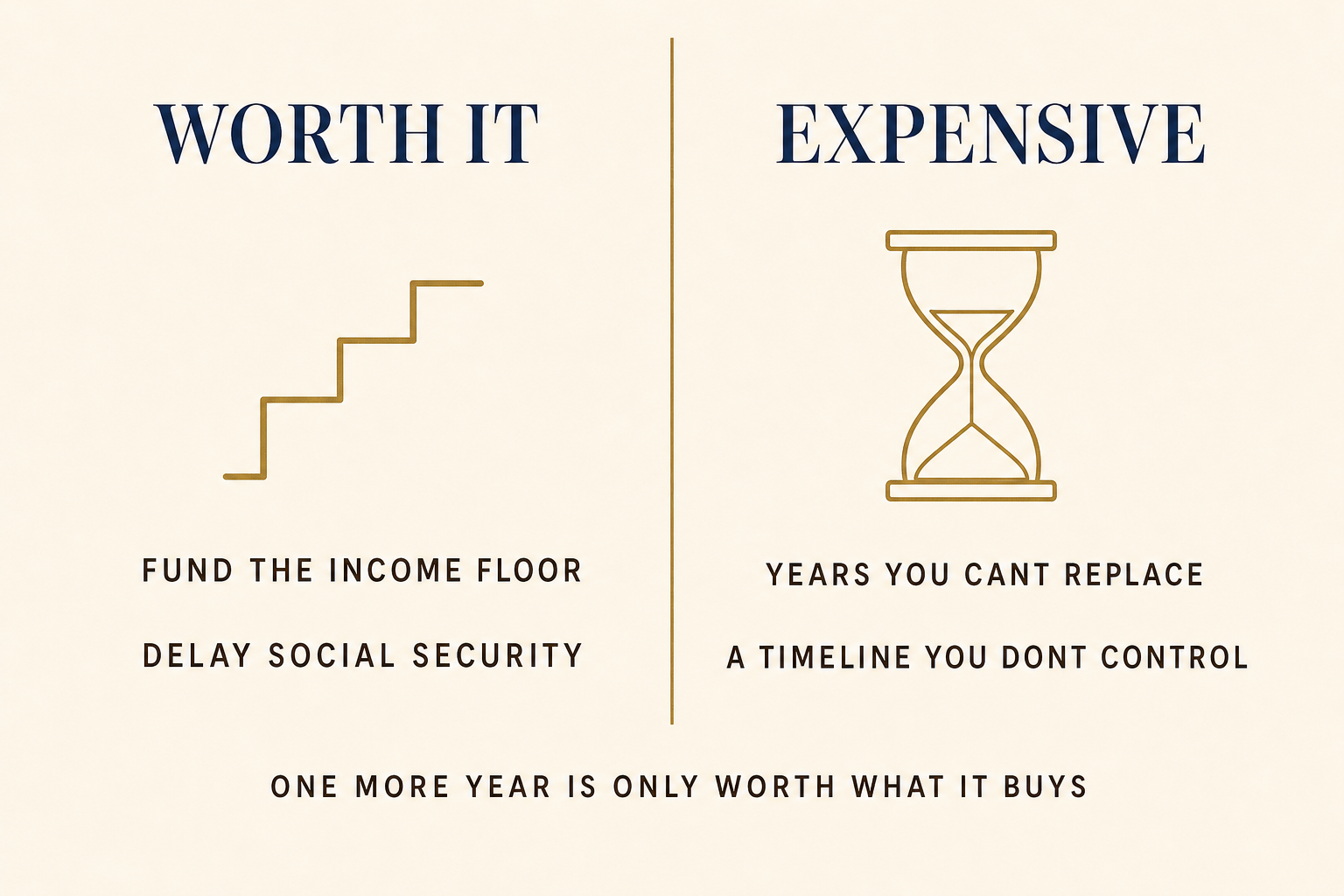
Working longer earns its keep when it closes a concrete gap. If your guaranteed income doesn’t yet cover your essential bills, another year or two of earning — and of not drawing down the portfolio — can be exactly what finishes the floor. The same logic holds when a few more years lets you delay Social Security toward 70: benefits grow by roughly 8% for each year you wait past full retirement age, up to 70, a permanent and inflation-adjusted raise that no market investment can promise you. More earning years can also lift the benefit directly, because Social Security averages your highest 35 years and a strong late-career year can replace an early low one. You can read the delayed-credit rules on the SSA’s own site.
It is also perfectly reasonable to keep working simply because the work is good for you — because you like it, it keeps you sharp and connected, and walking away would cost you more in purpose than it would pay you in free time. That is a fine reason. The point was never to retire as early as humanly possible. It was to make the call deliberately, for a reason you could say out loud.
How a bucket plan turns a money question into a life question
The reason “one more year” is so sticky is that most people never separate two very different questions: Do I have enough to be safe? and Do I actually want to keep working? When those two blur into one, fear answers both of them at once. Structure is what pulls them back apart.
This is the entire purpose of the Now, Soon, and Later bucket framework. The Soon bucket is a guaranteed income floor — Social Security, any pension, and other guaranteed sources — sized to cover your essential expenses. The Now bucket holds a year or two of spending in cash, so a bad market never forces your hand. The Later bucket stays invested for growth and for whatever legacy you have in mind.
Once that floor genuinely covers your essentials, the ground under the decision shifts. A market drop lands in the Later bucket, which has the time to recover, and never reaches the grocery money; the thing people fear most about retiring into a shaky market is handled by the structure, not by staying at your desk. And the question itself changes. It stops being “is it safe to stop?” — because now you can see that it is — and becomes “do I want to?” That is a far better question to be wrestling with at 63, and it is one most people never give themselves permission to reach.
Consider a hypothetical case: Ray and Diane, both 63, in suburban Columbus. Ray earns good money and has said “maybe two more years” three years running. On paper they are fine — roughly $1.1 million saved, a paid-off house, and about $6,000 a month in essential spending. When they finally map it out, their combined Social Security at full retirement age plus Diane’s small pension covers most of that floor, and a year of cash in the Now bucket carries the rest of the bridge. The honest finding isn’t that they need another year. It is that they needed to see the floor they already had. (These figures are illustrative and rounded, not a projection; your own numbers will look different.)
If you are genuinely unsure which camp you fall into, that is worth modeling before you commit another year to the office. A planning tool like ProjectionLab lets you test your own numbers — your spending, your claiming age, a few bad markets in a row — and watch whether one more year of work actually changes the outcome or just changes how you feel about it.
Disclosure: the ProjectionLab link above is an affiliate link. If you subscribe through it, I may earn a commission at no additional cost to you. I only point to tools I’d actually sit down and use.
The real cost, and the real payoff
One more year is worth it when it buys you something specific: a finished income floor, a larger lifetime Social Security benefit, or work you genuinely want to do. It is expensive when all it buys is the feeling of safety you already had — paid for with a year you cannot get back, and may not have been promised in the first place.
The goal was never the biggest possible number on a statement. It was the freedom that number is supposed to buy. At some point, continuing to grow the number becomes a way of avoiding the harder work of deciding what it was all for. If you have already crossed the line into “enough,” the bravest and most financially sensible thing you can do might simply be to stop proving it.
Key takeaways
- “One more year syndrome” is deferring a retirement you can afford out of fear rather than math — the tell is that no specific number would ever feel like enough.
- Extra working years are paid for with your healthiest years; Social Security data shows retirements are long, but the active years are front-loaded and finite.
- Nearly half of retirees leave earlier than planned, usually for reasons outside their control, so a plan that assumes you control the exit date is fragile, not safe.
- Working longer is the right call when it closes a real gap: funding your income floor, delaying Social Security toward 70, or doing work you genuinely value.
- A guaranteed income floor separates “is it safe to stop?” from “do I want to?” — and lets you answer the second question on purpose.
This article is published by Confluence Media Group LLC, an independent publisher of educational financial content. Thomas Clark is a Series 65 Investment Advisor Representative. The information provided is for educational and informational purposes only and is not personalized financial, tax, or legal advice. Past performance does not guarantee future results. All investing involves risk, including potential loss of principal. Consult a qualified professional before making financial decisions.
Confluence Media Group LLC is a separate entity from Confluence Capital Management, the investment advisory practice through which Thomas Clark provides advisory services. Advisory services are not offered through this publishing platform.
About Thomas Clark
Thomas Clark is the founder of Confluence Media Group LLC and a Series 65 Investment Advisor Representative. He has spent nearly two decades working with families on retirement planning, with a focus on Social Security optimization, retirement income coordination, and the bucket planning approach to building a guaranteed income floor.
Thomas writes and publishes at thomasclarkadvisor.com and is the author of The Just in Case Binder — a 148-page printable family financial organizer for households who want to make sure the people they love know where everything is.
He lives in North Carolina with his family.
Subscribe to the weekly newsletter · Get the Just in Case Binder

Thomas Clark is a Series 65 licensed investment advisor and experienced trader. He specializes in investing, retirement planning, and market analysis, helping individuals build wealth and make informed financial decisions.
