
Sell in May and Go Away? What Retirees Should Actually Do
The old “sell in May and go away” adage has a kernel of truth in the long-run data — and it still shouldn’t change how a retiree invests. Here’s what the seasonal pattern really shows, and the structural move that matters far more.

The stock market is closed today for Memorial Day. That makes this a fitting morning to talk about the oldest piece of seasonal advice on Wall Street: “Sell in May and go away.”
The idea is tidy. Stocks supposedly do their best work from November through April, then drift sideways through the summer and early fall. So you sell at the start of May, sit in cash, and buy back around Halloween.
Here is my honest answer, and I’ll spend the rest of this article backing it up: there is a small kernel of truth buried in the historical data, and it still should not change a single thing about how a retiree runs a portfolio. The pattern is real on paper and nearly useless in practice — and for anyone living on their money, the whole debate is the wrong conversation.
Where the saying comes from
The phrase is older than the modern market. It traces back to an English expression — “Sell in May and go away, and come back on St. Leger’s Day” — referring to the slow summer stretch when London’s financial class decamped to the countryside.
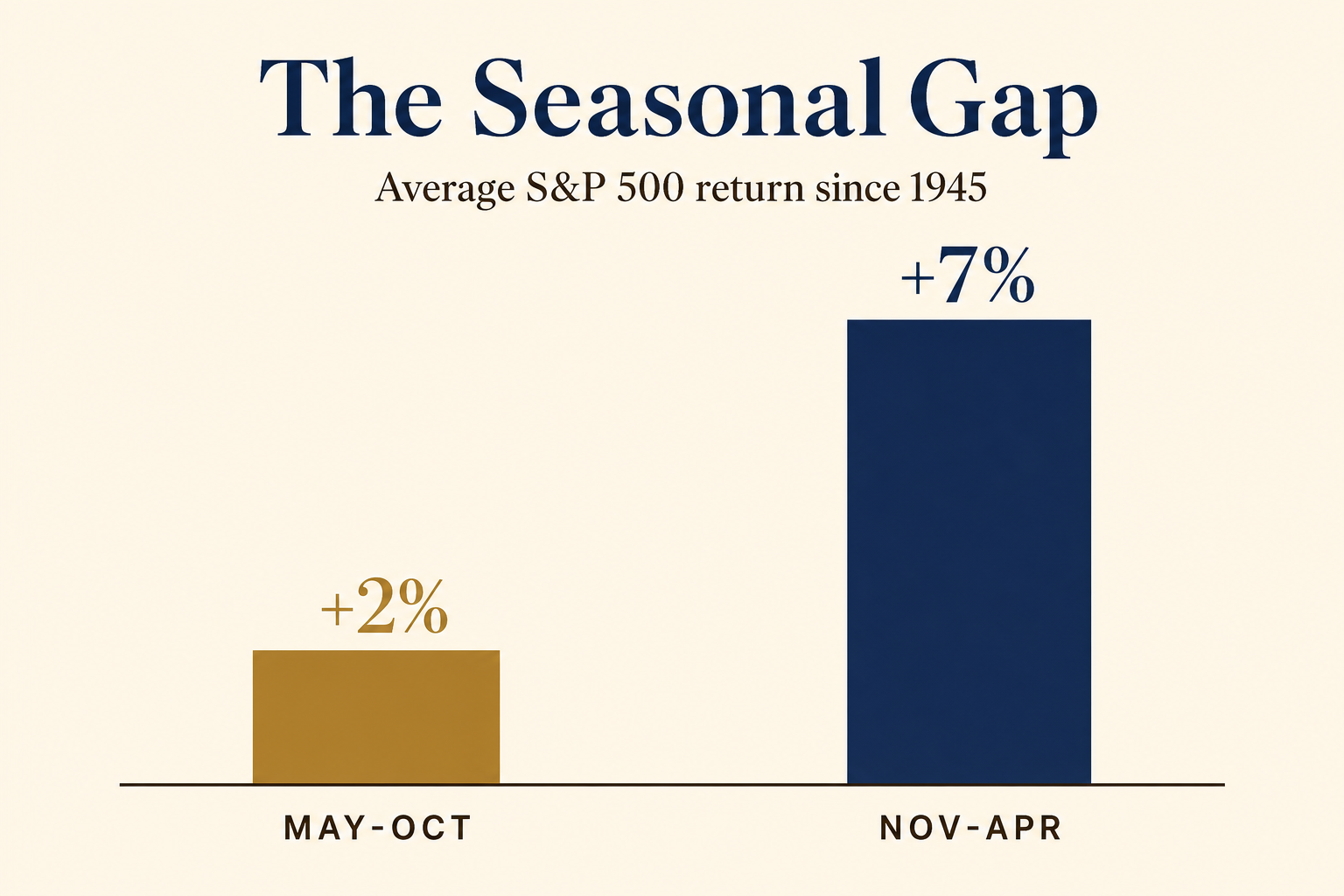
And the long-run numbers do give it some support. Going back to 1945, the S&P 500 has gained roughly 7% on average during the November-through-April window and risen in price about three-quarters of the time. The May-through-October stretch has averaged closer to 2% and risen about two-thirds of the time, according to analysis from American Century Investments. So yes — historically, the warm-weather months have been the market’s weaker season.
If you stop reading there, “sell in May” sounds like settled science. The problem is what happens when you keep reading.
“Weaker” is not the same as “bad”
Look closely at that May-to-October figure. A 2% average gain that shows up two years out of three is still, on average, a gain. The summer isn’t a reliable decline you can dodge — it’s a slower climb you’d be stepping out of.
And the pattern has faded. Over the past decade, the May-through-October period has finished positive roughly 80% of the time, with an average gain in the neighborhood of 5%. In plain terms: an investor who dutifully sold every May would have been sitting in cash during a rising market in about four summers out of five.
This year is a live example. As of late May, the S&P 500 sits around 7,470 and is up roughly 8.5% for the year, even after a bout of geopolitical volatility tied to conflict in the Middle East. First-quarter corporate earnings came in strong — up about 28% over the prior year. Nobody knows what the next five months hold, but “the summer is automatically dead money” is not a safe assumption to bet real dollars on.
The two costs almost nobody mentions
Even if the seasonal edge were larger and more dependable than it is, acting on it carries two costs that rarely make it into the headline.
Taxes and friction. Selling your equity funds every spring in a taxable brokerage account is a taxable event. You could be handing the IRS a chunk of capital gains every single year in order to chase a 2%-versus-7% seasonal difference. The tax drag alone can swallow the supposed edge whole.
Being out on exactly the wrong days. Markets do most of their heavy lifting in short, unpredictable bursts — and a surprising number of the best days land in the very months “sell in May” tells you to be absent. One widely cited illustration makes the point: $1,000 invested in the S&P 500 back in 1976 and simply left alone would have grown to roughly $295,000 by the end of 2025. The same $1,000, hopping out every April 30 and back in every November 1, would have grown to only about $46,000. Same starting dollar. A wildly different finish, driven mostly by the gains the calendar rule made you miss.
That gap is the real lesson. The danger in market timing usually isn’t the selling — it’s the getting back in, late and unsure, after the rebound already happened.
A hypothetical: meet Ron
Consider a hypothetical case. Ron is 68, retired three years ago, and keeps about $600,000 in a taxable brokerage account. Every spring he reads the “sell in May” headline, gets a little nervous, and moves most of his stock funds to cash “just to be safe for the summer.”
Two things happen to Ron, year after year. First, those spring sales generate capital gains, so he owes tax on gains he didn’t actually need to realize. Second, he faces a decision he hates: when do I get back in? Some years the market keeps climbing through June and July, and by the time he works up the nerve to return, he’s buying back higher than he sold. The strategy that was supposed to reduce his stress quietly manufactures more of it — and costs him money doing so.
Now picture Ron’s neighbor with the same $600,000, who never touches it in response to a date on the calendar. She isn’t smarter or braver. Her portfolio is simply built so that the calendar doesn’t matter — which brings us to the part that actually counts.
What actually matters for a retiree
Here’s the reframe. The reason “sell in May” feels tempting is fear — the worry that a summer slump will hit your portfolio right when you need to live on it. The fix for that fear isn’t a seasonal trading rule. It’s structure.
This is exactly what the Now, Soon, Later bucket framework is designed to solve. Your Now bucket holds current living expenses in cash and short-term reserves. Your Soon bucket builds a guaranteed income floor from sources like Social Security, a pension, and income-focused fixed index annuities — money that pays your bills regardless of what stocks do this summer. Your Later bucket is the growth money you genuinely won’t touch for years.
When your portfolio is arranged that way, July’s market simply doesn’t reach your grocery budget. You don’t need a calendar rule to feel safe in May, because the next several years of spending were never riding on the market in the first place. The growth bucket can sit through every summer, every election cycle, and every scary headline doing its slow work — precisely because you’ve given it the one thing equities need most, which is time. That’s also why I treat the Later bucket’s allocation as a long-horizon decision, not a seasonal one.
Thomas’ Take: Seasonal patterns make for interesting trivia, not a plan. The retirees I’ve seen sleep well through a rocky summer aren’t the ones who timed a clean exit in May. They’re the ones whose next five years of spending never depended on what the market did this week — so they can let the rest ride.
The seasonal strategy worth keeping
There is a “seasonal” approach worth having. It just has nothing to do with the calendar. It’s structural: build the guaranteed income floor first, keep two to three years of spending out of the market entirely, and then let the growth bucket compound through every May and every October without your interference.
Do that, and “sell in May and go away” turns back into what it always should have been — a clever rhyme to bring up at a Memorial Day cookout, not a decision you have to make with your retirement on the line. If a summer pullback does come, you’ll be in the enviable position of not having to care. And if you want the deeper version of why short-term market moves matter so much less than they feel like they should, I walked through it in what a 10% correction actually means for retirees.
Key takeaways
- The seasonal pattern is real in the long-run averages — but the May-to-October stretch has still been positive most years, and over the past decade it finished higher roughly 80% of the time.
- Acting on the pattern carries two costs the rhyme ignores: capital-gains taxes in a taxable account, and the risk of missing the market’s best days while you wait to get back in.
- One illustration: $1,000 left invested since 1976 grew to roughly $295,000 by the end of 2025, versus about $46,000 for the same dollar that jumped out every summer.
- For retirees, the right “seasonal” move isn’t a trade — it’s structure. A funded Now bucket and a guaranteed Soon-bucket income floor make the summer market irrelevant to your spending.
This article is published by Confluence Media Group LLC, an independent publisher of educational financial content. Thomas Clark is a Series 65 Investment Advisor Representative. The information provided is for educational and informational purposes only and is not personalized financial, tax, or legal advice. Past performance does not guarantee future results. All investing involves risk, including potential loss of principal. Consult a qualified professional before making financial decisions.
Confluence Media Group LLC is a separate entity from Confluence Capital Management, the investment advisory practice through which Thomas Clark provides advisory services. Advisory services are not offered through this publishing platform.
About Thomas Clark
Thomas Clark is the founder of Confluence Media Group LLC and a Series 65 Investment Advisor Representative. He has spent nearly two decades working with families on retirement planning, with a focus on Social Security optimization, retirement income coordination, and the bucket planning approach to building a guaranteed income floor.
Thomas writes and publishes at thomasclarkadvisor.com and is the author of The Just in Case Binder — a 148-page printable family financial organizer for households who want to make sure the people they love know where everything is.
He lives in North Carolina with his family.
Subscribe to the weekly newsletter · Get the Just in Case Binder

Thomas Clark is a Series 65 licensed investment advisor and experienced trader. He specializes in investing, retirement planning, and market analysis, helping individuals build wealth and make informed financial decisions.
