
The Social Security Earnings Test, Explained for 2026
Working while claiming Social Security before full retirement age can trigger the earnings test — but the withheld money isn't a penalty, and it isn't gone. Here's how the 2026 rules actually work.

Here is a fear I hear all the time from people in their early sixties who are still working: “If I claim Social Security now, won’t the government just take it back because I’m earning a paycheck?”
It’s a fair worry, and it has a real rule behind it — the Social Security earnings test. But the story most people have in their heads is wrong in two important ways. The earnings test is not a tax, and the money it holds back is not gone. Understanding the difference changes how you think about working, claiming, and the years right before full retirement age.
Let’s walk through exactly how the 2026 earnings test works, what counts against you, what doesn’t, and the part almost nobody explains — how you get that money back.
Key Takeaways
- The earnings test only applies before your full retirement age (FRA). Once you hit FRA, you can earn any amount and your benefit is never reduced.
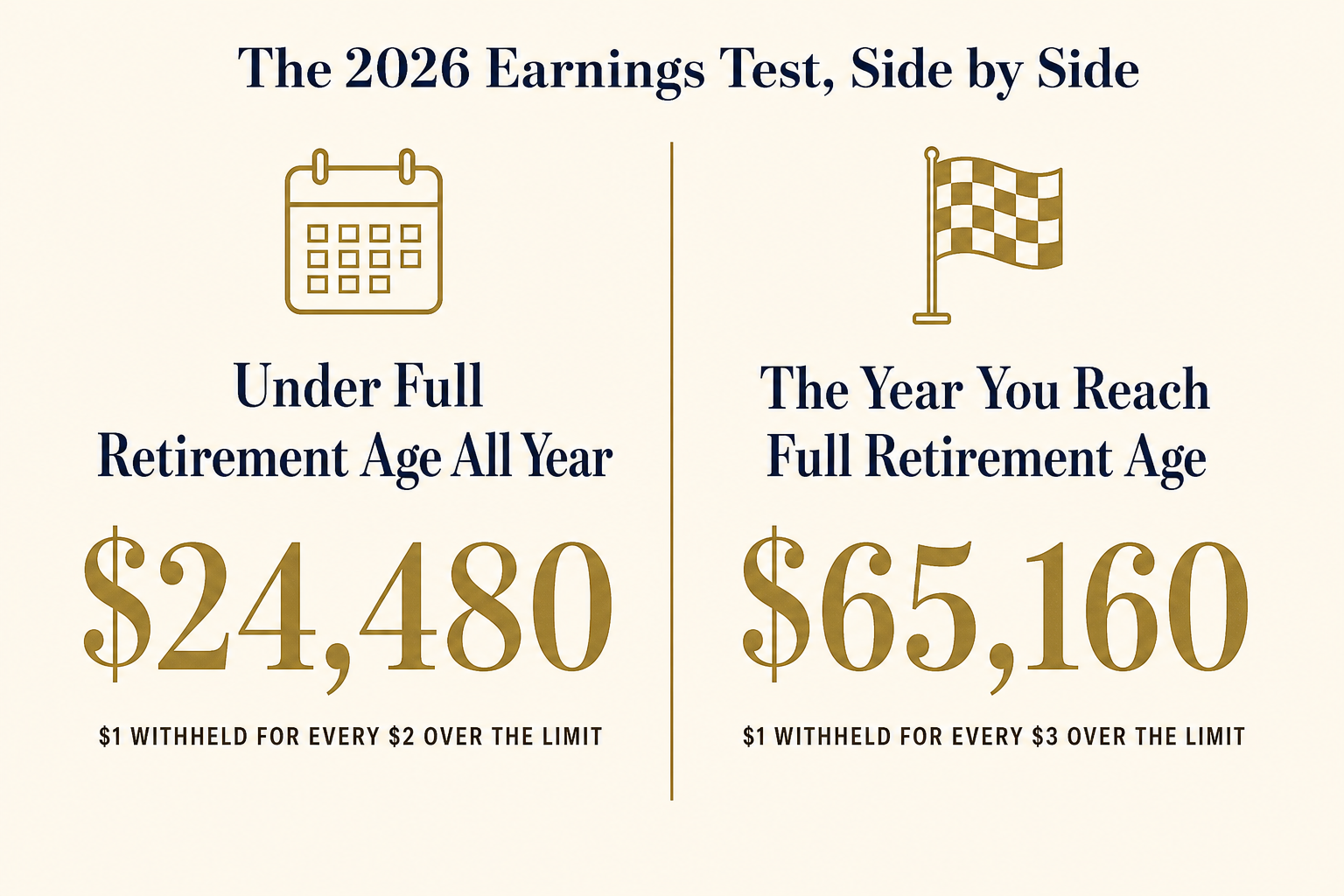
- In 2026, the limit is $24,480 if you’re under FRA all year. Above that, Social Security withholds $1 for every $2 you earn.
- The year you reach FRA, the limit jumps to $65,160, and the withholding softens to $1 for every $3 — counting only what you earn before your birthday month.
- Only wages and self-employment income count. Pensions, IRA withdrawals, dividends, interest, and annuity income do not.
- Withheld benefits are not lost. At FRA, Social Security recalculates your check upward to credit you for the months it held back.
The earnings test isn’t a tax — and it isn’t forever
The most damaging misconception is that the earnings test is a penalty for working. It isn’t. It’s a deferral. Social Security is temporarily holding some of your benefit and handing it back later in the form of a larger monthly check for the rest of your life.
The second thing to understand is that this rule has an expiration date built into it: your full retirement age. For anyone born in 1960 or later, FRA is 67. The moment you reach it, the earnings test disappears entirely. You could earn a million dollars the month after and collect every penny of your Social Security. The test exists only in the window between early claiming and FRA.
That framing matters, because the earnings test scares people into decisions that cost them more than the test ever would. I’d rather you understand the mechanics and make a clear-eyed choice.
The 2026 numbers
There are two different limits, and which one applies to you depends on whether this is the year you reach full retirement age.
If you are under FRA for the entire year, the 2026 annual limit is $24,480. For every $2 you earn above that, Social Security withholds $1 in benefits. So if you’re $10,000 over the limit, roughly $5,000 in benefits gets held back.
If 2026 is the year you reach FRA, the rules loosen considerably. The limit rises to $65,160, only the earnings in the months before the month you hit FRA count, and the withholding drops to $1 for every $3 over. Starting with your birthday month, there is no limit at all.
These figures are set by the Social Security Administration and adjust each year with the cost-of-living adjustment, so they climb over time. The mechanics — the $2-for-$1 and $3-for-$1 ratios, and the FRA cutoff — stay the same.
What counts as “earnings” — and the big thing that doesn’t
This is where a lot of retirees needlessly talk themselves out of claiming. The earnings test counts a much narrower slice of your income than most people assume.
What counts: wages from a job (including bonuses, commissions, and paid vacation) and net earnings from self-employment. That’s it.
What does not count is a long list of the income sources retirees actually live on: withdrawals from your 401(k), 403(b), or IRA; pension payments; annuity income; dividends, interest, and capital gains; rental income; and veterans or other government benefits. None of it touches the earnings test.
The practical upshot is important. A retiree who claims Social Security at 63 and lives on IRA withdrawals and a pension can pull six figures out of those accounts and never trigger a dollar of withholding. The test is aimed at earned income — a paycheck — not at your portfolio.
The part almost nobody explains: you get the money back
Here’s the piece that turns the earnings test from a scary penalty into a manageable timing issue.
When Social Security withholds benefits because you’re over the limit, it keeps a tally. When you reach full retirement age, it recalculates your monthly benefit to give you credit for every month it held back a check. In effect, it treats you as if you had claimed a little later than you actually did — which permanently bumps up your monthly amount.
Thomas’s Take: The earnings test doesn’t take your money. It reshuffles it — a smaller check now in exchange for a larger check for the rest of your life. Once you see it as a deferral rather than a fine, most of the anxiety around working in your early sixties disappears.
You don’t get a lump-sum refund. Instead, your check steps up at FRA and stays higher for as long as you live. For a retiree with a normal life expectancy, that recomputation gives back much or all of what was withheld — and if you live a long time, potentially more. The SSA’s own explainer describes this adjustment in detail.
A hypothetical: Frank, 63, still working part-time
Consider a hypothetical case. Frank, 63, claimed Social Security at 62 and collects $1,800 a month — $21,600 a year. He didn’t fully retire; he kept a part-time consulting practice that will bring in about $44,480 in 2026.
Frank is under FRA all year, so his limit is $24,480. He’s $20,000 over. At $1 withheld for every $2 over, Social Security holds back $10,000 of his benefits this year. Because the agency withholds whole monthly checks rather than a slice of each one, that works out to roughly six months of Frank’s checks being paused, with any small overage trued up later.
Now here’s what Frank’s neighbor gets wrong. The neighbor says, “See, you lost ten grand — you should’ve never claimed.” But Frank didn’t lose it. When he reaches full retirement age at 67, Social Security recalculates his benefit as if he’d claimed several months later than he did, and his monthly check rises for good. The $10,000 comes back to him over time as a higher lifetime benefit.
The more interesting question for Frank isn’t the earnings test at all. It’s whether claiming at 62 while still earning a healthy income was the right move in the first place — which is a different decision entirely.
The first-year rule most people miss
The annual limits assume you’re working a full calendar year. But retirement rarely lines up with January 1. If you retire mid-year, there’s a special monthly rule that can protect your benefits for the rest of that first year.
Under this rule, Social Security can pay you a full benefit for any month you’re considered “retired” — meaning you earn under the monthly limit (one-twelfth of the annual figure, or $2,040 in 2026 for those under FRA) — no matter how high your earnings were earlier in the year. So someone who earns $150,000 through August and then retires can still collect full checks for September through December of that first year. The special first-year rule exists precisely so a strong final working year doesn’t wipe out the benefits you’re newly entitled to.
The real question the earnings test is asking
Step back and the earnings test is really a signal, not an obstacle. If your earnings are high enough that a big chunk of your Social Security is being withheld, that’s a fairly loud hint that you may not need the check yet — and that claiming early, before full retirement age, might be locking in a permanently smaller benefit for no good reason.
This is where it connects to bucket planning. In the Now/Soon/Later framework, your paycheck is still filling the Now bucket while you’re working. Social Security’s real job is to anchor the Soon bucket — the guaranteed income floor that covers your essential expenses for life. Claiming early to grab a reduced check while a paycheck already covers your bills often works against that goal. Waiting lets the benefit grow, and a larger guaranteed benefit is a stronger floor. I walked through this trade-off in detail in the bridge-years problem, which is worth reading alongside this.
None of this means you should never claim while working. Health, cash-flow needs, and household circumstances all matter, and there are legitimate reasons to claim early. But the decision should be driven by your actual plan — not by a fear that the earnings test is punishing you. It isn’t.
The best way to see how this plays out for your own numbers is to run them. You can model different claiming ages and see the effect on your monthly benefit with our free Social Security calculator — it takes a few minutes and makes the trade-off concrete instead of abstract. And if you haven’t yet, it’s worth taking half an hour to audit your earnings record first, since every one of these calculations starts from the numbers on file at the SSA.
Frequently Asked Questions
Does the earnings test reduce my spouse’s benefit too?
If you’re the worker whose earnings exceed the limit, the withholding can affect benefits paid on your record, including a spousal benefit drawn on it. The earnings of the higher earner are what get tested. Your spouse’s own separate earned income is tested against their own benefit. (For how spousal benefits are calculated in the first place, see the post on the 50% rule.)
Do IRA or 401(k) withdrawals count against the earnings test?
No. Retirement account withdrawals, pensions, annuity payments, and investment income are never counted. Only wages and net self-employment earnings are.
If benefits are withheld, is that money gone forever?
No. At full retirement age, Social Security recalculates your benefit to credit you for the withheld months, permanently increasing your monthly check. Over a typical retirement, that adjustment returns much or all of what was held back.
What happens the year I turn my full retirement age?
A higher limit applies ($65,160 in 2026), only earnings before your birthday month count, and withholding drops to $1 for every $3 over. From your birthday month onward, there’s no limit at all.
This article is published by Confluence Media Group LLC, an independent publisher of educational financial content. Thomas Clark is a Series 65 Investment Advisor Representative. The information provided is for educational and informational purposes only and is not personalized financial, tax, or legal advice. Past performance does not guarantee future results. All investing involves risk, including potential loss of principal. Consult a qualified professional before making financial decisions.
Confluence Media Group LLC is a separate entity from Confluence Capital Management, the investment advisory practice through which Thomas Clark provides advisory services. Advisory services are not offered through this publishing platform.
About Thomas Clark
Thomas Clark is the founder of Confluence Media Group LLC and a Series 65 Investment Advisor Representative. He has spent nearly two decades working with families on retirement planning, with a focus on Social Security optimization, retirement income coordination, and the bucket planning approach to building a guaranteed income floor.
Thomas writes and publishes at thomasclarkadvisor.com and is the author of The Just in Case Binder — a 148-page printable family financial organizer for households who want to make sure the people they love know where everything is.
He lives in North Carolina with his family.
Subscribe to the weekly newsletter · Get the Just in Case Binder

Thomas Clark is a Series 65 licensed investment advisor and experienced trader. He specializes in investing, retirement planning, and market analysis, helping individuals build wealth and make informed financial decisions.
