
The Social Security Lump Sum That Costs You for Life
If you claim Social Security after full retirement age, the SSA may offer you up to six months of back pay as a lump sum. For most people, taking it is a costly mistake.

You walk into your Social Security filing a few months after your full retirement age. The claims representative looks at your record, smiles, and tells you there’s good news: because you waited past your full retirement age to file, you’re owed six months of back pay. They can cut you a lump sum for it right now — several thousand dollars, deposited in a couple of weeks.
It feels like found money. It is not. For most healthy people, taking that lump sum is one of the quietest, most expensive mistakes you can make with Social Security, and almost no one explains why before you sign.
Here’s what that check actually costs, and the handful of cases where taking it is the right call.
What the lump-sum offer really is
Social Security lets you claim retroactive benefits — back pay for months you were eligible but hadn’t yet filed. There are firm limits on it. You can only collect retroactively for months after you reached your full retirement age, which is 67 for anyone reaching it today. You can never reach back more than six months. And the back pay can never push your start date to a point before your full retirement age (the Social Security Administration simply won’t do it, because that would permanently cut your benefit in a way the rules don’t allow before full retirement age).
So the offer only shows up in one situation: you filed somewhere between one and six-plus months after your full retirement age. File two months late, you can get two months of back pay. File six months or more past full retirement age, you can get the full six-month lump sum. The SSA’s own handbook on retroactivity spells out the mechanics.
On paper it reads like a reward for patience. In practice it’s a trade, and the thing you’re trading away doesn’t appear anywhere on the paperwork in bold.
The part they don’t put in bold
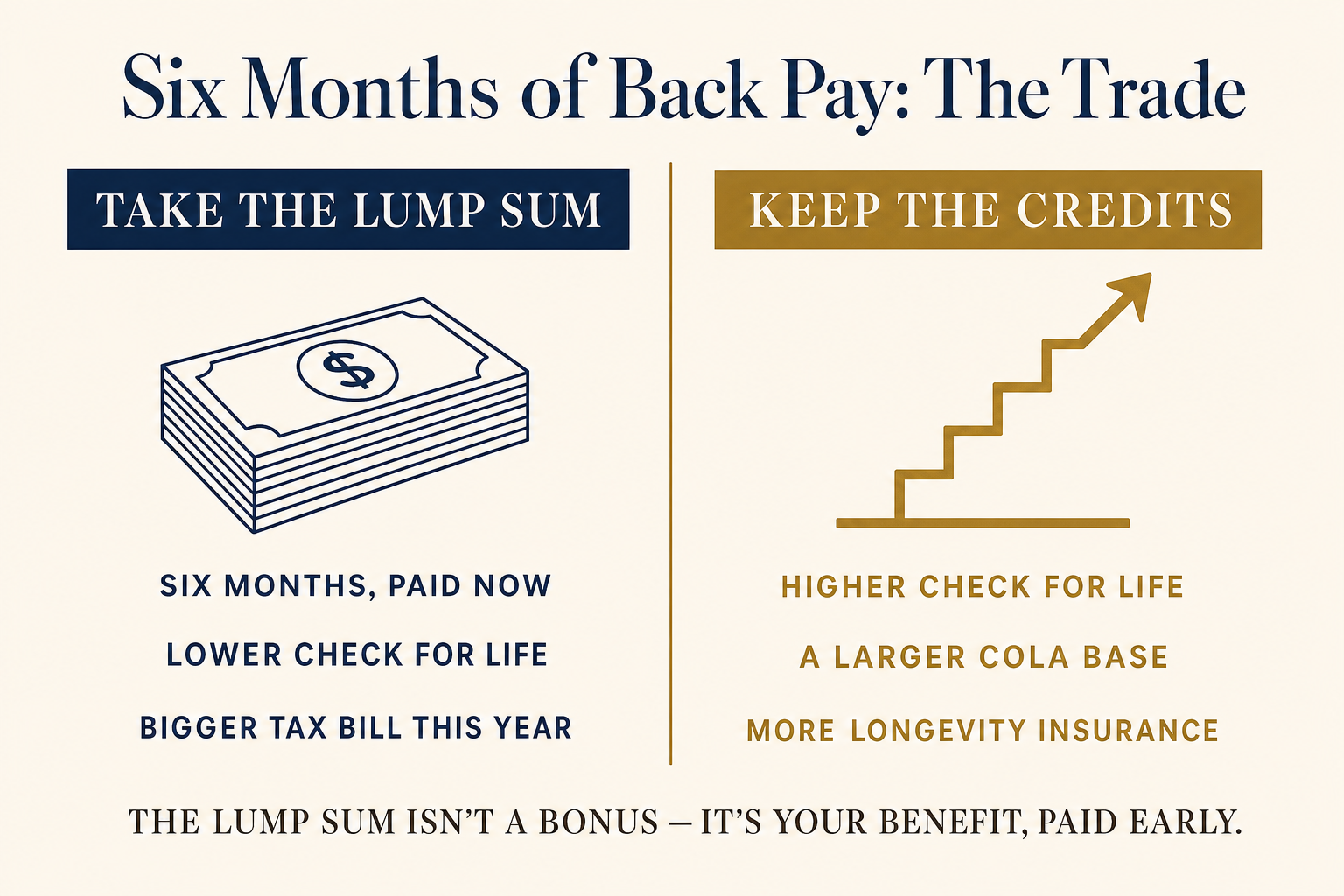
Every month you delay claiming Social Security past your full retirement age earns you a delayed retirement credit. Those credits are worth two-thirds of one percent per month — 8% for a full year — and they’re permanent. Wait from 67 to 70 and your monthly check is 24% larger, every month, for the rest of your life, with every future cost-of-living adjustment calculated on the bigger number.
When you accept six months of retroactive benefits, you are telling Social Security to treat your claim as if you filed six months earlier than you actually did. That means you forfeit six months of delayed retirement credits. Per AARP’s breakdown of the rule, that’s roughly a 4% permanent cut to your monthly benefit — two-thirds of a percent for each of the six back-paid months. The SSA’s own planner confirms the mirror image of this: the credits you give up would otherwise have raised your check for life.
The lump sum, in other words, is not a bonus layered on top of your benefit. It is six months of your benefit, paid early, in exchange for a smaller benefit forever.
Run the math over a real retirement
Consider a hypothetical case with round, illustrative numbers: Daniel, 67 and a half, files for Social Security six months after his full retirement age. His benefit at full retirement age would have been about $3,000 a month, and by waiting the extra six months he’d earned his way up to roughly $3,120.
The representative offers him six months of back pay: six times $3,000, or about $18,000, as a lump sum. If he takes it, his monthly check resets to the $3,000 figure — about $120 a month less than the $3,120 he’d otherwise lock in — and it stays lower for the rest of his life.
Eighteen thousand dollars today against $120 a month gone forever. Divide one by the other and the break-even lands at 150 months — twelve and a half years. If Daniel lives past roughly 80, declining the lump sum leaves him ahead, and the longer he lives, the wider the gap grows, because each year’s cost-of-living adjustment compounds on the larger base he’d have kept. Over a 20-year retirement, the $120-a-month difference adds up to more than $28,000 in benefits he traded away for an $18,000 check up front.
This is the same logic behind why I tell people the decision to delay Social Security is really a purchase of longevity insurance, not a bet. A larger guaranteed, inflation-adjusted check is worth the most precisely in the long-life scenario you can’t rule out — the one where you need the income most. The lump sum quietly sells that insurance back at a discount.
The tax and Medicare surprise
There’s a second cost that catches people off guard. That $18,000 lands in a single tax year, all at once. Social Security back pay is taxable the same way ordinary benefits are, and a sudden lump sum can shove more of your total benefits into the taxable column — up to 85% of them — and can even spike the income figure Medicare looks back on two years later to set your Part B and Part D premiums.
Thomas’ Take: A windfall that raises your taxes and your Medicare premiums while permanently lowering your Social Security check is not a windfall. It’s a bill with good lighting. The only way to know what it does to your specific numbers is to run them before you sign, not after the deposit clears.
When taking the lump sum is actually the right call
This isn’t an absolute rule, and anyone who tells you to never take retroactive benefits is skipping the cases where they make sense. There are a few.
If your health has genuinely changed and you have real reason to expect a shorter-than-average retirement, the math flips. You may not reach that twelve-and-a-half-year break-even, and getting six months of benefits in hand now is the better outcome. The same is true if you’re facing a real, immediate cash need — a medical bill, a critical home repair — where $18,000 today solves a problem that a slightly larger monthly check does not.
And if you never intended to earn delayed credits past your full retirement age in the first place — you meant to file at 67, life got busy, and you’re filing a few months late by accident — then the retroactive payment simply makes you whole for benefits you’d have taken anyway. In that case it isn’t a trade at all. Take it.
The mistake isn’t accepting the lump sum. The mistake is accepting it reflexively, because a stranger at a desk framed it as free money and no one told you it had a price.
The better default
If you’re healthy, you don’t need the cash, and you were deliberately letting your benefit grow, decline the retroactive payment and let your start date stand where you actually filed. You keep the credits you earned and the larger check for life.
Better still, make the decision on purpose instead of at the counter. Full retirement age is not a finish line — it’s just the point where your benefit stops being reduced and starts growing. If you can cover your bills from other sources, every month you wait toward 70 buys more of the one thing a long retirement runs on: guaranteed, inflation-protected income you cannot outlive. That’s the heart of building a reliable income floor, and it’s the reason the claiming decision deserves more than a snap judgment.
Before you file — and before you say yes to any lump sum — it’s worth running your own claiming ages and seeing what the numbers actually do. You can model different start dates with our free Social Security calculator to see the lifetime difference for your own benefit before anyone offers you a check.
The bottom line
The retroactive lump sum is the one moment in the Social Security process where the system makes the expensive choice feel like a gift. Six months of back pay sounds like a reward for waiting. What it actually does is undo the waiting — resetting your benefit lower, for good, and handing you a taxable chunk of your own money early. For a few people with shortened horizons or urgent needs, that’s a fair trade. For most people filing a little past full retirement age, the smartest thing you can say to that friendly offer is “no, thank you.” Knowing it’s a trade and not a bonus is the whole game.
Key takeaways
- Retroactive Social Security benefits are only available for months after your full retirement age, capped at six months of back pay.
- Accepting the lump sum resets your claim date earlier and permanently lowers your monthly benefit by roughly 4% for a full six-month payment — for life, with every future COLA built on the smaller number.
- The back pay arrives in one tax year, which can raise how much of your benefits are taxed and affect your Medicare premiums two years later.
- Taking it can make sense with a shortened life expectancy or an urgent cash need; for most healthy filers who meant to delay, declining it is the better default.
Frequently asked questions
Can I get retroactive Social Security benefits before my full retirement age?
No. Retroactive retirement benefits are only payable for months on or after full retirement age, and never for more than six months. The rules don’t allow back pay that would reach into the reduced-benefit years before full retirement age.
Is the lump sum taxable?
Yes. Back pay is taxed like any other Social Security benefit, and because it all arrives in one year, it can push more of your total benefits into the taxable range and influence the income Medicare uses to set your premiums. How much depends on your other income that year.
If I decline the lump sum, do I lose that money?
You’re not losing anything you were owed — you’re choosing to keep the larger monthly benefit instead of trading it for a one-time payment. Declining the back pay simply lets your benefit stay at the higher amount your delayed credits earned.
This article is published by Confluence Media Group LLC, an independent publisher of educational financial content. Thomas Clark is a Series 65 Investment Advisor Representative. The information provided is for educational and informational purposes only and is not personalized financial, tax, or legal advice. Past performance does not guarantee future results. All investing involves risk, including potential loss of principal. Consult a qualified professional before making financial decisions.
Confluence Media Group LLC is a separate entity from Confluence Capital Management, the investment advisory practice through which Thomas Clark provides advisory services. Advisory services are not offered through this publishing platform.
About Thomas Clark
Thomas Clark is the founder of Confluence Media Group LLC and a Series 65 Investment Advisor Representative. He has spent nearly two decades working with families on retirement planning, with a focus on Social Security optimization, retirement income coordination, and the bucket planning approach to building a guaranteed income floor.
Thomas writes and publishes at thomasclarkadvisor.com and is the author of The Just in Case Binder — a 148-page printable family financial organizer for households who want to make sure the people they love know where everything is.
He lives in North Carolina with his family.
Subscribe to the weekly newsletter · Get the Just in Case Binder

Thomas Clark is a Series 65 licensed investment advisor and experienced trader. He specializes in investing, retirement planning, and market analysis, helping individuals build wealth and make informed financial decisions.
