
Full Retirement Age Is 67 in 2027. It’s Not a Deadline.
In 2027, Social Security's full retirement age finishes its climb to 67 for everyone born in 1960 or later. Here's what that number really means — and why it was never the deadline most people assume.

In 2027, something that began in 1983 finally finishes. Everyone newly reaching full retirement age that year will have a full retirement age of exactly 67 — the last step in a phase-in Congress set in motion more than four decades ago. If you were born in 1960, this is your year.
Here is the part almost nobody gets right: reaching full retirement age does not mean it’s time to claim. Full retirement age is the single most misunderstood number in Social Security. It isn’t a deadline. It isn’t a reward for waiting. It’s a reference point — the age at which your benefit equals exactly what the formula says it should, with no reduction and no bonus. Treat it as a finish line and it can quietly cost you tens of thousands of dollars over a retirement.
What actually changes in 2027
The 1983 Social Security amendments gradually pushed full retirement age up from 65. The increase ran in two-month steps tied to birth year, and it ends at 67 for anyone born in 1960 or later. People born in 1960 turn 67 in 2027, which makes next year the moment the climb is officially over. From then on, 67 is simply the number — for every cohort that follows, with no further increases scheduled.
There’s one quirk worth knowing. Social Security treats anyone born on January 1 as belonging to the prior year, so a January 1, 1960 birthday uses the 1959 rule — a full retirement age of 66 and 10 months. For everyone else born that year and after, it’s a clean 67. Nothing dramatic flips for people already retired. What 2027 really offers is a clean moment to understand a number most people have been quietly misreading for years.
What full retirement age actually is
Every retirement benefit is built on one figure the Social Security Administration calls your Primary Insurance Amount, or PIA. That’s the benefit you’d receive if you claimed exactly at full retirement age — not a penny more, not a penny less. Full retirement age is just the age where you collect 100% of that number.
Claim before it, and your benefit is permanently reduced. Claim after it, and your benefit permanently grows. That’s the entire function of the age: it’s the hinge the whole system swings on. It is not the age the government is steering you toward, and it is not the point where waiting stops paying off. Those are the two assumptions that do the damage, and both are wrong. I wrote more about the second one in why you should never delay Social Security past 70 — the credits really do stop there, but not before.
The three things your full retirement age quietly controls
Full retirement age earns your attention not as a date to act on, but as the anchor for three separate pieces of math. Understand these and the claiming decision stops feeling like a coin flip.
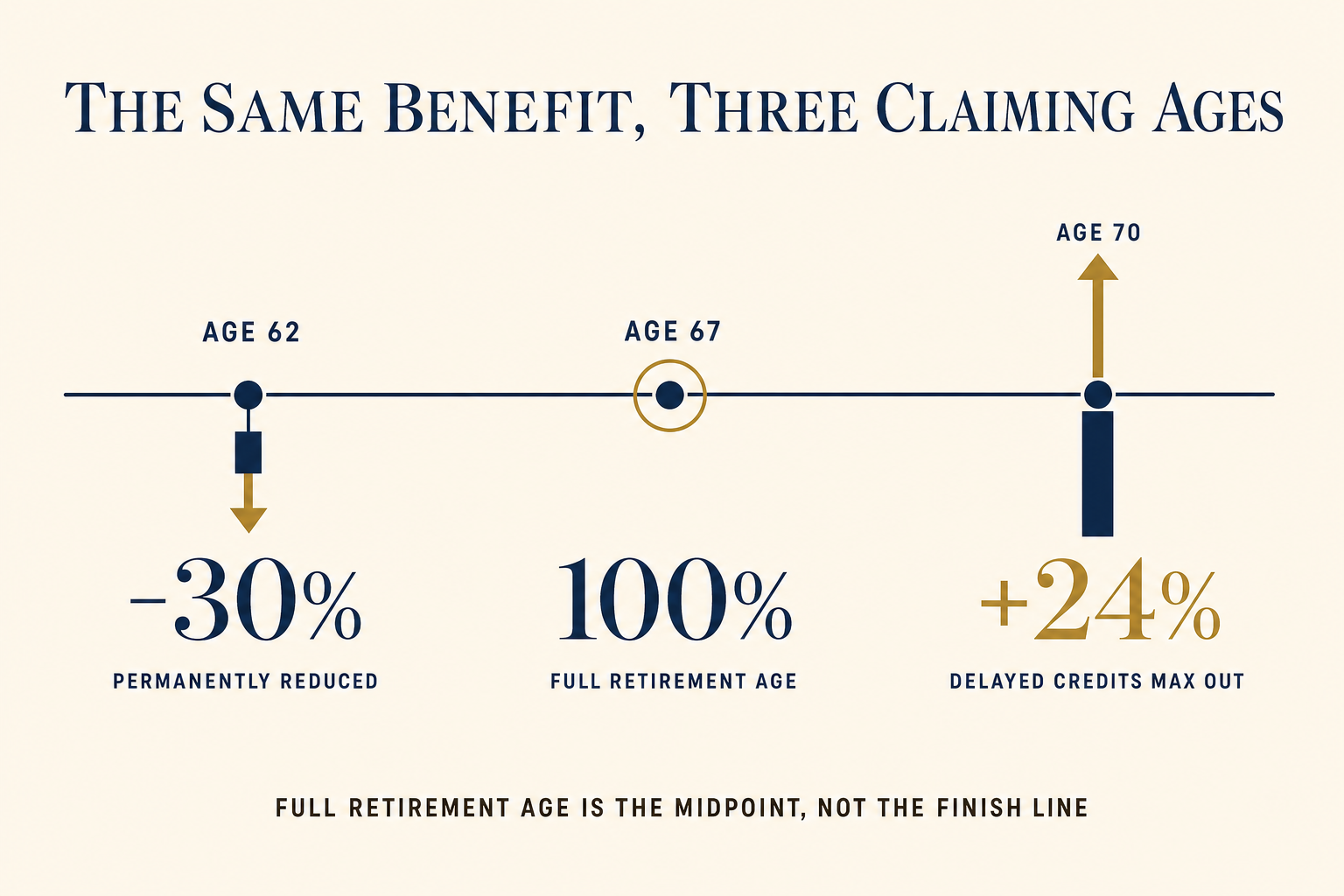
First, it sets the cost of claiming early. With a full retirement age of 67, claiming at 62 cuts your benefit by about 30%, and that cut is permanent — it doesn’t snap back when you reach 67 later. The reduction isn’t linear, either. The Social Security Administration docks your benefit by five-ninths of one percent for each of the first 36 months you claim early, then by five-twelfths of one percent for every month beyond that. The practical takeaway: the earliest years are the most expensive ones to give up.
Second, it sets the reward for waiting. From full retirement age to 70, your benefit grows through delayed retirement credits worth about 8% a year. For the 67 cohort, that’s up to 24% above your PIA if you hold out until 70. This isn’t a market return you’re hoping for — it’s a guaranteed, government-set increase, which is a rare thing to be offered in retirement. It’s also why claiming early to invest the difference rarely works out the way people expect.
Third, it anchors what your spouse and your survivor receive. A spousal benefit tops out at 50% of your PIA — your full-retirement-age number — when your spouse claims at their own full retirement age. And a survivor inherits the benefit you were actually receiving, including every delayed credit you earned by waiting. Delaying isn’t only a bet on your own longevity; it’s a raise for the person who outlives you. That’s the piece most people miss, and it’s the heart of how the 50% spousal rule works.
One more thing ties all three together: the annual cost-of-living adjustment compounds on whatever base you lock in. A larger starting benefit means every future COLA is calculated on a bigger number, for the rest of your life and your survivor’s.
If you want to see what these adjustments look like against your own numbers, I built a free Social Security calculator that lays your estimated benefit at 62, at full retirement age, and at 70 side by side. Seeing the three figures next to each other does more to clarify the decision than any article can.
A hypothetical worth walking through
Consider a hypothetical case: Dennis, born in 1960, turns 67 in 2027. He’s still working part-time, enjoys it, and doesn’t strictly need the income yet. His full-retirement-age benefit works out to a round $2,600 a month. Because he’s hit full retirement age, he feels a pull to go ahead and file — after all, this is the age, isn’t it?
Look at what the hinge does to his number. Had he claimed back at 62, he’d be collecting roughly $1,820 a month, locked in for life. If instead he waits until 70, his benefit grows to about $3,224 — the same person, the same earnings record, a difference of more than $1,400 a month between the earliest and latest choice. (These figures are illustrative and rounded to keep the math clear.)
The point isn’t that Dennis should automatically wait. It’s that hitting full retirement age told him almost nothing about the right move. The actual question is whether his guaranteed income already covers the bills he has to pay no matter what the market does. If it doesn’t, those delayed credits are among the cheapest guaranteed income he’ll ever be able to buy.
The decision full retirement age can’t make for you
This is where I come back to how I think about retirement income. I build plans around an income floor — the layer of guaranteed money that covers your essential expenses no matter what stocks do in any given year. Social Security usually sits at the center of that floor, alongside any pension and, for some households, an income-focused fixed index annuity. It’s typically the largest, most durable, inflation-adjusted piece a retiree has.
Thomas’ Take: Delaying Social Security isn’t about squeezing out a bigger number for its own sake. It’s the most reliable way to widen your guaranteed income floor — the money that lets you stop flinching every time the market has a bad week. When your grocery bill doesn’t depend on the S&P 500, every other financial decision gets easier.
So the real question at full retirement age isn’t “have I reached it?” It’s “what does my floor still need?” If your essentials are already covered from other sources, claiming at full retirement age to leave your portfolio alone can be a perfectly sound choice. If they’re not, waiting often buys more security than any other move available to you. This is a genuine tradeoff, and the variables that decide it are specific: your health and family longevity, whether you’re married and who’s likely to be the survivor, whether you’re still working and brushing up against the earnings test, and whether you have a bridge of savings to carry you through the waiting years.
Key takeaways
- In 2027, full retirement age finishes its climb at 67 for everyone born in 1960 or later — the completion of a schedule set in 1983.
- Full retirement age is a reference point, not a deadline: it’s the age you collect 100% of your PIA, with reductions before and credits after.
- For the 67 cohort, claiming at 62 cuts the benefit roughly 30%; waiting to 70 adds up to 24% — both permanent, and both passed on to a survivor.
- The claiming decision should be driven by your guaranteed income floor, not by the date on your statement.
Next year just makes 67 official for good. But the age printed on your Social Security statement under “full retirement age” was never an instruction. It’s the midpoint of a range that runs from 62 to 70, and where you land inside that range is one of the highest-leverage money decisions you will ever make. The number isn’t telling you to act. It’s handing you a choice — so make it on purpose.
This article is published by Confluence Media Group LLC, an independent publisher of educational financial content. Thomas Clark is a Series 65 Investment Advisor Representative. The information provided is for educational and informational purposes only and is not personalized financial, tax, or legal advice. Past performance does not guarantee future results. All investing involves risk, including potential loss of principal. Consult a qualified professional before making financial decisions.
Confluence Media Group LLC is a separate entity from Confluence Capital Management, the investment advisory practice through which Thomas Clark provides advisory services. Advisory services are not offered through this publishing platform.
About Thomas Clark
Thomas Clark is the founder of Confluence Media Group LLC and a Series 65 Investment Advisor Representative. He has spent nearly two decades working with families on retirement planning, with a focus on Social Security optimization, retirement income coordination, and the bucket planning approach to building a guaranteed income floor.
Thomas writes and publishes at thomasclarkadvisor.com and is the author of The Just in Case Binder — a 148-page printable family financial organizer for households who want to make sure the people they love know where everything is.
He lives in North Carolina with his family.
Subscribe to the weekly newsletter · Get the Just in Case Binder

Thomas Clark is a Series 65 licensed investment advisor and experienced trader. He specializes in investing, retirement planning, and market analysis, helping individuals build wealth and make informed financial decisions.
