
Why You Should Never Delay Social Security Past 70
Delayed retirement credits stop at age 70. Waiting longer adds nothing and can cost you benefits you never get back. Here's why you claim at 70.

A reader told me recently that he was proud of himself for “still holding out” on Social Security at 71. He figured every month he waited was buying him a bigger check down the road. I had to be the one to tell him the hard part: his benefit stopped growing more than a year ago, and every check he skipped in the meantime is gone for good.
Waiting to claim Social Security is one of the most powerful moves a retiree can make. But it is a strategy with a hard expiration date. At age 70, the reward for patience ends completely. Wait one day longer and you get nothing extra for it — you just give up income you were entitled to collect. This is one of the few retirement decisions where the right answer is genuinely simple: if you have made it to 70 without claiming, claim now.
Why waiting is usually smart — up to a point
To understand why 70 is the ceiling, it helps to see what delaying actually buys you on the way there. Your full retirement age, or FRA, is the age at which you receive 100% of your earned benefit. For most people retiring today, that is somewhere between 66 and 67, depending on birth year.
Claim before FRA and your benefit is permanently reduced. Claim after FRA and the Social Security Administration adds delayed retirement credits — an increase of two-thirds of 1% for every month you wait, which works out to about 8% a year. Stretch that across the full window and the numbers get serious. For someone with an FRA of 67, the benefit at 70 is roughly 77% larger than it would have been at 62, and about 24% larger than the FRA amount itself. The Social Security Administration lays out this math in its guide to delayed retirement credits.
That larger number then does double duty. Every future cost-of-living adjustment is calculated on the bigger base, so delaying quietly amplifies every raise you will ever get — including the 3.6% COLA coming in 2027. And because a surviving spouse steps up to the higher earner’s full benefit, delaying protects household income for two lifetimes, not just one. This is exactly why I treat a delayed benefit as the anchor of the Soon bucket: it is the largest block of inflation-adjusted, guaranteed income most households will ever own.
At 70, the increases stop — completely
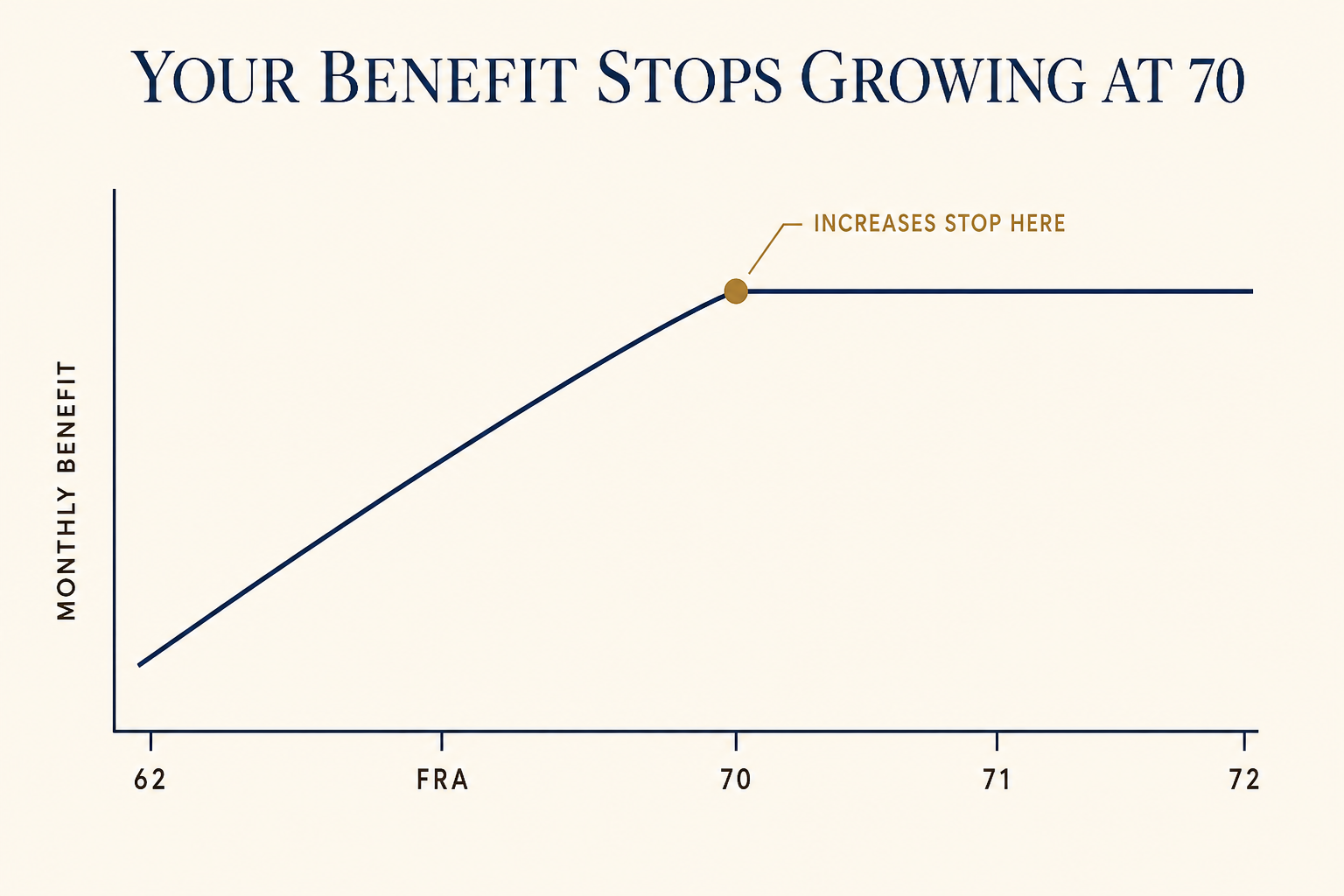
Here is the part the proud 71-year-old had missed. Delayed retirement credits stop accruing the month you turn 70. There is no credit for month 71, or 72, or any month after. The Social Security Administration is explicit about it: the benefit increase for waiting no longer applies once you reach age 70, even if you keep delaying.
The only thing that keeps growing after 70 is the annual cost-of-living adjustment — and you receive those COLAs whether you have claimed your benefit or not. In other words, waiting past 70 buys you nothing the system wouldn’t have given you anyway. You are simply choosing to leave each monthly check on the table.
Thomas’ Take: Delaying Social Security is a raise you earn by waiting. At 70 the raises are done. Waiting past 70 isn’t patience — it’s just declining money you’ve already earned.
Waiting past 70 doesn’t stall. It leaks.
People assume that if they file a little late, Social Security will simply “catch them up.” It mostly won’t. The agency will pay a lump sum of retroactive benefits, but only for a maximum of six months, and never for any month before your full retirement age. The rules are spelled out in the SSA’s retirement benefits materials.
So picture someone who meant to file at 70 but didn’t get around to it until 71 — twelve months late. When they finally apply, the six-month retroactive window recovers half of those missed checks. The other six months are gone permanently. There is no appeal, no make-up payment, no interest. The money simply never existed as far as the system is concerned.
Consider a hypothetical retiree named Margaret, age 71. Her benefit at 70 worked out to a round $3,000 a month, and she assumed letting it “ride” would keep adding to it. It didn’t — it stopped growing at 70. By the time she files, she has gone a full year without a single check. The six-month lookback pays her $18,000 in a lump sum, but the first six months of the year — another $18,000 — are lost for good. That is a hard tuition bill for a misunderstanding about how the credits work.
The one situation where filing “late” isn’t a disaster
I want to be fair, because there are genuine “it depends” moments in Social Security planning — when to claim between 62 and 70 is one of them, and I have written about why the usual break-even math is the wrong question for that decision. But waiting past 70 is not one of those moments. There is no benefit-math scenario where holding out past 70 pays you more.
The only non-catastrophic version of “late” is administrative: you turned 70, life got busy, and you file a few months afterward. In that case the six-month retroactive payment can make you whole, as long as you don’t drift beyond six months. File the moment you notice. Don’t wait for a tidier time.
One important distinction: deciding not to claim past 70 is different from voluntarily suspending a benefit you’ve already started. Suspension is a specific, intentional strategy with its own rules. Simply never filing is not a strategy — it’s an oversight, and an expensive one.
How to claim at 70 the right way
The mechanics are simple if you plan a few months out. The Social Security Administration lets you apply up to four months before you want benefits to begin, so the clean move is to set a reminder for roughly three to four months before the month you turn 70. File in that window, ask for benefits to start the month you reach 70, and your full set of delayed credits is baked in from the very first payment.
If you’re married, this is also the moment to confirm the survivor math works the way you intend, because the higher earner’s age-70 benefit becomes the floor the surviving spouse lives on. That coordination is the heart of the claiming decision that protects your spouse, and it’s worth getting right while both of you are around to decide it together.
If you want to see what claiming at 70 does to your own numbers — and how that guaranteed income lines up against your essential expenses — you can model it with the free Social Security calculator on the site. It’s built to show the tradeoffs across claiming ages, including the point where the growth flatlines.
Key takeaways
- Delayed retirement credits add about 8% a year between full retirement age and 70 — and then stop entirely at 70.
- After 70, only the annual COLA increases your benefit, and you get that whether you’ve claimed or not.
- File late and the SSA pays at most six months of retroactive benefits, never reaching back before full retirement age. Everything beyond six months is lost permanently.
- Apply up to four months before your 70th birthday month so your first check reflects the full credits.
- Delaying past 70 is not a strategy. If you’ve made it to 70 unclaimed, claim now.
Frequently asked questions
Does my benefit keep growing after 70 because of cost-of-living adjustments?
Yes, but that growth is the COLA, not delayed retirement credits — and COLAs apply to your record whether or not you’ve filed. Waiting past 70 doesn’t earn you an extra COLA; it only costs you the checks you skip.
I’m already past 70 and never filed. What should I do?
File now, and ask about the six-month retroactive lump sum when you apply. You can recover up to six months of missed payments, but not more, so there’s no reason to wait another day.
Is there ever a reason to delay past 70?
Not for the benefit math. The increases are finished at 70. The only “late” filing that doesn’t cost you is one you correct within six months.
Social Security is one of the rare corners of retirement planning where patience is richly rewarded — right up until it isn’t. The system draws a bright line at 70 and stops paying you to wait. The retirees who come out ahead aren’t the ones who hold out the longest. They’re the ones who understand exactly when the waiting is supposed to end — and then collect what they’ve spent a lifetime earning.
This article is published by Confluence Media Group LLC, an independent publisher of educational financial content. Thomas Clark is a Series 65 Investment Advisor Representative. The information provided is for educational and informational purposes only and is not personalized financial, tax, or legal advice. Past performance does not guarantee future results. All investing involves risk, including potential loss of principal. Consult a qualified professional before making financial decisions.
Confluence Media Group LLC is a separate entity from Confluence Capital Management, the investment advisory practice through which Thomas Clark provides advisory services. Advisory services are not offered through this publishing platform.
About Thomas Clark
Thomas Clark is the founder of Confluence Media Group LLC and a Series 65 Investment Advisor Representative. He has spent nearly two decades working with families on retirement planning, with a focus on Social Security optimization, retirement income coordination, and the bucket planning approach to building a guaranteed income floor.
Thomas writes and publishes at thomasclarkadvisor.com and is the author of The Just in Case Binder — a 148-page printable family financial organizer for households who want to make sure the people they love know where everything is.
He lives in North Carolina with his family.
Subscribe to the weekly newsletter · Get the Just in Case Binder

Thomas Clark is a Series 65 licensed investment advisor and experienced trader. He specializes in investing, retirement planning, and market analysis, helping individuals build wealth and make informed financial decisions.
