
Should You Claim Social Security Early and Invest It?
Claiming Social Security at 62 and investing the difference sounds like a smart move. Here is the math on why it rarely beats simply waiting.

Here’s a pitch you’ve probably heard, maybe from a neighbor, maybe from a corner of the internet that’s very confident about money: claim Social Security the moment you turn 62, invest every check instead of spending it, and you’ll come out ahead of the person who waited. You get your money sooner, you put it to work in the market, and compounding does the rest. Why hand the government an interest-free loan by waiting?
It’s a seductive argument because it sounds sophisticated. It treats your benefit like investable capital and dares you to be the smart one. But run the actual math, and it rarely works — not because investing is bad, but because of what you’d have to beat, and the risk you’d have to take to try.
The argument, stated fairly
Let’s give it its due, because there’s a real idea in there. If your full retirement age is 67 — which it is for anyone born in 1960 or later — you can start benefits as early as 62 at a permanently reduced rate. Claim early, the thinking goes, and you collect eight extra years of checks you’d otherwise forgo by waiting until 70. Invest those checks in a diversified portfolio, let them grow, and the early head start plus market returns should beat the larger-but-later benefit the delayer gets.
On paper, with a high enough assumed return and a short enough life, the early-and-invest path can win. That’s the whole case. The problem is every word doing the heavy lifting in that sentence: “high enough,” “assumed,” and “short enough.”
The hurdle you’re actually trying to beat
Start with what you give up by claiming early. At a full retirement age of 67, claiming at 62 locks your monthly benefit at 70% of your full amount — a permanent 30% cut. Waiting instead earns delayed retirement credits of 8% per year up to age 70, which brings the check to 124% of your full benefit. Claiming at 70 instead of 62 is worth about 77% more, every month, for life.
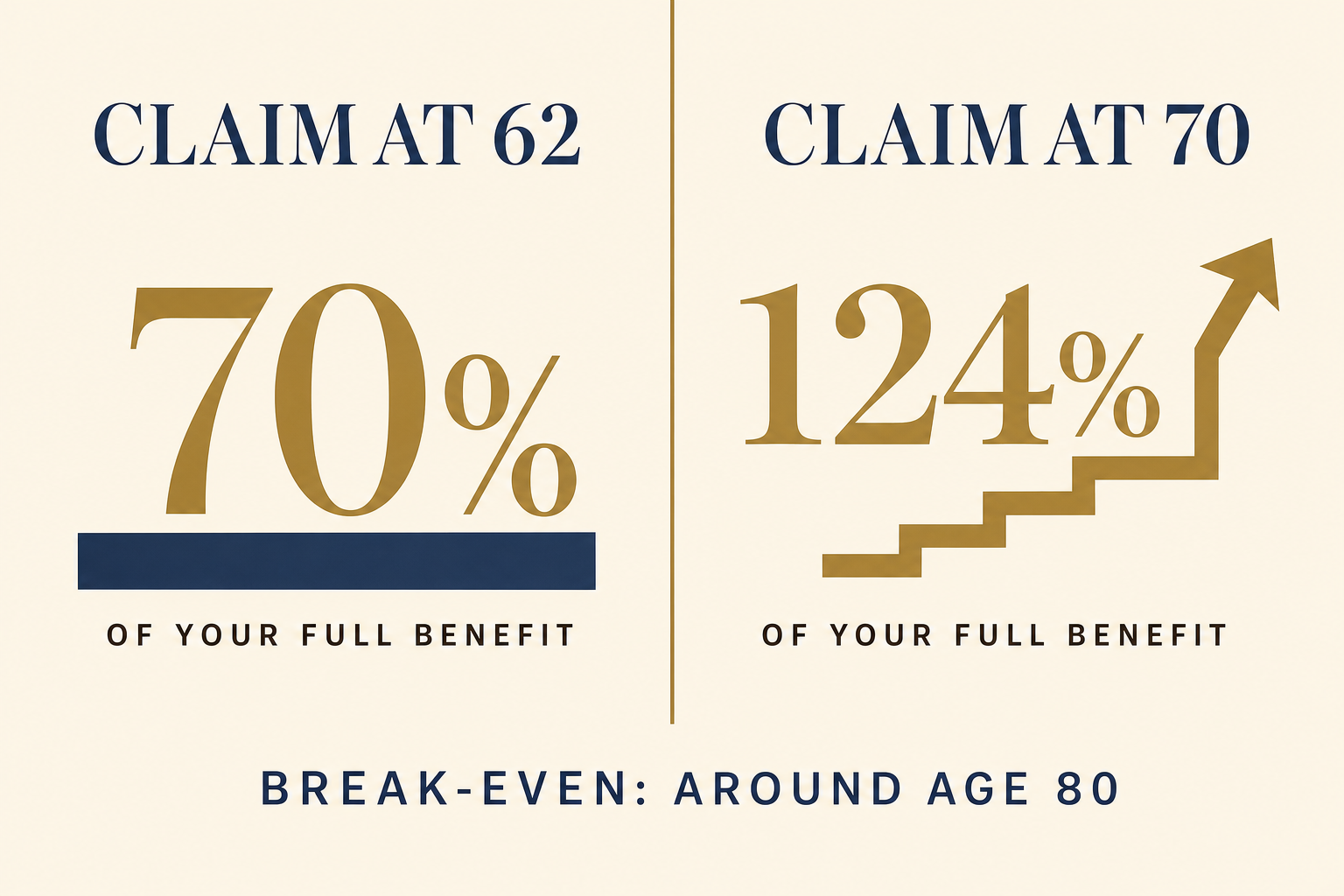
That 8%-per-year increase is the hurdle. It’s a guaranteed, government-backed raise, and on top of it every annual cost-of-living adjustment compounds on the larger base. So the “invest the difference” plan isn’t competing against a savings account. It’s competing against a guaranteed increase of roughly 8% a year plus inflation adjustments, with no market risk at all.
To beat that by investing, your portfolio has to clear that same bar reliably — after taxes, after fees, and through whatever the market actually does in your 60s. A guaranteed 8% raise is a genuinely hard return to beat with any investment you’d want a near-retiree holding. You can hope to beat it. You cannot count on it. And “hope” is a poor foundation for the income that pays your bills for the rest of your life.
The risk the pitch never prices in
Even if the long-run averages were on your side, the “invest it” plan asks you to take market risk at the worst possible moment. You’d be moving money into stocks in the years right around when you stop working — exactly the stretch where a bad run does the most lasting damage. Advisors call this sequence-of-returns risk, and it’s the most overlooked weakness in early-retirement math.
Here’s why it bites. A guaranteed benefit has no bad years. It goes up on schedule whether the market soars or crashes. An invested portfolio of early Social Security checks can be down 20% in the exact window you were counting on it to be pulling ahead — and a loss early in the game is far harder to recover from than the same loss later, because you have fewer years of compounding left to repair it. The delayer, meanwhile, got an 8% raise that year regardless. You took the risk; they took the guarantee.
What the pitch quietly ignores
Three more things fall out of the “invest the difference” story, and all of them cut the same way.
The first is the survivor benefit. When one spouse dies, the survivor keeps the larger of the two benefits, not both. A bigger delayed benefit isn’t only income for your life — it’s the floor your spouse lives on if you go first. I’ve written about how the claiming decision protects the surviving spouse, and an invested side account doesn’t replace that guaranteed, inflation-adjusted, lifelong survivor check.
The second is behavior. The plan only works if you actually invest every check and never touch it — through market drops, home repairs, and the ordinary temptations of a dollar sitting in an account. In practice, money claimed early has a way of getting spent rather than invested. A strategy that depends on perfect discipline for a decade is a strategy most people don’t actually run.
The third is taxes. Social Security benefits can be taxable depending on your other income, and the investment gains on the money you’re setting aside get taxed too. The after-tax return you’d need to win is higher than the headline number — one more reason the hurdle is taller than it looks.
When claiming early and investing can actually make sense
This isn’t “always wait.” There are real cases where claiming earlier is the right call — serious health issues that genuinely shorten your expected lifespan, no other income to bridge the gap years, or a single person with a modest benefit and pressing liquidity needs. Those are legitimate reasons to claim early. They just aren’t the “invest it and beat the system” reason.
There’s also a narrow version of the invest-it case that holds up: if you already have more guaranteed income than you need, don’t plan to spend the benefit, and want it invested for heirs with a long time horizon, then claiming early to invest is a deliberate choice to put that money in your growth bucket. That’s a legitimate decision — but notice what it is. It’s not a plan to maximize your retirement income. It’s an estate-and-growth bet you can afford precisely because your own floor is already covered.
That’s the reframe that matters. Regular readers know I think about retirement income in three buckets — Now, Soon, and Later. Delaying Social Security is one of the cheapest, most powerful ways to build the Soon bucket, your guaranteed income floor. “Claim early and invest” is really a proposal to shrink that guaranteed floor and move the money into the Later bucket, where it rides the market. Framed honestly, the question isn’t “can I beat the system?” It’s “do I want to trade guaranteed, inflation-protected lifetime income for a market bet?” For most people covering essential bills, that’s the wrong trade.
Consider a hypothetical case: Dennis, 62, just retired with a full benefit of about $2,400 a month at 67. He’s tempted to claim now — roughly $1,680 a month — and invest every check. His neighbor plans to wait. Dennis isn’t really choosing “more money sooner.” He’s making a bet: that his portfolio will beat a guaranteed 8%-a-year increase plus annual COLAs, after taxes, with no bad years at the start, while also giving up the larger survivor benefit for his wife. Stated that way, it’s a much less obvious trade than the pitch made it sound — and if Dennis has a family history of long lives, as many do, it tilts further toward waiting.
If you want to see what the decision looks like with your own numbers — what you’d collect at 62, at full retirement age, and at 70 — you can run them through the free Social Security calculator on this site before you decide.
Thomas’ Take: I spent years trading, so I have real respect for the instinct to put money to work rather than leave it on the table. But delaying Social Security isn’t leaving money on the table — it’s buying a guaranteed, inflation-protected raise you can’t buy anywhere else. “Claim early and invest it” asks you to take market risk to try to beat a guarantee, at the one stage of life where the guarantee matters most. That’s not the smart-money move it’s dressed up to be. It’s trading your sturdiest income for a maybe.
Key takeaways
- The “claim at 62 and invest the difference” plan only wins on paper with a high assumed return and a short life — both of which are assumptions, not facts.
- Delaying raises your benefit by about 8% per year plus COLAs — a guaranteed, government-backed increase your investments would have to beat reliably, after taxes, to come out ahead.
- Investing early checks means taking market risk in the years around retirement, when a bad run does the most lasting damage. A guaranteed benefit has no bad years.
- The pitch ignores the survivor benefit, the discipline it takes to actually invest every check, and the taxes on both the benefit and the gains.
- Claiming early to invest can make sense if your guaranteed floor is already covered and the money is an estate-and-growth bet — but that’s a different goal than maximizing your retirement income.
Frequently asked questions
Doesn’t the stock market beat 8% a year over the long run?
Over long horizons, a diversified portfolio has historically grown — but “historically, on average, over decades” is not the same as “reliably, after taxes, starting in my 60s, with no bad years at the start.” You’d be relying on average long-run returns to show up exactly when you need them, which is the one thing markets don’t promise. The 8% delayed-credit increase, by contrast, is guaranteed.
Isn’t waiting just betting I’ll live long enough?
It’s the opposite of a bet — it’s insurance. I’ve argued before that the break-even age is the wrong question. Delaying protects you against the expensive outcome, which is living a long time and needing the income to keep coming. “Claim early and invest” leaves you exposed to exactly that risk.
What if Social Security runs out before I collect the bigger benefit?
A fair worry, and I’ve covered what the trustees’ projections actually say. The short version: the program faces a funding shortfall, not a shutdown, and the large majority of scheduled benefits remain payable under current projections. That’s not a reason to lock in a permanently smaller check and take market risk on top of it.
The “claim early and invest it” pitch survives because it flatters your sense of being the smart one in the room. But being smart about Social Security isn’t about outrunning a guarantee with a market bet. It’s about recognizing that a government-backed, inflation-adjusted, lifelong, 8%-a-year raise is one of the best deals in all of personal finance — and you don’t beat a deal like that. You take it.
This article is published by Confluence Media Group LLC, an independent publisher of educational financial content. Thomas Clark is a Series 65 Investment Advisor Representative. The information provided is for educational and informational purposes only and is not personalized financial, tax, or legal advice. Past performance does not guarantee future results. All investing involves risk, including potential loss of principal. Consult a qualified professional before making financial decisions.
Confluence Media Group LLC is a separate entity from Confluence Capital Management, the investment advisory practice through which Thomas Clark provides advisory services. Advisory services are not offered through this publishing platform.
About Thomas Clark
Thomas Clark is the founder of Confluence Media Group LLC and a Series 65 Investment Advisor Representative. He has spent nearly two decades working with families on retirement planning, with a focus on Social Security optimization, retirement income coordination, and the bucket planning approach to building a guaranteed income floor.
Thomas writes and publishes at thomasclarkadvisor.com and is the author of The Just in Case Binder — a 148-page printable family financial organizer for households who want to make sure the people they love know where everything is.
He lives in North Carolina with his family.
Subscribe to the weekly newsletter · Get the Just in Case Binder

Thomas Clark is a Series 65 licensed investment advisor and experienced trader. He specializes in investing, retirement planning, and market analysis, helping individuals build wealth and make informed financial decisions.
