
Will Social Security Be There When You Retire?
The headlines say Social Security is heading for insolvency, and the fear is pushing people to claim early and shrink their benefit for life. Here is what the 2025 Trustees Report actually says — and why you should plan for a haircut, not for zero.

Ask a room full of 58-year-olds whether Social Security will still be around when they retire, and most of them will tell you no. They’ve read the headlines. “Social Security heading for insolvency.” “Trust fund running dry.” “Benefits could vanish.” So they do something that costs them dearly: they claim as early as possible, at 62, to “get theirs before it’s gone.”
That decision is almost always a mistake, and it’s built on a misreading of what the word insolvent actually means for a program funded the way Social Security is. Let me walk you through what the 2025 Trustees Report really says, why your benefit is not going to zero, and how I plan around the one risk that is real.
What “the trust fund runs out” actually means
Here is the part the headlines leave out. Social Security isn’t a savings account with your name on it that empties when the balance hits zero. It’s a pay-as-you-go system. The payroll taxes coming out of today’s workers’ paychecks — that 6.2% you see on your pay stub, matched by your employer — go straight back out the door as this month’s benefit checks.
For decades, Social Security collected more in payroll taxes than it paid out. That surplus built up a reserve, the “trust fund.” Since 2021, the program has been paying out slightly more than it collects, so it’s drawing that reserve down to cover the gap. When people say the trust fund will be “depleted,” they mean that reserve cushion runs out — not that the money stops coming in.
The workers don’t stop paying FICA. The tax doesn’t switch off. Even with an empty reserve, incoming payroll taxes still cover the large majority of promised benefits. The question was never “zero or full.” It’s “full, or a smaller percentage.” That distinction changes everything about how you should plan.
The actual numbers from the 2025 Trustees Report
Every year the program’s trustees publish a report projecting its finances. The 2025 edition is the current one, and the numbers are specific enough to plan around rather than panic over.
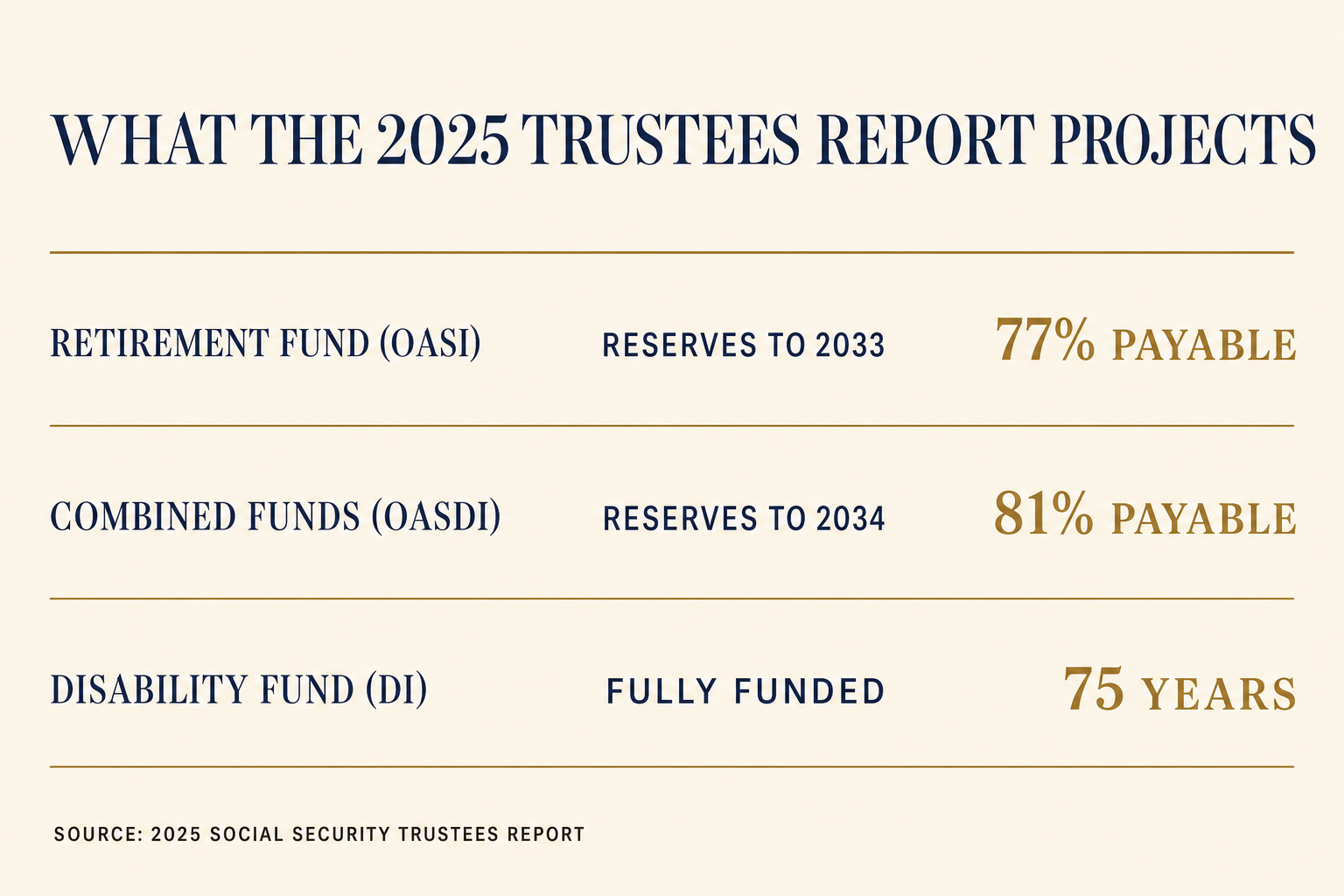
The retirement and survivors fund — the one that pays your retirement check, formally the OASI Trust Fund — is projected to deplete its reserves in 2033. At that point, incoming payroll taxes are projected to cover about 77% of scheduled benefits. In plain terms: if Congress did nothing at all between now and then, the worst-case outcome is roughly a 23% cut, not a shutoff.
Look at the system as a whole and the picture is slightly better. The combined retirement and survivors and disability funds are projected to last until 2034, with about 81% of benefits payable after that. The disability fund on its own isn’t projected to run short at any point in the next 75 years. And even at the very end of that 75-year window, in 2099, the program is projected to still cover about 72% of scheduled benefits on incoming taxes alone.
Across those full 75 years, the shortfall the actuaries have to close is 3.82% of taxable payroll. That’s a real number and a real problem. It is not a doomsday number. It’s the size of the hole Congress has to patch, and it is patchable.
Thomas’ Take: “Insolvent” is an accounting word that got adopted as a scare word. A program that keeps paying three-quarters of its obligations out of continuous tax revenue is not a program that’s disappearing. Plan for a possible trim. Do not plan for zero — planning for zero is how good savers talk themselves into bad claiming decisions.
Why benefits don’t go to zero
The reason is structural, and it’s worth sitting with. As long as people are working and paying into the system, money flows in every pay period. The reserve is a buffer on top of that flow, not the source of it. Draining the buffer reduces the cushion; it doesn’t cut the stream.
For the stream itself to stop, payroll taxation would have to end entirely — something that has never happened and that no serious proposal on either side of the aisle contemplates. The debate in Washington is about how to close a 23% gap, not whether to send checks. Those are very different conversations, and conflating them is what drives the fear.
Congress has fixed this before — and has many levers
We’ve been near this line once already. In 1983, the retirement fund was months from a shortfall. A bipartisan commission and Congress responded with a package of changes — they gradually raised the full retirement age from 65 to 67, brought new federal workers into the system, and made a portion of benefits taxable for higher-income recipients. The fix held for decades.
The levers available today are the same family of options, and I’ll lay them out without endorsing any one of them, because the mix is a political decision, not a planning one. Lawmakers can raise or eliminate the cap on wages subject to the payroll tax (in 2026, earnings above a set ceiling aren’t taxed for Social Security). They can nudge the tax rate up. They can adjust the benefit formula for higher earners, change how cost-of-living increases are calculated, or slowly shift the full retirement age again.
Which combination gets chosen will matter to your check at the margin. But the existence of workable options is the point. The arithmetic here is ordinary, not hopeless.
How to plan when the headline says “insolvent”
So what do you actually do with this? You build a plan that survives a haircut without being wrecked by one, and you refuse to let the fear rush your biggest claiming decision.
Consider a hypothetical case: Karen, 58, a nurse in Charlotte, divorced, with about $450,000 in her 403(b). Her full retirement age benefit at 67 would be roughly $2,600 a month. She’s spooked by the headlines and is leaning toward claiming at 62 — locking in a permanently reduced check of around $1,800 — because, in her words, “at least I’ll have it before they change the rules.”
Here’s the problem with that logic. Claiming at 62 cuts her benefit by about 30% for life — a certain, permanent reduction she’s choosing today to avoid a possible, partial reduction that might happen in 2033, and past changes to the program have generally been phased in for future retirees rather than clawed back from people already receiving checks. She’s trading a guaranteed loss for protection against a maybe. If she instead bridges the gap from her own savings and delays, each year of waiting raises her benefit, and that larger, inflation-adjusted base is exactly the kind of guaranteed income that anchors a retirement plan. Delaying isn’t automatically right for everyone — it assumes you have other money to cover the bridge years and reasonable health to expect a normal life span — but “I’m afraid the system won’t be there” isn’t one of the sound reasons to skip it.
This is where bucket planning does the quiet work. Social Security sits in what I call the Soon bucket — your guaranteed income floor, alongside any pension. The job of that floor is to cover your essential bills no matter what the market or the headlines do. If you’re worried about a future benefit trim, the response isn’t to grab a smaller check early; it’s to make the floor sturdier — delay the larger benefit where you can, and if there’s a gap to a guaranteed-income instrument, that’s the bucket it belongs in. Your Now bucket of cash covers the bridge years so you’re never a forced seller, and your Later bucket stays invested for growth.
Thomas’ Take: The honest way to plan for Social Security uncertainty is to model your plan twice — once at your full scheduled benefit, and once at about 80% of it — and make sure the second version still works. If a 20% haircut would break your plan, the fix is a stronger income floor and a bigger cash cushion, not an early claim locked in out of fear.
If you want to see what delaying versus claiming early actually does to your own numbers, run them before you file — not after. You can model your claiming ages with our free Social Security Calculator and see the difference in black and white.
Key takeaways
- “Trust fund depletion” means the reserve cushion runs out — not that benefits stop. Incoming payroll taxes keep funding most of the program.
- The 2025 Trustees Report projects the retirement fund’s reserves deplete in 2033, with about 77% of benefits payable on taxes alone after that; the combined funds last to 2034 at about 81%.
- The worst-case default outcome is a partial reduction, not a shutoff — and Congress has a known set of levers it has used before, in 1983.
- Claiming at 62 out of fear locks in a roughly 30% permanent cut to avoid a possible future trim that has never hit current beneficiaries.
- Plan for a haircut, not for zero: model your plan at about 80% of your scheduled benefit and make sure it still holds.
Frequently asked questions
If the trust fund runs out in 2033, will my check stop?
No. Projections show incoming payroll taxes would still cover roughly 77% of scheduled retirement benefits even with the reserve gone. A cut of that size would require Congress to do nothing at all for years, which is not how past shortfalls have played out.
Should I claim early to lock in benefits before the rules change?
Claiming early permanently reduces your benefit — by about 30% at 62 versus a full retirement age of 67. In the program’s history, changes have been applied to future retirees and phased in, not clawed back from people already receiving checks. Trading a certain, permanent reduction for protection against a possible, partial one rarely comes out ahead.
Is the disability side of Social Security in trouble too?
No. The disability fund is not projected to run short at any point in the next 75 years, according to the 2025 report. The reserve-depletion concern is specific to the retirement and survivors fund.
The real risk with Social Security was never that it vanishes. It’s that fear of its vanishing makes you claim early, shrink your own guaranteed income for life, and weaken the exact floor that would have carried you through whatever Congress decides. Build the plan that works at 80%. Then let Washington do the arithmetic it has always, eventually, done.
This article is published by Confluence Media Group LLC, an independent publisher of educational financial content. Thomas Clark is a Series 65 Investment Advisor Representative. The information provided is for educational and informational purposes only and is not personalized financial, tax, or legal advice. Past performance does not guarantee future results. All investing involves risk, including potential loss of principal. Consult a qualified professional before making financial decisions.
Confluence Media Group LLC is a separate entity from Confluence Capital Management, the investment advisory practice through which Thomas Clark provides advisory services. Advisory services are not offered through this publishing platform.
About Thomas Clark
Thomas Clark is the founder of Confluence Media Group LLC and a Series 65 Investment Advisor Representative. He has spent nearly two decades working with families on retirement planning, with a focus on Social Security optimization, retirement income coordination, and the bucket planning approach to building a guaranteed income floor.
Thomas writes and publishes at thomasclarkadvisor.com and is the author of The Just in Case Binder — a 148-page printable family financial organizer for households who want to make sure the people they love know where everything is.
He lives in North Carolina with his family.
Subscribe to the weekly newsletter · Get the Just in Case Binder

Thomas Clark is a Series 65 licensed investment advisor and experienced trader. He specializes in investing, retirement planning, and market analysis, helping individuals build wealth and make informed financial decisions.
