
Your Savings Rate Matters More Than Your Returns
Everyone argues about which fund will earn a better return. For most people still building wealth, the number that matters far more is the one they fully control — their savings rate.

Open any investing forum and you’ll find people arguing about the same thing: which fund, which allocation, which account will squeeze out an extra point or two of return. It’s the wrong argument for most people to be having. If you’re still building your savings — in your 20s, 30s, or 40s — the single number that will shape your financial life more than any other isn’t your return. It’s how much of your paycheck you actually keep.
That’s not a motivational line. It’s arithmetic. For the first decade or two of building wealth, your contributions do almost all the work, and your return does almost none. The market gets the attention because it’s exciting and it’s on the news every night. Your savings rate gets ignored because it’s boring and entirely up to you. The order of those two things is backwards.
The number you don’t control vs. the one you do
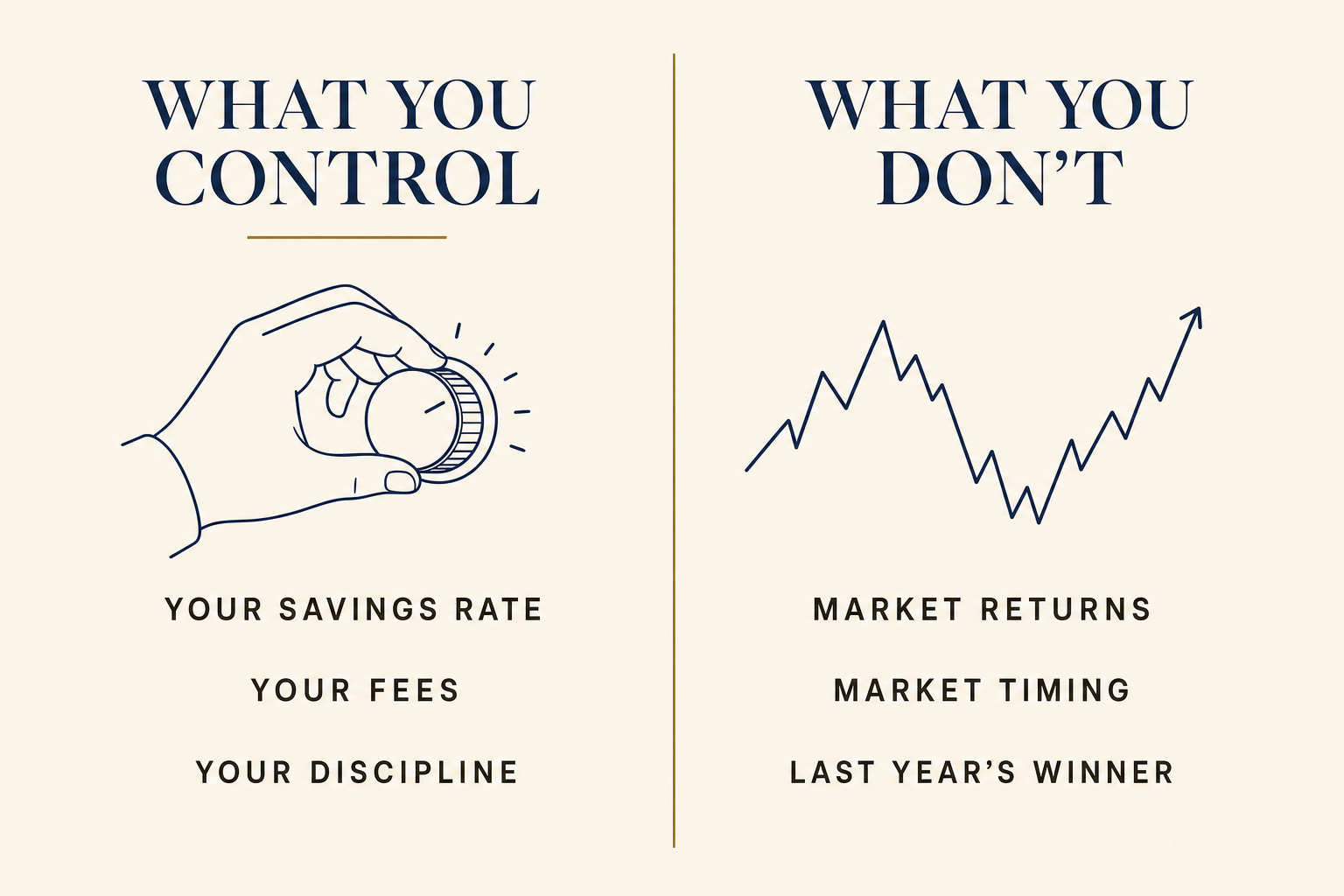
Your investment return is largely out of your hands. You can pick low-cost, broadly diversified funds and hold them — that’s the smart, controllable part — but you cannot decide what the market returns next year. The S&P 500 has historically averaged roughly 10% a year over the long run, closer to 7% after inflation, but that average hides enormous swings. Dimensional’s research found that annual returns landed within two percentage points of the long-term average in only six of the past 99 years. The “average” is something you ride through, not something you dial in.
Your savings rate is the opposite. You decide it. You can raise it this month by cutting a subscription, redirecting a raise, or automating a transfer the day your paycheck lands. It is the most powerful variable in your plan and the only one you fully own — which is exactly why it deserves more of your attention than the fund you picked.
And here’s the uncomfortable backdrop: Americans, on the whole, aren’t saving much. The U.S. personal saving rate has drifted down to roughly 3% of disposable income through 2026, according to the Bureau of Economic Analysis. At 3%, no realistic return bails you out. The lever almost everyone has, almost no one is pulling.
Why your savings rate does the heavy lifting early
The reason is simple once you see it. A return is a percentage of your balance. Early on, your balance is small, so even a great return is a small dollar amount. Your contribution, by contrast, is a flat dollar amount that lands in full every month regardless of what the market did. When the balance is small, the contribution dwarfs the return.
Consider a hypothetical — illustrative numbers, not a projection. Omar and Nadia both start investing at 30. Omar saves $1,000 a month and earns a steady, unremarkable 6% a year. Nadia saves half as much, $500 a month, but assume she’s a gifted stock-picker who earns 10% a year — four full points more than Omar, every single year, which almost no one actually sustains. Who’s ahead, and when?
| Years invested | Omar — saves more (6%/yr) | Nadia — higher return (10%/yr) |
|---|---|---|
| After 10 years | ~$158,000 | ~$96,000 |
| After 20 years | ~$441,000 | ~$344,000 |
| After 30 years | ~$949,000 | ~$987,000 |
Look at the first row. Ten years in, Omar — the ordinary saver with the ordinary return — is ahead by more than sixty thousand dollars. Nadia’s superior return hasn’t caught up because, for a decade, she simply had less money working. The return advantage is real, but it’s a percentage of a smaller pile.
When returns finally take over — and why it’s later than you think
Notice what it takes for Nadia’s higher return to win. She needs three decades, and she needs to beat Omar by four points a year the entire time without a single stretch of underperformance. Even then, at year 30, she’s only narrowly ahead. That is the most favorable case you can build for the “chase returns” side of the argument, and it still loses for twenty-plus years.
This is the part that gets the emphasis backwards in so much personal-finance content. Compounding is extraordinary — but it’s extraordinary at the end, after decades of contributions have built a balance large enough for the percentage to matter. The U.S. Securities and Exchange Commission’s investor education site, Investor.gov, has a free compound-interest calculator that makes this visible: slide the years out, and the return assumption only starts to dominate in the later years. Early on, the contribution line is doing the work.
So the practical sequence is: your savings rate builds the pile; compounding eventually takes over and runs with it. You can’t skip to the second part. And the thing that gets you to the second part faster isn’t a hotter fund — it’s a higher savings rate for longer.
What this actually means for you
If you’re in the building years, stop optimizing the last 1% of your return before you’ve maximized the part you control. Three moves matter more than fund selection. Automate your contributions so the decision happens once, not monthly — and if you save in a 401(k), pace those contributions across the year so you don’t accidentally cut off an employer match by front-loading it. Raise the rate whenever your income rises, before lifestyle absorbs the raise. And protect your return from the leaks you do control, chiefly fees, because a seemingly small annual fee quietly compounds into a large share of your ending balance.
Thomas’ Take: This is the same lesson that kept me solvent as a trader. You never control whether a given trade works — the market decides that. What you control is your position size, your costs, and your discipline. The traders who blew up were the ones obsessed with being right on direction; the ones who lasted managed the inputs they owned and let the outcomes average out. Wealth-building is the same game at a slower speed. Control the savings rate and the costs. Let the market’s return be what it’s going to be.
Run it on your own numbers
Averages make a nice argument, but your plan runs on your figures — your income, your real savings rate, the raises you expect, the years you have. The honest way to settle how much your savings rate matters in your case is to model it: hold the return flat and watch what happens to your ending balance when you move the savings rate up a few points, then do the reverse. A planning tool like ProjectionLab lets you build both versions with your actual numbers and see which lever moves your outcome more over the years you actually have. Seeing it on your own figures lands differently than reading someone else’s table.
Disclosure: the ProjectionLab link above is an affiliate link. If you subscribe through it, I may earn a commission at no additional cost to you. I only point to tools I’d actually sit down and use.
Key takeaways
- For the first 20-plus years of building wealth, how much you save moves your balance far more than what you earn on it — because your contribution dwarfs the return when the balance is still small.
- Your return is mostly out of your control; your savings rate is entirely in it. Spend your energy where you have leverage.
- A higher return only decisively wins over very long horizons, and only if you actually sustain it — which almost no one does.
- Automate contributions, raise the rate with every pay bump, and cut the fees you control. Those three beat fund-picking for most people.
The investing world will always sell you the exciting number — the fund that beat its benchmark, the strategy that printed money last year. The boring number is the one that builds the house. You can’t control what the market hands you, but you can decide, this month, to keep more of what you earn and put it to work. For most people with time on their side, that single decision outweighs every clever thing they’ll ever do with the money afterward.
This article is published by Confluence Media Group LLC, an independent publisher of educational financial content. Thomas Clark is a Series 65 Investment Advisor Representative. The information provided is for educational and informational purposes only and is not personalized financial, tax, or legal advice. Past performance does not guarantee future results. All investing involves risk, including potential loss of principal. Consult a qualified professional before making financial decisions.
Confluence Media Group LLC is a separate entity from Confluence Capital Management, the investment advisory practice through which Thomas Clark provides advisory services. Advisory services are not offered through this publishing platform.
About Thomas Clark
Thomas Clark is the founder of Confluence Media Group LLC and a Series 65 Investment Advisor Representative. He has spent nearly two decades working with families on retirement planning, with a focus on Social Security optimization, retirement income coordination, and the bucket planning approach to building a guaranteed income floor.
Thomas writes and publishes at thomasclarkadvisor.com and is the author of The Just in Case Binder — a 148-page printable family financial organizer for households who want to make sure the people they love know where everything is.
He lives in North Carolina with his family.
Subscribe to the weekly newsletter · Get the Just in Case Binder

Thomas Clark is a Series 65 licensed investment advisor and experienced trader. He specializes in investing, retirement planning, and market analysis, helping individuals build wealth and make informed financial decisions.
