
Why a 1% Fee Isn’t a 1% Problem
A 1% investment fee sounds like a rounding error, but charged every year and compounded over decades it can quietly erase a quarter or more of your nest egg. Here's where fees hide, what they really cost, and how to find exactly what you're paying.

A 1% fee sounds like a rounding error. It isn’t. It’s one of the largest numbers in your financial life, and you will never once see it printed on a statement.
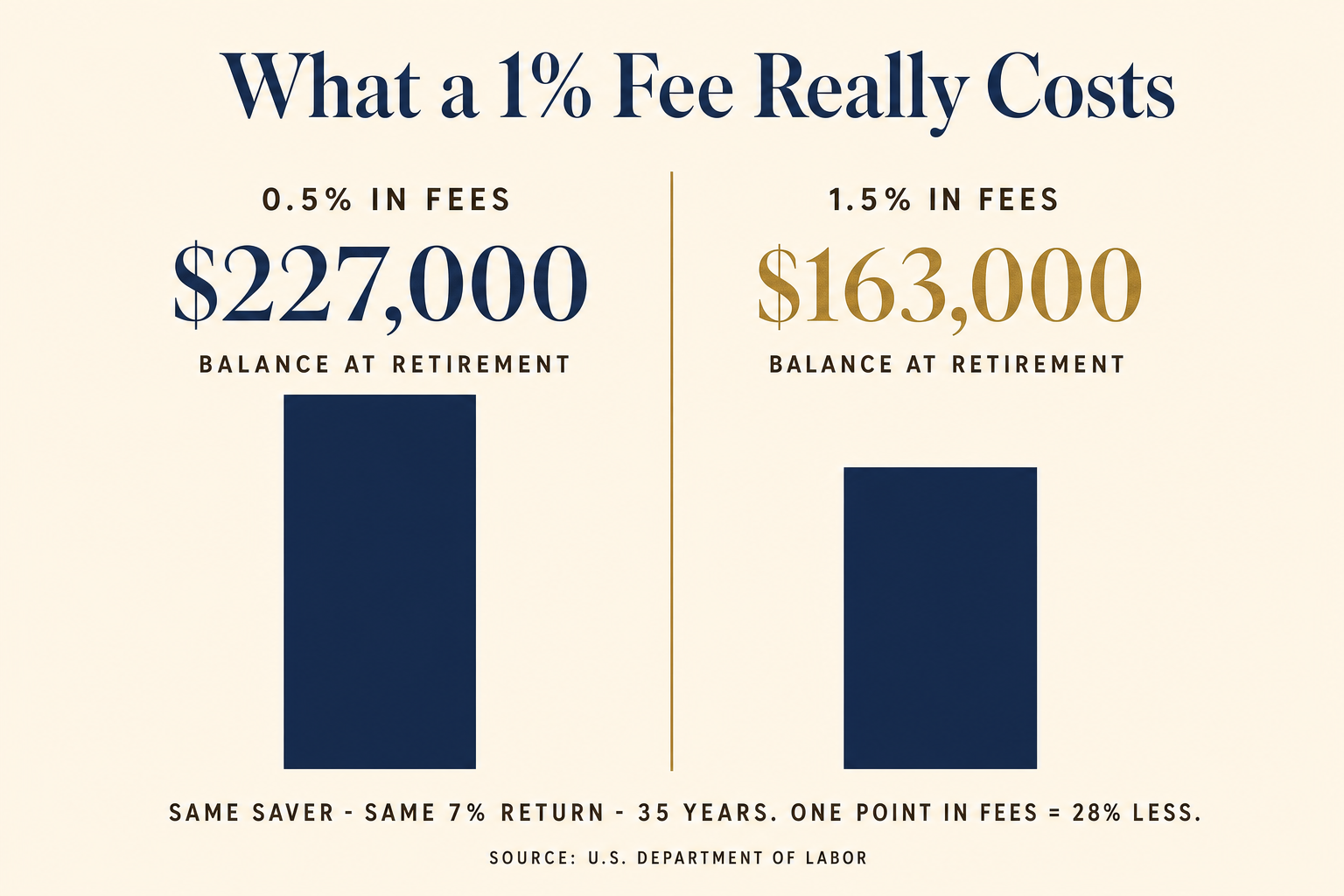
Here is the uncomfortable math, and it comes straight from the U.S. Department of Labor. Take a worker 35 years from retirement with $25,000 saved and a 7% annual return. If fees trim half a percent off that return each year, the account grows to about $227,000. Raise the fees to 1.5% — a difference of a single percentage point — and the same account grows to only about $163,000. That one point costs roughly 28% of the final balance. (You can read the example yourself in the DOL’s A Look at 401(k) Plan Fees.)
Nobody wrote that worker a check for $64,000. The money simply never arrived. That’s what makes fees so dangerous: they’re the cost you don’t feel, quietly subtracted from a number you never got to see.
A fee isn’t charged once. It’s charged every year, on everything.
Most people think about a fee the way they think about a sales tax — a one-time nick at the register. An investment fee works nothing like that. An expense ratio or an advisory fee is charged every single year, as a percentage of your entire balance, including all the growth that balance has produced.
So the fee compounds. And here’s the part that stings: it compounds against you at the same rate your money is trying to compound for you. Every dollar paid in fees this year is a dollar that isn’t invested next year, or the year after, or for the thirty years after that. You’re not just losing the dollar. You’re losing everything that dollar would have become.
Warren Buffett has made this point in plainer language than any prospectus ever will: performance comes and goes, but costs never falter. The market might hand you 7% one year and take back 10% the next. The fee shows up either way.
What a single percent actually buys the person collecting it
Consider a hypothetical case to see the gap open up. Maria and Dave are both 35, both earning well, both disciplined savers. Each starts with $100,000 and adds $500 a month for thirty years. We’ll assume both earn the same hypothetical 7% annual return before costs — an illustration, not a promise, and actual returns always vary.
The only difference between them is what they pay. Maria holds a broad, low-cost index fund charging 0.1% a year. Dave holds an actively managed fund and pays an advisor on top, for an all-in cost closer to 1.1% a year. Same contributions, same gross return, same patience. One number apart.
After thirty years, that single percentage point doesn’t cost Dave 1%. It costs him somewhere in the neighborhood of a sixth to a quarter of his ending balance — a six-figure gap on these illustrative numbers — because the fee has been quietly compounding against him the entire time. He didn’t make worse decisions. He made the same decisions and paid more to make them. The SEC lays out this same compounding effect in its investor bulletin, How Fees and Expenses Affect Your Investment Portfolio.
Where the fees actually hide
Part of why fees do so much damage is that they’re spread across several lines, and no one adds them up for you. A few of the usual places they live:
The expense ratio. This is the fund’s own annual charge, taken out before the return ever reaches you. A broad index fund might charge 0.03% to 0.10%. An actively managed stock fund often runs 0.50% to 1.00% or more. That difference is the single biggest cost lever most investors have, and it’s printed right in the prospectus — I ran one of these numbers out across three decades in what an expense ratio actually costs you over 30 years.
The advisory or management fee. If someone manages your portfolio for a percentage of assets, that’s typically around 1% a year — layered on top of whatever the underlying funds charge. Sometimes that buys real, comprehensive planning. Sometimes it buys a model portfolio you could have built in an afternoon. The fee is the same; what you get for it is not.
The layers you can’t see. 12b-1 marketing fees baked into certain share classes. Funds that hold other funds, so you pay two expense ratios for one investment. And the worst offender for sheer stacking: the variable annuity, where mortality-and-expense charges, subaccount fees, and optional riders can pile up past 3% a year. That’s the core reason variable annuities have no place in how I build an income floor — the fees swallow the very security the product claims to offer.
Your 401(k)’s plan costs. Recordkeeping and administrative fees get deducted quietly from plan accounts. By law your plan has to disclose them once a year, in a notice most people recycle unread.
Fees do the most damage where time does the most work
Not every dollar you own is equally exposed to fees, and this is where bucket planning clarifies the picture. The cash in your Now bucket — the money covering this year and next — barely cares about a fee, because it isn’t compounding for long. The money in your Later bucket is a different story. That’s your long-horizon growth money, the dollars meant to compound for twenty or thirty years, and it’s exactly where a fee has the most time to do damage.
So fee discipline isn’t a blanket rule applied evenly across everything you own. It’s sharpest on your longest-dated money. A tenth of a percent on your emergency cash is noise. A full percent on the retirement money you won’t touch for three decades is the DOL’s 28% in slow motion.
Thomas’ Take: You can’t control what the market returns next year. You can’t control inflation, tax law, or which way rates move. You can control, almost to the dollar, what you pay to invest. It’s the rare retirement variable that sits entirely in your hands — which is exactly why it’s worth one quiet afternoon to get right.
How to find what you’re actually paying
You can’t fix a number you’ve never looked at, and the whole system is designed so you rarely look. Finding your real, all-in cost takes less time than you’d think.
Start with the expense ratio of every fund you own — it’s one line in the prospectus or a column on your statement. Then run those funds through FINRA’s free Fund Analyzer, which shows what a given fund’s fees will cost you in real dollars over time. Pull your 401(k)’s annual fee disclosure and actually read it this year. And if you work with an advisor, ask the one question that cuts through everything: “What is my all-in cost, in dollars, this year — fund fees and advisory fee together?” A good advisor answers that without flinching.
If you want to see what trimming your costs does to your own numbers over a full retirement horizon, it’s worth modeling. A planning tool like ProjectionLab lets you run your actual contributions and time horizon and watch what a half-percent does across thirty years. Seeing it on your own figures lands differently than reading someone else’s example.
Disclosure: the ProjectionLab link above is an affiliate link. If you subscribe through it, I may earn a commission at no additional cost to you. I only point to tools I’d actually sit down and use.
When a fee is worth paying
None of this means every fee is a ripoff. A fee can earn its keep — if it buys genuine, comprehensive planning, or if it keeps you from the far more expensive mistake of panic-selling at the bottom. The behavior gap, the money investors lose by buying high and selling low, dwarfs most advisory fees. Someone who holds your hand through a 30% drop so you don’t liquidate your retirement at the worst possible moment may be worth every basis point.
The point was never “all fees are bad.” The point is that a fee should be a decision, not a default. Know what you pay. Know what you get for it. If the answer is “a lot” and “not much,” you have a problem the market can’t fix for you — but you can.
Here’s the reframe worth keeping. The market will do what it does, but costs are the one part of the equation you get to set in advance. It’s the same logic behind why your savings rate beats your returns — the levers you actually control tend to matter more than the ones you don’t. Every tenth of a percent you decline to pay keeps compounding, for you instead of for someone else. Over thirty years, that’s not a rounding error. It’s a bucket.
Key takeaways
- A 1% fee isn’t a 1% cost — charged annually on your whole balance, it can erase a quarter or more of a long-horizon nest egg (the DOL’s example: 28% over 35 years).
- Fees compound against you at the same rate your money compounds for you, so the damage grows the longer your time horizon.
- Costs hide in expense ratios, advisory fees, 12b-1 charges, fund-of-funds layering, variable-annuity riders, and 401(k) plan fees — no one adds them up for you.
- Fee discipline matters most on your Later-bucket money, the dollars with decades left to compound.
- Find your all-in cost using the fund prospectus, FINRA’s Fund Analyzer, and your plan’s annual fee disclosure — then decide whether what you pay is worth what you get.
Frequently asked questions
What counts as a “low” expense ratio?
For a broad, diversified index fund, anything under about 0.10% a year is genuinely cheap, and the lowest run near 0.03%. Actively managed funds commonly charge 0.50% to 1.00% or more. The number alone doesn’t make a fund good or bad — but on two funds holding similar things, the cheaper one keeps more of the return in your pocket.
Do index funds have fees too?
Yes. There’s no such thing as a free fund — index funds simply tend to charge far less because they aren’t paying a team to pick stocks. “Low cost” is not “no cost,” so it’s still worth checking the exact expense ratio rather than assuming.
Is a 1% advisory fee ever worth it?
It can be, when it buys real planning — tax coordination, withdrawal sequencing, Social Security timing, and the behavioral coaching that keeps you invested through bad markets. The problem isn’t the 1% itself; it’s paying 1% and receiving a generic portfolio you could have assembled yourself. Ask for the all-in dollar cost and judge it against what you actually receive.
This article is published by Confluence Media Group LLC, an independent publisher of educational financial content. Thomas Clark is a Series 65 Investment Advisor Representative. The information provided is for educational and informational purposes only and is not personalized financial, tax, or legal advice. Past performance does not guarantee future results. All investing involves risk, including potential loss of principal. Consult a qualified professional before making financial decisions.
Confluence Media Group LLC is a separate entity from Confluence Capital Management, the investment advisory practice through which Thomas Clark provides advisory services. Advisory services are not offered through this publishing platform.
About Thomas Clark
Thomas Clark is the founder of Confluence Media Group LLC and a Series 65 Investment Advisor Representative. He has spent nearly two decades working with families on retirement planning, with a focus on Social Security optimization, retirement income coordination, and the bucket planning approach to building a guaranteed income floor.
Thomas writes and publishes at thomasclarkadvisor.com and is the author of The Just in Case Binder — a 148-page printable family financial organizer for households who want to make sure the people they love know where everything is.
He lives in North Carolina with his family.
Subscribe to the weekly newsletter · Get the Just in Case Binder

Thomas Clark is a Series 65 licensed investment advisor and experienced trader. He specializes in investing, retirement planning, and market analysis, helping individuals build wealth and make informed financial decisions.
