
The 50/30/20 Rule Isn’t Wrong. You’re Using It Backward.
The 50/30/20 rule is the most popular budget in America, and for most people it quietly fails at the one job that matters. The problem isn't the math — it's the order.

Almost every budgeting guide you have ever read starts at the same line: the 50/30/20 rule. Fifty percent of your take-home pay for needs, thirty percent for wants, twenty percent for savings. It is clean, it is easy to remember, and it has helped a lot of people put their money in some kind of order for the first time.
I have no quarrel with the rule as a teaching tool. My quarrel is with how it gets used. For most households, the 50/30/20 rule quietly fails at the one job that actually builds wealth — and it fails for a reason that has nothing to do with the math. It fails because of the order.
Where the 50/30/20 rule came from
The rule is not the invention of a budgeting app. It comes from a 2006 book, All Your Worth: The Ultimate Lifetime Money Plan, written by Elizabeth Warren — then a Harvard bankruptcy professor — and her daughter, Amelia Warren Tyagi. Their insight was that most people do not need a spreadsheet with forty line items. They need three buckets: needs, wants, and savings, in a rough 50/30/20 split of after-tax income.
That simplicity is exactly why it caught on. A budget you can remember is a budget you might actually follow, and a rough framework you use beats a perfect one you abandon by February. So far, so good.
The first crack: “needs” already broke 50% for millions of people
Here is where the tidy ratio starts to diverge from real life. The rule assumes your genuine needs fit inside half your paycheck. For a large and growing share of households, they do not.
Housing is the obvious culprit. The federal standard has long treated housing as “unaffordable” once it crosses 30% of income — and by the Census Bureau’s own count, nearly half of all renter households now spend more than 30% of their income on housing alone. Add groceries, insurance, transportation, and childcare, and the “50% for needs” line is out of reach for a lot of people before they have bought a single want.
This matters because when the ratios do not fit, most people conclude they have failed the rule — and quit. That is the wrong lesson. The ratios were never the point. They are training wheels, not a law of physics.
The real problem is the order
Even for households where 50/30/20 fits comfortably, the rule carries a deeper design flaw: it puts saving last.
Read the rule left to right. You cover your needs, you fund your wants, and then — with whatever remains — you save. That sequence sounds responsible. In practice, it is the reason so many people with perfectly good incomes reach the end of the month with nothing left to save.
Money that is “left over” is rarely left over. Spending expands to fill the space available to it. If saving is the last item on the list, it is the first thing that gets skipped when the car needs brakes or a long weekend comes up. You are asking willpower to do a job that willpower is spectacularly bad at.
Thomas’ Take: Willpower is a terrible savings plan. It works great on the first of the month and runs out somewhere around the twentieth. The people who save consistently are not more disciplined than you — they have just taken the decision out of their own hands.
The fix: pay yourself first, and automate it
Flip the rule on its head. Instead of saving what is left after you spend, spend what is left after you save. The idea of “paying yourself first” is old, but the behavioral science behind it is worth taking seriously. In a landmark study, economists Richard Thaler and Shlomo Benartzi showed that when people commit in advance to saving automatically, savings rates climb sharply — not because participants suddenly found discipline, but because the saving happened before they could talk themselves out of it.
The mechanics are simple:
- Decide your savings number first — say, 20% of take-home pay, or whatever floor you can defend.
- Automate the transfer so the money leaves your checking account the day your paycheck lands. A payroll deferral into a workplace plan, an automatic transfer into a high-yield savings account, an auto-invested contribution — the tool matters far less than the automation.
- Live on what is left. Your needs and wants now share whatever remains, and you get to stop policing every coffee, because the only number that had to be protected is already gone.
Notice what this does to the 50/30/20 rule. It does not throw it away — it reorders it into 20/50/30. The 20% comes off the top, automatically, and the split between needs and wants sorts itself out downstream. Same rule. Opposite order. Completely different outcome.
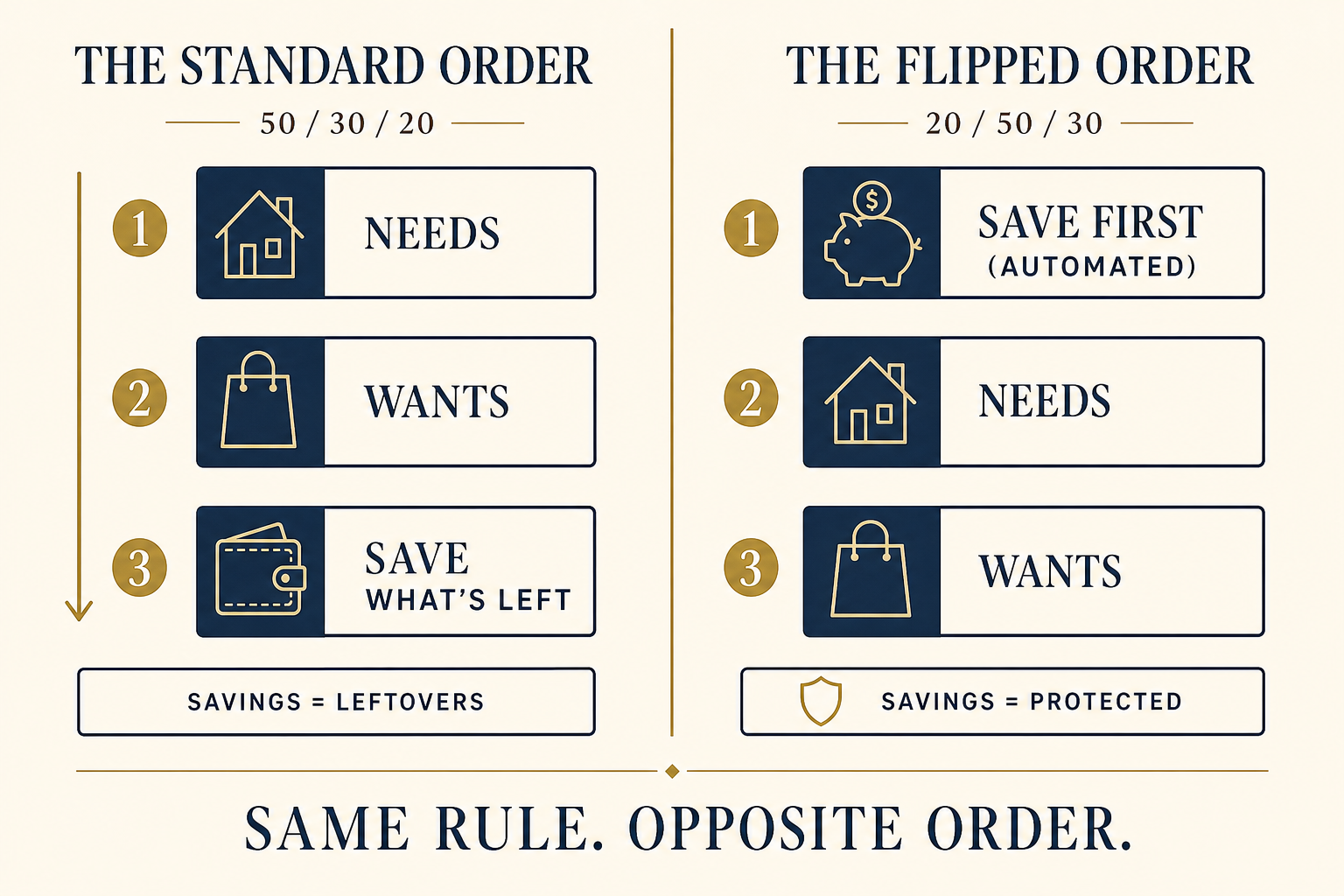
You can point that first automated slice wherever your plan needs it most — toward an emergency fund if you do not have one yet, or into the debt-versus-invest decision if you are carrying a balance. The destination can change. The habit of taking it off the top should not.
Make 20% a floor, not a ceiling
The other quiet failure of the rule is that people treat 20% as a target to hit rather than a minimum to beat. When a raise shows up, the extra money slides into the “wants” column and disappears. I have written before about lifestyle creep — the way rising income quietly raises your spending instead of your saving — and 50/30/20 practically invites it. If wants are “allowed” to be 30% of a bigger paycheck, then a bigger paycheck just buys bigger wants.
The households that build real wealth do the opposite. They hold their lifestyle roughly steady and let raises flow into the savings number. Your savings rate — not your investment returns — is the single biggest lever you control in your first couple of decades of earning. I made that case in detail in why your savings rate beats your returns, and it is the reason I would rather see someone saving 25% on autopilot than agonizing over which fund holds the 20%.
A hypothetical: same income, opposite order
Consider a hypothetical case — Marcus, 29, an IT support lead in Columbus who brings home about $4,000 a month after taxes. (Marcus is an illustration, not a real person, and the figures are round for clarity.)
Running 50/30/20 the standard way, Marcus intends to save $800 a month. But he pays rent, covers his car and groceries, meets friends out a few times, and by the last week of the month the $800 has quietly shrunk to $150. He is not reckless. He is just human, and the saving was last in line.
Now flip it. On payday, $800 moves automatically — $500 into his workplace plan and a Roth IRA, $300 into a high-yield savings account — before he ever sees it. His checking account starts the month at $3,200, and he runs his life on that. Nothing about his discipline changed. The order did. Over a year, that is roughly $9,600 set aside instead of $1,800, from the exact same paycheck and the exact same rule.
What if your needs really are over 50%?
If you are one of the many people whose genuine needs eat well past half your income, do not force the ratios and do not treat it as a personal failing. Save a smaller percentage automatically — 5%, even 3% — and protect it just as fiercely. A small amount that actually leaves your account every month beats an ambitious number you never reach. Then work the other side of the equation: the two levers that move a tight budget are lowering your largest fixed costs (usually housing and transportation) and raising your income. Neither is glamorous. Both beat rearranging the deck chairs on a 30% “wants” budget you do not have.
Key takeaways
- The 50/30/20 rule is a fine starting framework, but reading it left to right puts saving last — so it survives on leftovers that rarely exist.
- For millions of households, “needs” already exceed 50% of income. The ratios are training wheels, not a rule to feel guilty about.
- Flip it to 20/50/30: automate your savings off the top on payday, then live on what is left.
- Treat the savings percentage as a floor that rises with your income, not a ceiling that caps it.
- If your needs genuinely run above 50%, save a smaller amount automatically and go to work on your big fixed costs or your income — do not abandon the habit.
The 50/30/20 rule is not broken because the numbers are wrong. It is broken because it teaches you to save last, and last is where good intentions go to die. Move the saving to the front, automate it so it no longer depends on how strong you feel on the 25th, and let the rest of your money organize itself behind it. Do that, and you never really have to “budget” again in the white-knuckle sense — you just have to live on what is already left.
If you want to go deeper on why that first automated transfer matters more than almost anything else you will do with your money, start with why your savings rate beats your returns. And if you would like this kind of plain-English breakdown in your inbox each week, subscribe to the newsletter.
This article is published by Confluence Media Group LLC, an independent publisher of educational financial content. Thomas Clark is a Series 65 Investment Advisor Representative. The information provided is for educational and informational purposes only and is not personalized financial, tax, or legal advice. Past performance does not guarantee future results. All investing involves risk, including potential loss of principal. Consult a qualified professional before making financial decisions.
Confluence Media Group LLC is a separate entity from Confluence Capital Management, the investment advisory practice through which Thomas Clark provides advisory services. Advisory services are not offered through this publishing platform.
About Thomas Clark
Thomas Clark is the founder of Confluence Media Group LLC and a Series 65 Investment Advisor Representative. He has spent nearly two decades working with families on retirement planning, with a focus on Social Security optimization, retirement income coordination, and the bucket planning approach to building a guaranteed income floor.
Thomas writes and publishes at thomasclarkadvisor.com and is the author of The Just in Case Binder — a 148-page printable family financial organizer for households who want to make sure the people they love know where everything is.
He lives in North Carolina with his family.
Subscribe to the weekly newsletter · Get the Just in Case Binder

Thomas Clark is a Series 65 licensed investment advisor and experienced trader. He specializes in investing, retirement planning, and market analysis, helping individuals build wealth and make informed financial decisions.
