
Lifestyle Creep: Why Your Raise Disappeared
You got the raise, and six months later the money is gone. Lifestyle creep is why a bigger paycheck so rarely builds wealth — and it quietly costs you twice.

You got the raise. Six months later the money is gone, and you would struggle to say where it went. The apartment is a little nicer. The car payment is a little bigger. There are two more subscriptions than there used to be, and dinner out stopped feeling like a decision. Your income went up. Your bank balance did not.
That quiet process has a name: lifestyle creep. It is the reason a bigger paycheck so rarely turns into more wealth. And it is more expensive than almost anyone realizes, because it charges you twice — once now, and again decades from now.
Here is how it works, why the second cost is the one that actually matters, and the single rule that stops it without turning your life into a spreadsheet.
What lifestyle creep actually is
Lifestyle creep — sometimes called lifestyle inflation — is what happens when your spending rises to match your income. You get a raise, and within a few months your cost of living has quietly expanded to absorb it. The gap between what you earn and what you keep stays exactly where it was. You are earning more and saving the same.
The engine underneath it is a well-documented quirk of human psychology called hedonic adaptation: the tendency to return to a baseline level of satisfaction after any improvement. A nicer apartment, a newer car, a better phone each delivers a real jolt of pleasure — and then becomes the new normal. To feel that lift again, you reach for the next upgrade. The comforts you adapt to fastest are the ones you bought to feel better.
What makes creep so hard to catch is that no single purchase is reckless. Each upgrade is defensible on its own. It is the sum of a dozen reasonable-looking decisions that does the damage, and the sum never sends you a bill you can see.
The proof is in the spending data
If earning more automatically meant keeping more, higher earners would simply bank the difference. They do not. The Bureau of Labor Statistics tracks this every year in its Consumer Expenditure Survey, and the pattern is unmistakable. In 2024, households in the lowest income group spent about $35,000 a year. Households in the highest income group spent about $150,000 — more than four times as much.
Some of that gap is unavoidable; the necessities cost more in expensive places. But most of it is choice. Spending tracks income almost step for step, all the way up the ladder. The households that actually build wealth are the ones who break that correlation on purpose — who let income climb while holding spending closer to flat.
This is the same idea behind why your savings rate beats your investment returns for most of your working life. The gap between what you earn and what you spend is the raw material wealth is built from. Lifestyle creep attacks that gap directly, and it does it so gently you never feel the hit.
Why lifestyle creep costs you twice
The first cost is obvious: every dollar of a raise you spend is a dollar you did not save. Fair enough. That one you can see.
The second cost is the one that quietly reshapes your whole plan, and almost nobody accounts for it. When you permanently raise your spending, you also permanently raise the size of the retirement you have to fund.
Retirement is not a fixed target you are walking toward. It is a multiple of your annual spending. A common planning rule of thumb says you need roughly 25 times your yearly spending invested to live on it — the flip side of the familiar 4% guideline. It is a rough heuristic, not a promise, but it makes the point vividly: every $1,000 you add to your annual lifestyle does not just cost $1,000 this year. It adds about $25,000 to the finish line you are running toward.
So creep works both levers at once. It lowers the amount you are putting in, and it raises the amount you will eventually need. That is why two people who earn the exact same income over a career can end up in completely different places. One let the gap stay wide. The other let it close, one reasonable upgrade at a time.
This is also why “just earn more” is incomplete advice. A raise you fully absorb into your lifestyle can leave you further from retirement than you were before you got it, because you moved the finish line at the same time you stopped adding to the pot.
A hypothetical: Marcus and his $12,000 raise
Consider a hypothetical case. Marcus, 34, manages a customer support team in Denver. He is promoted from $78,000 to $90,000 — a $12,000 raise that lands as roughly $8,000 more in take-home pay after taxes.
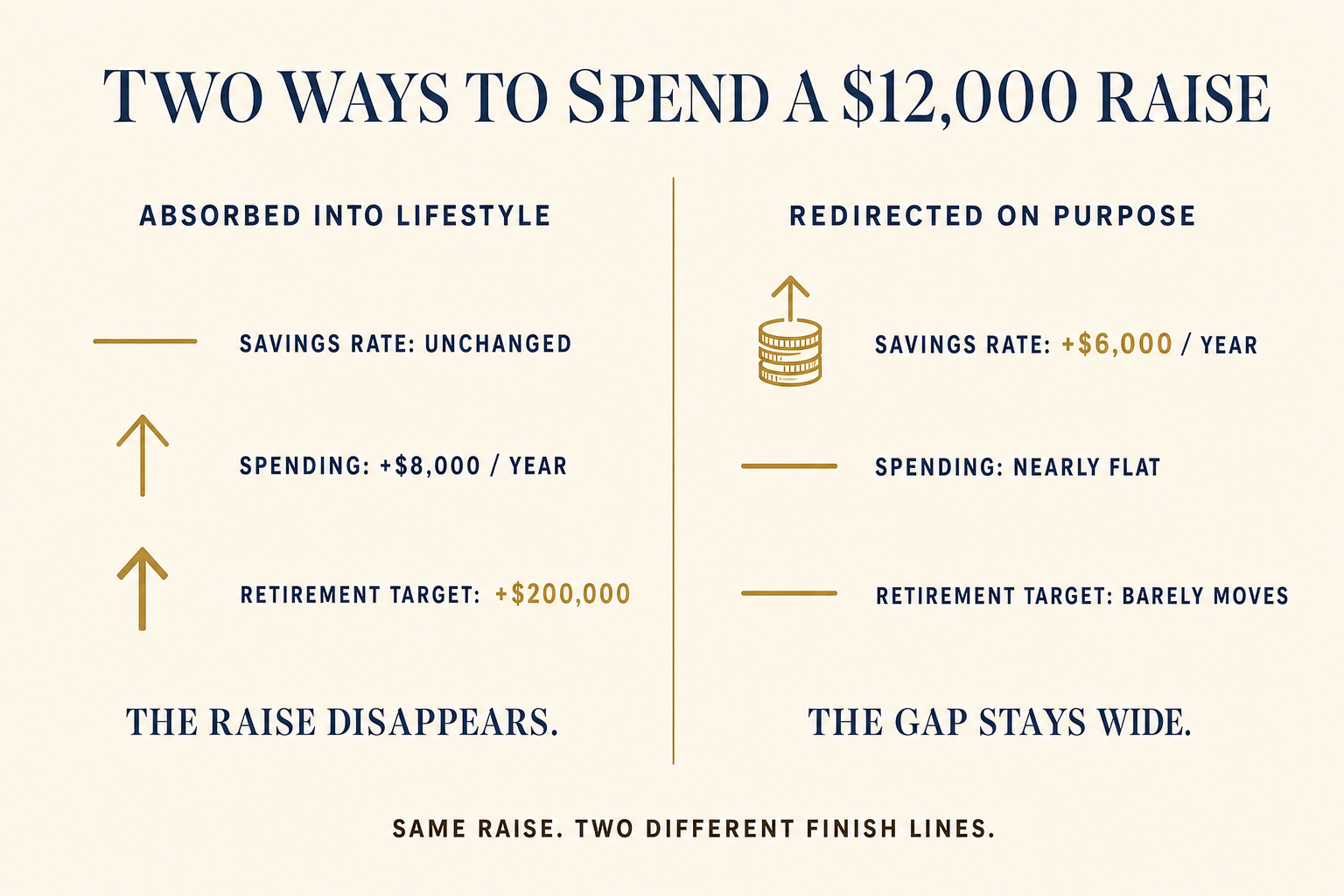
Down one path, Marcus does what most people do without deciding to. He moves into a nicer apartment, trades up the car, and lets a couple more subscriptions and easier dining out drift in. Together those upgrades run to about $8,000 a year — almost exactly his raise. The raise is gone. His savings rate has not moved an inch — and because his annual spending is now roughly $8,000 higher, the 25-times rule of thumb just quietly added around $200,000 to the nest egg he will eventually need.
Down the other path, Marcus decides in advance. He lets himself enjoy about $2,000 of the raise — a real, deliberate upgrade — and routes the other $6,000 a year straight into his investments automatically, before it ever hits his checking account. His spending barely moves, so his retirement number barely moves, and he is now investing $6,000 more every year across the three decades he has ahead of him.
Same person, same raise, same salary. The only difference is which side of the gap the money landed on. One version of Marcus is measurably further ahead. The other is running harder to reach a line that just moved away from him.
The fix is not a budget. It is a rule.
Budgets fail at this because they try to win an argument with you at the moment of every purchase, and you are a tough negotiator with yourself. The durable fix happens upstream, before the money is in play. You decide where a raise goes before it ever arrives.
The rule I would give my own kids is to pay the raise first — the same habit personal-finance writers consistently name as the most reliable defense against creep. The moment a raise or a bonus takes effect, route a fixed share of it — I would make it at least half — into savings or investments automatically, before it reaches your checking account. You never adapt to money you never see. This is the same logic that makes an automatic transfer on payday the quiet backbone of a well-built emergency fund, and it works for the same reason: it takes willpower out of the equation.
Then spend the other half on purpose. This is not a call for deprivation. Enjoy part of every raise, guilt-free and deliberately — that is what makes the rule survivable for years instead of weeks. The goal is to keep the gap, not to erase every pleasure from your life.
It also helps to see what the gap is actually buying you, because creep stays invisible until you connect this year’s spending to the size of the retirement it implies. If you want to make that concrete, this is worth modeling rather than guessing at. A planning tool like ProjectionLab lets you plug in your income and savings rate and watch what redirecting half of your next raise does to your retirement date — instead of eyeballing it. (ProjectionLab is a paid tool and that link is an affiliate link, which means I may earn a small commission at no extra cost to you. I only recommend tools I would use myself.)
There is a longer arc here too. The gap you protect in your 30s and 40s is the same gap that eventually funds your retirement number and, later, your Now, Soon, and Later buckets. Every bit of lifestyle you decline to take on today is spending your future income floor will never have to cover. Creep does not just cost you savings. It quietly enlarges the machine you will one day have to build to pay for the life you drifted into.
Thomas’ Take: A raise is not a reward you have already earned the right to spend. It is a fork in the road. The people who build real, durable wealth are almost never the highest earners in the room. They are the ones who treat every raise as a chance to widen the gap instead of close it — and who understand that the decision is made before the money arrives, not after.
Key takeaways
- Lifestyle creep is spending that rises to meet income, driven by hedonic adaptation — you get used to each upgrade and reach for the next one.
- It costs you twice: less money going into savings now, and a larger retirement number required later, because your target is a multiple of your spending.
- At a 25-times rule of thumb, every $1,000 of added annual spending raises your eventual retirement target by roughly $25,000 — a heuristic, not a guarantee, but a useful way to see the second cost.
- The fix is a rule, not a budget: pay the raise first by automatically diverting at least half of any raise before it reaches checking, and spend the rest on purpose.
Lifestyle creep is quiet by design. No alarm goes off when your spending drifts up to meet your income. It just feels like living a little better — which, honestly, it is. But the cost is real, and it compounds in two directions at once: less going in, and more required at the end.
The encouraging part is that the same quietness works in your favor the moment you decide the rule in advance. Redirect part of the next raise before you ever feel it is gone, and the gap does the work for you — this year, and every year after. You do not have to earn dramatically more to get ahead. You have to keep more of what earning more already gave you.
If this was useful, subscribe to the weekly newsletter for one clear idea like this each week, or read the companion piece on whether to pay off debt or invest once you have freed up that gap.
This article is published by Confluence Media Group LLC, an independent publisher of educational financial content. Thomas Clark is a Series 65 Investment Advisor Representative. The information provided is for educational and informational purposes only and is not personalized financial, tax, or legal advice. Past performance does not guarantee future results. All investing involves risk, including potential loss of principal. Consult a qualified professional before making financial decisions.
Confluence Media Group LLC is a separate entity from Confluence Capital Management, the investment advisory practice through which Thomas Clark provides advisory services. Advisory services are not offered through this publishing platform.
About Thomas Clark
Thomas Clark is the founder of Confluence Media Group LLC and a Series 65 Investment Advisor Representative. He has spent nearly two decades working with families on retirement planning, with a focus on Social Security optimization, retirement income coordination, and the bucket planning approach to building a guaranteed income floor.
Thomas writes and publishes at thomasclarkadvisor.com and is the author of The Just in Case Binder — a 148-page printable family financial organizer for households who want to make sure the people they love know where everything is.
He lives in North Carolina with his family.
Subscribe to the weekly newsletter · Get the Just in Case Binder

Thomas Clark is a Series 65 licensed investment advisor and experienced trader. He specializes in investing, retirement planning, and market analysis, helping individuals build wealth and make informed financial decisions.
