
529 College Savings: The Two Biggest Objections Are Gone
For years, two fair objections kept families away from 529 college savings plans — a grandparent financial-aid penalty and the fear of trapped money. Two recent law changes quietly answered both.

For years, I gave families two honest reasons to be careful about 529 college savings plans — and both of them were good reasons. If you were a grandparent, funding a grandchild’s account could quietly cut the amount of financial aid they qualified for. And for anyone, there was the nagging what-if: what happens to the money if the child skips college, wins a scholarship, or simply changes course? The old answer — income tax plus a 10% penalty on the earnings — was enough to make cautious savers keep their money somewhere else.
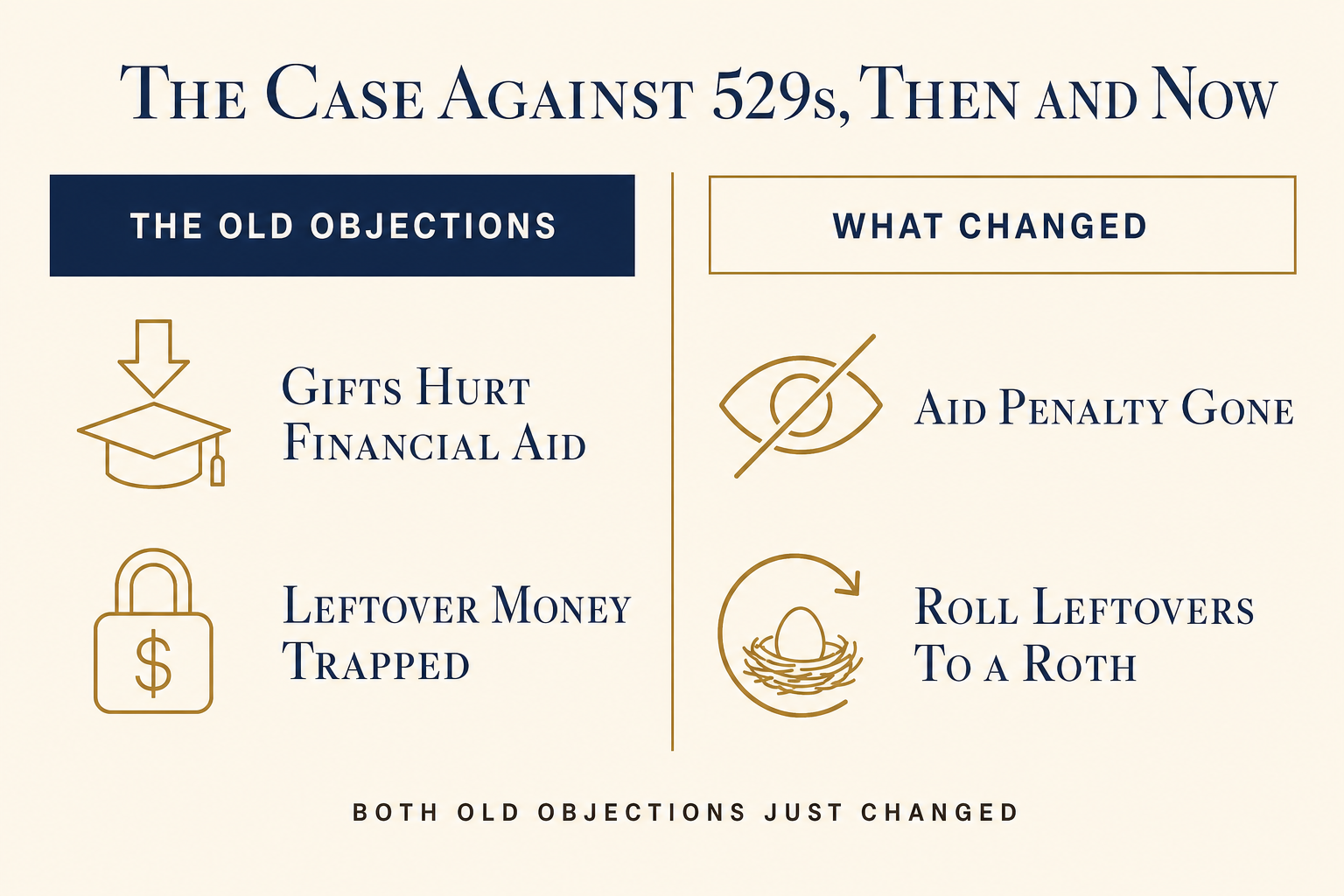
Here’s what almost nobody has noticed: over the last two years, both of those objections quietly died. One was killed by the new FAFSA. The other by a provision buried in the SECURE 2.0 Act. If you looked at 529 plans a few years ago and passed, the math you were working with is out of date — and with a new school year starting, it’s worth a fresh look.
First, what a 529 plan actually is
A 529 plan is a state-sponsored, tax-advantaged account built for education. You contribute after-tax dollars, the money grows tax-deferred, and withdrawals for qualified education expenses — tuition, fees, books, room and board — come out completely free of federal tax. Many states sweeten the deal with a deduction or credit for residents who contribute. In tax structure, it’s a close cousin of the account behind the HSA’s triple tax advantage: put money in, let it grow untaxed, and take it out untaxed for the right purpose.
Two features matter for what follows. First, the money grows on itself over time — the same quiet engine I described in the piece on compound interest — so a 529 opened when a child is young has a long runway. Second, and this is the part people forget: the account owner, not the child, keeps control. You decide when money comes out, and you can change the person it’s meant for. Hold onto that. It’s the reason both of the old objections fall apart.
Objection #1: “If I help, I’ll hurt their financial aid”
This one used to be real. Under the old federal aid rules, a grandparent-owned 529 was invisible as an asset — but the moment you used it, the withdrawal counted as untaxed student income on the following year’s FAFSA. Student income is assessed harshly. A well-meaning $10,000 tuition payment from Grandma could reduce the next year’s aid by as much as $5,000. That’s why advisors used to tell grandparents to sit on the account until the last year or two of college, when a lost aid year no longer mattered.
The FAFSA Simplification Act changed the machinery. Starting with the 2024–25 award year, the FAFSA pulls income data directly from federal tax returns and no longer asks about cash support or distributions from someone else’s 529. Because a qualified 529 withdrawal never appears on a tax return, it is now effectively invisible to the federal aid formula. A grandparent can pay for college straight from their own 529 without touching the student’s federal financial aid.
One honest caveat: a few hundred mostly-private colleges use a separate form called the CSS Profile for their own institutional aid, and some still ask about grandparent-owned 529s. But for the federal formula — Pell Grants, subsidized loans, the aid most families actually count on — the grandparent penalty is gone.
Objection #2: “What if they don’t go to college?”
This is the trapped-money fear, and it’s the one that kept the most people away. The old rule still applies to a truly wasted withdrawal: pull money out for something that isn’t a qualified education expense and you owe income tax plus a 10% penalty — but only on the earnings, never on the contributions you put in. What’s changed is how many exits now sit between you and that penalty.
- You can change the beneficiary. At any time, you can name a different family member — a sibling, a cousin, a niece, yourself, even a future grandchild. The money was never chained to one child.
- Qualified uses have expanded. Beyond college, a 529 now covers up to $10,000 a year of K–12 tuition, the costs of a registered apprenticeship, and up to $10,000 (lifetime) toward the beneficiary’s student loans.
- Leftover money can become retirement money. This is the headline change. Since January 1, 2024, unused 529 funds can be rolled into the beneficiary’s Roth IRA — tax-free and penalty-free — up to a $35,000 lifetime limit. It turns “trapped college money” into a head start on a young person’s retirement.
The 529-to-Roth rollover has guardrails, and they’re worth knowing before you count on it. The 529 account must have been open for at least 15 years. Any contribution made in the last five years (and its earnings) can’t be moved yet. Each year’s rollover counts against the beneficiary’s own annual Roth limit — $7,500 in 2026 — and the beneficiary must have earned income at least equal to the amount rolled. The Roth has to belong to the 529’s beneficiary, and it’s a direct trustee-to-trustee transfer. One pleasant surprise: the usual Roth income limits don’t apply here, so a well-paid young beneficiary isn’t shut out. It’s a multi-year drip rather than a one-time dump — but it is a real, legal way out. The IRS lays out the mechanics in its 529 plans questions and answers.
For grandparents, the door is now wide open
Put the two changes together and the 529 becomes one of the more elegant tools a grandparent has. Contributions are completed gifts — they leave your taxable estate — yet you, as owner, still control the money and can even reclaim it if you truly need to (paying tax and the 10% penalty on the earnings if it’s not for education). It’s the rare move that reduces your estate without fully letting go.
529 plans also have a superfunding rule found nowhere else in the tax code: you can front-load five years of the annual gift-tax exclusion at once. In 2026 the annual exclusion is $19,000 per recipient, so you can put up to $95,000 into one grandchild’s 529 in a single year — $190,000 for a married couple — and elect on IRS Form 709 to treat it as five equal annual gifts. That’s a large, immediate estate reduction that funds a grandchild’s future, and now, thanks to the FAFSA change, without the aid penalty that used to argue against grandparents owning the account at all.
One discipline, though, and it’s the same one I apply to every gift: a legacy move like this belongs in your Later bucket, and it only gets funded after your own income floor is secure. Before you write a $95,000 check, make sure the gift doesn’t crack your own plan. A planning tool like ProjectionLab lets you model a large one-time gift against your own retirement — how it moves your income floor, how it lands in a bad market year — so you’re gifting from genuine surplus, not from money you’ll wish you had back. (ProjectionLab is a paid tool; the link is an affiliate link, which means I may earn a small commission at no extra cost to you. I only recommend tools I’d use myself.) If you haven’t set that floor yet, start with sizing your Soon bucket first.
A hypothetical: Eleanor and her granddaughter
Consider a hypothetical case. Eleanor, 68, is a retired school administrator near Asheville. Her income floor is already set — Social Security and a small pension cover her essentials, with a cash cushion on top — so she has money she’d genuinely like to put to work for her granddaughter, Maya, who’s 10.
Eleanor opens a 529 with Maya as the beneficiary and contributes $50,000 (a round figure, for illustration). Over the next several years it grows tax-deferred. When Maya starts college, Eleanor pays tuition directly from the account — and because of the new FAFSA, those withdrawals don’t dent Maya’s aid the way they would have five years ago. Maya then wins a partial scholarship and finishes school with about $20,000 still in the 529. Rather than cash it out and owe tax plus a penalty, Eleanor — now that the account has cleared the 15-year mark — begins moving up to Maya’s annual Roth limit each year into a Roth IRA in Maya’s name. Leftover college money quietly becomes a retirement head start for a 22-year-old. Same account, two generations of tax-free growth. This is an illustration, not a projection or a promise about any specific plan — but the mechanics are exactly what the current rules now permit.
Thomas’ Take: The best financial tools are the ones that don’t punish you for guessing wrong about the future. For a long time, that was exactly the knock on 529 plans — commit the money, and you were stuck if life didn’t cooperate. That knock is mostly gone now. You can change the beneficiary, spend it on more kinds of education than before, and roll what’s left into a Roth. A 529 used to be a bet that a specific child would attend a specific kind of school. Today it’s closer to a flexible, tax-advantaged family education fund with a retirement escape hatch built in.
Key takeaways
- A 529 is a tax-advantaged education account: after-tax money in, tax-free growth and withdrawals for qualified education costs, with the owner — not the child — keeping control.
- The old grandparent financial-aid penalty is gone. Under the current FAFSA, qualified 529 withdrawals no longer count as student income on the federal aid form.
- Leftover money is no longer trapped. Change the beneficiary, use it for K–12, apprenticeships, or up to $10,000 of student loans — or roll up to $35,000 into the beneficiary’s Roth IRA.
- The 529-to-Roth rollover has rules: a 15-year-old account, a five-year lookback on contributions, the beneficiary’s annual Roth limit and earned income, and a trustee-to-trustee transfer.
- Grandparents can superfund up to $95,000 ($190,000 per couple) in one year and move it out of their estate — but only after their own retirement income floor is secure.
Frequently asked questions
Does helping pay for my grandchild’s college still hurt their financial aid?
For the federal formula, no. Since the 2024–25 award year, qualified 529 distributions aren’t reported as student income on the FAFSA. A minority of private colleges use the CSS Profile and may still ask; for federal aid, the old penalty is gone.
What happens to the money if my grandchild doesn’t go to college?
You have options: change the beneficiary to another relative, use it for apprenticeships or up to $10,000 of student loans, or roll up to $35,000 into the beneficiary’s Roth IRA under the rules above. Or simply withdraw it — you’ll owe income tax plus a 10% penalty on the earnings only, never on your contributions.
Can I get my money back if I need it?
Yes. As the account owner you keep control and can withdraw the funds for yourself at any time; a non-qualified withdrawal just owes tax and the 10% penalty on the earnings portion. That control is what separates a 529 from an irrevocable gift, and it’s a big part of why the account fits a grandparent’s estate and legacy plan so well.
How much can I put in at once?
In 2026 you can contribute up to $19,000 per beneficiary with no gift-tax paperwork, or front-load up to $95,000 ($190,000 for a married couple) using the five-year election on IRS Form 709.
The bottom line
For years I told cautious families that 529 plans were good accounts with two real catches. I don’t say that anymore — because the catches are the part that changed. If a 529 didn’t fit your family a few years ago, the rules you turned it down over may no longer exist. With a new school year underway and a grandchild’s college bill somewhere on the horizon, it’s worth doing the one thing the old objections used to talk you out of: taking the account seriously.
This article is published by Confluence Media Group LLC, an independent publisher of educational financial content. Thomas Clark is a Series 65 Investment Advisor Representative. The information provided is for educational and informational purposes only and is not personalized financial, tax, or legal advice. Past performance does not guarantee future results. All investing involves risk, including potential loss of principal. Consult a qualified professional before making financial decisions.
Confluence Media Group LLC is a separate entity from Confluence Capital Management, the investment advisory practice through which Thomas Clark provides advisory services. Advisory services are not offered through this publishing platform.
About Thomas Clark
Thomas Clark is the founder of Confluence Media Group LLC and a Series 65 Investment Advisor Representative. He has spent nearly two decades working with families on retirement planning, with a focus on Social Security optimization, retirement income coordination, and the bucket planning approach to building a guaranteed income floor.
Thomas writes and publishes at thomasclarkadvisor.com and is the author of The Just in Case Binder — a 148-page printable family financial organizer for households who want to make sure the people they love know where everything is.
He lives in North Carolina with his family.
Subscribe to the weekly newsletter · Get the Just in Case Binder

Thomas Clark is a Series 65 licensed investment advisor and experienced trader. He specializes in investing, retirement planning, and market analysis, helping individuals build wealth and make informed financial decisions.
