
Dividends Aren’t Free Money: What a Dividend Really Is
A dividend isn't a gift from the company — it's your own capital handed back to you, and the share price drops to match. Here's what a dividend really is, why chasing yield backfires in retirement, and how to build income you can actually count on.

There is a certain comfort in a dividend. The money shows up in your account whether the market had a good quarter or a terrible one, and it arrives without you having to sell a thing. For a lot of people — especially those near or in retirement — that feeling is the whole appeal: income that seems to fall from the tree while the tree keeps growing.
I want to gently take that idea apart, because it costs people money. A dividend is not a gift from the company, and it is not free. It is your own capital handed back to you, and the share price drops by roughly the amount of the dividend the instant it is paid. That single fact should change how you think about dividends — not enough to avoid them, but enough to stop building a retirement around chasing them.
What actually happens when a dividend is paid
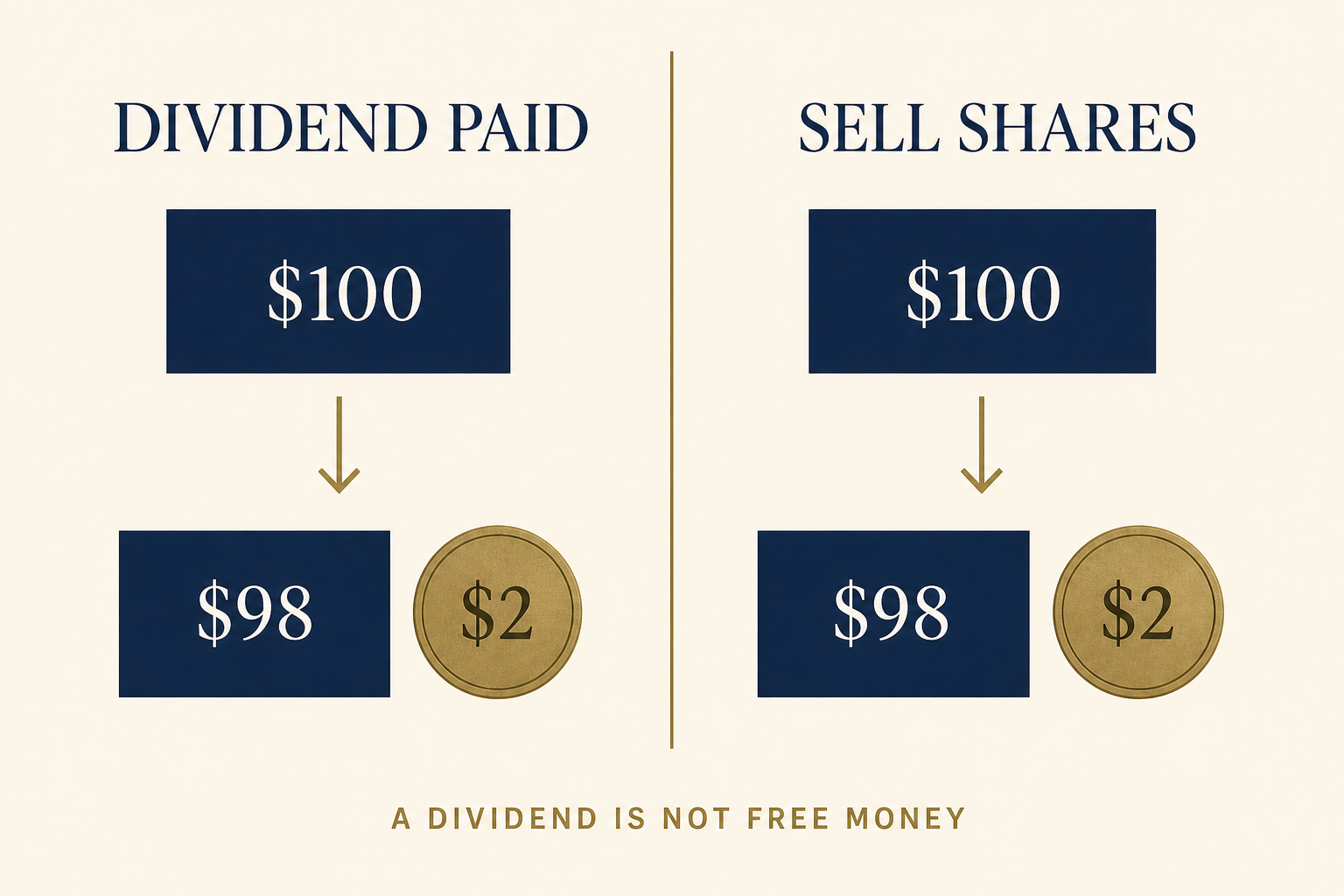
Say you own a share worth $100, and the company declares a $2 dividend. On the ex-dividend date — the cutoff that decides who gets the payment — the share price opens about $2 lower, at roughly $98, all else equal. You now hold $98 of stock and $2 in cash. Before taxes, you have exactly what you started with: $100.
This is not a quirk — it is mechanical. The company sent $2 of its own cash out the door, so the business is worth $2 per share less than the day before, and the market prices that in immediately. The U.S. Securities and Exchange Commission’s investor education site describes a dividend plainly as a distribution of a company’s earnings to shareholders — a transfer, not new wealth created in the moment of payment. You did not get richer that morning; you converted a sliver of your ownership into cash.
“Dividend income” is a feeling, not a free lunch
Here is the idea that reframes everything: what matters is total return — the change in your share price plus the dividends you collected. A stock that rises 6% and pays nothing delivered the same 6% as a stock that rose 4% and paid a 2% dividend. The market does not care whether your return arrives as appreciation or as a check. Your net worth does not either.
Once you see returns that way, a dividend and a sale look like two routes to the same place. Owning a fund that pays you a 2% dividend is economically almost identical to owning a non-paying fund and selling 2% of your shares yourself — a “homemade dividend.” The main differences are taxes and control, and both, as we will see, tilt in favor of doing it yourself.
None of this makes dividends bad. It makes them ordinary — one channel through which the return you were already earning gets delivered. The trouble starts when people treat that channel as extra money and rebuild a whole portfolio to maximize it.
Where chasing yield quietly backfires
The temptation is obvious: if a dividend is income and you never have to sell, then a higher yield must be better income. So the yield screener comes out, and a portfolio built for growth gets rebuilt around whatever pays 5%, 6%, 7%. That is where the real damage happens, in three ways.
First, a high yield is often a warning, not a reward. Yield is the dividend divided by the price. When a company gets into trouble and its stock falls, the yield mechanically rises — right up until management cuts the dividend to preserve cash. Reaching for the highest yield on the screen frequently means reaching for the companies the market is most worried about. The “income” you were counting on is exactly the income most likely to be cut.
Second, a yield-first portfolio concentrates you. The highest-paying corners of the market cluster in a handful of sectors — utilities, some financials, energy, and real estate trusts. Build for yield and you quietly bet the farm on a few slices of the economy, which is the opposite of the diversification you thought you had. I wrote about a version of this problem in why your index fund may be more concentrated than you think; the yield-chasing version is more concentrated still, and on purpose.
Third, in a taxable account, dividends are income you did not choose to realize. Every payment is a taxable event whether you needed the cash or not, and not all dividends are taxed alike — “qualified” dividends get favorable long-term rates while ordinary ones are taxed at your regular income rate, a distinction the IRS spells out in Topic No. 404. When you fund income by selling shares instead, you decide when to trigger the tax, and you often pay it at lower capital-gains rates on just the gain.
Thomas’ Take: A yield screener sorted high-to-low is one of the most dangerous tools a retiree can open. It is a list, more often than not, of companies in trouble — dressed up as a list of paychecks.
Where dividends genuinely earn their place
I am not anti-dividend, and I do not want to leave you with a caricature. Dividends are a real and meaningful part of long-run stock returns — over long stretches of market history, reinvested dividends have accounted for a large share of the total gains from equities. FINRA’s investor education on stocks treats dividends as one of the two ways stocks pay you, alongside price appreciation — which is exactly right. A steady, growing payout can also signal something real about the durability of a company’s earnings, and there is nothing wrong with liking cash that simply arrives. The key is to enjoy dividends as a byproduct of owning good businesses in a diversified way — not to hunt them as if they were a separate, free source of money.
The retirement version of this question
Here is where it matters most. As people approach retirement, the dividend myth mutates into something that sounds responsible: “I’ll move everything into high-dividend stocks and live off the income without ever touching my principal.” It feels prudent. It is usually a mistake.
Reorganizing a whole portfolio around yield does three risky things at once. It concentrates you in a few sectors. It makes your “paycheck” a dividend that can be cut precisely in the downturn when you can least afford it. And it confuses the two questions a retirement plan has to answer separately: what income can I count on, and how should my growth money be invested.
My whole approach — the Now, Soon, and Later bucket framework — keeps those two questions apart on purpose. Your reliable income belongs in the Soon bucket, built from genuinely guaranteed sources: Social Security, any pension, and, where it fits, an income-focused fixed index annuity. That floor does not depend on any board of directors choosing to keep a dividend. Your Later bucket is your growth engine — invested for total return, diversified across the whole market, and drawn from on your schedule, not the market’s. Squeeze your income floor out of stock dividends instead and you drag market risk into the one place that was supposed to be safe, reintroducing the exact sequence-of-returns risk that bucket planning exists to neutralize.
Consider a hypothetical case. Gary, 66, just retired outside Charlotte with $700,000 saved and a paid-off house. A newsletter has him convinced to move the whole balance into high-dividend stocks yielding around 6% — about $42,000 a year — so he can “live off the dividends and never sell.” On paper it looks like a self-funding paycheck. Underneath, that 6% yield packs him into a few sectors, and if a recession forces even a couple of those companies to trim their payouts, his income falls in the same year his portfolio does. Compare that to sizing his Soon bucket so Social Security plus a modest guaranteed layer covers his essential bills, and leaving the rest in a diversified, total-return Later bucket he sells from on his own schedule. His spending no longer rises and falls with a dividend committee’s decisions. The income he can count on is the income that was actually guaranteed.
If you would rather see this trade-off in your own numbers than in the abstract, this is exactly the kind of thing worth modeling. I use and recommend ProjectionLab for testing how a real income plan — a guaranteed floor plus total-return withdrawals across your Now, Soon, and Later buckets — holds up against a yield-chasing version before you commit real money to either. You can try it here. (Disclosure: that’s an affiliate link. If you subscribe through it, Confluence Media Group may earn a commission at no extra cost to you. I only point people to tools I actually think earn their keep.)
Key takeaways
- A dividend is not new money. The share price drops by roughly the dividend amount when it is paid, so before taxes your total value is unchanged.
- What matters is total return — price change plus dividends. Receiving a 2% dividend and selling 2% of your shares get you to nearly the same place, minus the tax differences.
- Chasing the highest yield tends to buy troubled companies, concentrate you in a few sectors, and hand you unwanted taxable income in a brokerage account.
- Dividends are a legitimate part of stock returns — enjoy them as a byproduct of owning good businesses broadly, not as a separate free lunch to maximize.
- In retirement, build your income floor from guaranteed sources in the Soon bucket and let a diversified Later bucket grow — don’t manufacture a “paycheck” out of dividend yield.
Frequently asked questions
Are dividends taxed differently from selling shares? Often, yes, and usually not in your favor when you are chasing them. Qualified dividends are taxed at favorable long-term capital-gains rates; ordinary dividends are taxed at your regular income rate. When you raise cash by selling shares instead, you are taxed only on the gain, and you control the timing. The account matters too — inside an IRA or Roth, the dividend-versus-sale distinction largely disappears, which is part of why where you hold each type of asset is its own decision.
Isn’t it safer to live off dividends and never touch principal? It feels safer, but “principal” and “dividends” are not really separate piles — a dividend is principal being returned to you with the share price marked down to match. A plan that never sells but leans on a high yield can be riskier than one that draws modestly from a diversified portfolio, because it quietly concentrates you and depends on payouts that can be cut.
Don’t dividend stocks hold up better in a crash? Sometimes, and sometimes not. Dividend-heavy sectors have their own bad decades, and companies under stress cut dividends exactly when you are counting on them. Real downside protection in retirement comes from a guaranteed income floor and cash you set aside on purpose — not from the label on your stock fund.
The goal was never income that feels free. It is income you can actually count on. That reliability comes from a floor you built to be guaranteed and a growth engine you invested for total return — not from the highest number on a yield screen. Dividends will still land in your account along the way. Just call them what they are: a piece of the return you were already earning, handed to you in cash.
This article is published by Confluence Media Group LLC, an independent publisher of educational financial content. Thomas Clark is a Series 65 Investment Advisor Representative. The information provided is for educational and informational purposes only and is not personalized financial, tax, or legal advice. Past performance does not guarantee future results. All investing involves risk, including potential loss of principal. Consult a qualified professional before making financial decisions.
Confluence Media Group LLC is a separate entity from Confluence Capital Management, the investment advisory practice through which Thomas Clark provides advisory services. Advisory services are not offered through this publishing platform.
About Thomas Clark
Thomas Clark is the founder of Confluence Media Group LLC and a Series 65 Investment Advisor Representative. He has spent nearly two decades working with families on retirement planning, with a focus on Social Security optimization, retirement income coordination, and the bucket planning approach to building a guaranteed income floor.
Thomas writes and publishes at thomasclarkadvisor.com and is the author of The Just in Case Binder — a 148-page printable family financial organizer for households who want to make sure the people they love know where everything is.
He lives in North Carolina with his family.
Subscribe to the weekly newsletter · Get the Just in Case Binder

Thomas Clark is a Series 65 licensed investment advisor and experienced trader. He specializes in investing, retirement planning, and market analysis, helping individuals build wealth and make informed financial decisions.
