
Your Index Fund Isn’t as Diversified as You Think
The S&P 500 owns 500 companies, but its ten largest now make up nearly 40% of the index — more concentrated than the dot-com peak. Here's what top-heavy markets mean for a retiree drawing income.

The S&P 500 owns 500 companies. On paper, buying an index fund that tracks it is the most diversified move an ordinary investor can make — one purchase, five hundred businesses, risk spread wide. That was true for most of the last century. It is a lot less true today.
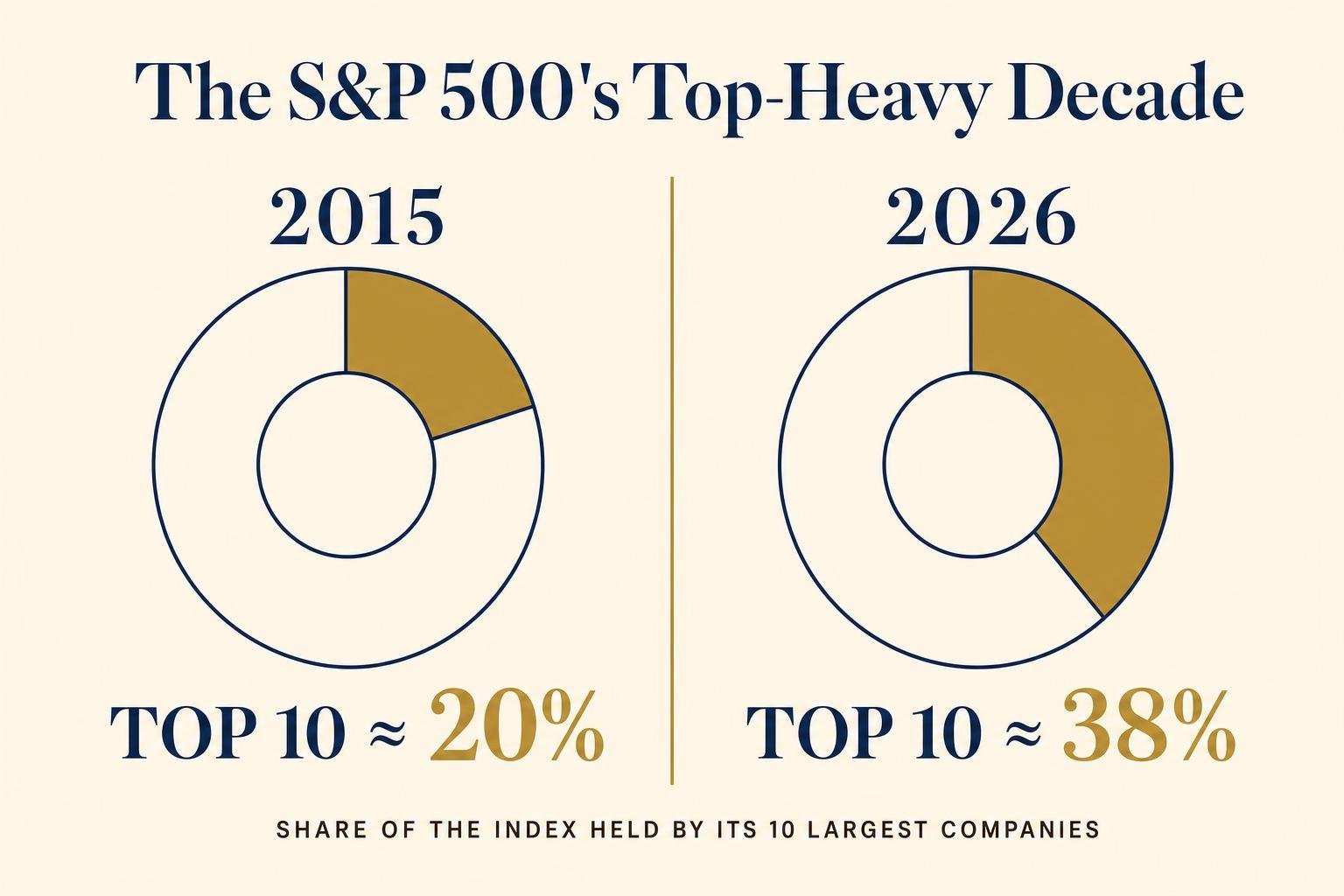
As of the first half of 2026, the ten largest companies in the index account for roughly 38% of its entire weight. A decade ago that number was about 20%. It is now higher than it was at the peak of the dot-com bubble in 2000. When you buy the index today, close to four of every ten dollars go into the same small handful of names.
This isn’t a crash warning, and I’m not predicting one. It’s a piece of plumbing most retirees don’t know is sitting inside a fund they think of as the safest, most boring thing they own. Understanding it is the difference between knowing what you actually hold and assuming a label protects you.
How an index fund quietly concentrates itself
The S&P 500 is cap-weighted. Each company’s share of the index is set by its market value — its stock price times the number of shares outstanding. The biggest company gets the biggest slice, the smallest gets a sliver, and the fund holds them all in that proportion automatically.
That design has a quiet consequence. When a company’s stock rises, its weight in the index rises with it. The fund doesn’t trim its winners — it lets them grow. So a handful of enormous companies that have run up over several years don’t just lead the index; they slowly become it. You didn’t decide to put 7% of your money into a single stock. The math decided it for you, one good quarter at a time.
Nobody at the fund company is making that call. There’s no manager choosing to load up on technology. It’s the mechanical result of tracking a value-weighted benchmark in a market where a few companies got very large very fast. The word “index” sounds neutral. The weighting underneath it is anything but.
How concentrated we actually are
The numbers are worth sitting with. Between roughly 1990 and 2015, the top ten S&P 500 companies held a fairly steady 18–23% of the index. Since then that share has nearly doubled, reaching record territory in the high 30s by 2025 and 2026, with the top ten now near 40% of the entire index.
For perspective, at the height of the dot-com bubble in 2000, the top ten peaked around 27% before the unwind. We are now meaningfully past that. And the leadership isn’t spread evenly across industries: by mid-2026, semiconductors alone have grown to roughly a fifth of the entire S&P 500 — about four times their share at the start of the decade. I wrote about that narrowing leadership in the first-half market recap; concentration is the structural story sitting underneath this year’s record highs.
One honest caveat, because the fear-mongering version of this article skips it: the companies at the top today are, for the most part, genuinely profitable, cash-generating businesses — not the profitless story stocks that led in 1999. Concentration by itself is not fraud, and it is not proof of a bubble. High concentration has happened before — the “Nifty Fifty” of the early 1970s was its own version — and the index has always eventually recovered from it. The issue isn’t the quality of the companies. It’s what concentration does to your risk.
Why “diversified” and “concentrated” aren’t opposites
Here’s the distinction that matters. “Diversified” is a claim about how many things you own. “Concentrated” is a claim about where the risk actually sits. You can be both at once — and right now, a standard S&P 500 index fund is exactly that.
You own 500 companies, so the label “diversified” is technically accurate. But because a small group carries so much of the weight, the fund’s day-to-day fate is tied to how those few names behave. The whole point of diversification is that no single thing can hurt you much. When the largest handful stumble together — one disappointing product cycle, one sector falling out of favor — the other 490 companies can’t cushion the fall the way 490 companies are supposed to. The diversification is real in name and thin in effect.
Thomas’ Take: Diversification is supposed to mean that no single thing can sink you. When ten names drive nearly 40% of your fund, that promise is quietly broken — even though you technically own five hundred stocks. The label didn’t change. What’s underneath it did.
What actually changes for a retiree
For someone still working and adding money every month, concentration is mostly noise. A drawdown in the biggest names is a chance to keep buying at lower prices, and time is on your side. This is the accumulation phase, and volatility is a friend you’ll thank later.
Retirement flips that. Once you’re drawing income, a sharp fall in a top-heavy market can force you to sell shares at exactly the wrong moment — the sequence-of-returns problem I’ve written about before. If your growth money and your grocery money are the same money, a narrow-leadership drawdown isn’t an abstraction. It’s your monthly withdrawal, coming out of a fund that just dropped because five companies had a bad quarter.
This is where bucket planning earns its keep. In the Now / Soon / Later framework, market-exposed money lives in the Later bucket — the long-horizon growth money you won’t touch for years. Concentration lives there too, and that’s fine, because you’re not selling the Later bucket to pay this month’s bills. The Soon bucket — a guaranteed income floor built from Social Security, a pension, or an income-focused fixed index annuity — is what covers the essentials. When your grocery bill doesn’t depend on how the ten biggest stocks did this quarter, concentration becomes a fact you monitor instead of a risk that can actually hurt you.
What to actually do about it
Not much needs to change, but three things are worth doing. First, know what you own. Pull up your largest fund, find its top ten holdings, and see what percentage of the fund they represent. Most people are genuinely surprised. You can’t manage a risk you’ve never looked at.
Second, understand your options without treating any of them as a mandate. Some investors hold an equal-weight version of the index — where all 500 companies carry the same slice — alongside or instead of the standard cap-weighted fund, precisely to dilute the concentration. That’s a legitimate structural choice with its own trade-offs, not a recommendation for your situation. The point is to make the choice on purpose rather than inherit it by default.
Third, make sure the concentration lives in the right bucket. The trade-offs here — how much market exposure your plan can actually carry, how large an income floor you need, when to claim Social Security — are exactly the kind of thing worth modeling before you commit. A tool like ProjectionLab lets you run your own portfolio against different withdrawal orders, claiming ages, and market scenarios and see how the “do I run out” risk actually moves when the growth bucket takes a hit. (ProjectionLab is an affiliate partner; if you subscribe through that link, Confluence Media Group may earn a commission at no additional cost to you. I only point readers toward tools I’d actually use.)
Two retirees, one fund
Consider a hypothetical case. Two retirees, both 66, both holding $600,000 in the same S&P 500 index fund. Ray assumes he’s fully diversified — 500 companies, nothing to worry about — and draws $2,500 a month straight from the fund to cover his bills. Diane owns the identical fund, but she’s built a Soon-bucket income floor from Social Security and a small annuity that covers her essentials, and she keeps two years of spending in cash.
Now imagine the market’s largest names hit a rough stretch and the index falls 25%, driven mostly by the same handful of companies that had carried it higher. Ray is selling shares into that decline every month just to eat, locking in the loss on the way down. Diane isn’t selling anything; her income floor keeps paying, and her index fund is free to recover on its own schedule. They own the exact same concentrated fund. Only one of them is exposed to the concentration.
The S&P 500 is still one of the finest wealth-building tools ever made, and I’m not suggesting anyone abandon it. But “I own the index, so I’m diversified” is doing more work in most retirement plans than it can bear. Diversification is a claim about your holdings. Safety is a claim about your income. In a market this concentrated, the second claim is the only one that pays your bills — and it doesn’t come from the fund. It comes from how you’ve built everything around it.
This article is published by Confluence Media Group LLC, an independent publisher of educational financial content. Thomas Clark is a Series 65 Investment Advisor Representative. The information provided is for educational and informational purposes only and is not personalized financial, tax, or legal advice. Past performance does not guarantee future results. All investing involves risk, including potential loss of principal. Consult a qualified professional before making financial decisions.
Confluence Media Group LLC is a separate entity from Confluence Capital Management, the investment advisory practice through which Thomas Clark provides advisory services. Advisory services are not offered through this publishing platform.
About Thomas Clark
Thomas Clark is the founder of Confluence Media Group LLC and a Series 65 Investment Advisor Representative. He has spent nearly two decades working with families on retirement planning, with a focus on Social Security optimization, retirement income coordination, and the bucket planning approach to building a guaranteed income floor.
Thomas writes and publishes at thomasclarkadvisor.com and is the author of The Just in Case Binder — a 148-page printable family financial organizer for households who want to make sure the people they love know where everything is.
He lives in North Carolina with his family.
Subscribe to the weekly newsletter · Get the Just in Case Binder

Thomas Clark is a Series 65 licensed investment advisor and experienced trader. He specializes in investing, retirement planning, and market analysis, helping individuals build wealth and make informed financial decisions.
