
How Big Should Your Emergency Fund Really Be?
The “three to six months” rule ignores the two things that actually set your emergency fund: how stable your income is and how low your essential bills can go. Here’s a smarter way to size it — and why a too-big fund is its own quiet cost.

“Three to six months of expenses.” It’s the most repeated number in personal finance, and it’s close to useless. It treats a surgeon with a working spouse the same as a freelancer whose income swings every quarter — as if they need the same cushion. They don’t. The right size for your emergency fund has almost nothing to do with a rule of thumb and almost everything to do with two numbers most people never actually calculate.
Let me give you those two numbers, then a way to put them together. Along the way I’ll make a case you won’t hear from most budgeting apps: for some people a six-month fund is dangerously thin, and for others it’s a quiet drag on their wealth.
Where “three to six months” actually came from
The rule is durable because it’s easy to say and hard to argue with. It shows up in every budgeting app, every intro-to-money article, and most back-of-the-envelope advice. But notice what it leaves out. It doesn’t ask what you earn, how steady that income is, who else is in the household, or what your fixed bills look like. A single number can’t carry all of that.
Even the Consumer Financial Protection Bureau, which publishes one of the better plain-English guides to emergency savings, doesn’t lead with “three to six months.” Its guidance starts somewhere more honest: the amount you need depends on your situation, and the best estimate comes from looking at your own past unexpected expenses. The rule of thumb is a tidy number someone bolted on later, because “it depends” is unsatisfying advice. Unsatisfying isn’t the same as wrong.
The two numbers that actually set your fund
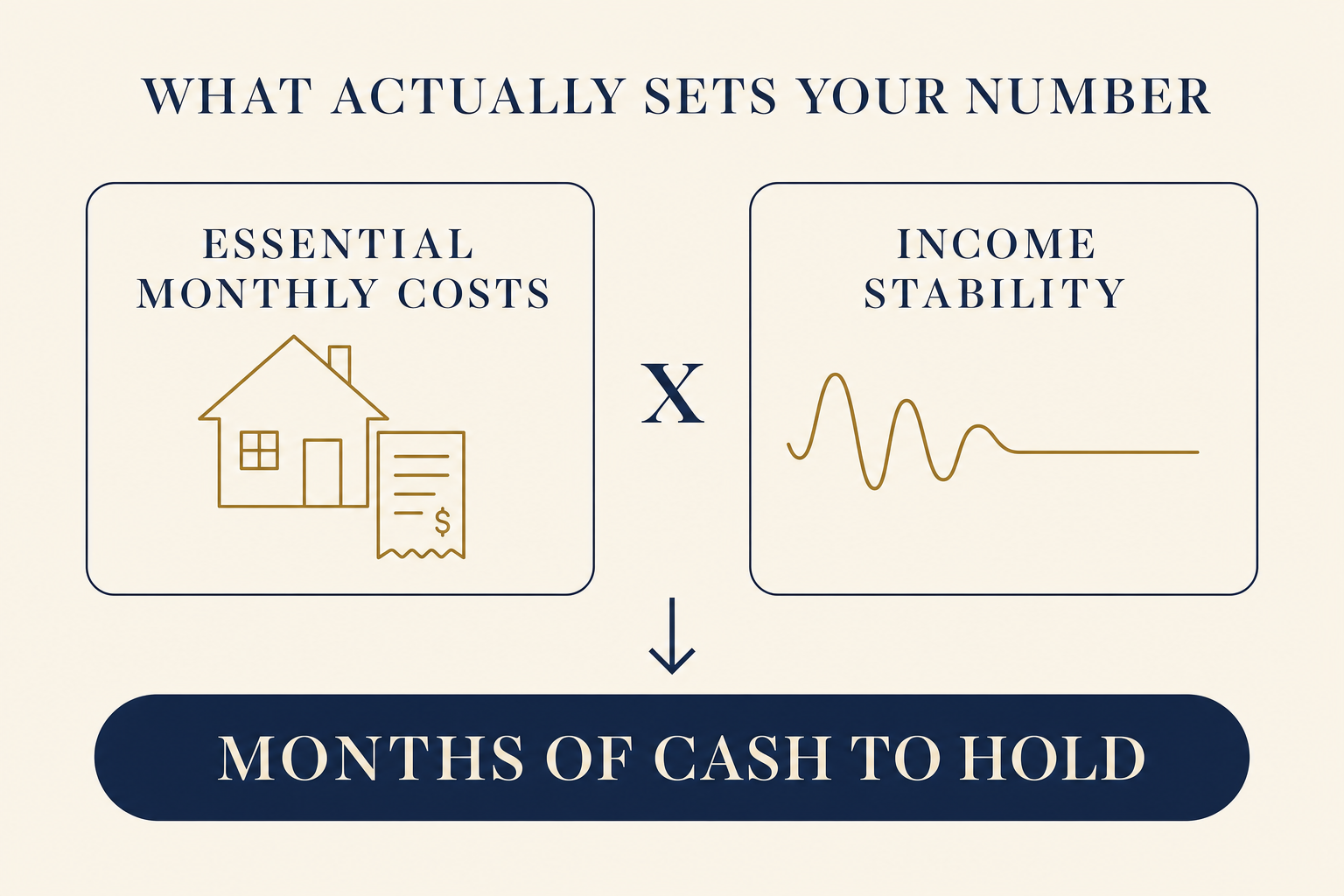
Start with your fixed-cost floor — not your spending, your essentials. Rent or mortgage, utilities, groceries, insurance, minimum debt payments, and the handful of bills that don’t stop when your income does. This is almost always lower than your take-home pay, because it strips out restaurants, travel, and the discretionary spending you’d cut the same week a paycheck disappeared. If you’ve never drawn that line between needs and wants, it’s the same split that makes the 50/30/20 budget useful in the first place. Your emergency fund is measured in months of this number, not months of your lifestyle. Get this floor wrong and every other calculation inherits the error.
Then size the number of months to your income volatility — how likely your income is to stop, and how long it would take to replace. A tenured teacher married to a nurse is in a very different position than a commission salesperson, a small-business owner, or a two-income household where both paychecks come from the same shaky industry. The first has a backstop and a steady paycheck. The others are carrying the whole risk on one unpredictable line.
This is where the labor market earns a mention. In early 2026, the median unemployed worker was out of work for roughly 13 weeks — about three months — and a quarter of the unemployed had been searching for 27 weeks or more, according to the Bureau of Labor Statistics. Read that again: “three months” isn’t a cushion for the median job search. It is the median job search. And specialized, higher-paying roles routinely take longer to replace, not shorter.
Thomas’ Take: The people most certain they’ll “find something fast” are often the ones in the most specialized, highest-paying jobs — exactly the roles that take the longest to refill. Confidence is not a funding strategy.
A better way to size it
Put the two numbers together: take your essential monthly costs and multiply by a months factor set by how replaceable your income is. The factor isn’t a guess — it tracks your backstops.
- Very stable income with a second household earner — three months of essentials is often enough. A spouse’s paycheck is already covering part of the risk.
- One stable income, no backup earner — four to six months. The classic rule finally fits here, which is probably why it got generalized to everyone.
- Variable, commission, or self-employed income — six to twelve months, measured against your lean months, not your good ones.
- A known near-term risk on top of that — a layoff rumor, a health issue, a car on its last legs, a high insurance deductible you’d have to fund out of pocket — gets added as a specific dollar line item, not a vague “extra buffer.”
Notice that the top of that range — twelve months — is a number no rule of thumb will ever hand you. For a lot of self-employed people, it’s exactly the right answer.
A hypothetical to make it concrete
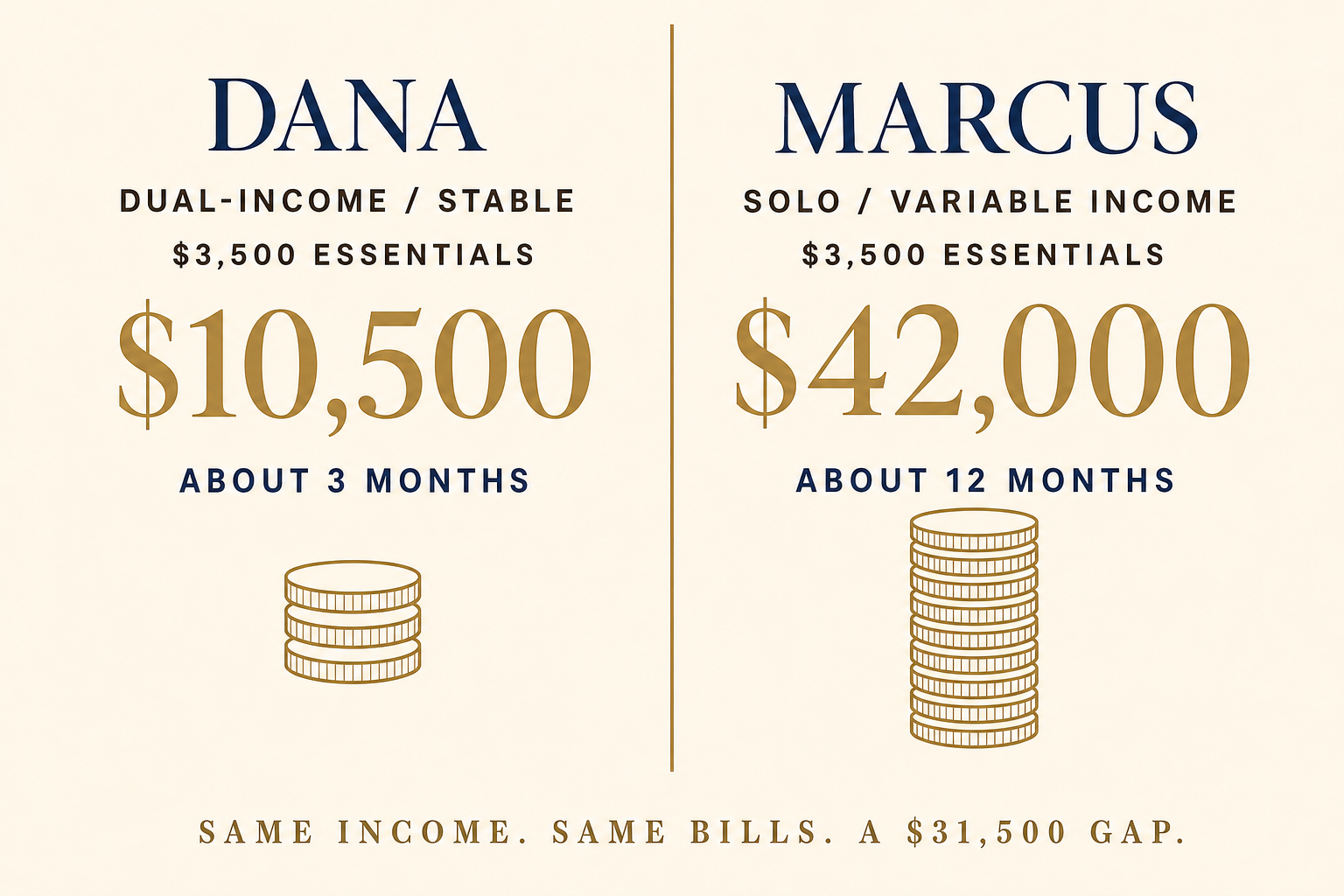
Consider a hypothetical case: two neighbors, each bringing home $6,000 a month. Dana is a public-school administrator married to a nurse; between them, one income alone covers the essentials. Her essential bills run about $3,500 a month. Marcus is a self-employed contractor whose income swings between $3,000 and $9,000 with the seasons, and he’s his household’s only earner. His essentials also run about $3,500.
The rule of thumb says both should hold somewhere between $10,500 and $21,000 — three to six months of essentials. But Dana’s income is backstopped by a spouse and is about as stable as income gets; three months, roughly $10,500, is a reasonable floor for her. Marcus has no backstop, a volatile top line, and a work slowdown that could easily run two seasons. Nine to twelve months of essentials — $31,500 to $42,000 — is the honest number for him.
Same income. Same bills. Same rule of thumb. And a $30,000 gap in the right answer. That gap is the entire point: the rule hid the only variables that mattered.
Where to keep it — and where not to
An emergency fund has exactly one job: to be there, in full, the day you need it. That rules out two popular mistakes. It shouldn’t sit in your checking account, where it quietly leaks into ordinary spending, and it shouldn’t be invested in the stock market, where it can be down 20% on the exact morning you lose your job. Spending it by accident and watching it fall at the worst moment are the two ways emergency funds fail in practice.
The right home is boring on purpose: a high-yield savings account or a money market account at an FDIC-insured bank, where your balance is protected up to $250,000 per depositor, per institution. You’ll earn a little interest while it waits, and a little is fine — this was never the money that’s supposed to grow. If you’ve read my take on bucket planning and mental accounting, this is the Now bucket in its purest form: liquidity you can reach without selling anything or asking anyone.
When a big emergency fund is actually a mistake
Here’s the stance most budgeting advice won’t take: for some people the emergency fund is too big, and that’s its own quiet cost. Cash held far beyond what your situation calls for isn’t “extra safe” — it’s money not doing its job. Over a decade, the gap between a money-market yield and a diversified portfolio compounds into real money, and an oversized cash pile is how careful savers accidentally shortchange their own future.
If you have genuinely stable income, a working partner, and real backups — Roth contributions you could withdraw in a pinch, a home-equity line opened before you need it, family you could lean on briefly — then carrying twelve months of idle cash “just in case” may cost you more than the risk it’s covering. The discipline that builds a fund is the same discipline that, past a point, should be pointed at investing instead. As I’ve argued before, your savings rate matters more than your returns early on — but only if the savings actually get invested rather than parked forever in cash.
This is the same discipline problem in reverse from the one most people have. If you’re still building toward one month of essentials, hold more. If you’re sitting on two years of cash because it feels safe, that feeling has a price tag.
Key takeaways
- The “three to six months” rule ignores the two variables that set your real number: how stable your income is, and how low your essential bills can go.
- Size the fund in months of essential expenses, not months of your full lifestyle.
- Match the months to your income volatility — roughly three months for stable dual-income households, six to twelve for variable or single-income earners.
- Keep it liquid and protected: a high-yield savings or money market account at an FDIC-insured bank. Never checking, never the market.
- An oversized emergency fund is a real cost, not free safety. Past what your situation needs, that cash belongs at work.
Frequently asked questions
Does a paid-off house change how much I need?
It lowers your essential-cost floor, which lowers the dollar target — a mortgage is often the single largest fixed bill. It doesn’t change the logic. You still size the fund in months of whatever essentials remain, and the decision to retire that mortgage early is its own separate question.
Should retirees keep an emergency fund?
The framing shifts. In retirement, the “emergency fund” becomes your Now bucket — one to two years of spending held in cash so you’re never forced to sell investments into a downturn just to cover groceries. The job is identical; the time horizon is simply longer.
Can credit cards or a HELOC count as my emergency fund?
As a backup, yes; as the primary fund, no. The moment you most need cash — a job loss, a medical event — is often the exact moment a lender gets nervous and cuts your available credit. Borrowed liquidity can be pulled back by the lender. Cash in your own insured account can’t be.
The real question
The honest answer to “how big should my emergency fund be?” is itself a question: how long could your income stop, and how low can your bills go while it’s stopped? Answer those two honestly and you’ll land on a figure a rule of thumb would never have given you — and you’ll stop measuring your safety against a number that was never built for your life.
The goal was never to hit three months or six. It was to turn a bad month into a nuisance instead of a catastrophe, without parking so much cash that you quietly lose the decade. Get the two numbers right, and the rule of thumb becomes what it always should have been: someone else’s starting point, not your answer.
This article is published by Confluence Media Group LLC, an independent publisher of educational financial content. Thomas Clark is a Series 65 Investment Advisor Representative. The information provided is for educational and informational purposes only and is not personalized financial, tax, or legal advice. Past performance does not guarantee future results. All investing involves risk, including potential loss of principal. Consult a qualified professional before making financial decisions.
Confluence Media Group LLC is a separate entity from Confluence Capital Management, the investment advisory practice through which Thomas Clark provides advisory services. Advisory services are not offered through this publishing platform.
About Thomas Clark
Thomas Clark is the founder of Confluence Media Group LLC and a Series 65 Investment Advisor Representative. He has spent nearly two decades working with families on retirement planning, with a focus on Social Security optimization, retirement income coordination, and the bucket planning approach to building a guaranteed income floor.
Thomas writes and publishes at thomasclarkadvisor.com and is the author of The Just in Case Binder — a 148-page printable family financial organizer for households who want to make sure the people they love know where everything is.
He lives in North Carolina with his family.
Subscribe to the weekly newsletter · Get the Just in Case Binder

Thomas Clark is a Series 65 licensed investment advisor and experienced trader. He specializes in investing, retirement planning, and market analysis, helping individuals build wealth and make informed financial decisions.
