
Should You Pay Off Your Mortgage Before You Retire?
For a decade, keeping a cheap mortgage and investing the difference was the obvious move. At 7%+ rates — and through the retirement income-floor lens — that math no longer holds.

For most of the last decade, this was one of the easiest questions in retirement planning. You had a 3% mortgage, the market had just handed you double-digit years, and every spreadsheet said the same thing: keep the cheap loan, invest the difference, come out ahead. I said it myself.
Then rates moved. A 30-year fixed mortgage is sitting around 7.3% as of early October 2026, with the Freddie Mac weekly survey near 7.28% and daily snapshots a notch higher. The 10-year Treasury pushed above 5% — the highest in nearly two decades. When the loan you’re carrying costs that much, the old answer stops being automatic. And for someone five years from retirement, the question was never really about the interest spread anyway.
The spread argument got a lot weaker
The case for keeping a mortgage rests on arbitrage: if your loan costs less than your investments earn, borrow cheap and invest the gap. At 3%, that gap looked wide and comfortable. At 7.3%, it’s narrow and uncertain.
Here’s the part that trips people up. Paying down a 7.3% mortgage isn’t like earning 7.3% in your portfolio — it’s better than that, because it’s guaranteed and it’s after no risk. Every extra dollar against the principal returns exactly the loan rate, with no sequence-of-returns risk, no bad decade, no 3am worry. Beating a guaranteed 7.3% in the market means reaching for more risk at precisely the age when you have the least room to recover from a mistake. The spread didn’t just shrink. It inverted for a lot of households.
The tax argument is mostly a ghost
The other reason people keep a mortgage is the interest deduction. For the large majority of retirees, that deduction is worth nothing — because they never itemize.
The 2026 standard deduction is $32,200 for a married couple filing jointly and $16,100 for a single filer. A couple who are both 65 or older add roughly $3,300 on top, putting them near $35,500 before they count a dollar of mortgage interest, charitable gifts, or state taxes. There’s also a temporary $6,000-per-person senior deduction running from 2025 through 2028. To get any tax benefit from mortgage interest, your itemized deductions have to clear that whole standard-deduction wall first — and a retiree with a seasoned, mostly-principal payment rarely does. The IRS lays out the itemize-or-not math in Topic No. 501, and the deductibility rules themselves live in Publication 936.
So when someone tells you “keep the mortgage for the write-off,” ask whether they actually itemize. Most don’t. The write-off they’re protecting is imaginary.
The reason I lean toward payoff has nothing to do with either
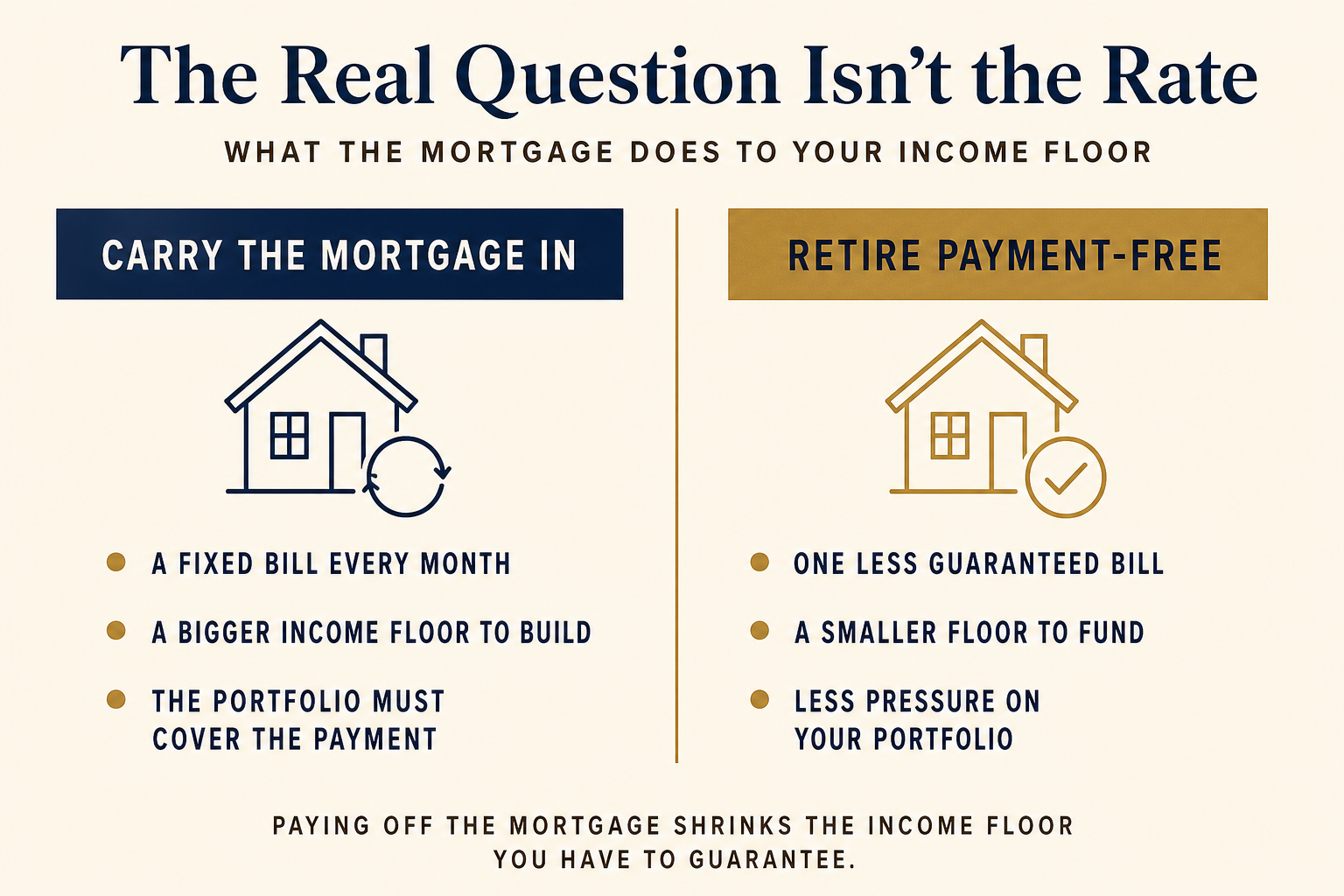
Strip away the spread and the tax angle and you get to the thing that actually matters in retirement: your mortgage payment is a bill. A big, fixed, non-negotiable bill that shows up every month whether the market is up or down, whether you’re healthy or not, whether it’s a good year or a terrible one.
In the bucket approach I use, retirement income gets built in three layers — a Now bucket for near-term spending, a Soon bucket of guaranteed income (Social Security, pensions, income annuities) to cover your essential bills, and a Later bucket invested for growth. The single most important number in that whole structure is your income floor: the guaranteed income you need to cover the expenses you can’t skip. A mortgage payment sits right in the middle of that floor.
Eliminate a $2,000 monthly payment and you’ve just lowered the floor you have to build by $24,000 a year, for as long as the loan would have run. That’s $24,000 a year of guaranteed income you no longer have to manufacture out of Social Security timing, a pension election, or an annuity. Paying off the mortgage doesn’t just save interest — it shrinks the hardest part of the retirement-income problem. That’s the lever, and almost nobody frames it that way.
Thomas’ Take: A paid-off house is the cheapest guaranteed income you’ll ever buy. You’re not chasing a yield — you’re deleting an expense. And a deleted expense is worth more than an equal dollar of income, because it never gets taxed, never needs a COLA, and never depends on a claiming strategy going right.
When I don’t pay it off
This isn’t a blanket rule, and the way you pay it off matters more than whether you do. There are real tradeoffs, and a few situations where keeping the mortgage is the better call.
Don’t drain your liquidity to kill the loan. If paying off the mortgage empties your cash reserves, you’ve traded a manageable payment for fragility — one roof repair or medical bill away from borrowing at credit-card rates. Your emergency reserves and your Now bucket come first; the mortgage gets the surplus, not the foundation.
Don’t let the payoff detonate a tax bill. Pulling $300,000 out of a traditional IRA in one year to clear a mortgage can push you into a higher bracket, add a surcharge to your Medicare premiums two years later, and tax more of your Social Security — a cost that can swamp the interest you saved. This is where which account you pull from, and in what order, does real work. A payoff spread across a few tax years, or funded from taxable savings, often beats one dramatic withdrawal.
And if your mortgage is still one of those sub-4% loans from the refinancing window, the original math mostly holds — a guaranteed 3.25% return isn’t compelling, and you may do better keeping the cheap loan and investing. The rate environment that makes payoff attractive is the current one, not the one you locked in during 2021.
A hypothetical to make it concrete
Consider a hypothetical couple: Ray and Diane, both 61, planning to retire at 65. They have about $140,000 left on their mortgage at 7.1%, roughly $1,900 a month in principal and interest, with nine years to run. They also have a taxable brokerage account and a healthy cash cushion, plus their retirement accounts.
The old reflex says invest the taxable money and keep the loan. But run it through the floor lens. If they direct their taxable savings and the next four years of surplus toward the mortgage, they can walk into retirement with no payment. That erases roughly $22,800 a year of required income — income they’d otherwise have to cover by claiming Social Security earlier than ideal or by leaning harder on their portfolio in the fragile first years. Clearing the loan from taxable dollars also avoids inflating the IRA withdrawals that drive their future tax and Medicare costs. For Ray and Diane, payment-free at 65 does more for their plan than a slightly larger brokerage balance would. Your figures will point somewhere of their own — the framework is what travels, not the numbers.
How to settle it on your own numbers
The honest way to resolve this is to stop arguing in the abstract and model your actual situation: your real balance and rate, your real income floor, and what happens to your required guaranteed income when the payment disappears versus when it stays. A planning tool like ProjectionLab lets you build both versions with your own figures and watch what the payoff does to the income you actually have to generate — and to your tax picture in the years you’d fund it. Seeing it on your own numbers lands differently than reading someone else’s example.
Disclosure: the ProjectionLab link above is an affiliate link. If you subscribe through it, I may earn a commission at no additional cost to you. I only point to tools I’d actually sit down and use.
The decision isn’t really about beating your mortgage rate in the market. It’s about how big a guaranteed-income floor you want to build — and whether you’d rather spend the next decade funding a bank’s payment or funding your own freedom from it. For people within sight of retirement, in a 7% world, I keep landing on the same place: enter retirement owing no one, and build a smaller floor on purpose.
Key takeaways
- At today’s ~7.3% mortgage rates, paying down principal is a guaranteed, risk-free return that’s hard to beat in the market without taking on more risk than a near-retiree should.
- The mortgage-interest deduction is worthless to most retirees, who take the standard deduction ($32,200 MFJ in 2026, more with age add-ons) and never itemize.
- The real prize is a smaller income floor: erasing the payment erases guaranteed income you’d otherwise have to build.
- Never drain your emergency reserves or trigger a large one-year taxable withdrawal to do it — how you fund the payoff matters as much as whether you do.
- If you still hold a sub-4% loan, the old “invest the difference” logic probably still wins.
Frequently asked questions
Does paying off my mortgage hurt my credit score?
It can nudge it down slightly by closing an active installment account, but a few points on a score you’re no longer using to borrow is not a reason to carry a seven-figure-lifetime interest cost. The score is a tool for getting credit, not a measure of financial health.
Isn’t my home equity “trapped” once I pay off the mortgage?
It’s less liquid, yes — which is exactly why liquidity comes first and the mortgage gets only your surplus. Home equity is best treated as a walled-off reserve, not a spending bucket, a point worth its own discussion in where home equity fits a bucket plan.
Should I stop investing entirely to pay the mortgage down faster?
No. Keep capturing any employer match and keep your buckets intact. Mortgage payoff competes for your surplus cash, not for the contributions and reserves that your plan already depends on — the same discipline behind building your buckets before you retire.
This article is published by Confluence Media Group LLC, an independent publisher of educational financial content. Thomas Clark is a Series 65 Investment Advisor Representative. The information provided is for educational and informational purposes only and is not personalized financial, tax, or legal advice. Past performance does not guarantee future results. All investing involves risk, including potential loss of principal. Consult a qualified professional before making financial decisions.
Confluence Media Group LLC is a separate entity from Confluence Capital Management, the investment advisory practice through which Thomas Clark provides advisory services. Advisory services are not offered through this publishing platform.
About Thomas Clark
Thomas Clark is the founder of Confluence Media Group LLC and a Series 65 Investment Advisor Representative. He has spent nearly two decades working with families on retirement planning, with a focus on Social Security optimization, retirement income coordination, and the bucket planning approach to building a guaranteed income floor.
Thomas writes and publishes at thomasclarkadvisor.com and is the author of The Just in Case Binder — a 148-page printable family financial organizer for households who want to make sure the people they love know where everything is.
He lives in North Carolina with his family.
Subscribe to the weekly newsletter · Get the Just in Case Binder

Thomas Clark is a Series 65 licensed investment advisor and experienced trader. He specializes in investing, retirement planning, and market analysis, helping individuals build wealth and make informed financial decisions.
