
Where Home Equity Fits in a Retirement Bucket Plan
Your house is probably your largest asset — and it doesn't belong in your retirement income floor. Here's how home equity fits a Now, Soon, Later bucket plan: as a walled-off reserve, not a fourth bucket.

Add up everything a typical 62-year-old owns, and one number usually dwarfs the rest: the house. For a great many households heading into retirement, home equity is the single largest asset on the balance sheet — often bigger than the 401(k). And yet, when I walk someone through a Now, Soon, Later bucket plan, the house is almost always the thing they’ve never assigned a job. It just sits there, quietly, as if it isn’t part of the plan at all.
That instinct is half right. Your house does not belong inside your income floor. But leaving it out of the plan entirely is its own mistake, because home equity does two specific jobs better than almost anything else you own — as long as you’re honest about what those jobs are.
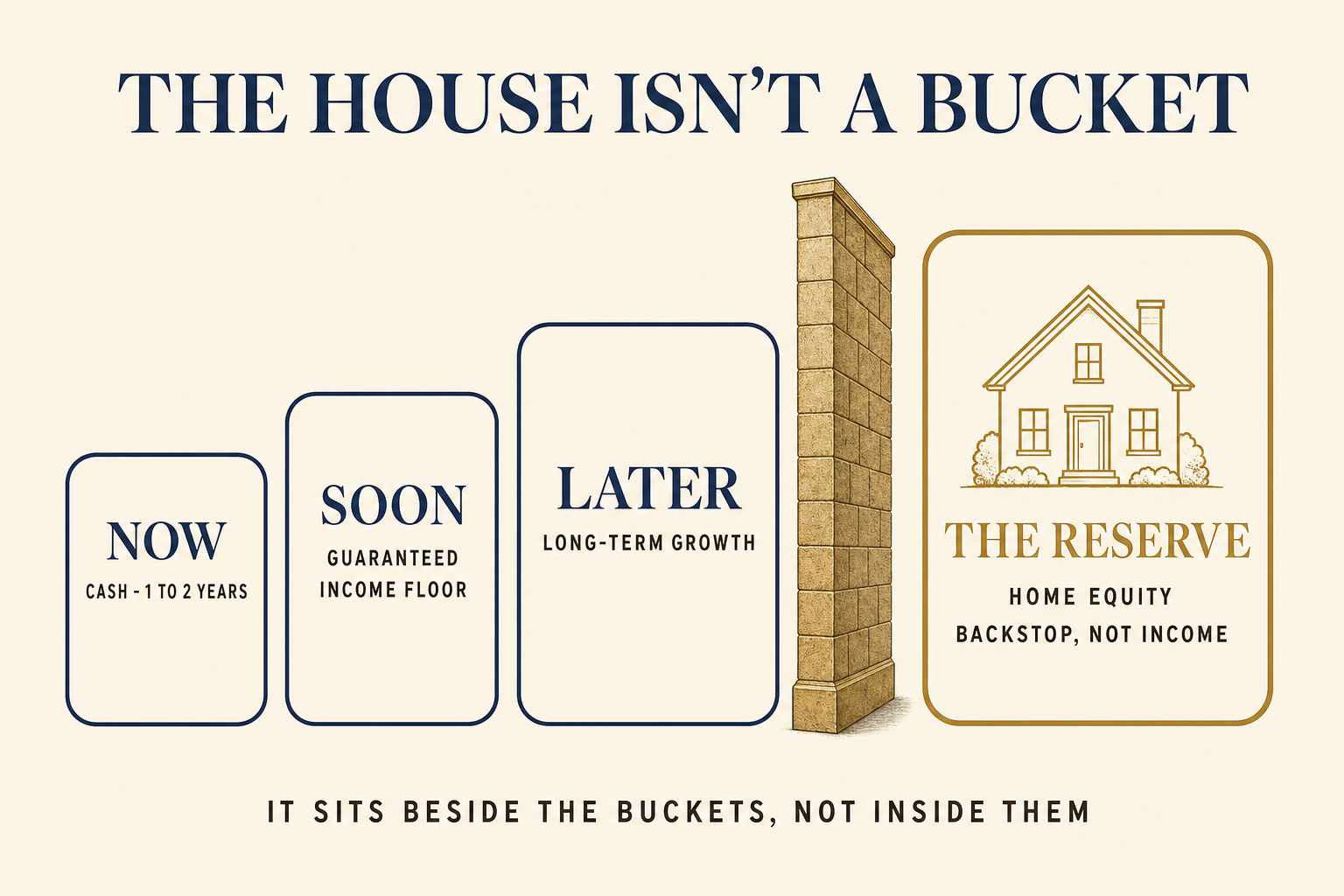
So let’s give the house a job. Not a fourth spending bucket, but a walled-off reserve that sits beside the three buckets and backstops the risks they can’t cover on their own.
Your house is not a bucket
The Now, Soon, Later framework divides your money by when you’ll spend it. The Now bucket holds a year or two of cash for living expenses. The Soon bucket is your guaranteed income floor — Social Security, any pension, and income-focused annuities — built to cover the essentials. The Later bucket is long-term growth you won’t touch for years.
Notice the common thread: every bucket exists to be spent, in usable pieces, on a schedule you control. That’s the test. And it’s exactly the test your house fails. You can’t spend a bathroom. To turn home equity into money you have to either sell the whole thing or borrow against it, and in the meantime you have to live somewhere. An asset you occupy and can only access in one large, irreversible move is not a bucket. It’s a reserve.
Why home equity doesn’t belong in your income floor
The income floor is the most important number in a retirement plan. It’s the guaranteed, roughly monthly income that covers your essential bills no matter what the market does. To do that job, floor income has to be three things: reliable, reasonably liquid, and not dependent on you selling something at a good price.
Home equity is none of those. It’s illiquid, it’s lumpy, it’s priced by a housing market you don’t control, and you’re living inside the collateral. Counting it as part of your floor means you’d have to move out or take on debt just to realize it — which is the opposite of what a floor is supposed to do. A floor you have to leave your house to stand on isn’t a floor. It’s a decision you’ve deferred and dressed up as a plan.
This matters because the people most tempted to count the house as income are usually the ones whose guaranteed income falls a little short of their essentials. The house looks like it closes the gap. It doesn’t. It just hides the gap behind a someday-maybe you haven’t actually thought through.
The two jobs home equity does well
Once you stop asking the house to be a paycheck, it becomes clear what it’s genuinely good at. Two things, specifically.
First, it backstops a broken sequence. The first decade of retirement is fragile: a bad early market while you’re drawing income can do lasting damage. A pre-arranged home equity line — set up while you still qualify — can cover a stretch of spending so you’re not forced to sell investments into a downturn. But note the word backstop. This sits behind your Now cash and your Soon floor, not in front of them. It’s the reserve you tap when the first two lines are strained, not your opening move.
Second, it self-funds a late-life shock — usually long-term care. A serious care need is the risk most retirement plans quietly ignore, and it’s expensive: a private room in a nursing home now runs well over $100,000 a year in much of the country. Home equity is the natural source to meet it, for a reason that’s easy to miss — the moment you need heavy care is often the same moment you’re leaving the home for good. The asset and the need line up. If you’ve chosen to self-insure against care, the house is frequently the reserve doing that work.
Hold both jobs in your head and you’ll see why walling the house off is freeing rather than limiting. When you know the Reserve is there for the bad decade and the late-life shock, you can let the Later bucket actually grow instead of hoarding cash against every “what if.”
The three honest ways to turn a house into money
A reserve is only useful if you know how you’d draw on it. There are three real options, and each has a cost worth naming out loud.
Downsizing is the cleanest. You sell, buy or rent something smaller, and free up equity with no debt attached. The tradeoffs are transaction costs and the emotional weight of leaving a home — real, but at least they’re one-time and knowable. For many households, right-sizing the home is the simplest way to convert the Reserve into spendable buckets.
A reverse mortgage — specifically an FHA-insured HECM, available at 62 and up — is the most misunderstood. It’s non-recourse, which means you or your heirs never owe more than the home is worth, and the unused portion of a line of credit grows over time. Used as a standby line you arrange before you need it, it’s a legitimate sequence-risk backstop. Used to fund everyday spending, it’s usually a slow-motion mistake: the fees are real, the balance compounds, and the equity erodes. The Consumer Financial Protection Bureau lays out the costs plainly, and HUD requires counseling before you can get one. My position: a HECM can be good insurance and bad income. Set it up as a backstop, not a habit. I’ve written more on when reverse mortgages make sense and when they don’t.
A home equity line of credit is the cheapest standby liquidity if you open it while you’re still working and clearly qualify. The catch is that lines get harder to obtain in retirement, and a bank can reduce or freeze an unused line — sometimes at the exact moment you’d want it. Treat a HELOC as a working-years tool you carry into retirement, not something to count on arranging later.
What this looks like beside the buckets
Consider a hypothetical couple — Nadia and Sam, both 64, planning to retire next year outside Raleigh. Their essentials run about $5,000 a month. Between Social Security and a small pension, roughly $4,200 of that is covered by guaranteed income, and they hold about two years of cash in the Now bucket. Their Later bucket sits around $500,000, and their house — paid off — is worth about $450,000. (These are illustrative round numbers, not a projection.)
Here’s the move that changes how retirement feels for them: they assign the house one job — to stay untouched. It becomes their Reserve. It gives them a standby credit line they can arrange now against a rough first decade, and a self-funding source if one of them needs care at 85. Because that reserve exists, they don’t have to keep the Later bucket in cash out of fear. The house earns its keep precisely by not being spent — and knowing that lets the rest of the plan breathe.
The point of a reserve
The real job of your house in a bucket plan is to make itself unnecessary most of the time. You’re not trying to squeeze income out of it. You’re arranging the other three buckets well enough that the house gets to just be your home — a reserve you’re glad exists and rarely have to touch. Walling it off is exactly what lets you use it wisely on the day, years from now, you might finally need to.
Key takeaways
- Home equity belongs on your retirement balance sheet, but not in your income floor — it’s illiquid, lumpy, and you live in it.
- Treat the house as a walled-off Reserve that sits beside the Now, Soon, and Later buckets, not as a fourth spending bucket.
- The Reserve does two jobs well: backstopping a bad early market so you don’t sell investments in a downturn, and self-funding a late-life care shock.
- There are three honest ways to tap it — downsizing, a standby HECM line of credit, or a HELOC opened while you’re still working — each with real costs.
- A reverse mortgage can be good insurance and bad income. Arrange it as a backstop before you need it, not as a way to cover groceries.
Frequently asked questions
Should I count home equity in my retirement net worth?
On the balance sheet, yes — it’s a real asset. In your income floor, no. Net worth measures what you own; the floor measures what reliably pays your bills. The house belongs in the first calculation and not the second.
Is a reverse mortgage a good idea?
As a pre-arranged backstop for the two jobs above, it can be — the HECM’s non-recourse protection and growing standby line are genuine features. As a way to fund everyday spending, it rarely is, because the costs and compounding erode the equity you were counting on. The use case matters more than the product.
What if the house is essentially my whole plan?
Then the honest answer is that downsizing or a care plan has to be explicit, not a someday-maybe. If guaranteed income doesn’t cover essentials and the only backstop is the home, that’s not a reason to panic — it’s a reason to decide, on purpose, how and when the house converts into income rather than leaving it to chance.
If you want to see whether you’d ever actually need to tap the house — and when — that’s worth modeling against your own numbers rather than eyeballing. A planning tool like ProjectionLab lets you test scenarios like a bad first decade or a late-life care event and watch whether your income floor and cash reserves hold without the house. (ProjectionLab is a paid tool; the link is an affiliate link, which means I may earn a small commission at no extra cost to you. I only recommend tools I’d use myself.)
This article is published by Confluence Media Group LLC, an independent publisher of educational financial content. Thomas Clark is a Series 65 Investment Advisor Representative. The information provided is for educational and informational purposes only and is not personalized financial, tax, or legal advice. Past performance does not guarantee future results. All investing involves risk, including potential loss of principal. Consult a qualified professional before making financial decisions.
Confluence Media Group LLC is a separate entity from Confluence Capital Management, the investment advisory practice through which Thomas Clark provides advisory services. Advisory services are not offered through this publishing platform.
About Thomas Clark
Thomas Clark is the founder of Confluence Media Group LLC and a Series 65 Investment Advisor Representative. He has spent nearly two decades working with families on retirement planning, with a focus on Social Security optimization, retirement income coordination, and the bucket planning approach to building a guaranteed income floor.
Thomas writes and publishes at thomasclarkadvisor.com and is the author of The Just in Case Binder — a 148-page printable family financial organizer for households who want to make sure the people they love know where everything is.
He lives in North Carolina with his family.
Subscribe to the weekly newsletter · Get the Just in Case Binder

Thomas Clark is a Series 65 licensed investment advisor and experienced trader. He specializes in investing, retirement planning, and market analysis, helping individuals build wealth and make informed financial decisions.
