
How Big Should Your Retirement Income Floor Be?
Your retirement income floor only needs to cover the expenses you can't skip, not your entire budget. Here's how to size it, count what's already guaranteed, and solve for the gap.

Ask ten people what a retirement income floor is and you’ll get two wrong answers for every right one. Half picture handing their entire nest egg to an insurance company in exchange for a monthly check. The other half have never heard the term and quietly assume their 401(k) balance is the plan. Both miss the point.
A retirement income floor is the layer of income you can count on no matter what the market does — the money that shows up whether stocks are up 20% or down 30%. And here’s the part almost everyone gets wrong about it: your floor does not need to cover every dollar you spend. It needs to cover the dollars you can’t skip.
That one distinction is the whole game. Get it right and your floor becomes a number you can actually hit. Get it wrong and you’ll either over-insure, or you’ll look at the number, decide it’s impossible, and do nothing.
First, know which bucket this lives in
I organize retirement income around three buckets: Now (cash and near-cash for current living expenses), Soon (your guaranteed income floor), and Later (market growth for the years and legacy goals further out). The income floor is the job of the Soon bucket, and it’s the one most people underthink.
The Soon bucket’s whole purpose is to produce income you don’t have to worry about — income that keeps arriving on the first of the month regardless of headlines. If you want the fuller picture of how the three buckets coordinate across a household, I walked through it in bucket planning for couples. This post is about one question inside that framework: how big does the floor actually need to be?
The number most people get wrong
When people try to size their floor, they start with the wrong total. They add up everything they expect to spend in retirement — the groceries and the golf, the mortgage and the Mediterranean cruise — and conclude they need to guarantee all of it. That number is big, scary, and almost always more than you need to lock down.
Your spending isn’t one thing. It’s two. There’s the money that keeps the lights on and the roof overhead — and there’s the money that makes retirement fun. The floor is for the first kind. The second kind can ride on the Later bucket, because if the market has a rough year, you can skip the cruise. You cannot skip the electric bill.
Step 1: Find your non-negotiable baseline
Start by separating essential from discretionary spending. Essentials are the bills that don’t care how your portfolio is doing: housing, utilities, food, insurance premiums, out-of-pocket healthcare, property taxes, and the minimum transportation you need to live your life. Discretionary is everything you’d trim without a second thought in a bad year — travel, dining out, gifts, hobbies.
The data backs up where the essentials cluster. The Bureau of Labor Statistics Consumer Expenditure Survey consistently shows that housing, healthcare, food, and transportation make up the large majority of what older households actually spend. Those are your floor categories.
Here’s a method that takes an afternoon, not a spreadsheet degree: pull your last three months of spending and run every line through one question — would I still have to pay this if my investments dropped 30% tomorrow? If yes, it’s essential. Total the essentials and multiply by twelve. That annual number is your floor target. Not your whole budget. Your floor.
Step 2: Count what’s already guaranteed
Now the good news, and it’s usually better than people expect: a chunk of your floor is probably already built. You just haven’t added it up.
Social Security is guaranteed, inflation-adjusted income for life — the backbone of most people’s floor. For a median earner, it’s designed to replace roughly 40% of pre-retirement income, according to the Social Security Administration. If you have a pension, that’s floor income too. Add them together and you’ve found the part of the floor that already exists.
And the single biggest lever you have over that number is when you claim. Every year you delay Social Security past full retirement age, up to age 70, adds delayed retirement credits worth about 8% a year — a permanently larger, COLA-adjusted check for the rest of your life. That’s not a market bet. It’s a guaranteed raise to your floor, and it’s why claiming strategy deserves more thought than almost any other retirement decision. (More on why the age-67 line isn’t the deadline people think it is in this piece on full retirement age.)
Before you do anything else, get a clear read on what your benefit looks like at different claiming ages. You can model it in a few minutes with our free Social Security calculator — because the size of your floor gap depends heavily on this one number.
Step 3: The gap is your real target
Here’s the formula the whole post has been building toward, and it’s deliberately simple:
Essential expenses − guaranteed income you already have = your floor gap.
That gap — not your total spending — is what the rest of the Soon bucket needs to cover. For a lot of households, it’s a far smaller and far more manageable number than the one that was keeping them up at night.
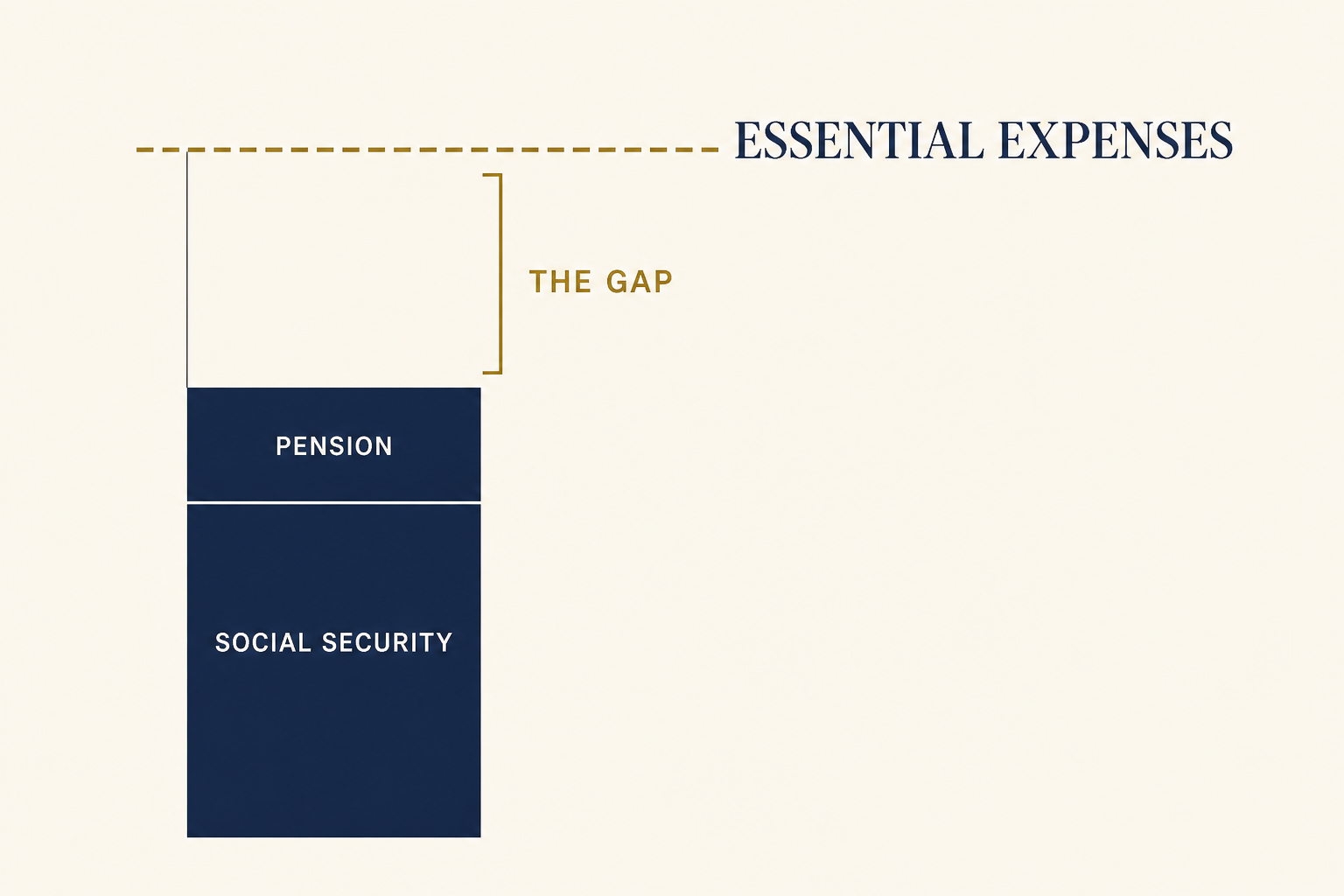
Consider a hypothetical couple: Raj and Priya, both 63, recently retired outside Minneapolis. They run the three-month exercise and land on about $5,000 a month in true essentials — roughly $60,000 a year. Their combined Social Security, if they both wait until full retirement age, comes to about $3,800 a month. Their pension situation is modest: a small pension of about $400 a month from Priya’s years at a hospital system. Add the guaranteed pieces and they’re at roughly $4,200 a month against a $5,000 floor.
Their floor gap is about $800 a month. Not $5,000. Not the whole nest egg. Eight hundred dollars a month of income they need to make guaranteed — and that’s a problem with real, ordinary-sized solutions. (These are round, illustrative figures for a made-up couple, not a projection of anyone’s actual benefits.)
Where the gap gets filled — and where it shouldn’t
Once you know the gap, you have a few honest ways to close it, and the right mix depends on your situation:
- Close part of it by delaying Social Security. If one more year of work or a short bridge from savings lets you claim later, those delayed credits may shrink the gap before you spend a dime on anything else.
- Use a conservative slice of the Soon bucket as a bridge. Short-term Treasuries, CDs, or a short-duration bond ladder can cover a defined number of years of the gap with very little market risk.
- Consider an income-focused Fixed Index Annuity for lifetime coverage of the gap. An FIA with an income rider is built to do exactly this job — turn a lump sum into a guaranteed stream you can’t outlive. In bucket planning, this is the Soon bucket’s tool: it’s for income, not growth.
Two cautions, said plainly. A Fixed Index Annuity is an income instrument, not a growth engine — judge it by the reliability of the income, not by chasing index upside. And this is where I part ways with a lot of annuity pitches: you only need to cover the gap. Guaranteeing far more than your essentials locks up money that belonged in the Later bucket. Over-insuring is a real cost, not free safety.
Thomas’ Take: A Variable Annuity is the wrong tool for the floor and I’ll say it every time. It stacks market risk and high fees onto the one part of your plan that’s supposed to be free of both. The point of the floor is to remove worry — you don’t do that by buying something that can still fall in value. For the Soon bucket, guaranteed means guaranteed.
Why the floor changes how retirement actually feels
The math is only half of it. The reason I push so hard on building a real floor is what it does to your experience of retirement.
When your essentials are covered by income that doesn’t flinch, a market drop stops being an emergency and becomes what it actually is — a temporary number on a screen. Your groceries are still paid for. Your mortgage is still paid for. The Later bucket can have a bad year without touching your life, because your life runs on the floor. I made this case in real time during the recent Nasdaq correction: the people who’d built a floor barely changed their behavior, because the thing paying their bills hadn’t moved.
That’s the quiet payoff nobody puts on a brochure. A guaranteed income floor doesn’t just protect your spending — it protects your ability to leave the Later bucket alone long enough to do its job. For more on not strangling that growth bucket out of fear, see where retirees play the Later bucket too safe.
Key takeaways
- Your income floor needs to cover your essential expenses, not your entire budget.
- Separate spending into essential vs. discretionary by asking: would I still pay this if my portfolio dropped 30%?
- Social Security and any pension already build part of your floor — add them up before assuming you need more.
- Your floor gap (essentials minus guaranteed income) is the number that actually matters, and it’s usually smaller than you feared.
- Fill the gap — and only the gap. Over-guaranteeing locks up money that belongs in the growth-oriented Later bucket.
Frequently asked questions
Should I annuitize my whole portfolio to be completely safe?
Almost never. You only need to guarantee your floor gap. Annuitizing well beyond your essentials trades away growth and flexibility you’ll likely want later in retirement. Cover the gap, keep the rest working.
What if Social Security already covers my essentials?
Then congratulations — your floor may already be built. In that case, the planning work shifts almost entirely to the Later bucket and to tax-smart withdrawal sequencing, not to buying more guaranteed income you don’t need.
Does my floor need to keep up with inflation?
Ideally, yes, at least in part. Social Security comes with an annual cost-of-living adjustment built in, which is one of its most underrated features. Pensions and annuity income may or may not adjust, so it’s worth knowing which of your floor sources rise with inflation and which stay flat.
Size your floor to your essentials, count what you already have, and solve for the gap. That’s a number you can actually plan around — and it’s almost always friendlier than the one in your head.
This article is published by Confluence Media Group LLC, an independent publisher of educational financial content. Thomas Clark is a Series 65 Investment Advisor Representative. The information provided is for educational and informational purposes only and is not personalized financial, tax, or legal advice. Past performance does not guarantee future results. All investing involves risk, including potential loss of principal. Consult a qualified professional before making financial decisions.
Confluence Media Group LLC is a separate entity from Confluence Capital Management, the investment advisory practice through which Thomas Clark provides advisory services. Advisory services are not offered through this publishing platform.
About Thomas Clark
Thomas Clark is the founder of Confluence Media Group LLC and a Series 65 Investment Advisor Representative. He has spent nearly two decades working with families on retirement planning, with a focus on Social Security optimization, retirement income coordination, and the bucket planning approach to building a guaranteed income floor.
Thomas writes and publishes at thomasclarkadvisor.com and is the author of The Just in Case Binder — a 148-page printable family financial organizer for households who want to make sure the people they love know where everything is.
He lives in North Carolina with his family.
Subscribe to the weekly newsletter · Get the Just in Case Binder

Thomas Clark is a Series 65 licensed investment advisor and experienced trader. He specializes in investing, retirement planning, and market analysis, helping individuals build wealth and make informed financial decisions.
