
The Later Bucket Is Where Retirees Play It Too Safe
Most retirement advice says get conservative the day you stop working — but your Later bucket's one job is growth, and a guaranteed income floor gives it more room to take risk than fear usually allows. Here's why the bravest move with your long-term money is to invest it for growth and then look at it the least.

Most retirement advice tells you to get more conservative the day you stop working. For two of your three buckets, that advice is exactly right. For the third, it’s quietly expensive.
I spend a lot of my writing talking people out of claiming Social Security too early, or sizing their guaranteed income floor too small. But there’s a mistake I see just as often, and it runs in the opposite direction: a retiree with a perfectly solid income floor who keeps their long-term growth money parked in a money market fund “to be safe.” They’ve built a good plan and then defended it against the wrong risk.
If you’ve read my work on the Now, Soon, Later framework, you know I’m cautious by temperament. So I want to be clear about what this piece is and isn’t. This is not a case for taking more risk everywhere. It’s a case for taking the right amount of risk in the one bucket whose entire job is to grow — and recognizing that for most retirees, “the right amount” is more than fear is letting them hold.
The Later bucket has exactly one job
Quick refresher, because the whole argument rests on it. In bucket planning, you divide your money by when you’ll spend it, not by what it’s invested in:
- The Now bucket holds the next year or two of living expenses in cash and cash-like holdings. Its job is to never go down.
- The Soon bucket is your guaranteed income floor — Social Security, any pension, and income-focused tools like a fixed index annuity’s income rider. Its job is to cover your essential bills for life, no matter what markets do.
- The Later bucket is money you will not touch for ten, fifteen, twenty years or more. Its job is to grow.
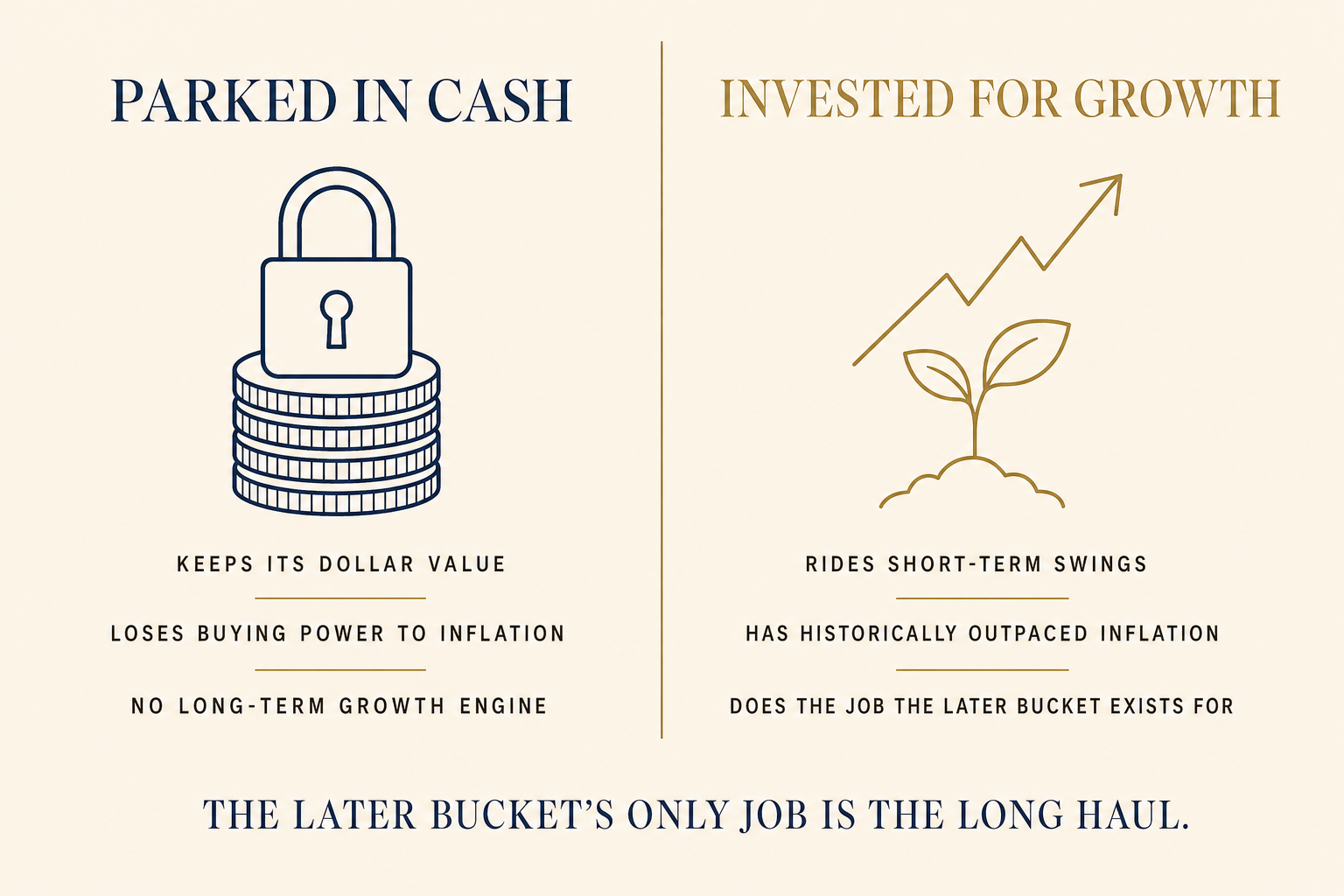
That’s it. The Later bucket has one assignment: outpace inflation over a long horizon so the plan still works when you’re 85. It is not there to feel safe. It is not there to be checked every morning. It is there to do the one thing cash cannot do — grow faster than the cost of living, for a long time.
When you invest the Later bucket like it’s a second Now bucket, you haven’t reduced your risk. You’ve just traded a risk you can see (market swings) for a risk you can’t (slowly running out of purchasing power). One of those shows up on a screen in red. The other shows up at 85, when it’s too late to fix.
Why most retirees play it too safe here
The instinct is understandable. You spent your working years being told to “dial down risk as you approach retirement,” and that’s good advice for your overall mix. But people apply it to every dollar at once. They retire, feel the weight of no more paychecks, and reach for safety across the board — including in the one account that’s specifically set aside for two decades from now.
There’s also a quieter driver: a growth account that never gets touched starts to feel like a number on a screen rather than money with a purpose. So it gets managed by anxiety instead of by its job. A down quarter feels like a mistake to correct rather than the normal cost of owning growth.
The result is a portfolio that looks prudent and behaves timidly. Cash and short-term bonds dominate a bucket that has fifteen or twenty years to work. That’s not conservative. That’s under-investing money that has the longest runway you’ll ever give it again.
A guaranteed floor changes your risk capacity
Here’s the part that makes bucket planning different from generic “age in bonds” advice. There are two separate questions buried in every allocation decision, and most people only ask one of them. I’ve written about this distinction before in risk tolerance vs. risk capacity, but it matters most of all right here.
Risk tolerance is how much volatility you can stomach emotionally. Risk capacity is how much you can actually afford to take without derailing your plan. They are not the same thing, and the Later bucket is where the gap gets expensive.
When your essential expenses are covered by a guaranteed floor — Social Security plus a pension, say — a market crash does not force you to sell a single share of your Later bucket. Your groceries, your mortgage, your utilities are being paid by checks that don’t care what the S&P did this week. That’s enormous. The thing that actually destroys retirement portfolios isn’t a bad year; it’s being a forced seller in a bad year, locking in losses to buy groceries. A solid floor removes that trap.
Which means a retiree with a well-built floor often has more capacity to hold equities in their Later bucket than a 45-year-old who’d have to raid that same account if they lost their job. The floor doesn’t just buy safety. It buys the ability to sit still through a downturn — and sitting still is most of what long-term investing requires. This is the same reason I keep hammering on sequence-of-returns risk: protect the early-spending money, and the long-term money is free to ride out the order the returns happen to arrive in.
Your time horizon is longer than you think
People plan as if retirement is a short final chapter. The numbers say otherwise. According to the Social Security Administration’s actuarial tables, a 65-year-old today can expect to live into their mid-80s on average — and averages hide the real planning problem. For a 65-year-old married couple, there’s a meaningful chance at least one spouse lives past 90. (You can look up your own figures on the SSA actuarial life tables.)
So the money in your Later bucket may not get spent for 25 or 30 years. That is a longer horizon than many people in their 40s give their own investments. Treating it like short-term money because you feel old ignores how long the money itself has to work.
And over long horizons, two things that feel backwards turn out to be true. First, inflation is the real threat to “safe” money. At roughly 3% inflation, a dollar loses about half its buying power over 24 years — you can run the math yourself with the BLS inflation calculator. Cash held for 25 years doesn’t stay safe; it quietly shrinks. Second, the historical record for diversified stocks over long holding periods has been far steadier than the daily headlines suggest. Researchers who’ve studied rolling 20-year windows of the U.S. stock market going back over a century have found that every one of them produced a positive total return. That’s a historical pattern, not a promise — past performance never guarantees future results, and no one should treat it as a floor under the next 20 years. But it should reframe what “risky” means over the horizon the Later bucket actually operates on. The SEC’s investor education on asset allocation makes the same basic point: time horizon is one of the biggest inputs into how much risk makes sense.
What belongs in the Later bucket — and what doesn’t
None of this is a case for gambling. “More risk than fear is letting you hold” is not the same as “all-in on whatever’s hot.” The Later bucket is a growth engine, and growth engines are boring on purpose.
What fits: broadly diversified, low-cost stock exposure — the kind of ownership of the whole market that’s designed to be held through cycles, not traded. As people move closer to needing the money, a slice of it shifts toward the Soon and Now buckets over time, which is the sensible version of “getting more conservative” I wrote about in how your mix should evolve.
What doesn’t fit: a big permanent cash position that’s there out of nerves rather than need — that belongs in the Now bucket, sized deliberately, not smeared across the whole portfolio. And I’ll say plainly what I always say: a variable annuity is not how I’d build a Later bucket. It layers market risk underneath high fees, which defeats the point of owning growth cheaply. Fixed index annuities have a role in my framework, but it’s an income role in the Soon bucket — not a growth role here. Keep each tool in the bucket that matches its job.
If you want to see what a different Later-bucket allocation actually does to your plan over your real horizon — not a rule of thumb, your numbers — it’s worth modeling. I use ProjectionLab to stress-test how an allocation holds up across good and bad market sequences before committing to it.
Disclosure: the ProjectionLab link above is an affiliate link. If you subscribe, Confluence Media Group LLC may earn a commission at no additional cost to you. I only point to tools I’d actually use, and this is educational information, not a recommendation to buy any specific investment.
Then look at it the least
Here’s the discipline that ties it together, and it’s the part almost no one tells you: once your Later bucket is invested for its job, the best thing you can do is stop watching it.
Checking a long-term growth account every day doesn’t make it grow. It just manufactures the fear that makes you sell at the wrong time. My years around trading taught me this the hard way — the losing move is almost never the position itself, it’s taking a position bigger than you can hold through a drawdown without flinching, then bailing at the bottom. Size it so you can hold it. In retirement, your guaranteed floor is what lets you hold it. That’s the whole trick: the Soon bucket’s quiet job is to earn you the right to ignore the Later bucket.
Consider a hypothetical couple — call them Jim and Carol, both 66, living outside Charlotte. Between Social Security and Jim’s pension, their essential bills are fully covered for life. They also have about $500,000 in an old 401(k) they won’t need to draw on for at least fifteen years. Out of caution, they’ve kept roughly 70% of it in a money market fund. Their floor is already doing the safety job — but their long-term money, the money with the longest runway they’ll ever give it, is mostly sitting out the one job it was set aside to do. Nothing about their floor requires that caution. Their fear is running an account that their plan already freed to grow. (Jim and Carol are illustrative, not a real client, and the point is the structure, not the specific percentage.)
Thomas’ Take: A guaranteed income floor isn’t only protection. It’s permission. Once your essentials are covered no matter what markets do, the bravest and most sensible thing you can do with your long-term money is give it room to actually grow — and then quit staring at it.
Key takeaways
- The Later bucket has one job: grow faster than inflation over a long horizon. Invested too conservatively, it fails that job silently.
- A guaranteed income floor raises your capacity to hold equities in the Later bucket, because a crash can’t force you to sell it to pay bills.
- Your real horizon for this money is often 20–30 years — longer than many younger investors give their own savings.
- Over long holding periods, cash is the one that quietly loses to inflation; diversified stocks have historically been the steadier choice — though past patterns are never a guarantee.
- Keep each tool in its bucket: cash in Now, guaranteed income in Soon, low-cost growth in Later. Then look at Later the least.
Frequently asked questions
Doesn’t getting more conservative in retirement mean holding more cash? For your near-term spending, yes — that’s the Now bucket’s job, and it should be solid. But “more conservative overall” doesn’t mean every dollar gets conservative at the same time. The money you won’t spend for two decades can and usually should stay invested for growth.
How much of my Later bucket should be in stocks? There’s no universal number, and anyone who gives you one without knowing your floor, your horizon, and your temperament is guessing. The point of this piece is narrower: if your essential expenses are covered by guaranteed income, your capacity for growth in the Later bucket is probably higher than fear is letting you use. Decide the specifics with your own situation in view.
What if I don’t have a pension and Social Security doesn’t cover my essentials? Then your first job isn’t the Later bucket — it’s sizing your Soon bucket so the floor is actually a floor. The freedom to let the Later bucket grow comes from that floor. Build it first.
This article is published by Confluence Media Group LLC, an independent publisher of educational financial content. Thomas Clark is a Series 65 Investment Advisor Representative. The information provided is for educational and informational purposes only and is not personalized financial, tax, or legal advice. Past performance does not guarantee future results. All investing involves risk, including potential loss of principal. Consult a qualified professional before making financial decisions.
Confluence Media Group LLC is a separate entity from Confluence Capital Management, the investment advisory practice through which Thomas Clark provides advisory services. Advisory services are not offered through this publishing platform.
About Thomas Clark
Thomas Clark is the founder of Confluence Media Group LLC and a Series 65 Investment Advisor Representative. He has spent nearly two decades working with families on retirement planning, with a focus on Social Security optimization, retirement income coordination, and the bucket planning approach to building a guaranteed income floor.
Thomas writes and publishes at thomasclarkadvisor.com and is the author of The Just in Case Binder — a 148-page printable family financial organizer for households who want to make sure the people they love know where everything is.
He lives in North Carolina with his family.
Subscribe to the weekly newsletter · Get the Just in Case Binder

Thomas Clark is a Series 65 licensed investment advisor and experienced trader. He specializes in investing, retirement planning, and market analysis, helping individuals build wealth and make informed financial decisions.
