
Bucket Planning for Couples: Two Incomes, One Floor
Most couples plan Social Security as two separate decisions. It's really one. Here's how two incomes build a single retirement floor that survives the first death.

Most couples I talk to treat Social Security as two separate choices. He decides when he’ll claim, she decides when she’ll claim, and the two decisions get made more or less independently — often with each person quietly optimizing for their own breakeven age.
That’s the wrong frame, and it’s an expensive one. For a married couple, claiming isn’t two decisions. It’s one household decision with two moving parts, and the two benefits are going to have to do a job together: fund one shared retirement for as long as either of you is alive.
Bucket planning is how you make that job concrete. The trouble is that almost everything written about buckets assumes a single person deciding for themselves. A couple has to coordinate — two income timelines, often two different ages, and the near-certainty that one of you will eventually be living on what’s left. Here’s how the three buckets actually work when there are two of you.
Two people, one floor
Start with the part most couples get backward. You do not build two retirement plans that happen to share an address. You build one floor that two incomes pour into.
The Now, Soon, and Later framework still has three buckets, not six. The Now bucket is the household’s cash for near-term spending. The Soon bucket is the household’s guaranteed income floor — Social Security, any pensions, and optionally an income annuity — covering the bills that have to be paid no matter what the market does. The Later bucket is the household’s growth money. One of each, feeding one life.
What changes with a couple is that the Soon bucket gets built from two Social Security records that start at two different times, and one of those records is going to outlive the other. That single fact drives almost every coordination decision worth making.
The claiming decision is a household decision
Here’s the stance I’ll take that a lot of breakeven calculators won’t: for most married couples, the higher earner’s claiming age has very little to do with the higher earner. It’s a decision about the survivor.
When one spouse dies, the household doesn’t keep both Social Security checks. It keeps the larger of the two, and the smaller one goes away. So the higher earner’s benefit isn’t really “his” income or “her” income — it’s the income the surviving spouse will live on, potentially for a decade or more alone.
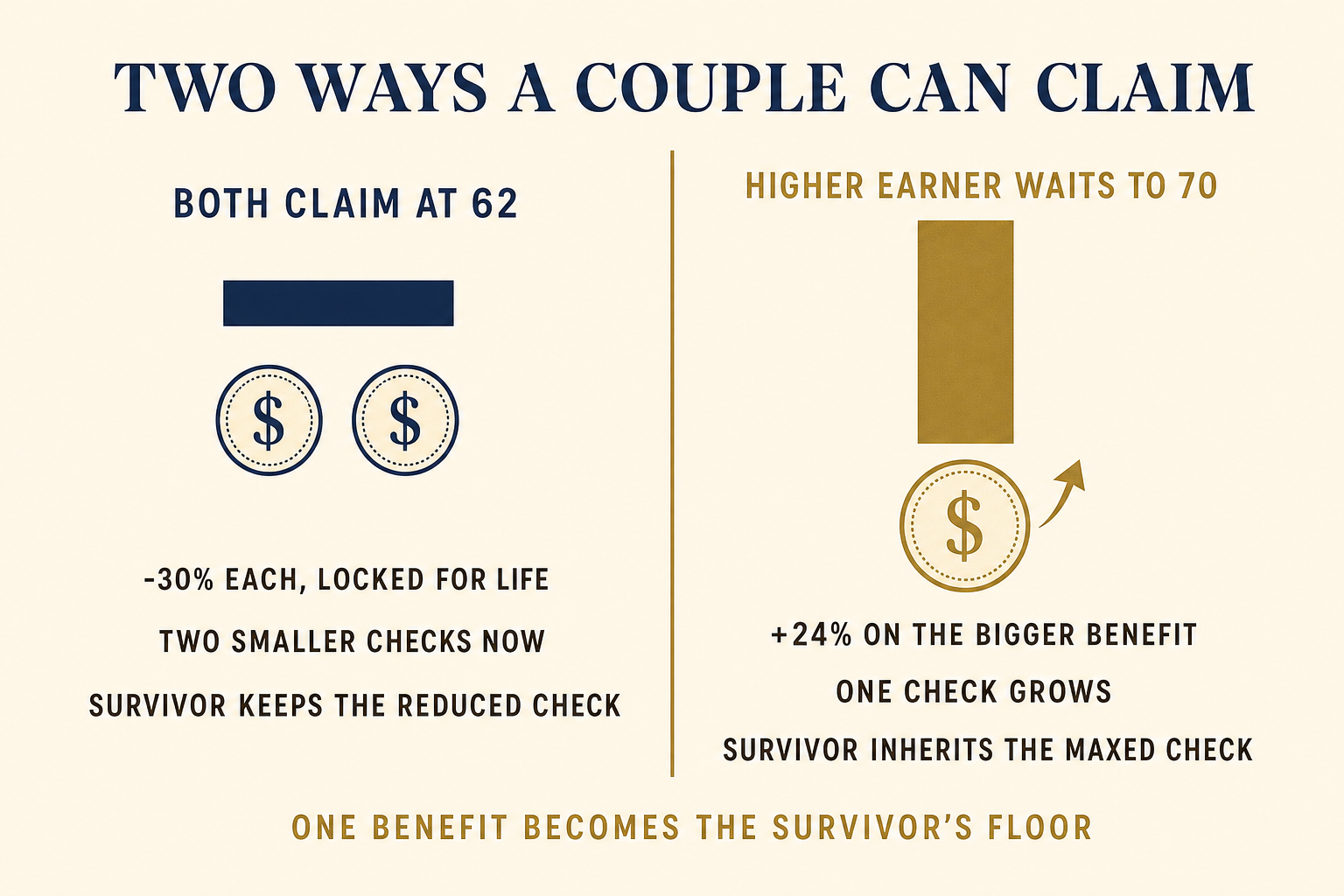
And this is where delaying pays off in a way a single person’s breakeven math misses. Social Security grows by about 8% a year for every year you wait past full retirement age, up to age 70 — a permanent increase of up to 24% for the cohort now reaching a full retirement age of 67, per the Social Security Administration. When the higher earner delays, those delayed retirement credits don’t just raise that person’s check. They raise the survivor benefit, because a surviving spouse steps up to the deceased worker’s full benefit, credits included, if it’s larger than their own.
Put plainly: the higher earner delaying to 70 is often less about maximizing a joint lifetime payout and more about buying the survivor the biggest possible floor for the years they may spend on a single check. The lower earner, meanwhile, can frequently claim earlier to get household cash flowing, because that smaller benefit is the one likely to disappear first anyway.
A hypothetical couple, to make it concrete
Consider a hypothetical case — an illustration with round numbers, not a projection. Marcus is 65 and Elena is 62. Marcus was the higher earner; his benefit at full retirement age would be roughly $3,000 a month. Elena’s would be about $1,600. They spend around $70,000 a year, of which maybe $50,000 is genuinely non-negotiable — housing, food, insurance, utilities, healthcare.
The independent-optimizer version has each of them glancing at a breakeven chart and claiming somewhere in their early-to-mid sixties. It feels balanced. It quietly underbuilds the survivor’s floor.
The household version looks different. Marcus delays to 70, letting his benefit grow to roughly $3,720 in today’s dollars before any cost-of-living adjustments compound on top. Elena claims earlier to start household income and bridge the gap. While they’re both alive, two checks cover a comfortable share of the $50,000 essential floor. And when one of them dies — whichever one — the survivor keeps Marcus’s maxed-out benefit instead of a reduced one. The structure did its real job at the moment the household went from two incomes to one.
Nothing about this requires exotic products or perfect timing. It requires treating the two claims as one plan.
Sizing the shared Soon bucket — and the bridge years
Once you know the claiming plan, you can size the Soon bucket around a single question: what will it take to cover the household’s essential expenses from guaranteed sources once both benefits are on?
If two Social Security checks plus a pension cover the essentials, the Soon bucket is largely built for you and the Later bucket can stay invested for growth and legacy. If there’s a gap, that’s the gap an income annuity is designed to close — a tool for the Soon bucket, used for income, never as a growth play, and never a variable annuity, which stacks market risk and fees onto the one part of the plan that’s supposed to be certain.
The wrinkle unique to couples is the bridge. When the higher earner delays to 70, there are years where the household runs on less guaranteed income than it eventually will — on purpose, to buy that larger benefit later. Those bridge years get funded from the Now bucket and from measured withdrawals from the Later bucket. Delaying Social Security is one of the few guaranteed “returns” in all of retirement, but you have to fund the wait — which is why a couple’s Now bucket often needs to be a little deeper than a single person’s.
The Now and Later buckets, built for two
The Now bucket stays what it always is — a cash reserve sized to a job, not stuffed for comfort. For a couple funding a Social Security bridge, that job is bigger, so the reserve is usually bigger. But the same discipline applies: too much idle cash quietly loses ground to inflation, and that’s as true for two people as for one.
The Later bucket is where couples often get too cautious, and it’s worth saying plainly that a long joint life expectancy argues for more growth exposure, not less. With two people, the odds that at least one of you is alive 30 years from now are meaningfully higher than for either of you individually. That’s a longer runway for the growth money to do its work — which is exactly why the Later bucket is the one most retirees play too safe. The income floor is what lets you leave it invested through the drops.
Thomas’ Take: If you’re married and you remember one thing, make it this: the higher earner’s claiming age is the single biggest lever you have over the survivor’s standard of living. Run the claim as a household decision, not as two people each chasing their own breakeven. The spreadsheet optimizes for the couple. Life bills the survivor.
Survivor-proofing the plan
Every couple’s plan eventually becomes one person’s plan. A good bucket plan is built so the floor survives that transition — and a fragile one isn’t.
Two things change the day the first spouse dies, and both squeeze the survivor. The household loses the smaller Social Security check, so income drops. And the survivor usually files taxes as a single person the following year, where the brackets are tighter and more of the remaining income can be taxed — the survivor’s penalty that catches so many widows and widowers off guard. Less income, taxed harder, often for years.
Designing for this is what separates a couple’s bucket plan from two stapled-together solo plans. It’s the reason the higher earner delays, and a reason to keep the Later bucket healthy rather than spending it down early, since it becomes the survivor’s cushion. It’s also why the planning for the death of a spouse shouldn’t wait until it happens — the decisions that protect the survivor get made while you’re both here and healthy. The solo retiree’s plan is the one the survivor eventually runs; the work now is making sure it’s funded.
Run it on your own two timelines
The honest way to settle the claiming question for your household is to stop arguing about breakeven ages and model both timelines side by side — both of you claiming early, versus the higher earner delaying to 70 — and watch what happens to the survivor’s income in each. A planning tool like ProjectionLab lets you build both scenarios with your actual benefit estimates, your real spending, and your own ages, then carry each one forward to the point where only one of you is still drawing income. Seeing the survivor’s floor rise or fall on your own numbers lands very differently than reading someone else’s example.
Disclosure: the ProjectionLab link above is an affiliate link. If you subscribe through it, I may earn a commission at no additional cost to you. I only point to tools I’d actually sit down and use.
Key takeaways
- For a married couple, Social Security claiming is one household decision, not two independent ones. The two benefits fund a single floor.
- When one spouse dies, the household keeps only the larger benefit. That makes the higher earner’s claiming age primarily a decision about the survivor’s income.
- Delaying the higher earner’s benefit to 70 raises the survivor benefit too, because a surviving spouse steps up to the deceased worker’s full benefit, delayed credits included.
- Build one Soon bucket from two income records, and fund the “bridge years” while the higher earner waits from a slightly deeper Now bucket.
- A long joint life expectancy argues for keeping the Later bucket invested — and for designing the plan so the floor survives the first death.
Frequently asked questions
Should the lower earner always claim early? Not always, but often it makes sense: the lower benefit is the one that disappears when the first spouse dies, so there’s less value in growing it, and starting it early gets household cash flowing while the higher earner delays. Check first whether the lower earner qualifies for a larger spousal benefit, which can reach up to half of the higher earner’s full-retirement-age amount. The exception is when the lower earner is likely to be the long-lived survivor; then it’s worth modeling.
What if we’re close in age and earnings? The closer your benefits are, the less dramatic the survivor math, but the household framing still holds. Coordinate so that at least one benefit is grown toward 70 to protect whoever ends up alone, and size the Now bucket to fund the wait.
Two incomes feel like redundancy while you’re both here, and that’s exactly the trap — it makes couples plan as though both checks will always arrive. One of them won’t. The couples who retire well build a single floor strong enough to hold up the day it has to carry one person instead of two. That’s not pessimism. It’s the point of planning as a household.
This article is published by Confluence Media Group LLC, an independent publisher of educational financial content. Thomas Clark is a Series 65 Investment Advisor Representative. The information provided is for educational and informational purposes only and is not personalized financial, tax, or legal advice. Past performance does not guarantee future results. All investing involves risk, including potential loss of principal. Consult a qualified professional before making financial decisions.
Confluence Media Group LLC is a separate entity from Confluence Capital Management, the investment advisory practice through which Thomas Clark provides advisory services. Advisory services are not offered through this publishing platform.
About Thomas Clark
Thomas Clark is the founder of Confluence Media Group LLC and a Series 65 Investment Advisor Representative. He has spent nearly two decades working with families on retirement planning, with a focus on Social Security optimization, retirement income coordination, and the bucket planning approach to building a guaranteed income floor.
Thomas writes and publishes at thomasclarkadvisor.com and is the author of The Just in Case Binder — a 148-page printable family financial organizer for households who want to make sure the people they love know where everything is.
He lives in North Carolina with his family.
Subscribe to the weekly newsletter · Get the Just in Case Binder

Thomas Clark is a Series 65 licensed investment advisor and experienced trader. He specializes in investing, retirement planning, and market analysis, helping individuals build wealth and make informed financial decisions.
