
Bucket Planning for the Solo Retiree: No Second Check
Most retirement planning assumes there are two of you — two Social Security checks, a survivor benefit, a second income to lean on. Here's how the Now, Soon, and Later bucket plan changes for the solo retiree, and why structure matters more when it's just you.

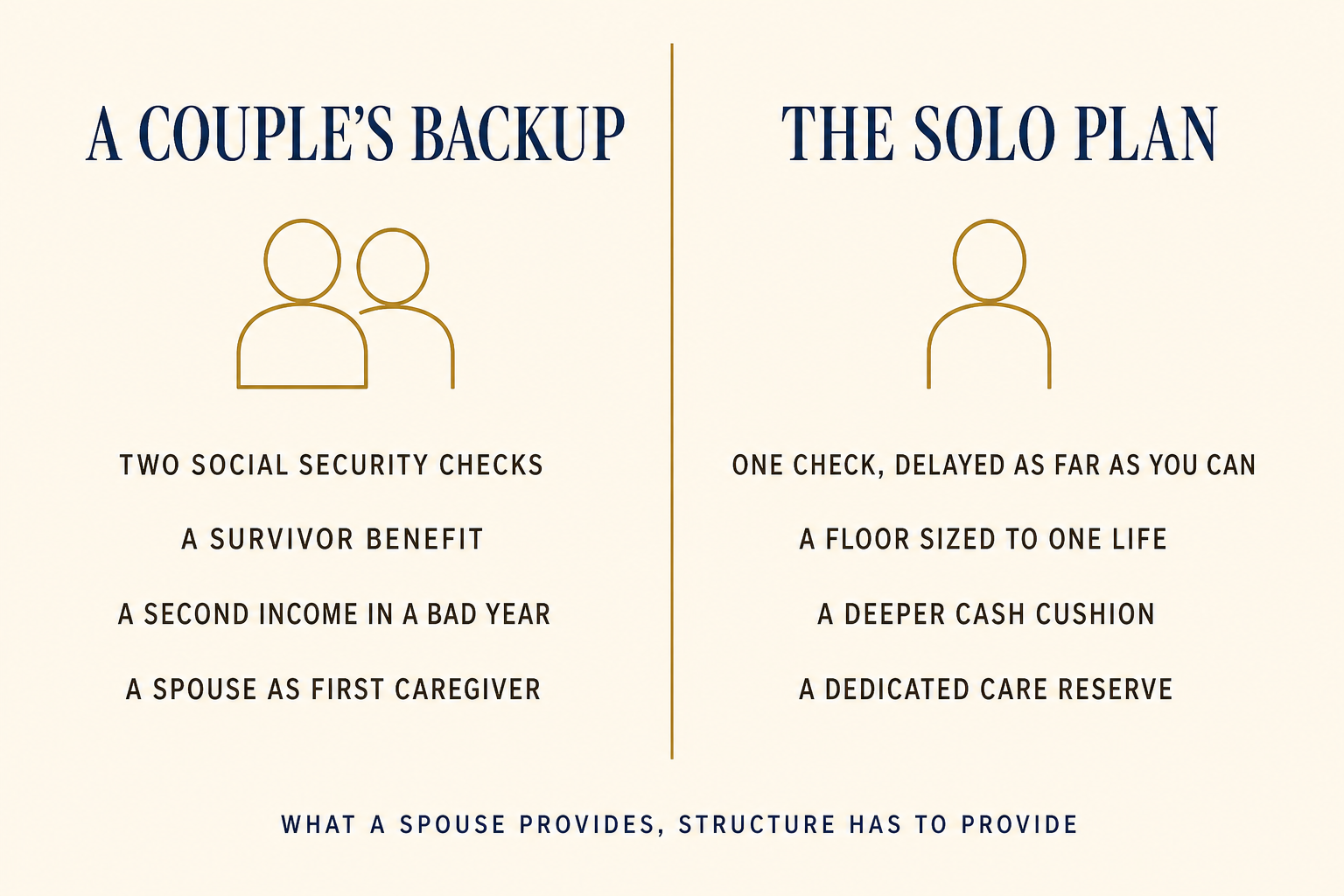
Most retirement planning quietly assumes there are two of you. Two Social Security checks. A survivor benefit if one of you dies first. A second income to lean on when a year goes sideways, and a second set of eyes on the plan. Nearly every retirement example you have read — including a lot of mine — stars a married couple at a kitchen table.
But a large and growing share of retirees are doing this alone: widowed, divorced, or never married. If that is you, here is the part almost no one says out loud. Bucket planning matters more for you, not less. You have less margin for error, so structure is what has to buy you the safety a spouse would otherwise provide.
This is how the Now, Soon, and Later framework changes when it is just you — and where the solo version is actually easier than the couple’s.
Why going solo changes the math
Three structural things are different when you retire on your own, and each one points in the same direction: toward a stronger, simpler, more deliberate plan.
You have one Social Security check, and no survivor lever. A married couple gets to play two claiming decisions off each other — often delaying the higher earner partly to lock in a bigger survivor benefit. You have exactly one claiming decision, and it is the whole ballgame. That raises the stakes on getting it right.
You have one income if something goes wrong. No spouse’s earnings, no second benefit, no partner working part-time to cushion a surprise expense or a bad market year. That makes sequence-of-returns risk — the danger of being forced to sell investments into a downturn — hit harder, because there is no other stream to lean on while you wait for a recovery.
You are the only person watching the plan. There is no one across the table to catch a mistake, and no built-in backup if your own health or memory slips in your 80s. This is the risk solo retirees think about least and should think about most.
Now the good news, because it is real. Your essentials number is one person’s, not two — a household of one is cheaper to run. So a fully guaranteed income floor, the holy grail of bucket planning, is often more achievable for you than for a couple. The solo plan asks more of your discipline and less of your budget.
Build the Soon bucket first — and make your one decision count
For any retiree, the Soon bucket is the guaranteed income floor you build first, because it determines how much work the other two buckets have to do. For a solo retiree it is close to everything. Get the floor right and no market, and no single mistake, can take the lights out.
The floor is built from guaranteed income — the kind that shows up whether the market is up, down, or closed. Start with Social Security, and think hard about waiting. Every year you delay claiming past your full retirement age adds roughly 8% to your benefit until age 70, and that larger amount is adjusted for inflation for life (Social Security Administration).
Here is where the usual advice misfires for you. A couple often delays the higher earner’s claim to protect the survivor. You have no survivor to protect — but that does not make delaying less valuable. It arguably makes it more valuable, because for a solo retiree delaying is the purest longevity insurance there is. If you live to 95 with no second income in the house, the biggest inflation-adjusted check you can arrange is the best hedge you will ever buy. Claim early out of habit and you shrink the one guaranteed stream you have for the rest of a potentially very long life.
Thomas’ Take: A guaranteed income floor does for a solo retiree exactly what a spouse’s second check does for a couple — it means no single bad year, and no single bad decision, can sink the ship. If you build only one thing well, build this. Everything else in a solo plan gets easier to face once the floor is solid.
If you are widowed, you have a lever couples-focused advice ignores: you may be entitled to both your own benefit and a survivor benefit, and can sometimes take one earlier and switch to the larger later. That sequencing is worth real money — survivor benefit timing has its own rules, so walk through it before you file.
If Social Security alone does not cover your essentials, the gap is a job for guaranteed income, not for the stock market. A pension fills part of it if you have one. If there is still a shortfall, an income-focused Fixed Index Annuity with an income rider can close it — a private pension you build yourself, used as an income tool in the Soon bucket, not a growth play (the SEC’s investor.gov has a plain-English primer on annuities). Building that floor from scratch is the same work whether or not you have a partner — it is entirely doable on one income.
Size the Now bucket toward the top of the range
The Now bucket is your spending cash and your shock absorber — enough safe, liquid money that you never have to sell a growth investment in a bad year to pay for a good life. The standard guidance is two to three years of the gap between your guaranteed floor and your total spending. As a solo retiree, lean toward three. You have no second income to bridge a rough stretch — no spouse’s part-time work, no second Social Security check to ride out a down market. Your cushion has to be the structural stand-in for the backup you do not have.
This money lives somewhere genuinely safe and liquid — a high-yield savings account, a government money market fund, or a short ladder of Treasury bills and CDs. Do not reach for yield here; the Now bucket’s job is to be boring and available. And once it is funded, resist the urge to refill it by selling into a downturn — the whole point of building it deep is so you never have to.
The Later bucket, and the question a couple doesn’t have to ask
Whatever is left after the floor and the Now bucket is the Later bucket — your growth engine, invested for the long horizon in a diversified mix aligned with your risk tolerance. Because the first two buckets removed the forced sale, this money gets to stay invested and recover on its own schedule.
But a solo retiree has to ask one question here that a couple can usually skip: who runs this if I can’t? If your health slips at 84, there is no spouse who already knows the accounts, the passwords, and the plan. So keep the Later bucket deliberately simple — fewer holdings, consolidated at one custodian, are far easier for someone to step into than a dozen accounts scattered across five firms. Name a durable power of attorney, add a trusted contact to your accounts, and write down where everything is. The simplest Later bucket is not just the cheapest to run — it is the kindest to hand off.
The fourth bucket a solo retiree actually needs: long-term care
For most retirees, three buckets are all you need, and a fourth only earns its place when it holds a genuinely different job. A solo retiree is the clearest case there is for that fourth bucket, and the job is long-term care.
Here is the uncomfortable arithmetic. Someone turning 65 today has almost a 70% chance of needing some long-term care, and about one in five will need it for five years or more (Administration for Community Living). A married person often has a spouse as the first-line caregiver for free. On your own, a care need is far more likely to mean paid help from day one — and paid help is expensive.
That is why a solo plan should carve out a dedicated long-term-care reserve — a self-funded pool, a hybrid insurance policy, or some combination — kept separate from the income buckets. Leave that risk unfunded and a care event drains the Soon bucket or forces a fire sale of the Later bucket at the worst possible time. Give it its own money and its own rules, so a health event stays a health event instead of becoming a financial one too.
A hypothetical solo build, start to finish
Consider a hypothetical case: Gloria, 64, single — divorced years ago, no kids at home — who just retired from teaching outside Charlotte. She has about $750,000 across a 403(b), an IRA, and a Roth, plus a paid-off condo. Her essential expenses run around $3,600 a month; with travel and the occasional visit to see her sister, total spending is closer to $4,500. She also has a small teacher’s pension of about $900 a month starting now. (The numbers are round and illustrative.)
Floor first. Gloria decides to delay Social Security to 70 — no survivor to plan for, but no second income either, so the biggest lifetime check is her best hedge against living to 95. Say her benefit is roughly $2,400 a month at her full retirement age of 67, growing to about $2,976 at 70. That check plus her $900 pension gives her about $3,876 of guaranteed monthly income — comfortably above her $3,600 essentials. Her floor is fully covered by guaranteed sources, no annuity strictly required, though a small income rider could add cushion.
The Now bucket carries the bridge. From 64 to 70 she has a six-year bridge to fund before the bigger check arrives. She sets aside about three years of the gap — roughly $120,000 — in a high-yield savings account and a short Treasury ladder, at the top of the range because there is no second income if the market is ugly the year she needs cash. The rest of the bridge comes from measured, bracket-aware IRA withdrawals.
The fourth bucket and the Later bucket. She earmarks about $100,000 as a dedicated long-term-care reserve she won’t count as spendable income — there is no spouse to be her first caregiver. The remaining $430,000 stays invested in a plain, diversified mix, consolidated at one custodian, with her sister named as durable power of attorney and trusted contact. If her health ever slips, someone she trusts can step in without a scavenger hunt.
Before you lock in a claiming age, a bridge size, or a care reserve, this is exactly the kind of plan worth modeling against your real numbers. A tool like ProjectionLab lets you run your own version — different claiming ages, cash cushions, and withdrawal orders — and watch how your “will I run out” risk actually moves as you change the inputs. (ProjectionLab is an affiliate partner; if you subscribe through that link, Confluence Media Group may earn a commission at no additional cost to you.)
What to do this week
You do not need a spreadsheet with forty tabs. You need three numbers and one decision: your annual essentials, your total spending, your guaranteed income at different claiming ages, and when you will claim. Then you build in order — floor first, cash second, growth last — with a care reserve set to one side and a trusted person named to step in.
Retiring on your own is not a lesser version of retirement planning. It is a more demanding one, and structure is the answer. A guaranteed floor sized to one life, a cushion built a little deeper than the textbook says, a care reserve you funded on purpose, and a plan simple enough to hand off — that is how solo retirement stops feeling like a tightrope and starts feeling like solid ground. You do not need a second income. You need a plan that knows what to do without one.
Frequently asked questions
Do I really need bucket planning if I’m single? Arguably more than a couple does. With one income and no survivor benefit to fall back on, structure is what replaces the safety a second person would otherwise provide. The floor-first, cash-cushion approach is built to survive a bad market year without a second paycheck in the house.
Where does long-term care fit if I don’t have a spouse? In its own fourth bucket. Without a partner to serve as first-line caregiver, a care need is more likely to mean paid help from the start, so a dedicated reserve kept separate from your income buckets keeps a health event from draining the rest of the plan.
This article is published by Confluence Media Group LLC, an independent publisher of educational financial content. Thomas Clark is a Series 65 Investment Advisor Representative. The information provided is for educational and informational purposes only and is not personalized financial, tax, or legal advice. Past performance does not guarantee future results. All investing involves risk, including potential loss of principal. Consult a qualified professional before making financial decisions.
Confluence Media Group LLC is a separate entity from Confluence Capital Management, the investment advisory practice through which Thomas Clark provides advisory services. Advisory services are not offered through this publishing platform.
About Thomas Clark
Thomas Clark is the founder of Confluence Media Group LLC and a Series 65 Investment Advisor Representative. He has spent nearly two decades working with families on retirement planning, with a focus on Social Security optimization, retirement income coordination, and the bucket planning approach to building a guaranteed income floor.
Thomas writes and publishes at thomasclarkadvisor.com and is the author of The Just in Case Binder — a 148-page printable family financial organizer for households who want to make sure the people they love know where everything is.
He lives in North Carolina with his family.
Subscribe to the weekly newsletter · Get the Just in Case Binder

Thomas Clark is a Series 65 licensed investment advisor and experienced trader. He specializes in investing, retirement planning, and market analysis, helping individuals build wealth and make informed financial decisions.
