
How Remarriage Affects Your Social Security Benefits
Remarrying can protect your Social Security — or quietly end a benefit. It depends entirely on which benefit you're claiming and, for survivors, your age when you say "I do." Here's how each rule actually works.

There’s a fear I hear again and again from widows, widowers, and divorced people who are finally ready to build a new life with someone: “If I remarry, I’ll lose my Social Security.”
Sometimes that’s true. Often it isn’t. And in one specific case, the entire outcome turns on a single birthday. The rules aren’t complicated once you see the structure underneath them — but almost nobody explains that structure, so people either give up income they were entitled to or, worse, quietly schedule a wedding date that costs them thousands of dollars a year for the rest of their lives.
Here’s how remarriage actually affects your Social Security, benefit by benefit.
First, know which check you’re living on
Social Security isn’t one benefit. It’s several, and remarriage treats each one completely differently. Before you can know whether a new marriage helps you, hurts you, or does nothing at all, you have to answer one question: which record is your benefit based on?
There are four possibilities:
- Your own retirement benefit — built from your own work record.
- A spousal benefit — based on a living spouse’s record, worth up to 50% of theirs.
- A divorced-spouse benefit — based on a living ex-spouse’s record, if that marriage lasted at least 10 years.
- A survivor benefit — based on a deceased spouse’s (or deceased ex-spouse’s) record.
Remarriage does something different to each of these. Let’s take them from the simplest case to the trickiest.
Your own benefit: remarriage changes nothing
If you’re claiming Social Security on your own earnings record, you can marry, remarry, and marry again after that, and your benefit doesn’t move an inch. It was built from your wages over your working life, and it stays yours regardless of your marital status. Full stop.
This matters more than it sounds. Plenty of people who spent decades in the workforce panic about remarriage when they have no reason to — their benefit was never tied to anyone else to begin with. If your own record is your primary benefit, you can close this tab and go enjoy the wedding.
Divorced-spouse benefits: remarriage ends them
If you’re divorced, were married at least 10 years, and are currently unmarried, you can claim a benefit on your living ex-spouse’s record — even if they’ve remarried, and without needing their permission or even their knowledge. I walked through how that works in Social Security and divorce — claiming on an ex-spouse’s record.
But that benefit has a condition built into it: you have to be unmarried to collect it. The moment you remarry, benefits paid on your former spouse’s record generally stop, as Social Security spells out plainly. There is no age exception here. This is the rule people most often get wrong, because they assume the age-60 survivor rule (coming up next) applies everywhere. It doesn’t.
One piece of good news: if that new marriage later ends — by divorce, annulment, or the death of your new spouse — you can typically become eligible again on your ex-spouse’s record, assuming you still meet the other requirements. Remarriage closes the door, but it doesn’t necessarily brick it over.
Survivor benefits: the age-60 line that changes everything
Here’s where the single most important — and most heartbreakingly precise — rule in this entire area lives.
If you’re receiving, or eligible for, a survivor benefit on a deceased spouse’s record, the effect of remarriage depends entirely on how old you are on your wedding day:
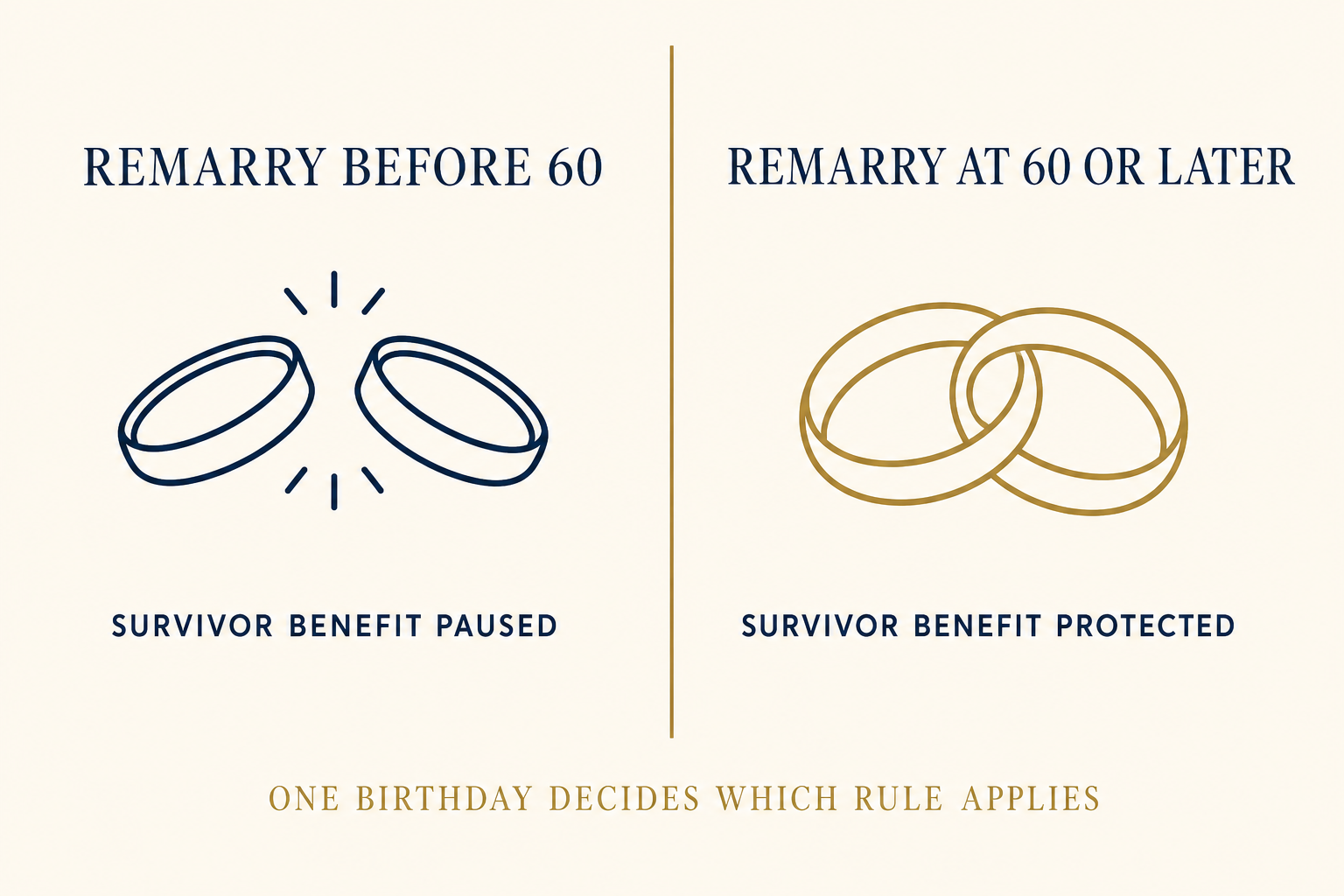
- Remarry before age 60 (or before 50, if you have a qualifying disability): you generally cannot collect survivor benefits for as long as that marriage lasts.
- Remarry at 60 or later (50 or later if disabled): your remarriage does not affect your survivor benefit at all. You keep it.
Read that again, because the arithmetic is brutal. Someone who remarries at 59 years and 11 months can lose access to a survivor benefit. That same person, marrying the same partner one month later at age 60, keeps it in full. It is, without exaggeration, the most expensive month on the Social Security calendar — and it’s written directly into Social Security’s own program rules on the effect of remarriage.
Thomas’ Take: If you’re a widow or widower in your late 50s and you’re seriously thinking about remarriage, the wedding date is a financial decision, not only a romantic one. I’m not telling anyone to plan their heart around a government rule. I am telling you to know the number before you set the date — because Social Security will not warn you, and “we didn’t know” does not reopen a benefit after the fact.
That same age-60 line extends to surviving divorced spouses. If your marriage to a now-deceased ex-spouse lasted at least 10 years, you can qualify for a survivor benefit on their record under the same terms — and it’s protected if you remarry at 60 or later. Notice how different this is from the divorced-spouse benefit while your ex is still living, which ends on remarriage at any age. The death of the ex-spouse switches which rulebook applies. I covered the timing side of survivor claiming in the widow’s Social Security trap.
A new marriage can also open a new door
Remarriage doesn’t only take things away. It can also make you newly eligible for something.
Once you’ve been married to your new spouse for about a year, you may qualify for a spousal benefit on their record — up to 50% of their full benefit, if that’s more than your own. And if you remarried at 60 or later as a survivor, you’re not forced to choose blindly: you can generally collect whichever is higher, the survivor benefit on your late spouse’s record or a benefit tied to your new spouse.
That flexibility is the piece almost nobody uses well. A survivor who remarries at 62 might claim the survivor benefit now, let her own retirement benefit keep growing until 70, and then switch to whichever one ends up largest. Remarriage doesn’t erase those moves. In the right situation, it adds one more option to the menu.
A hypothetical: one birthday, thousands of dollars
Consider a hypothetical case. Carol, 59, was widowed three years ago and lives outside Charlotte. Her late husband’s record would pay her a survivor benefit of roughly $2,600 a month at her full retirement age. She’s engaged to David, and they’d penciled in a spring wedding — a few months before Carol turns 60.
If Carol marries at 59, she gives up her ability to collect that survivor benefit for as long as the marriage lasts. If she and David simply move the date to just after her 60th birthday, the survivor benefit is fully protected. She can claim it on her late husband’s record, and if David’s record would eventually pay her more, she can take that instead.
Carol and David are no less committed for waiting a few months. But that one scheduling choice is worth roughly $31,000 a year in preserved income options — the kind of number that belongs in the wedding-planning conversation, not discovered a year later.
Now contrast that with another hypothetical. Frank, 63, collects a divorced-spouse benefit on his living ex-wife’s record after their 22-year marriage. If Frank remarries, that benefit stops — regardless of his age — because the age-60 protection is a survivor rule, and Frank’s ex-wife is very much alive. Same age bracket as Carol, completely different result, purely because the underlying benefit is a different one.
Where this fits in a retirement income plan
In the Now, Soon, Later bucket planning framework I use, Social Security is the backbone of the Soon bucket — the guaranteed income floor that covers your essential bills so you’re never forced to sell investments in a down market. For a widow, widower, or divorced spouse, a survivor or spousal benefit is often the single largest piece of that floor.
So a remarriage decision isn’t only about the benefit you might lose or gain this year. It’s about the size and durability of the income floor you’re building for the rest of your life, and for a future surviving spouse. That’s exactly why I treat the marriage-and-claiming question as part of sizing the Soon bucket, not as a piece of standalone trivia.
Frequently asked questions
Will I lose my own Social Security if I remarry?
No. A benefit based on your own work record is unaffected by marriage, remarriage, or divorce. It’s yours regardless.
I’m a widow considering remarriage. Does my age really matter that much?
Yes — age 60 is the line. Remarry at 60 or later and your survivor benefit is protected. Remarry before 60 and you generally can’t collect it while that marriage lasts (age 50 if you have a qualifying disability).
I collect on my living ex-spouse’s record. What happens if I remarry?
That divorced-spouse benefit generally ends when you remarry, at any age. If the new marriage later ends by divorce, annulment, or death, you may qualify again.
Do I have to tell Social Security that I remarried?
Yes, and promptly. If a benefit should have stopped and didn’t, the agency can recover the overpayment later — so reporting a remarriage protects you as much as it protects the program.
The mistake isn’t remarrying
Remarriage and Social Security isn’t a single rule. It’s four benefits, each with its own logic, plus one birthday that carries more weight than any other date on the calendar. The mistake is almost never the marriage itself. The mistake is deciding when without knowing what’s actually on the line.
If you’re weighing a remarriage — or helping a parent who is — run the numbers before you set a date. Our free Social Security calculator lets you compare claiming ages and benefit types side by side, so the wedding date and the money decision can finally be made with the same set of facts in front of you.
This article is published by Confluence Media Group LLC, an independent publisher of educational financial content. Thomas Clark is a Series 65 Investment Advisor Representative. The information provided is for educational and informational purposes only and is not personalized financial, tax, or legal advice. Past performance does not guarantee future results. All investing involves risk, including potential loss of principal. Consult a qualified professional before making financial decisions.
Confluence Media Group LLC is a separate entity from Confluence Capital Management, the investment advisory practice through which Thomas Clark provides advisory services. Advisory services are not offered through this publishing platform.
About Thomas Clark
Thomas Clark is the founder of Confluence Media Group LLC and a Series 65 Investment Advisor Representative. He has spent nearly two decades working with families on retirement planning, with a focus on Social Security optimization, retirement income coordination, and the bucket planning approach to building a guaranteed income floor.
Thomas writes and publishes at thomasclarkadvisor.com and is the author of The Just in Case Binder — a 148-page printable family financial organizer for households who want to make sure the people they love know where everything is.
He lives in North Carolina with his family.
Subscribe to the weekly newsletter · Get the Just in Case Binder

Thomas Clark is a Series 65 licensed investment advisor and experienced trader. He specializes in investing, retirement planning, and market analysis, helping individuals build wealth and make informed financial decisions.
