
The HSA Is the Retirement Account You’re Using Wrong
A health savings account is the only account that's tax-free going in, growing, and coming out for medical costs. Used as a retirement account instead of a spending account, it may be the most tax-efficient dollar you own — if you avoid the Medicare timing trap.

Most people treat a health savings account like a second checking account. Money goes in from each paycheck and comes right back out at the pharmacy counter or the dentist’s office. That works. It also throws away the best tax deal in the entire retirement system.
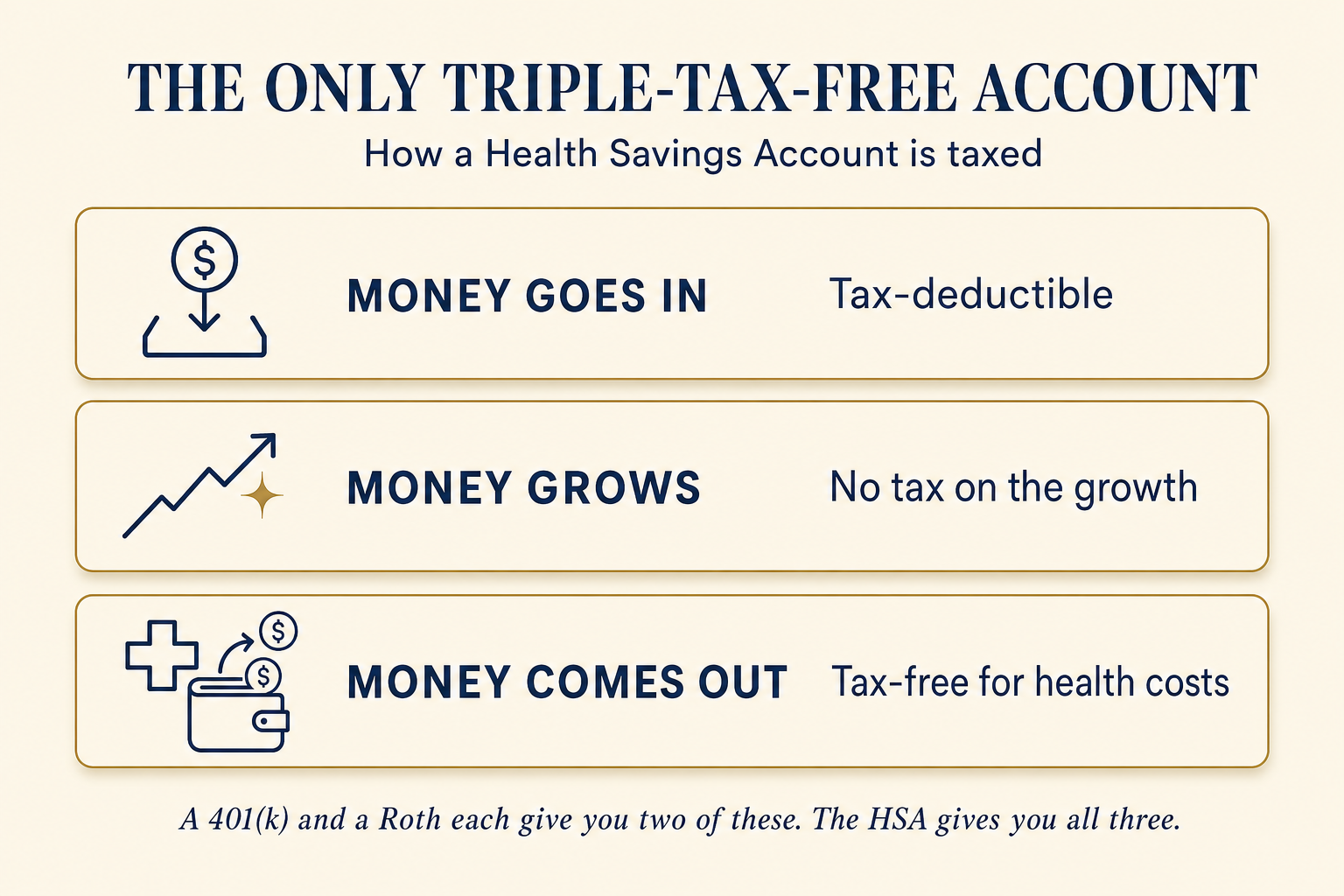
An HSA is the only account that is tax-free on all three sides: the money goes in untaxed, it grows untaxed, and — when you spend it on health care — it comes out untaxed. Your 401(k) gives you a deduction now and a tax bill later. A Roth gives you a tax bill now and tax-free money later. The HSA refuses to choose. It does both.
Used deliberately, it stops being a medical piggy bank and becomes something closer to a stealth retirement account, with a tax advantage neither your 401(k) nor your Roth can match. But there is a catch on the back end that trips up people in their mid-sixties every single year, and it is tied to the exact month you sign up for Medicare. Let us take both halves in order — the opportunity first, then the trap.
What actually makes an HSA different
Start with the eligibility, because it is narrow. You can only contribute to an HSA if you are covered by a qualifying high-deductible health plan (HDHP) and carry no other disqualifying coverage. For 2026, that means a plan with a deductible of at least $1,700 for self-only coverage or $3,400 for a family, with out-of-pocket maximums capped at $8,500 and $17,000. If you have that kind of plan, you can contribute up to $4,400 (self-only) or $8,750 (family) for 2026, plus an extra $1,000 catch-up once you turn 55.
The high deductible scares people off, and I understand why. But the account attached to it is unlike anything else you have access to. Contributions reduce your taxable income the year you make them. The balance grows with no tax on the interest, dividends, or gains. And withdrawals for qualified medical expenses are never taxed — not this year, not in retirement, not ever. The IRS spells all of this out in Publication 969. Three tax breaks stacked in one account. That is the whole story, and it is the reason the HSA deserves a place near the top of your funding order, not the bottom — a point worth weighing against everything else competing for the same dollars in the financial order of operations.
The move almost no one makes: stop spending it
Here is where most HSAs go wrong. People use the debit card. Every qualified expense gets paid straight out of the account, the balance hovers near zero, and the money never gets the chance to do the one thing that makes it powerful — grow.
The alternative is simple to describe and harder to practice. If your cash flow allows it, pay your current medical bills out of pocket and leave the HSA alone to invest. Most custodians let you move the balance out of cash and into low-cost funds once you clear a small minimum. Then — and this is the part people do not realize — you save the receipts. There is no deadline to reimburse yourself from an HSA. A bill you pay out of pocket today can be reimbursed, tax-free, ten or twenty years from now, as long as the expense happened after you opened the account and you kept the record.
That turns the HSA into a long-horizon, tax-free growth account with a built-in escape hatch: a decade of saved receipts is a decade of tax-free withdrawals you can take whenever you want, for any reason at all, simply by reimbursing yourself.
The catch is purely practical. That strategy only works if you can actually find the receipts years later, and “somewhere in a drawer” is not a system. This is exactly the kind of record a tool like my Just in Case Binder is built to hold — one place where the account details and the paper trail live, so the money you have been patient with is still yours to claim when the time comes.
What your HSA turns into at 65
The account changes character the year you turn 65, and it changes in your favor. Before 65, if you pull money out for something that is not a qualified medical expense, you owe income tax plus a 20% penalty. After 65, that penalty disappears. A non-medical withdrawal is simply taxed as ordinary income — exactly like a traditional IRA distribution.
Sit with that for a moment. After 65, your HSA is at worst a traditional IRA, and at best a tax-free medical fund. There is no version of the account that is worse than the retirement account you already trust. And the medical side stays generous: withdrawals for qualified health costs remain completely tax-free, and in retirement those costs are not small. Fidelity’s 2026 estimate puts lifetime health care spending for a single 65-year-old at roughly $185,000, and that figure does not even include long-term care. An HSA is the only account purpose-built to pay that bill with dollars the IRS never touches.
It also reaches further than most people expect. Once you are on Medicare, your HSA can pay your Part B, Part D, and Medicare Advantage premiums tax-free — a meaningful break, since those premiums are a fixed cost for the rest of your life and can climb with income through IRMAA surcharges. The one exception worth memorizing: HSA funds cannot pay Medigap (Medicare Supplement) premiums tax-free. Use the account for those and the withdrawal becomes taxable income.
The Medicare trap that quietly ends your contributions
Now the trap, because this is where good intentions turn into a tax bill. The month you enroll in any part of Medicare, your HSA eligibility ends. You keep the account and keep spending from it, but you can no longer contribute. That rule is clean enough on its own. The problem is the timing wrinkle underneath it.
When you apply for Medicare after 65, Part A coverage is backdated — up to six months retroactively, though never earlier than the month you turned 65. And if you claim Social Security at or after 65, the Social Security Administration enrolls you in Part A automatically, with that same six-month lookback. So the day you file for Social Security, you may have effectively been on Medicare for the previous six months — which means any HSA contributions you made during those months become excess contributions, subject to income tax and a 6% excise tax until you pull them back out.
The fix is a date on the calendar, not a change in strategy. If you plan to work past 65 and keep funding your HSA, stop your contributions at least six months before you apply for Medicare or Social Security. Medicare.gov walks through the enrollment timing, but the HSA-specific move is the one most people miss: it is not the day you enroll that matters, it is six months earlier.
A hypothetical: how this plays out
Consider a hypothetical case: David, 58, a self-employed contractor outside Raleigh. He is covered by a family high-deductible plan, so he maxes his HSA each year — the full $8,750 plus his $1,000 catch-up. His cash flow is steady, so he pays the family’s routine medical bills from checking and lets the HSA stay invested, keeping every receipt in one labeled folder. He is not spending the account; he is building it.
David plans to keep working until 66 and then claim Social Security. Because filing for Social Security at 66 will backdate his Medicare Part A by six months, he has marked his calendar to stop HSA contributions six months before he applies — somewhere around his 65-and-a-half birthday. He will still have the account, still have years of receipts to reimburse himself from tax-free, and still be able to pay his Medicare premiums from it. He just stops adding to it on the right date instead of the wrong one. The numbers here are illustrative and rounded on purpose — the point is the sequence, not the dollars.
Where the HSA fits in your buckets
In the Now, Soon, and Later framework I use for retirement income, the HSA is a quiet specialist. It is not your income floor and it is not your growth engine. It is a dedicated, tax-free sleeve earmarked for one of the largest and most predictable expenses you will ever face in retirement: health care. Left to grow through your working years, it can sit alongside the Later bucket. Drawn down in retirement, it funds the medical slice of the Now bucket with untaxed dollars — which, in turn, takes pressure off the taxable and tax-deferred accounts you are carefully sequencing your withdrawals from.
Key Takeaways
- An HSA is the only account that is tax-free going in, growing, and coming out for medical costs — a combination no 401(k) or Roth can match.
- For 2026 you can contribute $4,400 (self-only) or $8,750 (family), plus $1,000 more at age 55, if you are covered by a qualifying high-deductible plan.
- The wealth-building move is to invest the balance, pay current medical costs out of pocket, and save receipts to reimburse yourself tax-free years later — there is no deadline.
- After 65, non-medical withdrawals are taxed like a traditional IRA with no penalty, and medical withdrawals — including most Medicare premiums — stay tax-free.
- Stop HSA contributions at least six months before you file for Medicare or Social Security, or the retroactive Part A rule can turn your contributions into a taxable mistake.
Frequently Asked Questions
Do I have to spend my HSA by the end of the year?
No. People confuse the HSA with a flexible spending account (FSA), which often is use-it-or-lose-it. An HSA has no year-end deadline. The balance rolls over indefinitely, stays yours if you change jobs or plans, and is designed to be carried for decades.
Can I still contribute if I am 66 and still working?
Only if you are not enrolled in any part of Medicare, including Part A. Some people who work past 65 with employer coverage delay Medicare specifically to keep contributing. That can work, but mind the six-month retroactive Part A rule when you eventually do file — it is the step that catches people.
What happens to my HSA when I die?
If your spouse is the named beneficiary, the account simply becomes their HSA and keeps all of its tax advantages. If anyone else inherits it, the account stops being an HSA and its full value becomes taxable income to them. That makes the beneficiary designation — and a record your family can actually find — worth checking now rather than later.
The HSA does not ask for much. It asks you to choose a high-deductible plan, fund the account, leave it alone, and keep your receipts — and then it asks you to remember one date in your mid-sixties. Do those things and you will have built the most tax-efficient account in your retirement almost by accident, while everyone around you was swiping the card.
This article is published by Confluence Media Group LLC, an independent publisher of educational financial content. Thomas Clark is a Series 65 Investment Advisor Representative. The information provided is for educational and informational purposes only and is not personalized financial, tax, or legal advice. Past performance does not guarantee future results. All investing involves risk, including potential loss of principal. Consult a qualified professional before making financial decisions.
Confluence Media Group LLC is a separate entity from Confluence Capital Management, the investment advisory practice through which Thomas Clark provides advisory services. Advisory services are not offered through this publishing platform.
About Thomas Clark
Thomas Clark is the founder of Confluence Media Group LLC and a Series 65 Investment Advisor Representative. He has spent nearly two decades working with families on retirement planning, with a focus on Social Security optimization, retirement income coordination, and the bucket planning approach to building a guaranteed income floor.
Thomas writes and publishes at thomasclarkadvisor.com and is the author of The Just in Case Binder — a 148-page printable family financial organizer for households who want to make sure the people they love know where everything is.
He lives in North Carolina with his family.
Subscribe to the weekly newsletter · Get the Just in Case Binder

Thomas Clark is a Series 65 licensed investment advisor and experienced trader. He specializes in investing, retirement planning, and market analysis, helping individuals build wealth and make informed financial decisions.
