
The Financial Order of Operations: Where Each Dollar Goes
Personal finance obsesses over which fund to buy. The bigger wins come from the order you fund things in - here is the sequence every extra dollar should follow.

Here is the question I get more than almost any other, usually phrased some version of this way: “I’ve got an extra few hundred dollars a month. Where should it go?” People expect me to name a fund. What they actually need is an order.
Personal finance spends almost all of its energy on the wrong question. Which index fund? Roth or traditional? Is the market too high to buy in right now? Those questions feel important, and a few of them are. But the biggest, most reliable wins don’t come from picking the right investment. They come from putting your dollars to work in the right sequence. That sequence has a name: the financial order of operations.
The real question isn’t what to buy. It’s what comes first.
Think back to math class. There was a right order to solve an equation, and if you added before you multiplied, you got the wrong answer even when every individual step was correct. Money works the same way. You can pick a perfectly good investment and still leave thousands of dollars on the table because you funded it in the wrong order.
Here’s the stance most of the internet won’t take plainly: a boring, ordinary investment funded in the right order beats a brilliant one funded in the wrong order. The order is where the free money and the guaranteed returns live. The picks are a rounding error by comparison. Get the sequence right and you can be mediocre at everything else and still come out ahead.
So let’s walk the sequence, one rung at a time, with the reason each step sits where it does.
The order of operations, one rung at a time
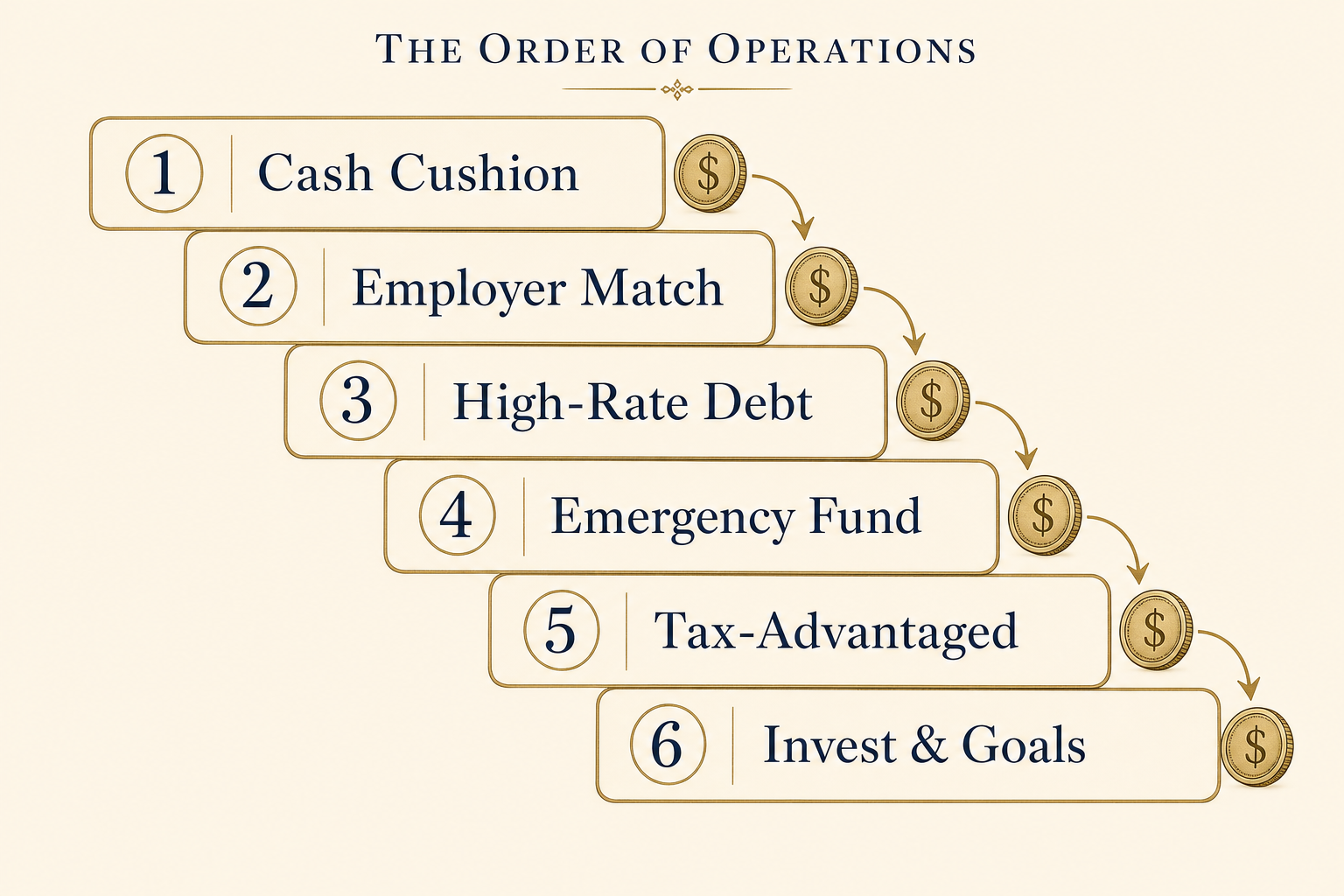
1. A starter cash cushion. Before anything else, park a small buffer — think one month of expenses, or a round $1,000 to $2,000 — somewhere boring and reachable, like a high-yield savings account. This isn’t your full emergency fund yet. It’s the thing that keeps a flat tire or a surprise copay from becoming a credit card balance. Without it, every other step keeps getting undone by life.
2. The full employer match. If your job offers a 401(k) match, contribute at least enough to capture every dollar of it — before you do anything else on this list beyond the starter cushion. A dollar-for-dollar match is an immediate 100% return on your contribution. That’s not a market forecast or a hopeful projection; it’s arithmetic. Your employer is handing you a guaranteed, risk-free doubling of that money, and it’s the only place you’ll ever be offered one. Skipping it to chase a hotter investment is turning down a raise. (It’s also why you shouldn’t rush to front-load your 401(k) so fast that you miss match dollars later in the year.)
3. High-interest debt. Next, attack anything charging you a high rate — credit cards above all. As of early 2026, the average rate on credit card balances that carry interest sits north of 21%, according to the Federal Reserve’s G.19 data. Paying off a balance charging 21% is the equivalent of earning 21%, guaranteed, risk-free, and tax-free. No investment offers that reliably. This is why the match still comes first — a 100% match beats a 21% payoff — but once the match is captured, high-rate debt is the best “investment” available to you. (A balance like this is also what quietly drags on your credit.)
4. The full emergency fund. Now finish what the starter cushion began: build cash to cover three to six months of essential expenses. This is the layer that lets you ride out a job loss or a medical bill without selling investments at the worst possible moment or sliding back into the debt you just cleared. It’s worth thinking about this money in layers rather than one big undifferentiated pile.
5. Tax-advantaged growth. With a floor under you and high-rate debt gone, now you invest in earnest — and you do it inside tax-advantaged accounts first. If you have a high-deductible health plan, the HSA goes here: it’s the only account with a triple tax advantage (deductible going in, tax-free growth, tax-free out for medical costs). Then fund an IRA and push your 401(k) beyond the match. For 2026, the IRS lets you put up to $24,500 into a 401(k) and $7,500 into an IRA, with an HSA cap of $4,400 for individual coverage and $8,750 for a family. Whether you lean Roth or traditional depends mostly on your tax bracket now versus the one you expect later.
6. Taxable investing and specific goals. Maxed the tax-advantaged accounts and still have money left over? Good problem. A regular taxable brokerage account has no contribution limit and no withdrawal rules, which makes it the right home for goals that sit between “this year” and “retirement” — a house down payment, a child’s 529, financial independence ahead of schedule.
Why the order beats the picks
Stack up the returns on each rung and the logic becomes obvious. The match is a guaranteed 100%. Clearing high-rate debt is a guaranteed 21%. Both of those are locked in, risk-free, available to almost everyone — and completely independent of whether you choose a total-market index fund or a target-date fund for the investing rungs.
Compare that to the energy people pour into the picks. The gap between a perfectly good diversified fund and a slightly better one might be a fraction of a percent a year, and it comes with no guarantee at all. Historically, broadly diversified stock funds have grown over long stretches of time, but markets rise and fall and nothing about future returns is promised. So why would you obsess over the uncertain fraction of a percent while skipping the certain 100% sitting in your benefits portal? Most people do exactly that. Don’t be most people.
A hypothetical: Devin has $500 a month and a decision to make
Consider a hypothetical case. Devin, 32, works in IT support in Des Moines, Iowa, earning about $68,000 a year. He has roughly $1,500 in savings, a $6,000 credit card balance at about 23%, and a 401(k) that matches his contributions dollar-for-dollar up to 4% of his pay. After his bills, he has around $500 a month of breathing room, and he’s been agonizing over which investing app to open.
The order answers his question for him. That $1,500 already stands in as a starter cushion, so he doesn’t touch it. His first move isn’t an app at all — it’s logging into his 401(k) and setting his contribution to at least 4% to capture every dollar of the match, even with the credit card still hanging over him. A guaranteed 100% beats a 23% balance. Then he points the rest of his $500 a month straight at that card, because wiping out 23% interest is the best guaranteed return he can buy. Once the card is gone, that same $500 rolls forward to finish his emergency fund, then into an IRA or HSA. He never did pick the “perfect” investment, and it won’t matter. He got the order right.
When it makes sense to bend the order
This is a framework, not a commandment, and a couple of adjustments are reasonable. If your high-rate debt is small, it can be worth clearing it before you fully fund the emergency cushion, simply for the momentum and the mental relief of being done with it. If your income is unpredictable — commission work, seasonal hours, self-employment — you may want more cash on hand before you invest much beyond the match.
The one rung I’d almost never move is the match. Because it’s a guaranteed 100% return, it comes ahead of even high-rate debt payoff in nearly every case. If you take one rule away from this piece, make it that one: never leave the match on the table.
The bucket-planning connection
If you’ve read my work on retirement, this sequence will feel familiar. The order of operations is really the accumulation-phase cousin of the Now, Soon, and Later bucket framework I use for retirement income. Your cash cushion and emergency fund are a Now bucket in miniature — money for life as it actually happens. Capturing the match and clearing high-rate debt build the stable base everything else rests on. And the long-term investing rungs are the seeds of the Later bucket you’ll eventually draw from decades out.
It’s the same idea at both ends of life: secure the floor first, then let the growth money grow. That’s also why, over a full career, how much you save and in what order tends to matter more than the returns you squeeze out of any one holding.
Key takeaways
- The sequence you fund things in matters more than which specific investment you pick.
- Capture the full employer match before anything else on the list — it’s a guaranteed 100% return you can’t get anywhere else.
- After the match, paying off high-rate debt (credit cards average north of 21%) is the best guaranteed return available to you.
- Only after a cash floor is in place and high-rate debt is gone does the “which fund” question start to matter — and even then, less than you’d think.
You don’t need a better fund. You need a better order. Fix the sequence first, and the rest of your money decisions get a lot quieter.
Want a plain-English walk-through like this in your inbox each week? Subscribe to the newsletter, or keep reading on why your savings rate beats your returns.
This article is published by Confluence Media Group LLC, an independent publisher of educational financial content. Thomas Clark is a Series 65 Investment Advisor Representative. The information provided is for educational and informational purposes only and is not personalized financial, tax, or legal advice. Past performance does not guarantee future results. All investing involves risk, including potential loss of principal. Consult a qualified professional before making financial decisions.
Confluence Media Group LLC is a separate entity from Confluence Capital Management, the investment advisory practice through which Thomas Clark provides advisory services. Advisory services are not offered through this publishing platform.
About Thomas Clark
Thomas Clark is the founder of Confluence Media Group LLC and a Series 65 Investment Advisor Representative. He has spent nearly two decades working with families on retirement planning, with a focus on Social Security optimization, retirement income coordination, and the bucket planning approach to building a guaranteed income floor.
Thomas writes and publishes at thomasclarkadvisor.com and is the author of The Just in Case Binder — a 148-page printable family financial organizer for households who want to make sure the people they love know where everything is.
He lives in North Carolina with his family.
Subscribe to the weekly newsletter · Get the Just in Case Binder

Thomas Clark is a Series 65 licensed investment advisor and experienced trader. He specializes in investing, retirement planning, and market analysis, helping individuals build wealth and make informed financial decisions.
