
Your Credit Score Isn’t a Financial Report Card
Your credit score measures how likely you are to repay lenders — not how wealthy you are. Here's what actually goes into the number, the threshold where chasing it stops paying off, and why your net worth is the scoreboard that matters.

Someone mentioned to me recently that they’d hit an 812 credit score, and they said it the way you’d announce a marathon time. I didn’t want to deflate them, but here’s the honest truth: a lender looks at an 812 and learns exactly one thing — how likely you are to pay them back. It says nothing about whether you’re actually building wealth. You can have an 812 and be one lost paycheck from trouble. You can be quietly, genuinely wealthy with a 690.
We’ve been trained to treat the credit score like a financial report card — a single grade that tells us whether we’re doing money “right.” It isn’t. It’s a lender’s risk gauge. And once you understand what it’s really measuring, you can stop losing sleep over the last twenty points and start watching the numbers that actually decide your future.
What a credit score actually measures
Your FICO score — the model built by Fair Isaac Corporation and used in roughly 90% of U.S. lending decisions — is a number between 300 and 850 that predicts one narrow thing: the likelihood you’ll fall 90 or more days behind on a debt in the near future. That’s it. The Consumer Financial Protection Bureau defines it plainly as “a prediction of your credit behavior, such as how likely you are to pay a loan back on time.”
Read that again, because the framing matters. The score was built for lenders, sold to lenders, and priced for lenders. It answers their question — “is this person safe to lend to?” — not yours. (The free scores you see in banking apps are often VantageScore, a competing model; useful for tracking direction, but the FICO version is what most lenders actually pull.)
Here’s what never enters the formula: your income, your savings, your net worth, your emergency fund, your retirement accounts. A score of 800 and a score of 600 tell a lender how much they can trust you with their money. Neither one says a word about how much of your own money you’ve managed to keep. As of the fall of 2026, the average FICO score sits at 714, and nearly half of Americans are at 750 or above. A “good” score is common. Real financial breathing room is not.
What actually goes into the number
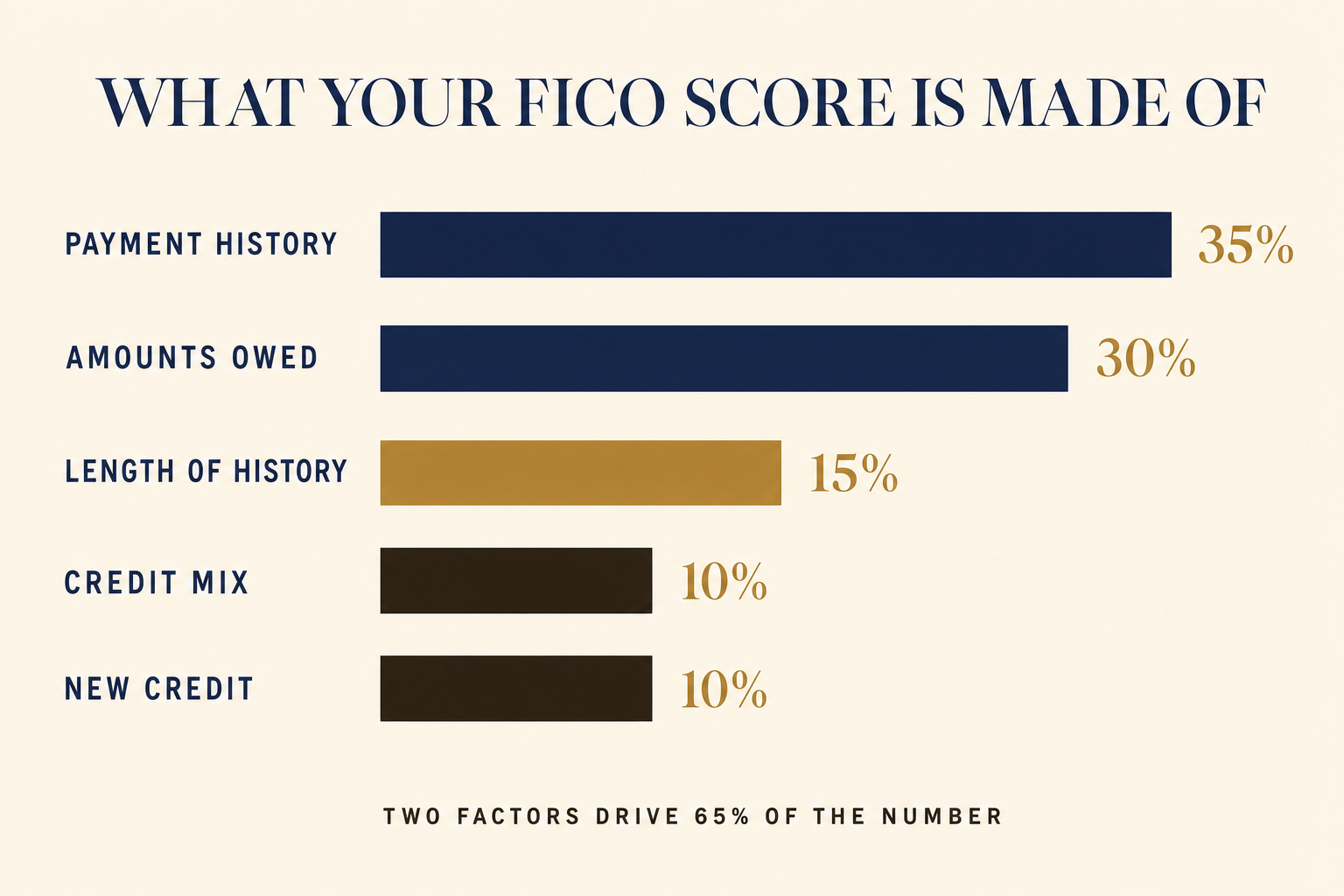
The score isn’t a black box. FICO tells you the five ingredients and roughly how much each one weighs:
- Payment history (35%) — do you pay on time? This is the single biggest lever, by a wide margin.
- Amounts owed (30%) — mostly your utilization: how much of your available credit you’re using. Riding at 90% of your limits reads as strain; sitting under about 30% reads as comfort, and lower is better still.
- Length of credit history (15%) — how long your accounts have been open. Older is better, which is why closing your first card can quietly cost you.
- Credit mix (10%) — whether you handle both revolving credit (cards) and installment loans (a car note, a mortgage).
- New credit (10%) — how many accounts you’ve opened recently. A cluster of new applications looks like risk.
Notice what the two biggest factors reward: paying on time and not leaning too hard on your limits. That’s most of the game right there. And notice the most expensive myth this chart quietly kills — you do not need to carry a balance and pay interest to build credit. Paying your card in full every month builds your score exactly the same way, and it costs you nothing. Interest is not a membership fee for good credit.
The threshold nobody tells you about
Here’s the part that reframes the whole chase. Credit scoring has sharply diminishing returns. Once you’re in the mid-700s, most lenders already hand you their best or near-best pricing. Pushing from 780 to 820 almost never changes the rate you’re offered on a mortgage, a car loan, or a card.
The score is a gate, not a dial you keep cranking for a prize. It swings open at a certain height and stays open. The extra thirty points people agonize over are usually worth close to nothing in real dollars — you’re polishing a number that already did its only job. If your score clears the gate, the correct amount of further attention to spend on it is roughly zero.
The report-card fallacy
Why does treating the score as a grade lead people astray? Because the model literally cannot see the things that make someone financially healthy. It can’t see a fully funded emergency fund. It can’t see a high savings rate. It can’t see a paid-off house or a growing brokerage account.
In fact, the score often punishes the very independence you’re working toward. A debt-free retiree who stops borrowing can watch their score drift downward — not because anything went wrong, but because the model rewards active, well-managed borrowing, and they’ve stopped giving it anything to measure. That’s the tell. The score grades how skillfully you use other people’s money. It has no opinion about how much of your own you’ve built.
Consider two hypothetical savers. Marcus, 29, has an 815. He also has $2,000 in the bank, a financed car, and three cards he pays off monthly. Dana, 34, has a 690 — she paid cash for an older car, carries no card balances, has one loan she’s nearly finished paying, and holds $40,000 in investments. The lender’s model prefers Marcus. The scoreboard that actually decides who retires comfortably — net worth, savings, margin for error — clearly prefers Dana. (These are illustrations, not real people.) If you only looked at the credit scores, you’d bet on exactly the wrong person.
The three habits that earn a “good enough” score
None of this means the score is worthless or that you should neglect it. It means you should earn a strong one on autopilot and then stop thinking about it. Three habits do almost all the work:
- Pay every bill on time, every time. Payment history is 35% of the score, and a single missed payment does more damage than almost anything else. Put your minimums on autopay as a safety net so a busy month can’t cost you.
- Keep your balances low against your limits. This is the 30% lever. If you want the reported number to look especially low, pay the card down before the statement closes, not just before the due date.
- Let your accounts age. Don’t close your oldest card, and don’t open new credit you don’t actually need. Time is doing free work for you here; don’t reset the clock.
Do those three things and you’ll land in the 700s and climb into the high 700s without a spreadsheet or a monthly ritual. There isn’t a valuable fourth move. The people selling you “credit optimization” past that point are selling you a rounding error.
Thomas’ Take: A credit score is a key, not a trophy. It opens doors to cheaper money. But nobody ever got wealthy by admiring the key — you get wealthy by what you do once you’re through the door.
Where the score actually earns its keep
So use it as what it is: a tool. A strong score is cheap capital on demand — a lower mortgage rate, an approval when the timing matters, often a better insurance quote. Over the life of a home loan, the gap between a mid-600s rate and a mid-700s rate can run into real five-figure territory. That’s worth having. It’s just not the point.
In my years trading, the most useful lesson I learned was the difference between a tool and a target. Your position size is a tool for managing risk; the goal was never a perfect position, it was a growing account. Same logic here. The credit score is the position. Your net worth is the account. Use the score to lower what borrowing costs you, then put your attention back on the things that actually compound — your savings rate, your investments, and the gap between what you earn and what you spend. If you’re weighing whether to attack a debt or invest the difference, that’s a wealth decision, not a credit-score decision, and it deserves to be made on its own terms.
Key takeaways
- A credit score predicts repayment risk for lenders. It does not measure your income, savings, or net worth.
- Payment history (35%) and credit utilization (30%) drive most of the number — on-time payments and low balances are the whole game.
- You never need to carry a balance or pay interest to build credit.
- Scoring has diminishing returns; once you’re in the mid-700s, chasing higher rarely changes the rates you’re offered.
- Watch your net worth, not your score. One decides your retirement; the other just prices your loans.
Frequently asked questions
Does checking my own credit score lower it?
No. Checking your own score or report is a “soft inquiry” and never affects your score. Only a “hard inquiry” — when a lender pulls your credit because you applied for something — can nudge it down, and only slightly and temporarily. You can pull your reports for free at annualcreditreport.com.
Why did my score drop after I paid off a loan?
It happens, and it isn’t a mistake. Paying off and closing an installment loan can shorten your average account age and thin out your credit mix — two smaller factors. It’s a cosmetic dip, not a sign you did anything wrong. Paying off debt is a win for your finances even when the score shrugs.
What score do I actually need?
For most borrowing, landing in the mid-700s gets you the best or near-best pricing lenders offer. Beyond that, more points are bragging rights, not savings.
This article is published by Confluence Media Group LLC, an independent publisher of educational financial content. Thomas Clark is a Series 65 Investment Advisor Representative. The information provided is for educational and informational purposes only and is not personalized financial, tax, or legal advice. Past performance does not guarantee future results. All investing involves risk, including potential loss of principal. Consult a qualified professional before making financial decisions.
Confluence Media Group LLC is a separate entity from Confluence Capital Management, the investment advisory practice through which Thomas Clark provides advisory services. Advisory services are not offered through this publishing platform.
About Thomas Clark
Thomas Clark is the founder of Confluence Media Group LLC and a Series 65 Investment Advisor Representative. He has spent nearly two decades working with families on retirement planning, with a focus on Social Security optimization, retirement income coordination, and the bucket planning approach to building a guaranteed income floor.
Thomas writes and publishes at thomasclarkadvisor.com and is the author of The Just in Case Binder — a 148-page printable family financial organizer for households who want to make sure the people they love know where everything is.
He lives in North Carolina with his family.
Subscribe to the weekly newsletter · Get the Just in Case Binder

Thomas Clark is a Series 65 licensed investment advisor and experienced trader. He specializes in investing, retirement planning, and market analysis, helping individuals build wealth and make informed financial decisions.
