
I Bonds vs. TIPS: Inflation Protection for Safe Money
Your safe money has one hidden risk: inflation quietly eating its value. I bonds and TIPS are the two government tools built to fix exactly that, and here's how each works and where it belongs.

Most people think of their safe money as the part of the plan they do not have to worry about. The CD, the savings account, the plain Treasury bond. It will not crash, so it feels handled. But safe money carries a quieter risk that never shows up on a statement: inflation slowly drains what those dollars can actually buy. Lock in a fixed 4% for ten years while prices rise 3% a year, and your “safe” money is barely treading water.
The federal government sells two products designed to fix exactly that problem, and most savers either confuse them or ignore them. Series I savings bonds and Treasury Inflation-Protected Securities, better known as TIPS, both tie your return to inflation instead of fighting it. They are not glamorous, and they are not a growth engine. But for the slice of your money that has to stay safe and keep up with the cost of living, they are two of the few tools built for the job.
The risk your safe money quietly ignores
Inflation is the reason a dollar you tuck away today buys less at the end of a long retirement than it does now. Even a mild 3% rate cuts the purchasing power of a fixed dollar roughly in half over about 24 years, which is well inside a modern retirement’s time horizon. A guaranteed income floor from Social Security helps here because it comes with annual cost-of-living adjustments, something inflation does to each of your buckets differently.
Your own safe savings usually have no such protection. A CD or a nominal bond pays you back a number that was fixed the day you bought it, and inflation gets to decide what that number is worth when it matures. That is the gap I bonds and TIPS are designed to close. Both are backed by the full faith and credit of the U.S. Treasury, and both adjust with the Consumer Price Index rather than leaving you exposed to it.
Series I bonds: the saver’s inflation hedge
An I bond earns two things stacked together: a fixed rate that stays with the bond for its entire life, and an inflation rate that resets every six months based on the CPI. Add them and you get the composite rate the bond actually pays. As an example of how that looks in practice, I bonds issued from November 2026 through April 2027 carry a fixed rate of 1.40% and an annualized composite rate of 5.51%, with both pieces resetting every May and November (TreasuryDirect, “Series I Savings Bonds”). The fixed portion is the part to watch, because it is the real return you keep above inflation for as long as you hold the bond.
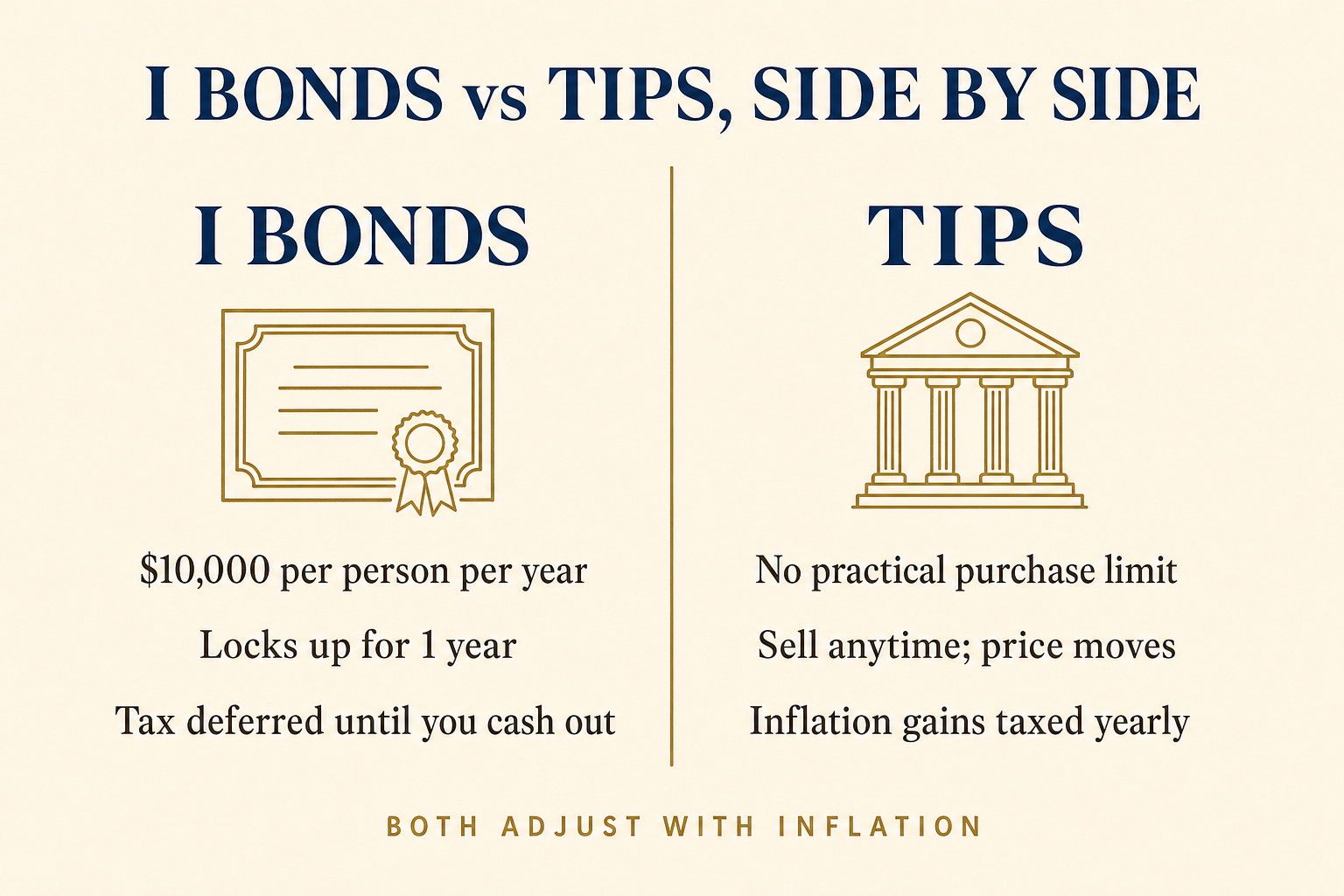
The catch is scale and liquidity. You can buy only $10,000 per person per calendar year, electronically through TreasuryDirect, since the paper option bought with a tax refund was discontinued at the start of 2025. You cannot touch the money at all for the first twelve months, and if you cash out before five years you forfeit the last three months of interest. After that it is penalty-free, and interest can keep compounding tax-deferred for up to 30 years.
The tax treatment is genuinely friendly. I bond interest is exempt from state and local income tax, and you can defer the federal tax until you cash the bond in rather than paying as you go. For a saver building a modest, patient reserve that will not be needed for at least a year, an I bond is one of the cleanest inflation hedges available. It is a supporting player, though, not a foundation. The $10,000 ceiling makes sure of that.
TIPS: the scalable version, with a tax quirk
TIPS solve the scale problem. Instead of a fixed face value, the principal of a TIPS bond is adjusted up and down with the CPI. Your fixed coupon rate is then paid on that adjusted principal, so when inflation pushes the principal higher, your interest payment rises with it. At maturity you receive the inflation-adjusted principal, and a built-in floor guarantees you never get back less than your original investment even if the economy sees deflation (TreasuryDirect, “TIPS”).
There is no $10,000 wall here. You can buy TIPS at Treasury auctions or, more commonly, through a low-cost TIPS mutual fund or ETF, which makes them the more practical choice once you are protecting a larger sum. They are also marketable, meaning you can sell before maturity. That cuts both ways: you are not locked in like an I bond, but the price you get fluctuates with interest rates, so a TIPS sold early can be worth more or less than you paid.
The quirk that trips people up is taxes. The annual inflation adjustment to your principal is taxed as income in the year it happens, even though you do not receive that money until the bond matures. That “phantom income” is why TIPS usually belong inside a tax-advantaged account like an IRA, where the yearly adjustments can grow without an annual tax bill, rather than in a taxable brokerage account.
Which one, and where it belongs
Treasury publishes a plain side-by-side comparison of the two, but the mechanics are only half the decision. Here is the honest framing most product comparisons skip. Inflation protection is not something every dollar needs. Your true cash, the money for this year’s bills and emergencies, does not have time to be eroded and should stay liquid. Your growth money has decades to outrun inflation on its own and belongs in stocks, which is exactly why the long-term bucket is where many retirees play it too safe.
The money that genuinely needs inflation protection is the in-between money: the funds you will spend in roughly the next five to fifteen years, the near-term half of your Now, Soon, and Later structure. That is where a locked-in nominal return does its quiet damage, and where I bonds and TIPS earn their place. I bonds fit a smaller, patient reserve. TIPS, held in the right account, handle the larger share.
Thomas’ Take: I don’t treat inflation-protected bonds as a cleverness contest between I bonds and TIPS. They answer the same question from different sizes of wallet. The real decision is how much of your safe money needs to keep pace with prices at all, and that depends entirely on how long before you will spend it.
How much you actually need is worth modeling rather than guessing, because the answer turns on your spending, your other income, and how many years each dollar has to wait. A planning tool like ProjectionLab lets you run your own numbers and watch how a few years of higher inflation would hit your plan, which makes it a lot easier to size the inflation-protected slice instead of buying a round number because it felt prudent.
Disclosure: the ProjectionLab link above is an affiliate link. If you subscribe through it, I may earn a commission at no additional cost to you. I only point to tools I’d actually sit down and use.
The mistakes that cancel out the benefit
These bonds are simple, but a few avoidable errors erase most of their value. The most common is holding TIPS in a taxable account and getting surprised by a tax bill on money you have not received yet. If you want TIPS, start by making room for them in an IRA.
The second is reaching for an I bond to cover a need inside of a year. You cannot redeem one at all for twelve months, so it is the wrong home for a true emergency fund, which belongs in cash where a reliable income floor and liquidity matter more than yield. The third is expecting either product to grow your wealth. They are designed to preserve purchasing power, not to beat the stock market, and judging them against equities misses the entire point. Used for the job they were built for, they do that job quietly and well.
Key takeaways
- Fixed “safe” money like CDs and nominal bonds carries a hidden risk: inflation erodes what the fixed payout can buy over a long retirement.
- Series I bonds pay a fixed rate plus a resetting inflation rate, are capped at $10,000 per person per year, lock up for a year, and grow tax-deferred. Good for a small, patient reserve.
- TIPS adjust their principal with the CPI, have no practical purchase limit, and are marketable, which makes them the scalable choice for a larger sum.
- TIPS create taxable “phantom income” each year, so they usually belong inside a tax-advantaged account rather than a taxable brokerage.
- Inflation protection matters most for the money you will spend in about five to fifteen years, not your cash and not your long-term growth.
Frequently asked questions
Can I buy both I bonds and TIPS?
Yes, and many savers do. The $10,000 annual limit applies only to I bonds, so a common approach is to use I bonds for a smaller patient reserve and TIPS, held in an IRA, for the larger inflation-protected share.
Are these better than a regular CD or Treasury?
Not better, different. A CD or nominal Treasury locks in a known dollar return, which is fine when inflation stays low and the term is short. I bonds and TIPS trade some of that certainty for protection against inflation surprising you over a longer horizon. The right tool depends on how long the money has to sit.
What happens to TIPS if there is deflation?
The principal can adjust downward during deflation, but at maturity a Treasury guarantee ensures you receive no less than your original principal. You are protected on the downside at the finish line even if prices fall along the way.
Safe money has one job, and it is not to make you rich. It is to be there, intact and useful, when you reach for it. The trap is assuming that “will not crash” and “will not lose value” are the same promise. They are not, and the difference is inflation. For the dollars you will spend a decade from now, I bonds and TIPS are two of the few places that keep that promise honestly. Match the tool to the timeline, mind the account you hold it in, and let your safe money do the one thing you actually hired it to do.
This article is published by Confluence Media Group LLC, an independent publisher of educational financial content. Thomas Clark is a Series 65 Investment Advisor Representative. The information provided is for educational and informational purposes only and is not personalized financial, tax, or legal advice. Past performance does not guarantee future results. All investing involves risk, including potential loss of principal. Consult a qualified professional before making financial decisions.
Confluence Media Group LLC is a separate entity from Confluence Capital Management, the investment advisory practice through which Thomas Clark provides advisory services. Advisory services are not offered through this publishing platform.
About Thomas Clark
Thomas Clark is the founder of Confluence Media Group LLC and a Series 65 Investment Advisor Representative. He has spent nearly two decades working with families on retirement planning, with a focus on Social Security optimization, retirement income coordination, and the bucket planning approach to building a guaranteed income floor.
Thomas writes and publishes at thomasclarkadvisor.com and is the author of The Just in Case Binder — a 148-page printable family financial organizer for households who want to make sure the people they love know where everything is.
He lives in North Carolina with his family.
Subscribe to the weekly newsletter · Get the Just in Case Binder

Thomas Clark is a Series 65 licensed investment advisor and experienced trader. He specializes in investing, retirement planning, and market analysis, helping individuals build wealth and make informed financial decisions.
