
The Inherited IRA 10-Year Rule Trap Most Heirs Miss
Most heirs know they have ten years to empty an inherited IRA. Far fewer know about the annual withdrawal hiding inside those ten years — and the 25% penalty for missing it.

When a parent’s IRA becomes your IRA, the hard part isn’t the paperwork. It’s the clock that starts the day they die — and the second clock hiding inside it that most heirs never hear about until the IRS sends a notice.
Most people who inherit a retirement account walk away with one sentence in their head: you have ten years to empty it. That’s true, and it’s also incomplete in a way that can cost you a real penalty and a worse tax bill. If the person you inherited from was already old enough to be taking their own required withdrawals, you don’t just owe a balance by year ten. You owe a withdrawal every year along the way — and 2026 is a year the IRS is actually enforcing it.
Let’s walk through what the inherited IRA 10-year rule really requires, who is exempt, and why “wait until year ten and deal with it then” is usually the most expensive plan you can pick.
What the 10-year rule actually says
Before 2020, an heir could “stretch” an inherited IRA over their own life expectancy, taking small required withdrawals for decades and letting the rest grow tax-deferred. The SECURE Act ended that for most non-spouse beneficiaries. If you inherited an IRA from someone who died in 2020 or later, and you’re not in one of the special categories below, you’re on the 10-year rule: the entire account has to be emptied by December 31 of the tenth year after the year of death.
So if you inherited in 2025, the account has to reach zero by the end of 2035. That part is simple, and it’s the part everyone remembers. The money comes out as ordinary income as you withdraw it, which is why how you spread those withdrawals matters as much as the deadline itself.
One vocabulary note, because the IRS language trips people up. A “required minimum distribution,” or RMD, is the smallest amount the law makes you pull out of a tax-deferred account in a given year. What the final regulations clarified is whether you, the heir, also owe annual RMDs during the ten-year window — and the answer depends entirely on one fact about the person who died.
The trap: the annual withdrawal hiding inside the ten years
Here is the distinction almost nobody explains. It turns on whether the original owner had already reached their required beginning date — the point at which their own RMDs had started.
If the owner died before they were required to start taking RMDs, you get the clean version: no annual withdrawal is required, and you can take the money out in any pattern you like, as long as the account is empty by the end of year ten.
If the owner died on or after their required beginning date — meaning they were already taking RMDs, or had just reached the age to — then the IRS requires you to take a withdrawal in each of years one through nine, calculated on your own single life expectancy, and then still empty the account by year ten. You don’t get to skip the yearly withdrawals and back-load everything into the final year.
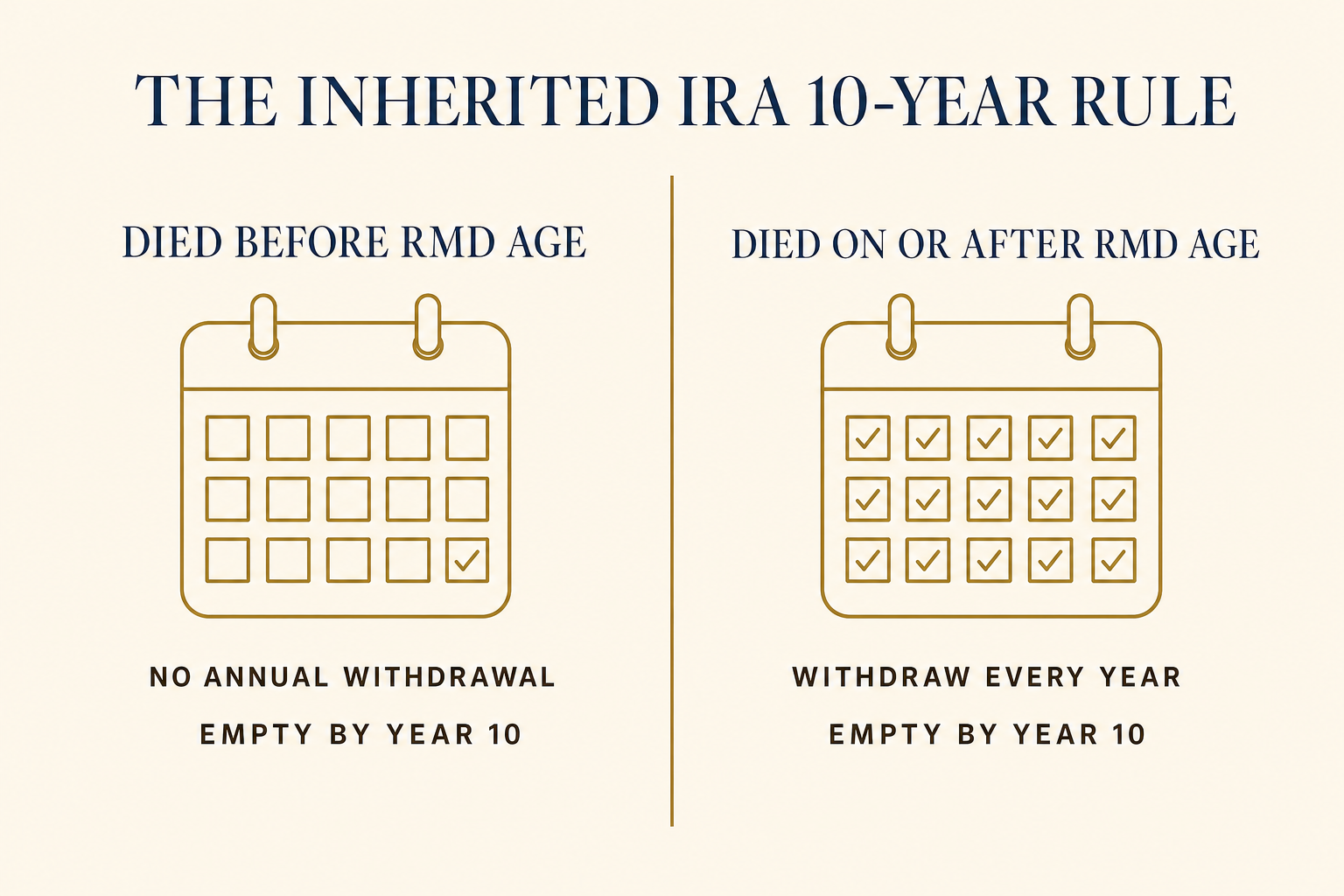
This is the part that generated years of confusion. When the SECURE Act passed, nobody was sure the annual withdrawals applied, so the IRS waived the penalty for missed beneficiary RMDs for 2021, 2022, 2023, and 2024. A lot of heirs took that to mean the annual withdrawals didn’t exist. They do. The IRS finalized the regulations and the waiver has ended — 2025 was the first year these annual withdrawals were actually required for post-2019 inheritances, and that requirement carries straight into 2026.
The current required age for an account owner’s own RMDs is 73 (it rises to 75 in 2033), so in practice this “annual RMD” version of the rule catches heirs of anyone who was in their mid-70s or older at death. That’s a large share of inherited IRAs.
Miss a required withdrawal and the penalty is steep — but fixable
If you were supposed to take an annual withdrawal and didn’t, the shortfall is subject to a 25% excise tax — a quarter of the amount you failed to withdraw. The reason I’m not writing that in alarm-bell language is that it’s also one of the more forgiving penalties in the tax code. Under the SECURE 2.0 rules, if you correct the miss within a two-year window, the penalty drops to 10%. And you can file Form 5329 to request a waiver for reasonable cause — a missed RMD caught and fixed promptly is routinely forgiven.
The takeaway isn’t panic. It’s that this is a rule worth getting right on purpose rather than discovering by accident, because the fix is easy before a deadline and annoying after one.
Who’s exempt: the eligible designated beneficiaries
Not everyone is on the 10-year clock. A smaller group, which the IRS calls eligible designated beneficiaries, can still stretch withdrawals over their own life expectancy. There are five categories: a surviving spouse, a minor child of the original owner, a disabled individual, a chronically ill individual, and anyone who is not more than ten years younger than the owner (think a sibling or a close-in-age partner).
Two of those deserve a flag. A minor child only gets the stretch until they reach the age of majority; at that point the 10-year clock starts, so the exemption is really a delay, not a pass. And a surviving spouse has the most flexibility of anyone — a spouse can roll the inherited IRA into their own IRA and treat it as if it had always been theirs, which resets the whole framework and is almost always the better move. If you inherited from a spouse, your decision tree is genuinely different from the one in this article, and it’s worth its own conversation with a tax professional.
One more clarification that saves people a lot of worry: inherited Roth IRAs follow the 10-year deadline but carry no annual withdrawal requirement, because a Roth owner is never treated as having a required beginning date. You still have to empty it within ten years, but you can let it grow tax-free the entire time and take it all at the end. If you’ve been following the mechanics of Roth timing, the same logic that makes the five-year clock on Roth conversions worth tracking applies here too.
Why waiting until year ten is usually the wrong play
Even when no annual withdrawal is required, letting the balance sit untouched until the final year is the mistake I see most often. The 10-year rule is not a tax break. It’s a tax deferral with a hard wall at the end, and ordinary-income tax is waiting at that wall.
Picture a $400,000 inherited IRA. Drain it in a single year and you’ve stacked $400,000 of ordinary income on top of your salary, almost certainly pushing a chunk of it into a higher bracket, and possibly dragging along other consequences — a bigger Medicare premium surcharge two years later if you’re near that age, a larger slice of your Social Security taxed, more of your investment income exposed. Spread that same $400,000 across ten intentional withdrawals and you can often keep every dollar in a lower bracket.
This is the same tax-aware thinking that drives the order you draw down your own accounts in retirement. An inherited IRA is one more account to coordinate, and the best years to take extra from it are often your low-income years — the stretch between leaving work and starting Social Security, the same window where a Roth conversion can make sense. If a big withdrawal is going to land in a high-income year, plan for the tax instead of being surprised by it; the mechanics of paying taxes without triggering an underpayment penalty matter here too.
A hypothetical to make it concrete
Consider a hypothetical case, with round numbers chosen for illustration rather than as any kind of projection. David is 58, still working, and he inherits his mother’s $500,000 traditional IRA. His mother was 79 when she died, so she was well past her required beginning date — which means David is on the 10-year rule with the annual withdrawal requirement attached.
If David assumes he can ignore the account until 2035, two things go wrong. First, he skips the annual withdrawals he actually owes in the meantime and exposes himself to that 25% penalty on each miss. Second, when the final-year wall arrives, he’s forced to pull whatever is left — potentially $500,000 or more after growth — in a single year, during what may be his peak earning years. That’s the worst possible time to recognize a half-million dollars of income.
The better version: David takes his required withdrawal each year, and in the years his income dips — once he cuts back to part-time at 62, say — he deliberately takes more than the minimum to drain the account while he’s in a lower bracket. By year ten there’s little left to force out at a bad rate. Same account, same rule, a dramatically different tax bill — decided entirely by whether he planned the withdrawals or let the calendar plan them for him.
What to do before December 31
If you inherited an IRA in 2025 or earlier and the original owner was taking RMDs, confirm now whether you owe a withdrawal for this calendar year — the deadline is December 31 and the custodian needs time to process it. Call the brokerage and ask two direct questions: was the original owner past their required beginning date, and what is my required distribution this year? They can run the calculation; you just have to ask before the year closes.
Then step back and look at the full ten-year arc instead of one deadline at a time. Which of the next several years are likely to be your lowest-income years? Those are the years to take more. That’s the whole game — not beating the deadline, but choosing the brackets.
The quieter lesson for your own plan
There’s a reason this rule blindsides families, and it isn’t that heirs are careless. The person who understood the account is gone, and everything about it — the custodian, the beneficiary form, whether RMDs had started, even whether it was traditional or Roth — has to be reconstructed from statements by someone who is grieving. The clock doesn’t pause for any of that.
Which is the argument for writing it down while you’re the one who knows. The accounts you’ll leave behind sit in your Later bucket — the growth and legacy money — and the kindest thing you can do for whoever inherits them is to make the map easy to find: where the accounts are, which are traditional and which are Roth, who the beneficiaries are, and a plain note that an inherited account comes with a clock. That’s exactly the gap The Just in Case Binder was built to close — a printable organizer that puts the whole picture in one place so the people you love aren’t reverse-engineering your finances under a deadline.
The 10-year rule is manageable when you see both clocks. The only version that hurts is the one you find out about late.
Key takeaways
- If you inherited an IRA from someone who died in 2020 or later and you’re not an eligible designated beneficiary, the account must be emptied within 10 years.
- If the original owner was already taking RMDs at death, you also owe an annual withdrawal in years one through nine — a requirement the IRS is enforcing again starting in 2025.
- Missing a required withdrawal triggers a 25% excise tax, reduced to 10% if corrected within two years and often waivable for reasonable cause via Form 5329.
- Inherited Roth IRAs use the 10-year deadline but have no annual withdrawal requirement.
- Don’t wait until year ten — spread withdrawals across your lowest-income years to control the tax instead of letting the final-year wall control it for you.
Frequently asked questions
Does the 10-year rule apply if I inherited from my spouse?
No. A surviving spouse is an eligible designated beneficiary with the most flexibility of any heir — including rolling the account into their own IRA and treating it as their own. A spousal inheritance follows a different set of rules than the one described here.
How do I know if the person I inherited from had started RMDs?
The current required beginning age is 73. If the owner was 73 or older, they had almost certainly started, which puts you in the annual-withdrawal version of the rule. The custodian holding the account can confirm it and calculate what you owe.
What if I already missed a required withdrawal from an inherited IRA?
Take the missed amount as soon as you can and file Form 5329 to request a penalty waiver for reasonable cause. Promptly corrected misses are routinely forgiven, and even if a penalty applies, the SECURE 2.0 reduction can cut it from 25% to 10%.
This article is published by Confluence Media Group LLC, an independent publisher of educational financial content. Thomas Clark is a Series 65 Investment Advisor Representative. The information provided is for educational and informational purposes only and is not personalized financial, tax, or legal advice. Past performance does not guarantee future results. All investing involves risk, including potential loss of principal. Consult a qualified professional before making financial decisions.
Confluence Media Group LLC is a separate entity from Confluence Capital Management, the investment advisory practice through which Thomas Clark provides advisory services. Advisory services are not offered through this publishing platform.
About Thomas Clark
Thomas Clark is the founder of Confluence Media Group LLC and a Series 65 Investment Advisor Representative. He has spent nearly two decades working with families on retirement planning, with a focus on Social Security optimization, retirement income coordination, and the bucket planning approach to building a guaranteed income floor.
Thomas writes and publishes at thomasclarkadvisor.com and is the author of The Just in Case Binder — a 148-page printable family financial organizer for households who want to make sure the people they love know where everything is.
He lives in North Carolina with his family.
Subscribe to the weekly newsletter · Get the Just in Case Binder

Thomas Clark is a Series 65 licensed investment advisor and experienced trader. He specializes in investing, retirement planning, and market analysis, helping individuals build wealth and make informed financial decisions.
