
The Roth Conversion Window Closes December 31
A Roth conversion for 2026 has to be done by December 31 — there's no April grace period like contributions, and no way to undo it. Here's how to use the gap years to fill the right tax brackets before the window closes.

You have until April 15 to put money into an IRA for this year. You do not have until April 15 to convert one. If a Roth conversion is on your list for 2026, the calendar closes on December 31 — no extension, no do-over, no “I meant to.” It is the one year-end tax move with a hard wall at the end of it, and every December I watch people discover that wall a day too late.
Here’s the part that trips people up: a Roth conversion is the rare tax move where you volunteer to pay tax now. That feels backwards, which is exactly why most people skip it and why the ones who understand it quietly build a better retirement. The deadline isn’t the hard part. Deciding how much to convert — and stopping at the right line — is.
What a Roth Conversion Actually Does
A conversion moves money from a traditional IRA or 401(k), where it has grown tax-deferred, into a Roth account, where it grows tax-free and comes out tax-free in retirement. You pay ordinary income tax on whatever you convert in the year you convert it. In exchange, that money never gets taxed again, and — this is the quiet win — a Roth IRA carries no required minimum distributions during your lifetime.
Think of your traditional IRA as an account with a silent partner. The IRS owns a slice of it, and the size of that slice depends on your tax bracket in the year you finally withdraw. A conversion is you buying out part of that partnership at today’s known price, instead of leaving the bill to float until your 70s, when required withdrawals, Social Security, and a possibly higher rate schedule all land at once. The IRS lays out the mechanics plainly in its guidance on rollovers and Roth conversions.
There are no income limits on a conversion — high earners who can’t contribute to a Roth directly can still convert — and there is no longer any way to undo one. The old “recharacterization” escape hatch, which let you reverse a conversion if the market dropped, was closed years ago. Once you convert, it’s done. That permanence is exactly why the number you choose matters.
Why December 31 Is a Hard Line
Most year-end tax deadlines come with a grace period. IRA and HSA contributions can be made right up until you file in April and still count for the prior year. Conversions don’t work that way. A conversion is tied to the calendar year the money actually moves, so to count for 2026 it has to be completed by December 31, 2026.
“Completed” is doing some work in that sentence. Many custodians set an internal cutoff before the 31st for year-end conversion requests, and a request placed too late can slip into January — which means a different tax year, different brackets, and a plan built around the wrong assumptions. If you’re converting this year, treat mid-December as the real deadline and call your custodian, not the last afternoon of the year.
This is the same hard December 31 wall that governs required minimum distributions, and for many retirees the two decisions are linked. I wrote about the other side of that deadline in the RMD deadline is the easy part — conversions are how you shrink those future RMDs before they start.
The Gap Years Are the Whole Game
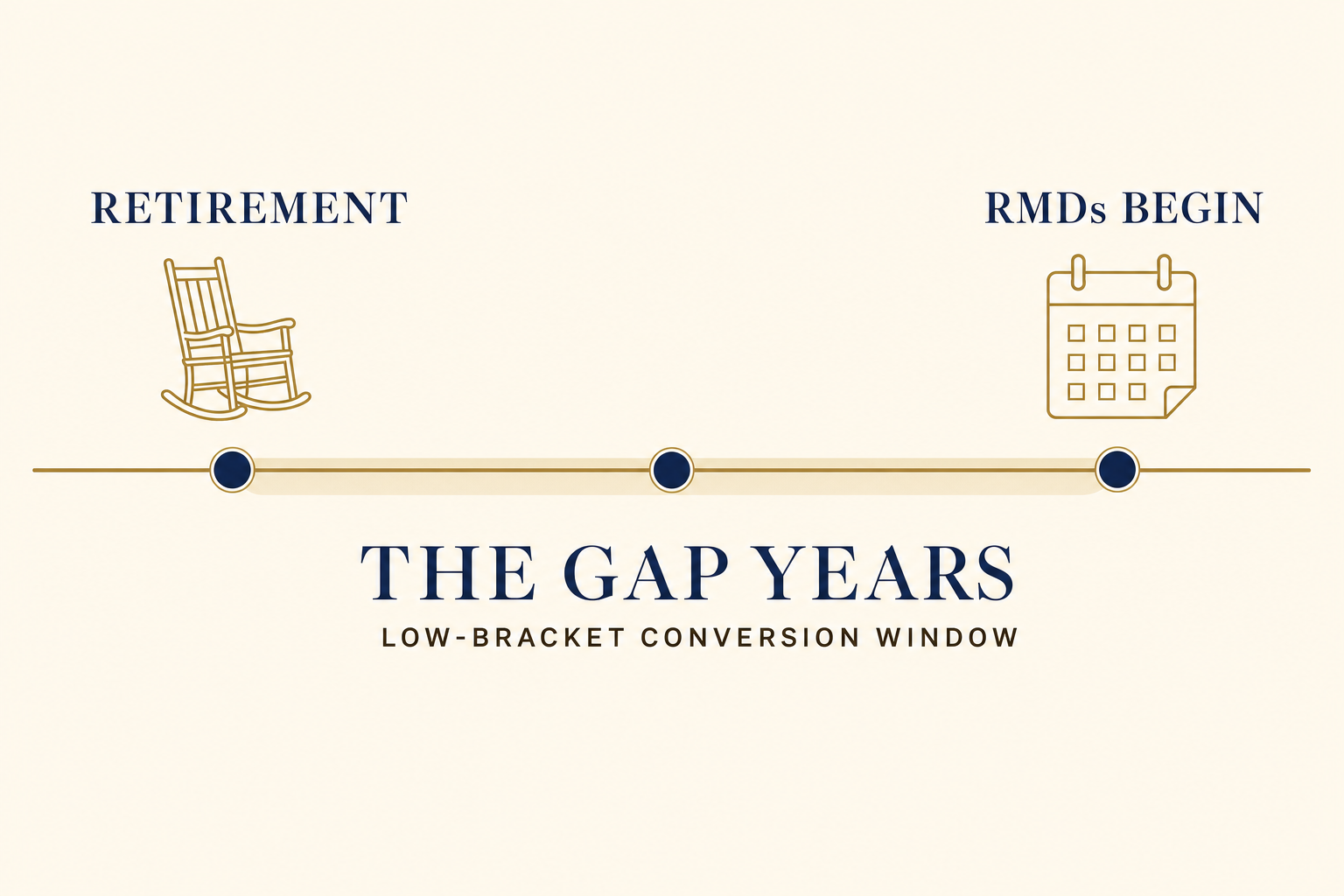
The single best window for conversions is the stretch between the paycheck stopping and required withdrawals starting — roughly your 60s, what I call the gap years. Under the SECURE 2.0 Act, RMDs begin at 73 for people born between 1951 and 1959 and at 75 for those born in 1960 or later. The years before that line are often the lowest-income, lowest-bracket window you will ever see again. No wages, Social Security not yet claimed or just starting, and no forced withdrawals. That’s empty space in your low brackets, and empty space is exactly what a conversion is designed to fill.
The discipline is to fill the low brackets on purpose and stop before the next one. The 2026 standard deduction — $16,100 for a single filer and $32,200 for a married couple filing jointly, with an extra amount for those 65 and older, per the IRS inflation adjustments for 2026 — shelters the first chunk of a conversion from tax entirely. From there you can convert up through the top of the 12% bracket, or the 22% bracket, depending on where your other income lands. The goal isn’t to convert everything in one heroic year; it’s to convert a measured amount each year, keeping yourself under the bracket line you’ve chosen. If the whole idea of “filling a bracket” is fuzzy, start with how tax brackets actually work — the move depends entirely on reading that chart correctly.
This also doesn’t happen in a vacuum. Which account you convert from, and in what order you tap everything else, are the same decision viewed from two angles. I walked through the sequencing in the retirement withdrawal order most people get wrong.
The Traps That Turn a Smart Move Expensive
A conversion done without looking at the whole picture can cost more than it saves. A few things to check before you pull the trigger.
First, the pro-rata rule. If you hold any after-tax money in a traditional IRA alongside pre-tax money, you can’t cherry-pick the already-taxed dollars to convert. The IRS treats every conversion as a proportional slice of all your traditional IRA balances combined, and you track the after-tax basis on IRS Form 8606. People with a large pre-tax balance and a small after-tax basis are often surprised to learn almost the entire conversion is taxable.
Second, the two-year Medicare echo. A conversion raises your income this year, and your income two years later decides your Medicare Part B and Part D premiums through the income-related monthly adjustment amount, or IRMAA. A conversion in 2026 feeds your 2028 premiums. Tip across a threshold and the surcharge lands for a full year. It’s avoidable with planning and genuinely annoying without it — I mapped exactly how the lag works in the IRMAA two-year lookback.
Third, pay the tax from outside the IRA. If you convert $40,000 and withhold the tax from the conversion itself, you’ve shrunk the amount that actually reaches the Roth — and if you’re under 59½, that withheld piece can count as an early distribution. Pay the tax from a taxable account whenever you can, so the full conversion lands in the Roth and keeps compounding. And know that each conversion starts its own five-year clock before those specific dollars can be withdrawn penalty-free before 59½.
Thomas’ Take: The most underrated reason to convert has nothing to do with your own tax bracket — it’s your spouse’s. When one spouse dies, the survivor files as a single taxpayer, often on nearly the same income, and gets pushed into higher brackets almost overnight. Every dollar you move to a Roth now is a dollar the survivor never has to withdraw at those compressed single-filer rates. I think of conversions as much as a gift to the surviving spouse as a tax play. I wrote about that trap in the widow’s penalty.
What This Looks Like in Practice
Consider a hypothetical case: Margaret and Dale, both 66, retired last year in Pennsylvania. They haven’t claimed Social Security yet — they’re letting it grow until 70 — and they’re living on about $40,000 a year from a taxable brokerage account. Between the standard deduction and their modest income, they’re sitting in the 12% bracket with real room before the 22% bracket begins. Dale has about $700,000 in a traditional IRA, and once he turns 75 his required withdrawals are going to be large.
Doing nothing feels safe. But if they coast through their 60s taking only what they spend, that $700,000 keeps growing, and the RMDs that start in their mid-70s could stack on top of two Social Security checks and shove them into a far higher bracket — permanently, and with an IRMAA surcharge to match.
A coordinated path looks different. Each year in the gap, they convert just enough to fill the top of their chosen bracket — say, roughly $40,000 — and pay the tax from the taxable account so the full amount lands in the Roth. They watch the IRMAA thresholds so a conversion doesn’t quietly tip their future premiums. By the time RMDs begin, the traditional balance is meaningfully smaller, a chunk of their nest egg is permanently tax-free, and if either of them is widowed, the survivor inherits a lighter tax burden. Same money. A materially different retirement. (These figures are illustrative.)
The reason a case like this is hard to eyeball is that the right conversion amount depends on your brackets, your IRMAA tiers, your Social Security timing, and the years you actually have left — all at once. That’s too multi-year for a napkin. A planning tool like ProjectionLab lets you build it with your real numbers and test converting more this year against less, then watch what each choice does to your taxes a decade out.
Disclosure: the ProjectionLab link above is an affiliate link. If you subscribe, Confluence Media Group LLC may earn a commission at no additional cost to you. I only point to tools I’d actually use, and this is educational information, not a recommendation to buy any specific investment.
The Bottom Line
A Roth conversion is one of the few retirement decisions where the calendar, not your custodian and not the market, sets the clock. Most of the year-end tax moves people rush to make — funding accounts, harvesting losses, giving to charity — have some flexibility built in. This one doesn’t. The window for 2026 closes on December 31 and reopens, a little narrower, next year, until the gap years run out and RMDs make the choice for you. The retirees who get the most out of this aren’t the ones who convert the most. They’re the ones who decided, on purpose, how much to move before the calendar decided for them.
Key Takeaways
- A Roth conversion for 2026 must be completed by December 31 — there’s no April grace period like there is for contributions, and no way to undo it once it’s done.
- The gap years between retiring and RMDs (which begin at 73 or 75 under SECURE 2.0) are the prime window: fill your low brackets on purpose, and stop before the next bracket or IRMAA threshold.
- Watch the pro-rata rule, the two-year IRMAA lookback, and pay the tax from outside the IRA so the full amount keeps compounding in the Roth.
- Converting shrinks the balance a surviving spouse would otherwise withdraw at single-filer rates — often the most valuable reason to do it.
Frequently Asked Questions
Is there an income limit on a Roth conversion?
No. Anyone with a traditional IRA or an eligible retirement plan can convert, regardless of income. Income limits apply to direct Roth contributions, not conversions — which is the whole basis of the “backdoor” Roth.
Can I reverse a conversion if the market drops?
No. The recharacterization of conversions was eliminated by the 2017 tax law. Once you convert, it’s permanent, which is why you choose the amount deliberately rather than converting on a hunch.
Should I convert everything in one year?
Rarely. A single large conversion can blow through several brackets and trip the IRMAA threshold at once. Spreading conversions across the gap years usually keeps more of the money in lower brackets. The right pace depends on your income, your other accounts, and your timeline.
This article is published by Confluence Media Group LLC, an independent publisher of educational financial content. Thomas Clark is a Series 65 Investment Advisor Representative. The information provided is for educational and informational purposes only and is not personalized financial, tax, or legal advice. Past performance does not guarantee future results. All investing involves risk, including potential loss of principal. Consult a qualified professional before making financial decisions.
Confluence Media Group LLC is a separate entity from Confluence Capital Management, the investment advisory practice through which Thomas Clark provides advisory services. Advisory services are not offered through this publishing platform.
About Thomas Clark
Thomas Clark is the founder of Confluence Media Group LLC and a Series 65 Investment Advisor Representative. He has spent nearly two decades working with families on retirement planning, with a focus on Social Security optimization, retirement income coordination, and the bucket planning approach to building a guaranteed income floor.
Thomas writes and publishes at thomasclarkadvisor.com and is the author of The Just in Case Binder — a 148-page printable family financial organizer for households who want to make sure the people they love know where everything is.
He lives in North Carolina with his family.
Subscribe to the weekly newsletter · Get the Just in Case Binder

Thomas Clark is a Series 65 licensed investment advisor and experienced trader. He specializes in investing, retirement planning, and market analysis, helping individuals build wealth and make informed financial decisions.
