
Your RMD Deadline Is December 31. That’s the Easy Part.
Your RMD deadline is December 31, and missing it brings a penalty. But the bigger retirement mistake is taking the minimum without a tax plan. Here’s how to coordinate it.

If you turned 73 this year, the IRS is expecting a withdrawal from your traditional retirement accounts before December 31 — and for decades, missing that date carried one of the harshest penalties in the tax code. The penalty has since been softened, but the deadline is real, and every fall I watch retirees scramble to pull a number off a worksheet so they don’t get dinged.
Here’s what I tell them: the deadline is the easy part. Hitting it is arithmetic. The hard part — the part that actually moves money over a 25-year retirement — is deciding what that withdrawal does to the rest of your plan. Most people take the minimum, pay the tax, and never think about it again. That’s the mistake.
What the December 31 Deadline Actually Requires
Required minimum distributions, or RMDs, are the IRS’s way of eventually collecting tax on money that has grown tax-deferred for decades inside traditional IRAs and 401(k)s. You took the deduction going in; the government takes its share coming out. That’s the whole deal.
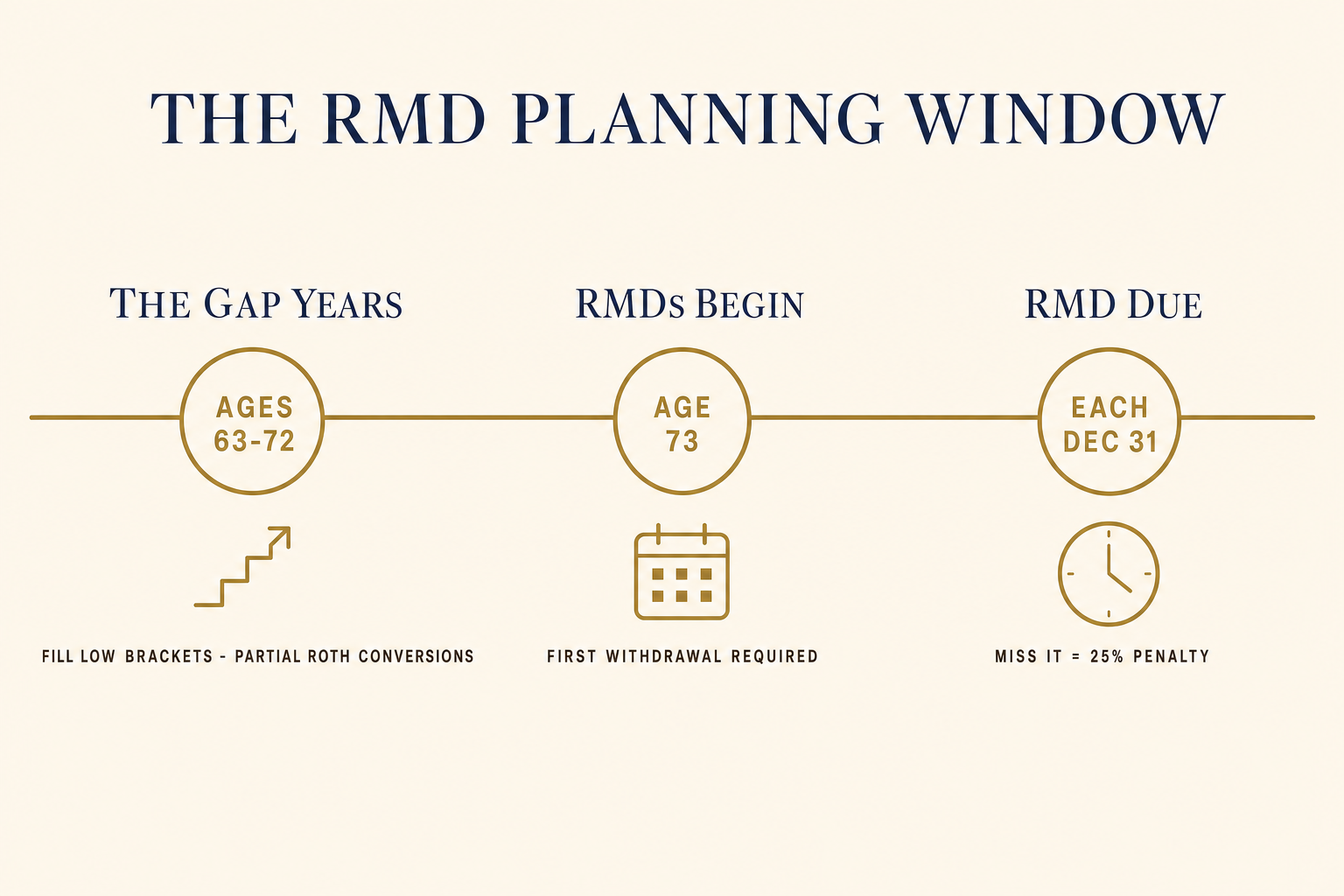
Under the SECURE 2.0 Act, RMDs now begin at age 73 for anyone born between 1951 and 1959, and at 75 for those born in 1960 or later. If 2026 is your first RMD year, you get one grace period: you can delay that very first withdrawal until April 1 of the following year. It sounds generous, and it’s usually a trap. Delaying means taking two RMDs in the same calendar year, stacking two years of taxable income on top of each other. For most people that does more damage than the short delay is worth. You can read the current rules straight from the source in the IRS required minimum distribution FAQs.
Every RMD after the first is due by December 31. Roth IRAs are exempt during your lifetime, and as of 2024 so are Roth 401(k)s — one more reason the Roth side of your retirement is worth building while you can. Miss the deadline and the excise tax is 25% of the amount you should have withdrawn. That’s steep, but it’s a real improvement over the old 50% penalty. Correct the shortfall promptly and it drops to 10%, and if the miss was an honest error you can file Form 5329 and ask the IRS to waive it entirely. So the penalty is survivable. The goal is to never need the mercy.
Why “Take the Minimum” Is the Wrong Default
The word minimum does something funny to people. It frames the entire decision as “withdraw as little as the law allows,” as if the goal were to keep as much as possible inside the account. For a lot of retirees, that instinct is backwards.
Your traditional IRA isn’t entirely yours. There’s a silent partner — the IRS — and your tax bracket in any given year decides how big their share turns out to be. The retiree who takes only the minimum every year and then dies with a large traditional balance often hands heirs a tax bill during the heirs’ peak earning years, now compressed into a 10-year payout window. Taking “the minimum” didn’t avoid the tax. It postponed it to a worse moment.
The real work happens before RMDs ever start. The stretch between leaving work and turning 73 — your 60s, what I call the gap years — is often the lowest-income, lowest-bracket window you’ll ever see again. That’s the time for partial Roth conversions, or simply for voluntary withdrawals that fill up the low brackets, so less is trapped in the account when RMDs finally force the issue. If you don’t understand how the brackets actually work, you can’t play this well — I wrote a whole piece on how tax brackets actually work, because the “a raise bumps me into a higher bracket” myth costs people real money right here.
An RMD Doesn’t Leave Your Plan — It Just Changes Buckets
Here’s the reframe that calms most people down: taking an RMD you don’t need to spend does not mean the money is gone. You lose the tax deferral, not the dollars.
Say your RMD is $35,000 and your Social Security and pension already cover your bills. You don’t have to spend a cent of it. You pay the tax that was always going to come due, and you move what’s left into a taxable brokerage account. In my bucket framework, that’s money sliding from a tax-deferred position into your Later bucket — still invested, still working, just in a different tax wrapper.
The RMD is a tax event, not a spending mandate. Once you see it that way, December 31 stops feeling like a bill and starts feeling like what it is: a scheduled checkpoint where you decide which bucket the money belongs in next.
The IRMAA Surprise That Lands Two Years Later
This is where “take the minimum” and “take whatever” both fail, and where coordination earns its keep. RMDs raise your taxable income, and your income drives more than your income-tax bill. It feeds the formula Medicare uses to set your Part B and Part D premiums — the income-related monthly adjustment amount, or IRMAA.
The catch is the timing: IRMAA looks back two years. The income on your 2026 return sets your 2028 Medicare premiums. A large RMD, a big Roth conversion, and a capital gain all landing in the same year can tip you across an IRMAA threshold and quietly raise your premiums for a full year. I’ve watched people do everything right on paper and still get a surprise premium letter because no one mapped the income across years. I laid out exactly how that two-year lookback works in this post on the IRMAA lookback.
This is exactly the kind of thing worth modeling before December rather than discovering in hindsight. The question — how a given withdrawal lands across your brackets, your IRMAA tiers, and the years you actually have left — is too multi-year to settle on a napkin. A planning tool like ProjectionLab lets you build it with your real numbers and test a larger withdrawal this year against a smaller one, then watch what each choice does downstream.
Disclosure: the ProjectionLab link above is an affiliate link. If you subscribe, Confluence Media Group LLC may earn a commission at no additional cost to you. I only point to tools I’d actually use, and this is educational information, not a recommendation to buy any specific investment.
The Most Underused Move: the QCD
If you’re charitably inclined and at least 70½, the qualified charitable distribution (QCD) is the most efficient tool on this list, and almost nobody uses it. You send money straight from your IRA to a qualified charity. It counts toward your RMD, and — this is the part that matters — it’s excluded from your income entirely.
That beats taking the RMD and then deducting a donation. An exclusion lowers the income that drives your tax bracket, the taxation of your Social Security, and your IRMAA tier all at once. A deduction only helps if you itemize, and most retirees now take the standard deduction. You can route well over $100,000 a year this way — the cap was $108,000 in 2025, and the IRS indexes it for inflation, so confirm the current figure in the IRS guidance on IRA distributions before you act. If giving is already part of your year, running it through the IRA instead of your checkbook can be worth thousands. I covered the broader year-end picture in year-end giving in 2026.
What This Looks Like in Practice
Consider a hypothetical case: Gerald, 74, a retired civil engineer in Ohio with about $900,000 in a traditional IRA. His Social Security and a modest pension already cover his monthly expenses, so he doesn’t need the cash. His RMD this year works out to roughly $35,000.
The “take the minimum, pay the tax, forget it” path has Gerald withdrawing the $35,000, owing tax on all of it, and — because it stacks on top of his other income — nudging him toward the next IRMAA tier for 2028.
A coordinated path looks different. Gerald gives to his church every year anyway, so he routes $12,000 of the RMD as a QCD. It satisfies that slice of the requirement and never appears as income. He takes the remaining $23,000 or so, pays the tax, and reinvests what’s left in his taxable account — keeping it in his Later bucket. His taxable income is lower, his IRMAA exposure is lower, and the charity received the same gift it would have gotten from his checking account. Same deadline. Same $35,000 out of the IRA. A materially different outcome, and none of it required earning an extra dime. (These figures are illustrative.)
Thomas’ Take: I’ve never met a retiree who felt good about a surprise tax bill or a surprise Medicare premium. Both are almost always the residue of a withdrawal decision nobody planned. The RMD is the one financial event you can see coming years in advance. Treat it that way.
The Bottom Line
The December 31 deadline will take you ten minutes and a call to your custodian. That’s the easy part, and if it’s all you do, you’ll be compliant. But compliant and coordinated are not the same retirement. The people who get the most out of their accounts aren’t the ones who take the smallest withdrawal — they’re the ones who decided, on purpose, where every dollar was going before the calendar decided for them. Treat the deadline as the checkpoint, not the goal, and the rest of your plan gets quieter for it.
Key Takeaways
- RMDs begin at 73 (born 1951–1959) or 75 (born 1960 or later); every RMD after your first is due December 31, and the missed-RMD penalty is now 25%, or 10% if you correct it promptly.
- Taking “the minimum” isn’t automatically the smart move. Coordinate withdrawals across years and brackets, and use the gap years before 73 for partial Roth conversions.
- An RMD you don’t need isn’t lost: reinvest it in a taxable Later-bucket account, or, if you give, use a QCD to satisfy the RMD and keep the money out of your income.
Frequently Asked Questions
Do I have to take an RMD from my Roth IRA?
No. Roth IRAs carry no RMDs during the original owner’s lifetime, and Roth 401(k)s dropped their RMD requirement starting in 2024. Inherited Roth accounts are a separate matter and do come with distribution rules.
Can I just reinvest my RMD if I don’t need the money?
Yes. You can’t put it back into the IRA, but nothing stops you from paying the tax and moving the rest into a taxable brokerage account. You give up the tax deferral, not the investment itself.
This article is published by Confluence Media Group LLC, an independent publisher of educational financial content. Thomas Clark is a Series 65 Investment Advisor Representative. The information provided is for educational and informational purposes only and is not personalized financial, tax, or legal advice. Past performance does not guarantee future results. All investing involves risk, including potential loss of principal. Consult a qualified professional before making financial decisions.
Confluence Media Group LLC is a separate entity from Confluence Capital Management, the investment advisory practice through which Thomas Clark provides advisory services. Advisory services are not offered through this publishing platform.
About Thomas Clark
Thomas Clark is the founder of Confluence Media Group LLC and a Series 65 Investment Advisor Representative. He has spent nearly two decades working with families on retirement planning, with a focus on Social Security optimization, retirement income coordination, and the bucket planning approach to building a guaranteed income floor.
Thomas writes and publishes at thomasclarkadvisor.com and is the author of The Just in Case Binder — a 148-page printable family financial organizer for households who want to make sure the people they love know where everything is.
He lives in North Carolina with his family.
Subscribe to the weekly newsletter · Get the Just in Case Binder

Thomas Clark is a Series 65 licensed investment advisor and experienced trader. He specializes in investing, retirement planning, and market analysis, helping individuals build wealth and make informed financial decisions.
