
The Widow’s Penalty: Why a Survivor Pays More in Tax
When a spouse dies, the household's income usually falls — but the survivor's tax bill can rise. Here's how the widow's penalty works, and how to plan for it while you're still filing jointly.

The largest tax increase many retirees will ever face doesn’t come from Congress. It arrives the year a spouse dies — and almost no one plans for it.
Here’s the part that catches people off guard. When one spouse passes away, the household’s income usually goes down. But the tax bill on what’s left can go up. Higher brackets, a smaller standard deduction, and steeper Medicare premiums all land on the surviving spouse at roughly the same time, often in the first full year on their own. Planners call it the widow’s penalty. It hits widowers too, but because women tend to outlive their husbands, a woman is more often the one left holding the bill.
The good news: this is one of the few major tax events in retirement you can actually see coming years ahead. Once you understand how it works, you can plan around it while both spouses are still here — which, as you’ll see, is the only time the planning really works.
First, what actually happens to the income
Start with Social Security, because that’s where the change is easiest to see. When one spouse dies, the survivor keeps the larger of the two benefits. The smaller check simply stops — you don’t get to keep both, as SSA’s survivors rules spell out.
So if one spouse was receiving $3,000 a month and the other $1,800, the survivor’s Social Security settles at $3,000. The household goes from $4,800 a month to $3,000 — a real cut, but notice it’s not a halving. The survivor keeps the bigger of the two checks, not half of the combined total.
Now look at everything else, because this is the part people forget. Required minimum distributions from a traditional IRA don’t stop — the surviving spouse generally rolls the account into their own IRA and keeps taking RMDs on the full balance. A pension with a survivor election keeps paying. Portfolio withdrawals continue. Interest and dividends keep coming. Add it all up and the survivor’s total income often falls by something like a quarter, not a half.
That gap — income down a little, but the tax framework about to shrink a lot — is the whole problem in one sentence.
Why the tax bill can rise when income falls
It comes down to filing status. For the year a spouse dies, the survivor can still file a joint return, as long as they haven’t remarried by year-end. That’s the last year of the married brackets. Beginning the next year, the survivor files as Single — unless they have a dependent child at home, which lets them use Qualifying Surviving Spouse status (the old “qualifying widow”) for up to two more years. Most retired couples have no dependent child, so for them the switch to Single lands the very next tax year. The rules are laid out in IRS Publication 501.
And the single tax framework is, roughly, half the married one — right across the board. Here are the 2026 numbers that matter most:
- The standard deduction nearly halves. A married couple where both spouses are 65 or older gets $35,500 in 2026 ($32,200 plus two $1,650 age add-ons). A single filer who is 65 or older gets $18,150 ($16,100 plus a $2,050 add-on). That’s roughly $17,000 of deduction the survivor simply loses.
- The brackets compress. The 12% bracket runs all the way up to $100,800 of taxable income for a married couple, but tops out at just $50,400 for a single filer. So income that sat comfortably in the 12% bracket as a couple can be taxed at 22% for the survivor — close to double the rate on those top dollars, without the household earning a cent more.
- The senior bonus deduction shrinks too. The 2025 tax law created a temporary extra deduction of up to $6,000 per person age 65 or older, available for tax years 2025 through 2028. A couple could claim up to $12,000; a survivor, up to $6,000. Worse, its income phaseout drops from $150,000 for a couple to $75,000 for a single filer — so a survivor is far more likely to lose part or all of it.
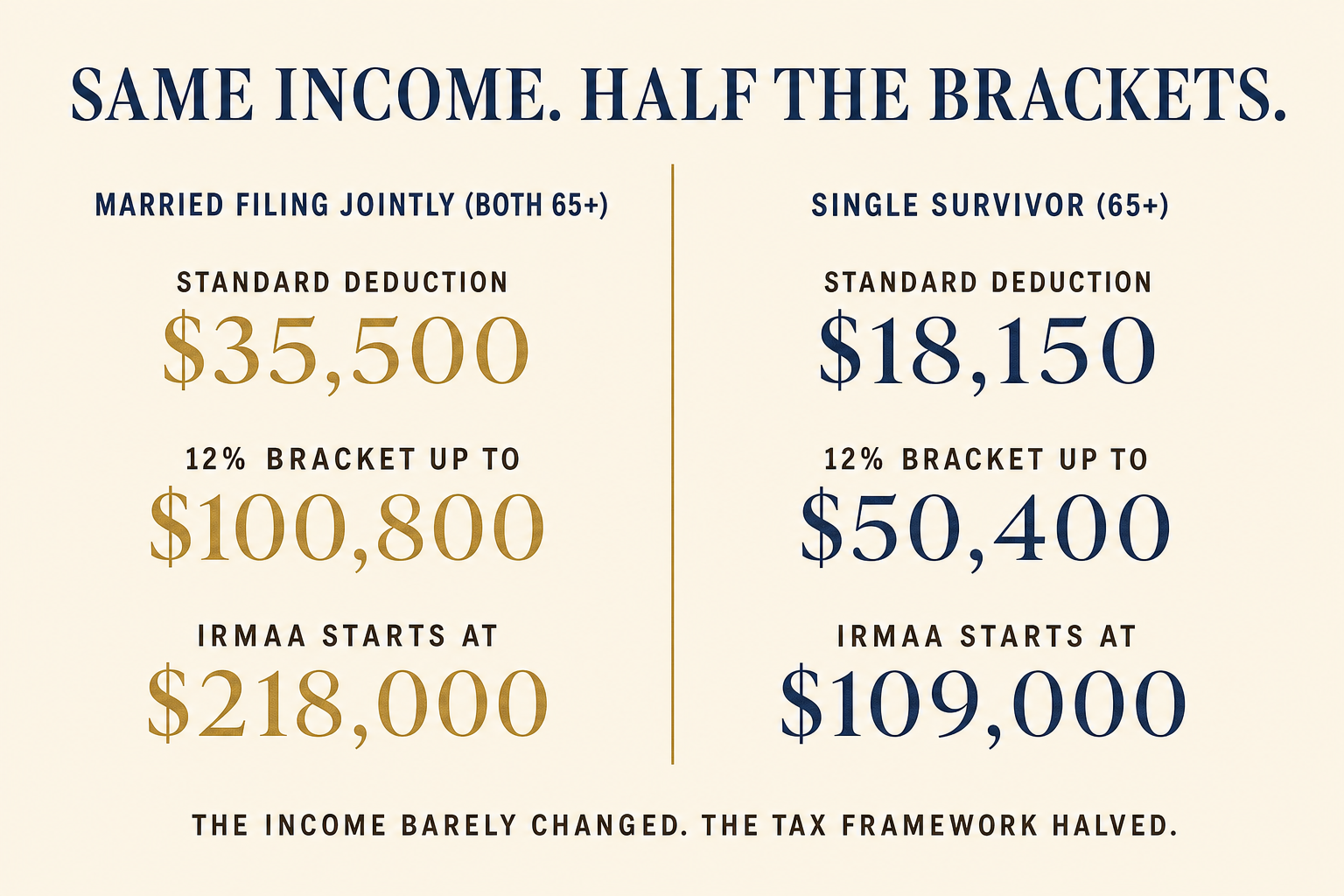
Stack those together and you get the trap: the income barely moved, but the deduction halved and the brackets halved underneath it. The same dollars get taxed harder simply because one person is now reporting them instead of two.
The Medicare surcharge that quietly compounds it
There’s a second bill most people never see coming, and it’s called IRMAA — the income-related monthly adjustment amount. It’s a surcharge added to your Medicare Part B and Part D premiums once your income crosses certain thresholds, and it’s based on your tax return from two years earlier. Our deeper breakdown of how IRMAA ambushes retirees walks through the mechanics.
Here’s where it meets the widow’s penalty. In 2026, IRMAA starts once income tops $109,000 for a single filer — but $218,000 for a married couple. Exactly half, like everything else. The standard Part B premium is about $203 a month; the first surcharge tier pushes that to roughly $284, plus about $15 a month on Part D. So the same retirement income that kept a couple comfortably under the married threshold can shove a single survivor over the single one, adding more than $1,000 a year in premiums on top of the higher income tax. And because IRMAA looks back two years, the surcharge can show up a year or two after the death — long after anyone connected it to the loss. The rules for higher-income beneficiaries are on SSA.gov.
A hypothetical: Joan and Walter
Let me make this concrete. Consider a hypothetical couple — the figures are illustrative, not a projection of anyone’s actual result.
Joan and Walter are both 73 and retired. Walter collects $3,000 a month in Social Security; Joan collects $1,800. They take about $45,000 a year from Walter’s traditional IRA, and Walter has a small pension of $15,000 a year that he elected to continue at 50% for Joan if he died first. Their combined income runs around $118,000. As a couple, their $35,500 standard deduction and up to $12,000 of senior bonus deduction shield a big slice of that, and most of the rest lands in the 10% and 12% brackets. Their income is nowhere near the $218,000 IRMAA line.
Walter dies the following winter. The next year, Joan files as Single at 74. Her Social Security drops to Walter’s $3,000 a month; her own $1,800 check ends. She rolls Walter’s IRA into her own and keeps taking roughly the same $45,000. The pension continues at the elected $7,500. Her income is now about $88,000 — down roughly a quarter.
But her tax framework didn’t drop a quarter. Her standard deduction fell from $35,500 to $18,150. Her income now exceeds the $75,000 single phaseout, so she loses part of the senior bonus deduction. And her top dollars now reach into the 22% single bracket instead of sitting in the couple’s 12%. Joan earns noticeably less than she and Walter did together, yet her effective tax rate goes up. She’s still under the $109,000 IRMAA line in this illustration — but she’s now about $21,000 away from a Medicare surcharge she and Walter were never remotely close to. One more RMD increase or a Roth conversion done at the wrong time, and she’d cross it.
How to plan for it — while you’re still a couple
Here’s the uncomfortable truth, and the useful one: almost nothing the survivor does after the death fixes this. The planning window is the years when both spouses are alive and filing jointly. That’s when you have the wide brackets and the big deduction to work with.
Thomas’ Take: The married-filing-jointly years are a tax asset with an expiration date you can’t predict. Most couples waste them staying in the 10% and 12% brackets to keep this year’s bill low, then hand the survivor a lifetime of 22% bills. Spend those brackets on purpose instead.
Four moves do most of the work:
1. Use the joint brackets while you have them. The low-bracket years when you’re both retired but before large RMDs kick in are the prime window to do Roth conversions in that gap-years window. Converting traditional IRA money and filling up the 12% (and sometimes the lower 22%) bracket now shrinks the RMDs that would otherwise be taxed at single rates later — and Roth dollars don’t count toward IRMAA. It’s the same logic behind getting the withdrawal order right: pay tax when it’s cheap, not when it’s forced.
2. Protect the survivor’s income floor. Two decisions matter most here. First, when a pension offers a single-life payout versus a joint-and-survivor option, the higher single-life check is tempting, but it leaves the survivor with nothing — the tradeoffs are exactly what we covered in the pension lump-sum-versus-monthly decision. Second, having the higher earner delay Social Security raises the very benefit the survivor will keep, because the survivor inherits the larger check. That’s the quiet, lasting reason behind the claiming decision that protects your spouse.
3. Build a real income floor. A surviving spouse is often managing money alone for the first time, sometimes in their 80s. The more of their essential expenses are covered by guaranteed income — Social Security, a pension survivor portion, and where it fits, an income-focused instrument — the less their standard of living depends on getting a portfolio exactly right. That’s the heart of the Now, Soon, and Later bucket approach: the Soon bucket exists precisely so the income floor doesn’t wobble when life changes.
4. Make the whole thing runnable by one person. The tax trap is the part advisors talk about. The quieter crisis is a survivor who can’t find the account logins, doesn’t know which checks arrive when, and has never filed the taxes. Writing it all down in one place — accounts, income sources, passwords, the people to call — is what The Just in Case Binder is built for. It won’t lower anyone’s bracket, but it’s the difference between a survivor who’s grieving and a survivor who’s grieving and locked out of the accounts.
The quiet event you can see coming
The widow’s penalty is easy to miss because it arrives in a year when no one is thinking about tax brackets. Income has gone down, so the assumption is that taxes will too. Then the first single return comes back higher, the Medicare premium letter shows a surcharge, and it feels like a cruel accident of timing.
It isn’t an accident. It’s one of the most predictable events in all of retirement planning — and one of the few you can prepare for literally years in advance. The couples who handle it well don’t do anything heroic in the moment. They simply spend their joint-filing years on purpose: converting at low rates, protecting the survivor’s income, and making sure the person left behind can actually run the plan. The time to do that is while you’re still a couple filing jointly. Once one return becomes a single return, the cheapest years are already gone.
This article is published by Confluence Media Group LLC, an independent publisher of educational financial content. Thomas Clark is a Series 65 Investment Advisor Representative. The information provided is for educational and informational purposes only and is not personalized financial, tax, or legal advice. Past performance does not guarantee future results. All investing involves risk, including potential loss of principal. Consult a qualified professional before making financial decisions.
Confluence Media Group LLC is a separate entity from Confluence Capital Management, the investment advisory practice through which Thomas Clark provides advisory services. Advisory services are not offered through this publishing platform.
About Thomas Clark
Thomas Clark is the founder of Confluence Media Group LLC and a Series 65 Investment Advisor Representative. He has spent nearly two decades working with families on retirement planning, with a focus on Social Security optimization, retirement income coordination, and the bucket planning approach to building a guaranteed income floor.
Thomas writes and publishes at thomasclarkadvisor.com and is the author of The Just in Case Binder — a 148-page printable family financial organizer for households who want to make sure the people they love know where everything is.
He lives in North Carolina with his family.
Subscribe to the weekly newsletter · Get the Just in Case Binder

Thomas Clark is a Series 65 licensed investment advisor and experienced trader. He specializes in investing, retirement planning, and market analysis, helping individuals build wealth and make informed financial decisions.
